Recognition: unknown
The Dynamic Gist-Based Memory Model (DGMM): A Memory-Centric Architecture for Artificial Intelligence
Pith reviewed 2026-05-09 16:54 UTC · model grok-4.3
The pith
The Dynamic Gist-Based Memory Model stores AI experience explicitly in a persistent graph to enable evolving interpretation without retraining.
A machine-rendered reading of the paper's core claim, the machinery that carries it, and where it could break.
Core claim
The Dynamic Gist-Based Memory Model (DGMM) encodes experience as interconnected conceptual structures in a graph grounded in time, source, and interaction context, using selective cue-conditioned recall to construct working memory. It provides a formal schema and architectural invariants based on additive memory growth and recall-conditioned interpretation, yielding properties including episodic persistence, locality of cue-conditioned surprise, and contextual variability without structural modification of stored memory.
What carries the argument
The Dynamic Gist-Based Memory Model (DGMM), which treats memory as an evolving graph-structured episodic-semantic substrate and uses cue-conditioned recall as the mechanism for building working memory.
If this is right
- Memories persist episodically and remain available for reinterpretation without any retraining of underlying parameters.
- Recall activates memory selectively and locally based on cues, limiting the scope of active context to relevant elements.
- Different cues can produce varying interpretations of the same stored memory without any changes to its structure.
- Provenance and temporal details are preserved explicitly through grounding in source and time during encoding.
- Reasoning becomes traceable to specific stored experiences, improving overall interpretability of system outputs.
Where Pith is reading between the lines
- DGMM could serve as an external layer added to existing large language models to provide persistent context beyond their fixed context windows.
- The approach implies new designs for interactive AI agents that accumulate and reference personal interaction histories over extended periods.
- Comparative experiments could test whether cue-conditioned recall in DGMM reduces hallucination rates compared to standard retrieval-augmented methods on temporal reasoning tasks.
- Explicit memory graphs might enable AI systems to maintain consistent identities across sessions by grounding responses in a shared, inspectable experience store.
Load-bearing premise
Experience can be effectively and scalably encoded as interconnected conceptual structures in a graph with selective cue-conditioned recall that overcomes the limitations of implicit parameterization without introducing prohibitive complexity or inconsistency.
What would settle it
An implementation showing that graph-based memory encoding produces inconsistent recall across repeated cues or scales poorly to large experience volumes without added complexity would falsify the central claim.
Figures
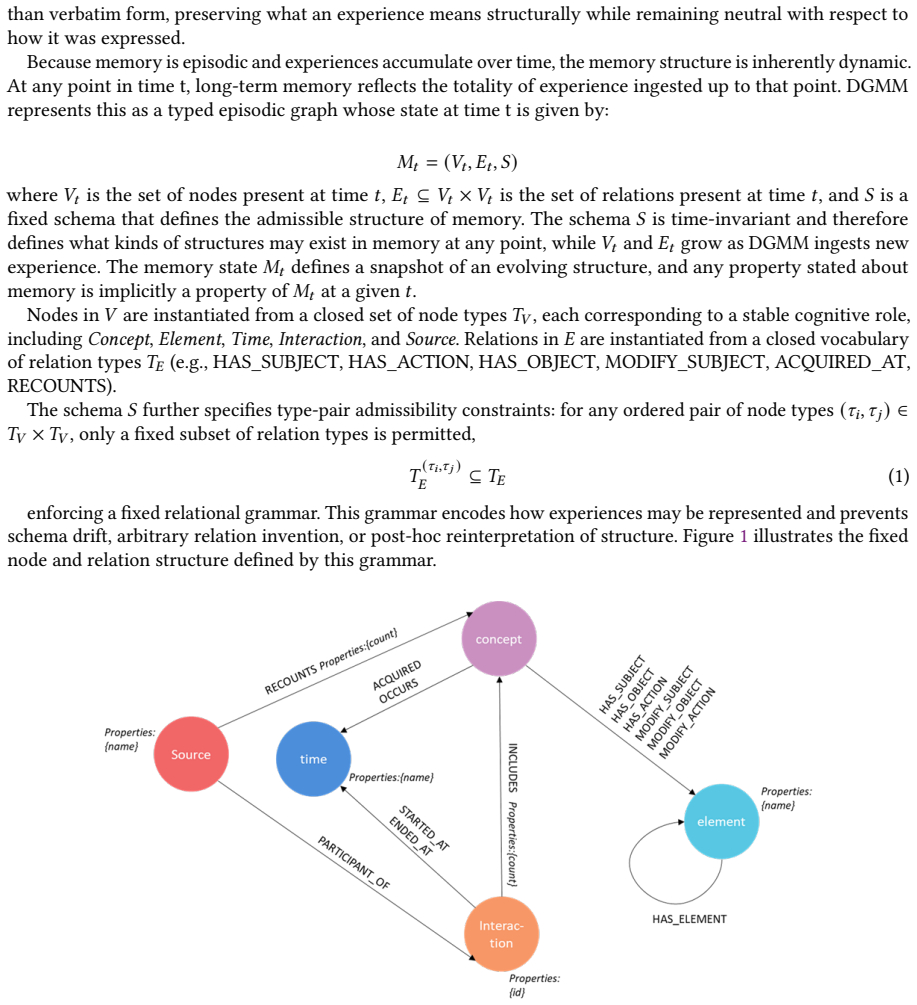

read the original abstract
Contemporary artificial intelligence systems achieve strong performance through large-scale parameterization, retrieval augmentation, and training on extensive static corpora. Despite these advances, they continue to face limitations in persistent memory, temporal grounding, provenance, and interpretability. These challenges are especially pronounced in large language models, where experience is encoded implicitly in fixed parameters, limiting the ability to preserve, inspect, and reinterpret past interactions over time. This paper establishes a memory-centric architectural foundation for artificial intelligence in which experience is represented explicitly and persistently to support temporal grounding, provenance, and interpretability. It proposes an alternative to parameter-centric approaches by treating memory as a first-class, structured substrate for reasoning. We introduce the Dynamic Gist-Based Memory Model (DGMM), an architecture in which experience is represented as an evolving, graph-structured episodic-semantic memory. DGMM encodes experience as interconnected conceptual structures grounded in time, source, and interaction context, and defines selective, cue-conditioned recall as the mechanism for constructing working memory. A formal schema and architectural invariants are provided based on additive memory growth and recall-conditioned interpretation. The results specify properties of DGMM, including episodic persistence, locality of cue-conditioned surprise, and contextual variability without structural modification of stored memory. DGMM provides a coherent architectural theory in which memory is explicit and persistent, supporting evolving interpretation without retraining and enabling interpretable, context-aware, and temporally grounded AI systems.
Editorial analysis
A structured set of objections, weighed in public.
Referee Report
Summary. The paper claims to introduce the Dynamic Gist-Based Memory Model (DGMM) as a memory-centric architecture for AI in which experience is encoded explicitly as an evolving graph-structured episodic-semantic memory. It asserts that selective cue-conditioned recall constructs working memory, that a formal schema and invariants (additive memory growth, recall-conditioned interpretation) are provided, and that this yields properties including episodic persistence, locality of cue-conditioned surprise, and contextual variability without structural modification or retraining, thereby enabling interpretable, temporally grounded systems as an alternative to implicit parameterization in models such as LLMs.
Significance. If a non-circular formal schema were supplied and shown to support consistent, scalable recall without prohibitive complexity or inconsistency, the work could provide a useful theoretical alternative to parameter-centric AI by making memory explicit, persistent, and inspectable. However, the manuscript supplies no such schema, derivations, or benchmarks, so the claimed advantages remain unevaluated.
major comments (3)
- [Abstract] Abstract: The statement that 'a formal schema and architectural invariants are provided' is not supported by any content in the manuscript; no equations, graph definitions, recall algorithms, or derivations appear, leaving all asserted properties (episodic persistence, locality of surprise) at the level of definitional assertion rather than independent demonstration.
- [The Dynamic Gist-Based Memory Model (DGMM)] The central architectural claim (graph-structured memory with cue-conditioned recall) is load-bearing for the paper's contrast with 'implicit parameterization,' yet no formal schema, pseudocode, or complexity analysis is given to show that selective recall remains local and consistent at scale; the weakest assumption therefore cannot be assessed.
- [Results] The listed results (episodic persistence, contextual variability without structural modification) follow directly from the definitional choices of additive growth and cue-conditioned interpretation rather than from any derivation or external validation, rendering the 'results' section circular.
minor comments (2)
- [Introduction] The manuscript would benefit from explicit comparison to existing memory-augmented architectures (e.g., differentiable neural computers or memory networks) to clarify novelty.
- Notation for 'gist' and 'cue-conditioned surprise' is introduced informally; a glossary or precise definition would aid readability.
Simulated Author's Rebuttal
We thank the referee for their constructive and detailed review of our manuscript on the Dynamic Gist-Based Memory Model (DGMM). We address each major comment point by point below, clarifying the theoretical framing of the work while indicating where revisions will strengthen the presentation.
read point-by-point responses
-
Referee: [Abstract] The statement that 'a formal schema and architectural invariants are provided' is not supported by any content in the manuscript; no equations, graph definitions, recall algorithms, or derivations appear, leaving all asserted properties (episodic persistence, locality of surprise) at the level of definitional assertion rather than independent demonstration.
Authors: The manuscript presents the schema through explicit textual definitions of a graph-structured memory (nodes as temporally grounded gists with semantic and contextual attributes, edges as associations) and states the invariants as additive growth and recall-conditioned interpretation. The listed properties are logical entailments of these definitions. We acknowledge that the absence of mathematical notation, pseudocode, or explicit derivations limits rigor. In revision we will add a dedicated formalization subsection with graph notation, a high-level recall procedure, and step-by-step derivations of the properties from the invariants. revision: yes
-
Referee: [The Dynamic Gist-Based Memory Model (DGMM)] The central architectural claim (graph-structured memory with cue-conditioned recall) is load-bearing for the paper's contrast with 'implicit parameterization,' yet no formal schema, pseudocode, or complexity analysis is given to show that selective recall remains local and consistent at scale; the weakest assumption therefore cannot be assessed.
Authors: Locality follows by construction from cue-conditioned subgraph selection, which activates only cue-similar components rather than global traversal; consistency is maintained by the additive-growth invariant that appends without overwriting. We agree that an explicit complexity discussion is needed to evaluate scalability. The revised manuscript will include a paragraph analyzing recall complexity under standard graph indexing assumptions and noting that locality is preserved at arbitrary scale provided cue matching remains sublinear. revision: yes
-
Referee: [Results] The listed results (episodic persistence, contextual variability without structural modification) follow directly from the definitional choices of additive memory growth and cue-conditioned interpretation rather than from any derivation or external validation, rendering the 'results' section circular.
Authors: For a theoretical architecture paper the results section enumerates the deductive consequences of the stated invariants, which is standard practice when no implementation or external data are involved. To eliminate any appearance of circularity we will retitle the section 'Derived Properties' and insert explicit logical derivations linking each property to the two invariants. revision: yes
Circularity Check
Properties presented as derived results reduce directly to definitional choices of the DGMM architecture
specific steps
-
self definitional
[Abstract]
"The results specify properties of DGMM, including episodic persistence, locality of cue-conditioned surprise, and contextual variability without structural modification of stored memory. DGMM provides a coherent architectural theory in which memory is explicit and persistent, supporting evolving interpretation without retraining and enabling interpretable, context-aware, and temporally grounded AI systems."
The enumerated properties are presented as outcomes of the DGMM model, yet they are direct logical consequences of the definitional premises (evolving graph-structured episodic-semantic memory, additive growth, cue-conditioned recall) with no intervening derivation, formal schema, or external test supplied in the text.
full rationale
The manuscript asserts that DGMM yields specific properties (episodic persistence, locality of cue-conditioned surprise, contextual variability) as results of its formal schema and invariants. Inspection of the provided text shows these properties are stipulated by the initial architectural description—an evolving graph-structured memory with additive growth and selective cue-conditioned recall—rather than derived via equations, proofs, or external benchmarks. No independent derivation chain exists; the central claim of a 'coherent architectural theory' is therefore equivalent to the input definitions by construction. The absence of any schema, pseudocode, or falsifiable invariants confirms the reduction.
Axiom & Free-Parameter Ledger
axioms (2)
- domain assumption Experience is best represented as an evolving, graph-structured episodic-semantic memory grounded in time, source, and interaction context
- ad hoc to paper Additive memory growth and recall-conditioned interpretation serve as architectural invariants
invented entities (1)
-
Dynamic Gist-Based Memory Model (DGMM)
no independent evidence
Reference graph
Works this paper leans on
-
[1]
arXiv preprint arXiv:2407.04363 , year =
P. Anokhin, N. Semenov, A. Sorokin, D. Evseev, M. Burtsev, and E. Burnaev. July 2024.AriGraph: Learning Knowledge Graph World Models with Episodic Memory for LLM Agents. en. arXiv:2407.04363 [cs]. (July 2024). Retrieved Aug. 29, 2024 from http://arxiv.org/abs/2407.04363. E. M. Bender, T. Gebru, A. McMillan-Major, and S. Shmitchell. Mar
-
[2]
Bender, Timnit Gebru, Angelina McMillan-Major, and Shmargaret Shmitchell
“On the Dangers of Stochastic Parrots: Can Language Models Be Too Big?” en. In:Proceedings of the 2021 ACM Conference on Fairness, Accountability, and Transparency. ACM, Virtual Event Canada, (Mar. 2021), 610–623.isbn: 978-1-4503-8309-7. doi:10.1145/3442188.3445922. B. Bernar, H. Winters, L. Fischer, B. Meyer, and M. Gyllenborg. Nov. 2024.Exploring the Co...
-
[3]
Knowledge Graph Embeddings: Open Challenges and Opportunities
“Knowledge Graph Embeddings: Open Challenges and Opportunities. ” en.Transactions on Graph Data and Knowledge (TGDK), 1, 1, 4:1–4:32. Artwork Size: 32 pages, 1553014 bytes Medium: application/pdf. doi:10.4230/TGDK.1.1.4. T. B. Brown et al.. July 2020.Language Models are Few-Shot Learners. en. arXiv:2005.14165 [cs]. (July 2020). doi:10.48550/arXiv.2005.141...
-
[4]
The economy of brain network organization
“The economy of brain network organization. ” en.Nature Reviews Neuroscience, 13, 5, (May 2012), 336–349. doi:10.1038/nrn3214. L. Cai, X. Mao, Y. Zhou, Z. Long, C. Wu, and M. Lan. Mar. 2024.A Survey on Temporal Knowledge Graph: Representation Learning and Applications. en. arXiv:2403.04782 [cs]. (Mar. 2024). doi:10.48550/arXiv.2403.04782. M. D’Alessandro,...
-
[5]
and Eisenschlos, Julian Martin and Gillick, Daniel and Eisenstein, Jacob and Cohen, William W
“Time-Aware Language Models as Temporal Knowledge Bases. ” en.Transactions of the Association for Computational Linguistics, 10, (Mar. 2022), 257–273. doi:10.1162/tacl_a_00459. Z. Duan, L. Zhiyi, C. Wang, B. Chen, B. An, and M. Zhou. Nov
-
[6]
Few-shot Generation via Recalling Brain-Inspired Episodic-Semantic Memory
“Few-shot Generation via Recalling Brain-Inspired Episodic-Semantic Memory. ” en. In: (Nov. 2023). Retrieved Nov. 13, 2025 from https://openreview.net/forum?id=dxPcdEeQk9. Z. Fayyaz, A. Altamimi, C. Zoellner, N. Klein, O. T. Wolf, S. Cheng, and L. Wiskott. Aug
2023
-
[7]
A Model of Semantic Completion in Generative Episodic Memory
“A Model of Semantic Completion in Generative Episodic Memory. ” en.Neural Computation, 34, 9, (Aug. 2022), 1841–1870. doi:10.1162/neco_a_01520. A. Ferrario and M. Loi. June
-
[8]
How Explainability Contributes to Trust in AI
“How Explainability Contributes to Trust in AI. ” en. In:2022 ACM Conference on Fairness, Accountability, and Transparency. ACM, Seoul Republic of Korea, (June 2022), 1457–1466.isbn: 978-1-4503-9352-2. doi:10.1145/3531146.3533202. M. Foucault. 1972.The Archaeology of Knowledge. eng. Knopf Doubleday Publishing Group, Westminster.isbn: 978-0-394-71106-5 978...
-
[9]
URL https://www.sciencedirect.com/science/ article/pii/S0022249601913884
“A Distributed Representation of Temporal Context. ” en.Journal of Mathematical Psychology, 46, 3, (June 2002), 269–299. doi:10.1006/jmps.2001.1388. Y. Jiang, W. Bai, X. Zhang, and J. Hu. Jan
-
[10]
Wikipedia-based information content and semantic similarity computation
“Wikipedia-based information content and semantic similarity computation. ” en.Information Processing & Management, 53, 1, (Jan. 2017), 248–265. doi:10.1016/j.ipm.2016.09.001. M. N. Jones, J. Willits, and S. Dennis. Dec. 2015.Models of Semantic Memory. en. Ed. by J. R. Busemeyer, Z. Wang, J. T. Townsend, and A. Eidels. Vol
-
[11]
Oxford University Press, (Dec. 2015). doi:10.1093/oxfordhb/9780199957996.013.11. I. Kant. 1781.Critique of pure reason. eng. Ed. by M. Weigelt. Trans. by F. M. Müller. Penguin classics. Penguin Books, London.isbn: 978-0-14-044747-7. May 5, 2026 20 J. Kirkpatrick et al.. Mar
-
[12]
“Overcoming catastrophic forgetting in neural networks. ” en.Proceedings of the National Academy of Sciences, 114, 13, (Mar. 2017), 3521–3526. doi:10.1073/pnas.1611835114. T. Knez and S. Žitnik. Dec
-
[13]
Event-Centric Temporal Knowledge Graph Construction: A Survey
“Event-Centric Temporal Knowledge Graph Construction: A Survey. ” en.Mathematics, 11, 23, (Dec. 2023),
2023
-
[14]
doi:10.3390/math11234852. J. Kong, H. Liang, Y. Zhang, H. Li, P. Shen, and F. Lu. Oct. 2024.Dynamic Semantic Memory Retention in Large Language Models: An Exploration of Spontaneous Retrieval Mechanisms. en. (Oct. 2024). doi:10.22541/au.173040837.79423019/v1. A. A. Kumar. Feb
-
[15]
Semantic memory: A review of methods, models, and current challenges
“Semantic memory: A review of methods, models, and current challenges. ” en.Psychonomic Bulletin & Review, 28, 1, (Feb. 2021), 40–80. doi:10.3758/s13423-020-01792-x. M. D. Lange, R. Aljundi, M. Masana, S. Parisot, X. Jia, A. Leonardis, G. Slabaugh, and T. Tuytelaars
-
[16]
“A continual learning survey: Defying forgetting in classification tasks. ” en.IEEE Transactions on Pattern Analysis and Machine Intelligence, 1–1. arXiv:1909.08383 [cs]. doi:10.1109/TPAMI.2021.3057446. P. Lewis et al
-
[17]
Curran Associates, Inc., 9459–9474. Retrieved Mar. 24, 2024 from https://proceedings.neurips.cc/paper_files/paper/2020/h ash/6b493230205f780e1bc26945df7481e5-Abstract.html. M. Liu, S. Chang, and L. Huang. Sept. 2022.Incremental Prompting: Episodic Memory Prompt for Lifelong Event Detection. en. arXiv:2204.07275 [cs]. (Sept. 2022). doi:10.48550/arXiv.2204....
-
[18]
Local Interpretations for Explainable Natural Language Processing: A Survey
“Local Interpretations for Explainable Natural Language Processing: A Survey. ”ACM Computing Surveys, (Mar. 2024), 3649450. arXiv:2103.11072 [cs]. doi:10.1145/3649450. K. Luu, D. Khashabi, S. Gururangan, K. Mandyam, and N. Smith
-
[19]
Time Waits for No One! Analysis and Challenges of Temporal Misalignment
“Time Waits for No One! Analysis and Challenges of Temporal Misalignment. ” en. In:Proceedings of the 2022 Conference of the North American Chapter of the Association for Computational Linguistics: Human Language Technologies. Association for Computational Linguistics, Seattle, United States, 5944–5958. doi:10.18653/v1/2022.naacl-m ain.435. X. Miao, Y. Li...
-
[20]
Ed. by L.-W. Ku, A. Martins, and V. Srikumar. Association for Computational Linguistics, Bangkok, Thailand, (Aug. 2024), 2489–2511. doi:10.18653/v1/2024.findings-acl .146. D. G. Nagy, G. Orban, and C. M. Wu. Jan. 2025.Interplay of episodic and semantic memory arises from adaptive compression. en. (Jan. 2025). doi:10.31234/osf.io/emky9. K. Nylund, S. Gurur...
-
[21]
Knowledge Graphs: Opportunities and Challenges,
“Knowledge Graphs: Opportunities and Challenges. ” en.Artificial Intelligence Review, 56, 11, (Nov. 2023), 13071–13102. doi:10.1007/s10462-023-10465-9. M.-m. Poo et al.. Dec
-
[22]
What is memory? The present state of the engram
“What is memory? The present state of the engram. ” en.BMC Biology, 14, 1, (Dec. 2016),
2016
-
[23]
doi:10.1186/s12915-01 6-0261-6. P. Rasmussen, P. Paliychuk, T. Beauvais, J. Ryan, and D. Chalef. Jan. 2025.Zep: A Temporal Knowledge Graph Architecture for Agent Memory. en. arXiv:2501.13956 [cs]. (Jan. 2025). doi:10.48550/arXiv.2501.13956. M. B. Ring
-
[24]
Child: A First Step Towards Continual Learning
“Child: A First Step Towards Continual Learning. ” en. In:Learning to Learn. Ed. by S. Thrun and L. Pratt. Springer US, Boston, MA, 261–292.isbn: 978-1-4613-7527-2 978-1-4615-5529-2. doi:10.1007/978-1-4615-5529-2_11. A. Sadeghian, M. Armandpour, A. Colas, and D. Z. Wang. May
-
[25]
ChronoR: Rotation Based Temporal Knowledge Graph Embedding
“ChronoR: Rotation Based Temporal Knowledge Graph Embedding. ” en. Proceedings of the AAAI Conference on Artificial Intelligence, 35, 7, (May 2021), 6471–6479. doi:10.1609/aaai.v35i7.16802. P. Sahoo, A. K. Singh, S. Saha, V. Jain, S. Mondal, and A. Chadha. Feb. 2024.A Systematic Survey of Prompt Engineering in Large Language Models: Techniques and Applica...
-
[26]
Question Answering Over Temporal Knowledge Graphs
“Question Answering Over Temporal Knowledge Graphs. ” en. In:Proceedings of the 59th Annual Meeting of the Association for Computational Linguistics and the 11th International Joint Conference on Natural Language Processing (Volume 1: Long Papers). Association for Computational Linguistics, Online, 6663–6676. doi:10.18653/v1/2021.acl-long.520. D. R. Schon...
-
[27]
A neural code for time and space in the human brain
“A neural code for time and space in the human brain. ” en.Cell Reports, 42, 11, (Nov. 2023), 113238. doi:10.1016/j.celrep.2023.113238. E. Spens and N. Burgess. Jan
-
[28]
A generative model of memory construction and consolidation
“A generative model of memory construction and consolidation. ” en.Nature Human Behaviour, 8, 3, (Jan. 2024), 526–543. doi:10.1038/s41562-023-01799-z. E. Spens and N. Burgess. 2025.Hippocampo-neocortical interaction as compressive retrieval-augmented generation. en. (2025). Q. Sun, S. Li, D. Huynh, M. Reynolds, and W. Liu. Jan. 2025.TimelineKGQA: A Compre...
-
[29]
SM Tonmoy, SM Zaman, Vinija Jain, Anku Rani, Vipula Rawte, Aman Chadha, and Amitava Das
“Lifelong robot learning. ” en.Robotics and Autonomous Systems, 15, 1-2, (July 1995), 25–46. doi:10.1016 /0921-8890(95)00004-Y. May 5, 2026 21 S. M. T. I. Tonmoy, S. M. M. Zaman, V. Jain, A. Rani, V. Rawte, A. Chadha, and A. Das. Jan. 2024.A Comprehensive Survey of Hallucination Mitigation Techniques in Large Language Models. arXiv:2401.01313 [cs]. (Jan. ...
-
[30]
Time cells in the human hippocampus and entorhinal cortex support episodic memory
“Time cells in the human hippocampus and entorhinal cortex support episodic memory. ” en.Proceedings of the National Academy of Sciences, 117, 45, (Nov. 2020), 28463–28474. doi:10.1073/pnas.2013250117. G. M. Van De Ven, T. Tuytelaars, and A. S. Tolias. Dec
-
[31]
Three types of incremental learning
“Three types of incremental learning. ” en.Nature Machine Intelligence, 4, 12, (Dec. 2022), 1185–1197. doi:10.1038/s42256-022-00568-3. L. Wang, X. Zhang, H. Su, and J. Zhu. Feb. 2024.A Comprehensive Survey of Continual Learning: Theory, Method and Application. en. arXiv:2302.00487 [cs]. (Feb. 2024). doi:10.48550/arXiv.2302.00487. T. Wu, L. Luo, Y.-F. Li, ...
-
[32]
arXiv preprint arXiv:2501.13958 , year=
Q. Zhang et al.. Jan. 2025.A Survey of Graph Retrieval-Augmented Generation for Customized Large Language Models. en. arXiv:2501.13958 [cs]. (Jan. 2025). doi:10.48550/arXiv.2501.13958. Z. Y. Zhang, Z. Li, Y. Li, B. Ding, and B. K. H. Low. June 2025.Respecting Temporal-Causal Consistency: Entity-Event Knowledge Graphs for Retrieval-Augmented Generation. en...
discussion (0)
Sign in with ORCID, Apple, or X to comment. Anyone can read and Pith papers without signing in.