Recognition: unknown
Liberata -- Graph Scientometrics for a Share Based System of Academic Publishing
Pith reviewed 2026-05-08 01:50 UTC · model grok-4.3
The pith
Replacing fixed authorship with tradable contribution shares and graph metrics captures academic impact, risk, and collaboration in large-scale research.
A machine-rendered reading of the paper's core claim, the machinery that carries it, and where it could break.
Core claim
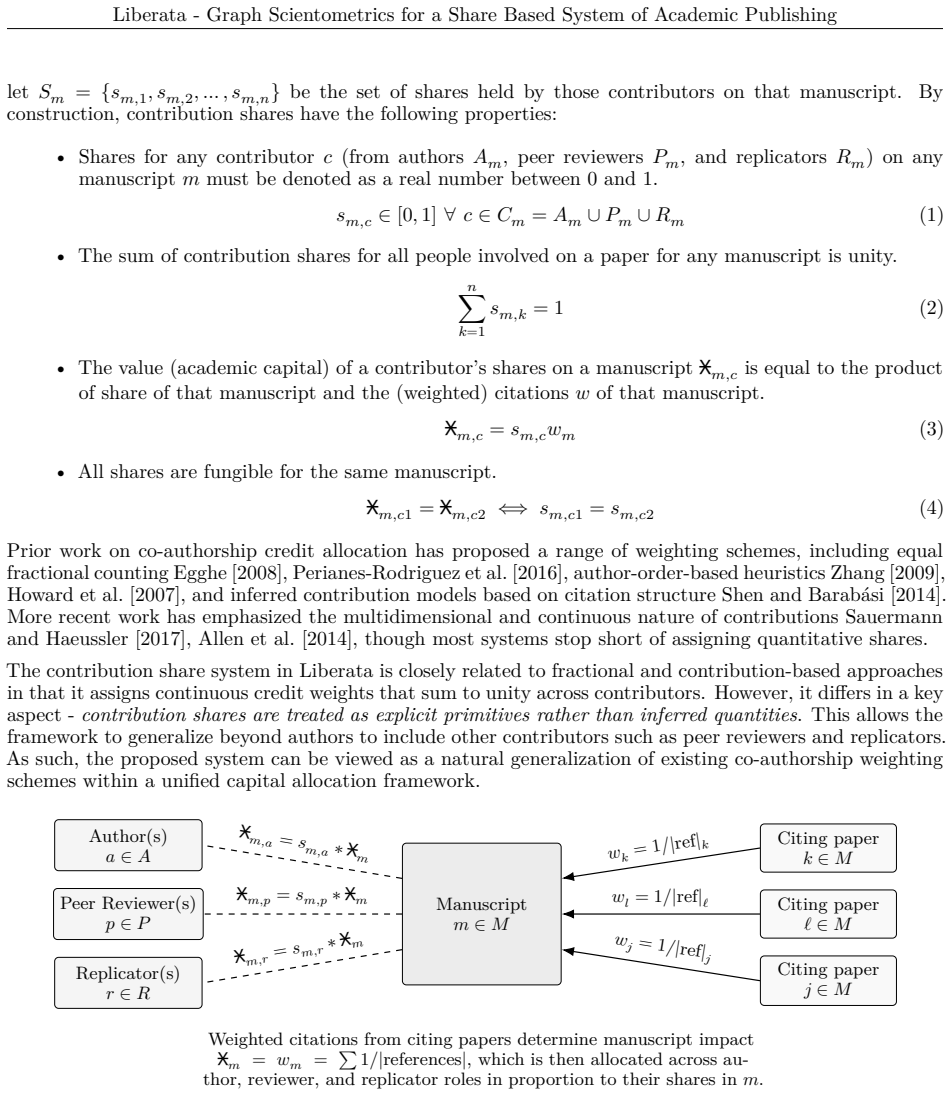
Liberata's scientometrics framework substitutes contribution shares for authorship positions; these shares sum to unity, encode ordinality and relative distances, and are tradable for peer-review and replication services. Citations receive weights to deter frivolous referencing, and modular correction factors support varied impact calculations. The system builds all metrics from a Shares graph and a References graph, yielding quantities for impact, risk, collaboration, collusion, quality-control value, and diversification that apply equally to individuals, institutions, regions, periods, and research fields.
What carries the argument
The Shares graph and References graph, which encode contributor ownership and citation relations from which every scientometric quantity is derived.
If this is right
- The same graph structures produce consistent metrics for institutions, regions, time periods, and entire fields without new definitions.
- Trading shares directly rewards contributors for sustained quality-control effort rather than initial publication.
- Weighted citations and modular factors reduce credit inflation while permitting context-specific impact views.
- Continuous shares remove the discrete breakpoints that currently enable career-boosting exploits.
- Risk and collusion measures become computable side effects of the same ownership and reference data.
Where Pith is reading between the lines
- Hiring and funding panels could substitute share-based capital calculations for citation tallies when comparing candidates.
- Peer-review marketplaces might concentrate effort on papers whose shares later trade at higher values.
- Risk metrics could flag collaborative clusters whose ownership patterns predict higher rates of later correction or retraction.
- Time-series extensions of the graphs would allow tracking how diversification of impact evolves across decades.
Load-bearing premise
Contribution shares can be assigned accurately and fairly in practice to reflect relative inputs, and trading them on marketplaces will reward long-term success without introducing fresh biases or exploitation.
What would settle it
Run a trial on a sample of papers in which independent assessors assign shares, allow trading for review services, then check whether the resulting graph metrics predict later replication success or sustained citations better than conventional h-index or citation counts.
Figures


read the original abstract
Contemporary scientometric indicators remain anchored in paradigms and axioms from when academic research was conducted in small scholarly communities. With the global proliferation of scientific research, academia is now organized in large communities with high rates of information incompleteness regarding work impact and individual contributions. This has significant implications for how research output is measured and quality controlled, especially as the rate of academic publishing continues to rise. Exploits of complex systems are typically found at discrete transition points where rules turn on or off, and academia is not immune to this pattern. Exploitative career boosting strategies are a growing problem, largely enabled by misaligned incentives and traditional metrics that force discretization of credit to authors and prior works despite their fundamentally continuous nature. This article introduces Liberata's scientometrics, a share based framework for academic publishing and quality control. In this system, authorship positions are replaced with contribution shares that sum to unity and encode both ordinality and relative contribution distances. These shares can be traded on Liberata's academic marketplaces for quality control services such as peer review and replication, rewarding contributors based on the long term success of the work. Citations are weighted to guard against frivolous referencing and credit inflation, and modular correction factors allow multiple measures of impact. Liberata's metrics are formalized through two fundamental graphs, Shares and References, from which the system constructs academic capital and derives scientometrics capturing impact, risk, collaboration, collusion, value of quality control, and diversification. These metrics represent academic contributions and extend naturally to institutions, regions, time periods, and research fields.
Editorial analysis
A structured set of objections, weighed in public.
Referee Report
Summary. The paper claims to introduce Liberata's scientometrics, a share-based framework for academic publishing that replaces authorship positions with contribution shares summing to unity, which encode ordinality and relative distances. These shares can be traded on academic marketplaces to reward quality control services based on long-term success. It proposes weighting citations to prevent inflation and uses two fundamental graphs—Shares and References—to construct academic capital and derive metrics for impact, risk, collaboration, collusion, value of quality control, and diversification. These metrics are said to extend naturally to institutions, regions, time periods, and research fields.
Significance. If the framework's graph-based metrics can be formally defined and validated to accurately reflect the claimed properties without introducing new biases, it could significantly improve upon traditional scientometric indicators by addressing information incompleteness in large academic communities, aligning incentives with long-term quality, and providing continuous rather than discrete credit assignment. This has potential to mitigate issues like citation inflation and exploitative publishing strategies.
major comments (1)
- [Abstract] The central claim that 'Liberata's metrics are formalized through two fundamental graphs, Shares and References, from which the system constructs academic capital and derives scientometrics capturing impact, risk, collaboration, collusion, value of quality control, and diversification' is presented without any supporting mathematical formalism. No definitions are given for the graph structures (e.g., nodes, edges, weights), operations on them, or how specific metrics are computed from them. This is load-bearing for the paper's contribution, as the extension to institutions and other aggregates is asserted as a natural consequence without demonstrated invariance or aggregation properties.
minor comments (1)
- [Abstract] The description of how shares 'encode both ordinality and relative contribution distances' is vague and would benefit from a concrete example or formal specification to clarify the intended meaning.
Simulated Author's Rebuttal
We thank the referee for their thorough review and for identifying the need for greater mathematical rigor in the presentation of Liberata's framework. We agree that the abstract and conceptual description require supporting formalism to substantiate the central claims, and we will revise the manuscript to address this directly.
read point-by-point responses
-
Referee: [Abstract] The central claim that 'Liberata's metrics are formalized through two fundamental graphs, Shares and References, from which the system constructs academic capital and derives scientometrics capturing impact, risk, collaboration, collusion, value of quality control, and diversification' is presented without any supporting mathematical formalism. No definitions are given for the graph structures (e.g., nodes, edges, weights), operations on them, or how specific metrics are computed from them. This is load-bearing for the paper's contribution, as the extension to institutions and other aggregates is asserted as a natural consequence without demonstrated invariance or aggregation properties.
Authors: We accept this criticism. The current manuscript introduces the two graphs at a descriptive level in the abstract and body but does not supply explicit set-theoretic or graph-theoretic definitions, edge-weighting rules, or closed-form expressions for the derived metrics. In the revised manuscript we will add a dedicated section 'Formal Definitions of the Fundamental Graphs' that (i) defines the Shares graph G_S = (V_S, E_S, w_S) with V_S as the union of author and paper nodes, E_S as directed contribution edges, and w_S normalized so that for each paper the outgoing shares sum to 1; (ii) defines the References graph G_R = (V_R, E_R, w_R) with citation edges weighted by a modular correction factor that penalizes inflation; (iii) specifies the algebraic operations that construct academic capital as a linear combination of the two graphs; and (iv) gives explicit formulas for each listed metric together with proofs or derivations of their aggregation properties (e.g., invariance under uniform scaling of institutional subgraphs and additivity across disjoint research fields). These additions will make the load-bearing claims verifiable and will replace the current assertion of 'natural extension' with demonstrated properties. revision: yes
Circularity Check
No circularity: Liberata asserts metrics from new graphs without equations or self-referential reductions.
full rationale
The paper introduces Shares and References graphs as foundational, then states that academic capital and scientometrics (impact, risk, collusion, etc.) are constructed and derived from them. No adjacency-matrix definitions, aggregation rules, monotonicity proofs, or explicit equations appear in the provided text. No parameters are fitted to data and then renamed as predictions. No self-citations are invoked to justify uniqueness or load-bearing premises. The framework is a conceptual proposal whose claimed semantics are asserted rather than derived; because nothing reduces to its own inputs by construction, the derivation chain contains no circular steps.
Axiom & Free-Parameter Ledger
axioms (2)
- domain assumption Contribution shares can be assigned to sum to unity while encoding ordinality and relative contribution distances
- domain assumption Weighted citations and modular correction factors can prevent frivolous referencing and credit inflation
invented entities (2)
-
Shares graph
no independent evidence
-
References graph
no independent evidence
Reference graph
Works this paper leans on
-
[1]
Frontiers in Handwriting Recognition (ICFHR), 2014 14th International Conference on , pages=
Real-time segmentation of on-line handwritten arabic script , author=. Frontiers in Handwriting Recognition (ICFHR), 2014 14th International Conference on , pages=. 2014 , organization=
2014
-
[2]
Soft Computing and Pattern Recognition (SoCPaR), 2014 6th International Conference of , pages=
Fast classification of handwritten on-line Arabic characters , author=. Soft Computing and Pattern Recognition (SoCPaR), 2014 6th International Conference of , pages=. 2014 , organization=
2014
-
[3]
arXiv preprint arXiv:1804.09028 , year=
Estimate and Replace: A Novel Approach to Integrating Deep Neural Networks with Existing Applications , author=. arXiv preprint arXiv:1804.09028 , year=
-
[4]
arxiv preprint , archivePrefix=
Block-corrected Modularity for Community Detection , author=. arxiv preprint , archivePrefix=. 2025 , eprint=
2025
-
[5]
and Scott, J
Allen, L. and Scott, J. and Brand, A. and Hlava, M. and Altman, M. , title =. Learned Publishing , volume =. 2014 , doi =
2014
-
[6]
and Mutz, R
Bornmann, L. and Mutz, R. and Daniel, H. D. , title =. Journal of the American Society for Information Science and Technology , volume =. 2008 , doi =
2008
-
[7]
and Xie, H
Chen, P. and Xie, H. and Maslov, S. and Redner, S. , title =. Journal of Informetrics , volume =. 2007 , doi =
2007
-
[8]
, title =
Egghe, L. , title =. Scientometrics , volume =. 2006 , doi =
2006
-
[9]
Hagen, N. T. , title =. PLoS ONE , volume =. 2008 , doi =
2008
-
[10]
Hirsch, J. E. , title =. Proceedings of the National Academy of Sciences , volume =. 2005 , doi =
2005
-
[11]
Hirschman, A. O. , title =. The American Economic Review , volume =
-
[12]
Hodge, S. E. and Greenberg, D. A. , title =. Science , volume =. 1981 , doi =
1981
-
[13]
Price, D. D. S. , title =. Science , volume =
-
[14]
An auction market for journal articles , journal =
Pr. An auction market for journal articles , journal =. 2010 , doi =
2010
-
[15]
Shen, H. W. and Barab. Collective credit allocation in science , journal =. 2014 , doi =
2014
-
[16]
and van Eck, N
Waltman, L. and van Eck, N. J. , title =. Journal of Informetrics , volume =. 2015 , doi =
2015
-
[17]
Scientometrics , volume=
Measuring researcher interdisciplinarity , author=. Scientometrics , volume=
-
[18]
Journal of Informetrics , volume=
Approaches to understanding and measuring interdisciplinary scientific research (IDR) , author=. Journal of Informetrics , volume=
-
[19]
Science , volume=
Quantifying long-term scientific impact , author=. Science , volume=
-
[20]
PNAS , volume=
Attention decay in science , author=. PNAS , volume=
-
[21]
Journal of Informetrics , volume=
A systematic empirical comparison of different approaches for normalizing citation impact indicators , author=. Journal of Informetrics , volume=
-
[22]
Journal of Informetrics , volume=
On the possibility and reliability of field normalization of bibliometric indicators , author=. Journal of Informetrics , volume=
-
[23]
Frontiers in Physics , volume=
Discovery of citation cartels in bibliometrics networks , author=. Frontiers in Physics , volume=
-
[24]
European Physical Journal B , volume=
Peer-review in a world with rational scientists: Toward selection of the average , author=. European Physical Journal B , volume=
-
[25]
Quantitative Science Studies , volume=
Self-citation and the manipulation of research metrics: Evidence from citation cartels , author=. Quantitative Science Studies , volume=
-
[26]
Self-Citations and scientific evaluation: Leadership, influence, and performance , author=. J. Informetrics , year=
-
[27]
EMBO reports , volume=
A proposal for calculating weighted citations based on author rank , author=. EMBO reports , volume=
-
[28]
Lawrence J. Smolinsky and Aaron J. Lercher , title =. CoRR , volume =. 2020 , url =. 2005.05471 , timestamp =
-
[29]
Science , volume=
Quantifying coauthor contributions , author=. Science , volume=. 2008 , publisher=
2008
-
[30]
Science , volume=
Credit for coauthors , author=. Science , volume=. 2009 , publisher=
2009
-
[31]
Journal of the American Society for Information Science and Technology , year=
Mathematical theory of the h- and g-index in case of fractional counting of authorship , author=. Journal of the American Society for Information Science and Technology , year=
-
[32]
Journal of Informetrics , volume=
Constructing bibliometric networks: A comparison between full and fractional counting , author=. Journal of Informetrics , volume=
-
[33]
Scientometrics , volume=
A method for assigning co-authorship credit , author=. Scientometrics , volume=
-
[34]
American Documentation , volume=
Bibliographic coupling between scientific papers , author=. American Documentation , volume=
-
[35]
Journal of the American Society for Information Science , volume=
Co-citation in the scientific literature: A new measure of the relationship between two documents , author=. Journal of the American Society for Information Science , volume=
-
[36]
Stanford InfoLab Technical Report , year=
The PageRank citation ranking: Bringing order to the web , author=. Stanford InfoLab Technical Report , year=
-
[37]
Journal of Statistical Mechanics: Theory and Experiment , volume=
Ranking scientific publications using a model of network traffic , author=. Journal of Statistical Mechanics: Theory and Experiment , volume=
-
[38]
Journal of Informetrics , volume=
Towards a new crown indicator: Some theoretical considerations , author=. Journal of Informetrics , volume=
-
[39]
PNAS , volume=
Universality of citation distributions: Toward an objective measure of scientific impact , author=. PNAS , volume=
-
[40]
Responsible Conduct of Research , author=
-
[41]
Science Advances , volume=
Authorship and contribution disclosures , author=. Science Advances , volume=
-
[42]
JAMA , volume=
The order of authorship: who’s on first? , author=. JAMA , volume=
-
[43]
PLoS Biology , volume=
Author sequence and credit for contributions in multiauthored publications , author=. PLoS Biology , volume=
-
[44]
Quarterly Journal of Economics , volume=
Alphabetical discrimination in academic publishing , author=. Quarterly Journal of Economics , volume=
-
[45]
Journal of Informetrics , volume=
An empirical analysis of the use of alphabetical authorship in scientific publishing , author=. Journal of Informetrics , volume=
-
[46]
Journal of Medical Ethics , volume=
Authorship attribution: survey of guidelines in biomedical journals , author=. Journal of Medical Ethics , volume=
-
[47]
Science , volume=
Science of science , author=. Science , volume=
-
[48]
Networks: An Introduction , author=
-
[49]
PNAS , volume=
The structure of scientific collaboration networks , author=. PNAS , volume=
-
[50]
Physica A , volume=
Evolution of the social network of scientific collaborations , author=. Physica A , volume=
-
[51]
2022 , eprint=
OpenAlex: A fully-open index of scholarly works, authors, venues, institutions, and concepts , author=. 2022 , eprint=
2022
-
[52]
The Journal of business , volume=
Mutual fund performance , author=. The Journal of business , volume=. 1966 , publisher=
1966
-
[53]
The journal of finance , volume=
Capital asset prices: A theory of market equilibrium under conditions of risk , author=. The journal of finance , volume=. 1964 , publisher=
1964
-
[54]
Journal of the American Society for Information Science , volume=
A general theory of bibliometric and other cumulative advantage processes , author=. Journal of the American Society for Information Science , volume=
-
[55]
The European Physical Journal B , volume=
How popular is your paper? An empirical study of the citation distribution , author=. The European Physical Journal B , volume=
-
[56]
Variabilit
Gini, Corrado , journal=. Variabilit
-
[57]
ASIS&T Bulletin , volume=
Altmetrics: A manifesto , author=. ASIS&T Bulletin , volume=
-
[58]
Journal of Informetrics , volume=
Ranking scientific articles based on bibliometric networks with a weighting scheme , author=. Journal of Informetrics , volume=. 2019 , publisher=
2019
-
[59]
Information Processing & Management , year=
Citation influence for journal aggregates of scientific publications , author=. Information Processing & Management , year=
-
[60]
Scientometrics , volume=
The weight of author self-citations: A fractional approach to self-citation counting , author=. Scientometrics , volume=
discussion (0)
Sign in with ORCID, Apple, or X to comment. Anyone can read and Pith papers without signing in.