Recognition: unknown
Improving SAT Solvers on Orthogonal Latin Square Problems
Pith reviewed 2026-05-08 01:38 UTC · model grok-4.3
The pith
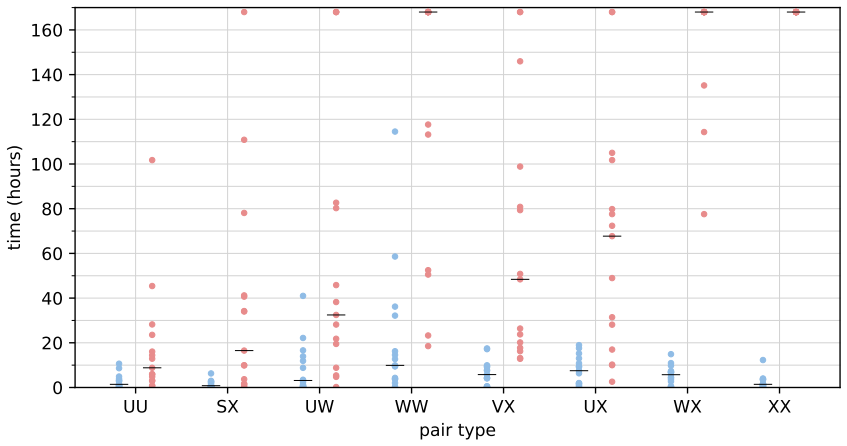
Augmenting CaDiCaL with the Euler-Parker algorithm solves the hardest 10x10 orthogonal Latin square cases in a median of 5100 seconds.
A machine-rendered reading of the paper's core claim, the machinery that carries it, and where it could break.
Core claim
CaDiCaL augmented with an external Euler-Parker algorithm solves the hardest 10x10 orthogonal Latin square instances in a median of around 5100 seconds, whereas the unaugmented solver could not solve them within seven days. The method works by invoking the Euler-Parker construction, realized through a Diophantine system solver, at appropriate points in the SAT search to generate or prune orthogonal mate candidates.
What carries the argument
The Euler-Parker algorithm for constructing orthogonal mates, implemented as a Diophantine equation solver that is invoked externally from within the SAT search.
If this is right
- Pairs of 10x10 orthogonal Latin squares whose existence was unknown for over 25 years become computationally reachable.
- The hybrid solver achieves orders-of-magnitude reductions in runtime on the most difficult cases compared with the unaugmented version.
- The same integration pattern can be applied to other orthogonal Latin square problems of varying orders and types.
- SAT solvers can usefully incorporate domain-specific combinatorial routines without losing their general-purpose character.
Where Pith is reading between the lines
- The same hybrid pattern may transfer to other combinatorial search problems that possess efficient specialized algorithms, such as certain design-theoretic or scheduling instances.
- Embedding the Diophantine solver more tightly inside the SAT engine rather than calling it externally could further reduce overhead.
- The reported speedups suggest that partial domain knowledge can be added modularly to existing solvers, offering a scalable route for other long-standing open problems in combinatorics.
Load-bearing premise
Calling the Euler-Parker algorithm from inside the SAT search can be arranged so that the added overhead and any compatibility friction do not erase the observed speedups on the target 10x10 instances.
What would settle it
Running the same hardest 10x10 instances with the augmented solver and finding that the median time exceeds seven days or that the plain CaDiCaL finishes faster.
Figures


read the original abstract
Latin squares are $n\times n$ matrices containing $n$ symbols, where each symbol appears exactly once in each row and column. They were studied by Euler, later popularized through Sudoku, and remain a rich source of difficult combinatorial search problems. Two Latin squares are orthogonal mates if, when overlaid, no ordered pair of symbols repeats. Pairs of orthogonal Latin squares exist for every order except 2 and 6, but finding orthogonal Latin squares computationally can be challenging. Satisfiability (SAT) solvers are strong at combinatorial search and have been used to resolve a number of various kinds of orthogonal Latin square problems. On the other hand, SAT solvers lack domain knowledge about Latin squares, such as the Euler-Parker algorithm for orthogonal mate construction. In this paper, we propose a hybrid method combining a SAT solver with the Euler-Parker algorithm (implemented using a Diophantine system solver) and show that the resulting solver is effective at finding certain kinds of orthogonal Latin squares. For example, certain pairs of $10\times10$ orthogonal Latin squares whose existence was unknown for over 25 years were recently found by Bright, Keita, and Stevens using a SAT solver. The hardest cases could not be solved by the SAT solver CaDiCaL within seven days, but CaDiCaL augmented with an external Euler-Parker algorithm solves these cases in a median of around 5,100 seconds.
Editorial analysis
A structured set of objections, weighed in public.
Referee Report
Summary. The paper proposes augmenting the CaDiCaL SAT solver with an external Euler-Parker algorithm (implemented via a Diophantine system solver) to find pairs of orthogonal Latin squares. It reports that this hybrid approach solves the hardest known 10x10 instances—previously unsolved by unaugmented CaDiCaL within seven days—in a median runtime of approximately 5100 seconds.
Significance. If the integration details and overhead measurements hold, the work demonstrates a practical way to inject domain-specific Latin-square knowledge into general-purpose SAT solvers, yielding concrete speedups on long-standing hard instances. The empirical runtime comparisons against an external baseline provide direct evidence for the performance claim and could inform similar hybridizations for other combinatorial problems.
major comments (2)
- [Hybrid method description (near the end of the abstract and corresponding methods section)] The hybrid integration is described only at a high level (external Euler-Parker calls during search) without specifying invocation points inside CaDiCaL, the exact form of partial Latin-square assignments passed to the Diophantine solver, triggering conditions, or any instrumentation of the fraction of runtime spent outside the SAT engine. This information is load-bearing for the central speedup claim, as prohibitive overhead or state-conversion costs could erase the reported gains.
- [Experimental results and runtime tables] The experimental results report median runtimes but omit error bars, the number of independent runs per instance, full benchmark specifications (e.g., exact instance encodings, hardware details, or timeout handling), and any comparison of search-node counts or learned-clause statistics between the plain and augmented solvers. These omissions make it difficult to assess whether the improvement is robust or instance-specific.
minor comments (2)
- [Introduction / abstract] The abstract states that pairs of orthogonal Latin squares exist for every order except 2 and 6; a brief reference to the known non-existence proofs would improve context.
- [Euler-Parker algorithm subsection] Notation for the Diophantine encoding of the Euler-Parker algorithm should be introduced with a small example for a small order (e.g., order 4) to aid readers unfamiliar with the technique.
Simulated Author's Rebuttal
We thank the referee for the constructive and detailed feedback. We address each major comment below and agree that expanding the description of the hybrid method and strengthening the experimental reporting will improve the manuscript.
read point-by-point responses
-
Referee: The hybrid integration is described only at a high level (external Euler-Parker calls during search) without specifying invocation points inside CaDiCaL, the exact form of partial Latin-square assignments passed to the Diophantine solver, triggering conditions, or any instrumentation of the fraction of runtime spent outside the SAT engine. This information is load-bearing for the central speedup claim, as prohibitive overhead or state-conversion costs could erase the reported gains.
Authors: We agree that the current description of the integration is high-level and that additional specifics are needed to fully support the speedup claims. In the revised manuscript we will expand the methods section to detail the exact points at which external Euler-Parker calls are invoked inside CaDiCaL, the precise format of the partial Latin-square assignments passed to the Diophantine solver, the triggering conditions used, and instrumentation results showing the fraction of runtime spent outside the SAT engine. These additions will demonstrate that the overhead is modest relative to the observed gains. revision: yes
-
Referee: The experimental results report median runtimes but omit error bars, the number of independent runs per instance, full benchmark specifications (e.g., exact instance encodings, hardware details, or timeout handling), and any comparison of search-node counts or learned-clause statistics between the plain and augmented solvers. These omissions make it difficult to assess whether the improvement is robust or instance-specific.
Authors: We acknowledge that the experimental section would benefit from greater statistical detail and additional solver metrics. In the revision we will include error bars derived from multiple independent runs, state the number of runs performed per instance, provide complete benchmark specifications (instance encodings, hardware platform, and timeout policy), and report comparisons of search-node counts and learned-clause statistics between plain CaDiCaL and the augmented solver. These changes will allow a clearer assessment of robustness. revision: yes
Circularity Check
No significant circularity in empirical runtime comparison
full rationale
The paper reports an experimental result: a hybrid SAT solver (CaDiCaL augmented with an external Euler-Parker/Diophantine algorithm) solves certain 10x10 orthogonal Latin square instances in a median of ~5100 seconds where the unaugmented solver times out after seven days. This is a direct benchmark measurement on fixed instances, not a derivation, fitted model, or theorem whose conclusion is forced by its own inputs. No equations, ansatzes, uniqueness theorems, or parameter fits are presented whose outputs reduce to the inputs by construction. Prior self-citations (e.g., Bright et al. on the original discovery) supply context for the benchmark instances but are not load-bearing for the runtime claim itself. The result is therefore self-contained against external benchmarks.
Axiom & Free-Parameter Ledger
axioms (1)
- domain assumption The Euler-Parker algorithm can be implemented using a Diophantine system solver.
Reference graph
Works this paper leans on
-
[1]
Euler, Recherches sur une nouvelle espèce de quarrés magiques, Verhandelingen uitgegeven door het zeeuwsch Genootschap der Wetenschappen te Vlissingen (1782) 85–239
L. Euler, Recherches sur une nouvelle espèce de quarrés magiques, Verhandelingen uitgegeven door het zeeuwsch Genootschap der Wetenschappen te Vlissingen (1782) 85–239
-
[2]
Tarry, Le problème des 36 officiers, Association Française pour l’Avancement des Sciences: Compte Rendu de la 29me session, Paris 1900 2 (1901) 170–203
G. Tarry, Le problème des 36 officiers, Association Française pour l’Avancement des Sciences: Compte Rendu de la 29me session, Paris 1900 2 (1901) 170–203
1900
-
[3]
Peterson, Les 36 officieurs, Annuaire des Mathématiciens (1902) 413–427
J. Peterson, Les 36 officieurs, Annuaire des Mathématiciens (1902) 413–427
1902
-
[4]
Wernicke, Das problem der 36 offiziere, Jahresbericht der Deutschen Mathematiker-Vereinigung 19 (1910) 264–267
P. Wernicke, Das problem der 36 offiziere, Jahresbericht der Deutschen Mathematiker-Vereinigung 19 (1910) 264–267
1910
-
[5]
H. F. MacNeish, Euler squares, Annals of Mathematics 23 (1922) 221–227. doi: 10.2307/1967920
-
[6]
E. T. Parker, Orthogonal Latin squares, Proceedings of the National Academy of Sciences 45 (1959) 859–862. doi:10.1073/pnas.45.6.859
-
[7]
R. C. Bose, S. S. Shrikhande, On the construction of sets of mutually orthogonal Latin squares and the falsity of a conjecture of Euler, Transactions of the American Mathematical Society 95 (1960) 191–209. doi:10.2307/1993286
-
[8]
R. C. Bose, S. S. Shrikhande, E. T. Parker, Further results on the construction of mutually orthogonal Latin squares and the falsity of Euler’s conjecture, Canadian Journal of Mathematics 12 (1960) 189–203. doi:10.4153/CJM-1960-016-5
-
[9]
L. J. Paige, C. B. Tompkins, The size of the10×10 orthogonal Latin square problem, Combinatorial Analysis (1960) 71–83. doi:10.1090/psapm/010/0115927
-
[10]
E. T. Parker, A computer search for Latin squares orthogonal to Latin squares of order ten, abstract 564-71, American Mathematical Society Notices 6 (1959) 798
1959
-
[11]
D. E. Knuth, The Art of Computer Programming, Volume 4A: Combinatorial Algorithms, Part 1, Addison-Wesley, Upper Saddle River, NJ, 2011
2011
-
[12]
Kochemazov, O
S. Kochemazov, O. Zaikin, A. Semenov, The comparison of different SAT encodings for the problem of search for systems of orthogonal Latin squares, in: International Conference Mathematical and Information Technologies-MIT, volume 1839 ofCEUR Workshop Proceedings, 2016, pp. 155–165. URL: https://ceur-ws.org/Vol-1839/MIT2016-p14.pdf
2016
-
[13]
G. Appa, D. Magos, I. Mourtos, Searching for mutually orthogonal Latin squares via integer and constraint programming, European Journal of Operational Research 173 (2006) 519–530. doi:10.1016/j.ejor.2005.01.048
-
[14]
N. Rubin, C. Bright, K. Cheung, B. Stevens, Improving integer and constraint programming for Graeco-Latin squares, in: 2021 IEEE 33rd International Conference on Tools with Artificial Intelligence (ICTAI), IEEE, 2021, p. 604–608. doi:10.1109/ictai52525.2021.00096
-
[16]
B. D. McKay, A. Meynert, W. Myrvold, Small Latin squares, quasigroups, and loops, Journal of Combinatorial Designs 15 (2006) 98–119. doi:10.1002/jcd.20105
-
[17]
C. Bright, A. Keita, B. Stevens, Myrvold’s results on orthogonal triples of 10×10 Latin squares: A SAT investigation, The Electronic Journal of Combinatorics 33 (2026) P1.30. doi:10.37236/13960
-
[18]
Myrvold, Negative results for orthogonal triples of Latin squares of or- der 10, Journal of Combinatorial Mathematics and Combinatorial Computing 29 (1999) 95–105
W. Myrvold, Negative results for orthogonal triples of Latin squares of or- der 10, Journal of Combinatorial Mathematics and Combinatorial Computing 29 (1999) 95–105. URL: https://combinatorialpress.com/jcmcc-articles/volume-029/ negative-results-for-orthogonal-triples-of-Latin-squares-of-order-10/
1999
-
[19]
Biere, T
A. Biere, T. Faller, K. Fazekas, M. Fleury, N. Froleyks, F. Pollitt, CaDiCaL, Gimsatul, IsaSAT and Kissat entering the SAT Competition 2024, in: M. Heule, M. Iser, M. Järvisalo, M. Suda (Eds.), Proc. of SAT Competition 2024 – Solver, Benchmark and Proof Checker Descriptions, volume B-2024-1 ofDepartment of Computer Science Report Series B, University of H...
2024
-
[20]
A. Biere, T. Faller, K. Fazekas, M. Fleury, N. Froleyks, F. Pollitt, CaDiCaL 2.0, in: A. Gurfinkel, V. Ganesh (Eds.), Computer Aided Verification - 36th International Conference, CAV 2024, Montreal, QC, Canada, July 24-27, 2024, Proceedings, Part I, volume 14681 ofLecture Notes in Computer Science, Springer, 2024, pp. 133–152. doi:10.1007/978-3-031-65627-9_7
-
[21]
S. A. Cook, The complexity of theorem-proving procedures, in: Proceedings of the third annual ACM symposium on Theory of computing - STOC ’71, STOC ’71, ACM Press, 1971, p. 151–158. doi:10.1145/800157.805047
-
[22]
V. Ganesh, M. Y. Vardi, On the Unreasonable Effectiveness of SAT Solvers, Cambridge University Press, 2020, p. 547–566. doi:10.1017/9781108637435.032
-
[23]
M. J. H. Heule, M. Scheucher, Happy ending: An empty hexagon in every set of 30 points, in: B. Finkbeiner, L. Kovács (Eds.), 30th International Conference on Tools and Algorithms for the Construction and Analysis of Systems, volume 14570 ofLecture Notes in Computer Science, Springer Nature Switzerland, Cham, 2024, p. 61–80. doi:10.1007/978-3-031-57246-3_5
-
[24]
Subercaseaux, E
B. Subercaseaux, E. Mackey, L. Qian, M. Heule, Automated symmetric constructions in discrete geometry, in: V. de Paiva, P. Koepke (Eds.), Intelligent Computer Mathematics, volume 16136 of Lecture Notes in Computer Science, Springer Nature Switzerland, 2025, p. 29–47. doi: 10.1007/ 978-3-032-07021-0_3
2025
-
[25]
B. Subercaseaux, J. Mackey, M. J. H. Heule, R. Martins, Automated mathematical discovery and verification: Minimizing pentagons in the plane, in: A. Kohlhase, L. Kovács (Eds.), Intelligent Computer Mathematics, volume 14960 ofLecture Notes in Computer Science, Springer Nature Switzerland, Cham, 2024, p. 21–41. doi:10.1007/978-3-031-66997-2_2
-
[26]
C. Bright, K. K. H. Cheung, B. Stevens, I. Kotsireas, V. Ganesh, A SAT-based resolution of Lam’s problem, Proceedings of the AAAI Conference on Artificial Intelligence 35 (2021) 3669–3676. doi:10.1609/aaai.v35i5.16483
-
[27]
In: Sankaranarayanan, S., Sharygina, N
B. Subercaseaux, M. J. H. Heule, The packing chromatic number of the infinite square grid is 15, in: S. Sankaranarayanan, N. Sharygina (Eds.), Tools and Algorithms for the Construction and Analysis of Systems, volume 13993 ofLecture Notes in Computer Science, Springer Nature Switzerland, Cham, 2023, p. 389–406. doi:10.1007/978-3-031-30823-9_20
-
[28]
C. Bright, J. Gerhard, I. Kotsireas, V. Ganesh, Effective problem solving using SAT solvers, in: J. Gerhard, I. Kotsireas (Eds.), Maple in Mathematics Education and Research, volume 1125 of Communications in Computer and Information Science, Springer International Publishing, Cham, 2020, p. 205–219. doi:10.1007/978-3-030-41258-6_15
-
[29]
K. Fazekas, A. Niemetz, M. Preiner, M. Kirchweger, S. Szeider, A. Biere, IPASIR-UP: User Propagators for CDCL, in: M. Mahajan, F. Slivovsky (Eds.), 26th International Conference on Theory and Applications of Satisfiability Testing (SAT 2023), volume 271 ofLeibniz International Proceedings in Informatics (LIPIcs), Schloss Dagstuhl – Leibniz-Zentrum für Inf...
-
[30]
C. Bright, I. Kotsireas, V. Ganesh, When satisfiability solving meets symbolic computation, Communications of the ACM 65 (2022) 64–72. doi:10.1145/3500921
-
[31]
M. England, SC-square: Overview to 2021, in: SC 2 2021: 6th International Workshop on Satisfia- bility Checking and Symbolic Computation, volume 3273 ofCEUR Workshop Proceedings, 2021, pp. 1–6. URL: https://ceur-ws.org/Vol-3273/invited1.pdf
2021
-
[32]
E. Abraham, Building bridges between symbolic computation and satisfiability checking, in: Proceedings of the 2015 ACM International Symposium on Symbolic and Algebraic Computation, ISSAC’15, ACM, 2015, p. 1–6. doi:10.1145/2755996.2756636
-
[33]
Zulkoski, V
E. Zulkoski, V. Ganesh, K. Czarnecki, MathCheck: A math assistant via a combination of computer algebra systems and SAT solvers, in: Automated Deduction - CADE-25, volume 9195 ofLecture Notes in Computer Science, Springer International Publishing, 2015, p. 607–622. doi: 10.1007/ 978-3-319-21401-6_41
2015
-
[34]
Z. Li, C. Bright, V. Ganesh, An SC-square approach to the minimum Kochen–Specker problem, in: SC2 2022: 7th International Workshop on Satisfiability Checking and Symbolic Computation, volume 3458 ofCEUR Workshop Proceedings, 2022, p. 55–66. URL: https://ceur-ws.org/Vol-3458/ paper6.pdf
2022
-
[35]
Z. Li, C. Bright, V. Ganesh, A SAT solver + computer algebra attack on the minimum Kochen–Specker problem, in: K. Larson (Ed.), Proceedings of the Thirty-Third International Joint Conference on Artificial Intelligence, IJCAI-24, International Joint Conferences on Artificial Intelligence Organization, 2024, pp. 1898–1906. doi:10.24963/ijcai.2024/210, main Track
-
[36]
Ajani, C
Y. Ajani, C. Bright, A hybrid SAT and lattice reduction approach for integer factorization, in: SC 2 2023: 8th International Workshop on Satisfiability Checking and Symbolic Computation, volume 3455 ofCEUR Workshop Proceedings, 2023, pp. 39–43. URL: https://cs.uwaterloo.ca/~cbright/reports/ sc2-fact-update.pdf
2023
-
[37]
Y. Ajani, C. Bright, SAT and lattice reduction for integer factorization, in: Proceedings of the 2024 International Symposium on Symbolic and Algebraic Computation, ISSAC ’24, ACM, 2024, p. 391–399. doi:10.1145/3666000.3669712
-
[38]
Alamgir, S
N. Alamgir, S. Nejati, C. Bright, SHA-256 collision attack with programmatic SAT, in: SC 2 2024: 9th International Workshop on Satisfiability Checking and Symbolic Computation, volume 3717 ofCEUR Workshop Proceedings, 2024, pp. 91–110. URL: https://ceur-ws.org/Vol-3717/paper5.pdf
2024
-
[39]
Ahmed, L
T. Ahmed, L. Zaman, C. Bright, Symbolic sets for proving bounds on Rado numbers, in: SC 2 2025: 10th International Workshop on Satisfiability Checking and Symbolic Computation, volume 4116 ofCEUR Workshop Proceedings, 2025, pp. 55–75. URL: https://ceur-ws.org/Vol-4116/paper139.pdf
2025
-
[40]
Kaski, O
P. Kaski, O. Pottonen,libexactuser’s guide, version 1.0 (2008). URL: https://pottonen.kapsi.fi/ hiit-tr-2008-1.pdf, HIIT Technical Reports 2008–1, Helsinki Institute for Information Technology HIIT
2008
-
[41]
G. Appa, I. Mourtos, D. Magos, Integrating Constraint and Integer Programming for the Orthog- onal Latin Squares Problem, volume 2470 ofLecture Notes in Computer Science, Springer Berlin Heidelberg, 2002, p. 17–32. doi:10.1007/3-540-46135-3_2
-
[42]
G. Appa, D. Magos, I. Mourtos, A branch & cut algorithm for a four-index assignment problem, Journal of the Operational Research Society 55 (2004) 298–307. doi:10.1057/palgrave.jors. 2601655
-
[43]
G. Appa, D. Magos, I. Mourtos, An LP-based proof for the non-existence of a pair of orthogonal Latin squares of order 6, Operations Research Letters 32 (2004) 336–344. doi: 10.1016/j.orl. 2003.10.010
-
[44]
F. Ma, J. Zhang, Finding orthogonal Latin squares using finite model searching tools, Science China Information Sciences 56 (2013) 1–9. doi:10.1007/s11432-011-4343-3
-
[45]
O. Zaikin, S. Kochemazov, A. Semenov, SAT-based search for systems of diagonal Latin squares in volunteer computing project SAT@home, in: 39th International Convention on Information and Communication Technology, Electronics and Microelectronics (MIPRO), 2016, pp. 277–281. doi:10.1109/MIPRO.2016.7522152
-
[46]
Zaikin, S
O. Zaikin, S. Kochemazov, The search for systems of diagonal Latin squares using the SAT@home project, volume 3 ofCEUR Workshop Proceedings, 2015, pp. 4–9. URL: https://ceur-ws.org/Vol-1502/ paper6.pdf
2015
-
[47]
Zaikin, A
O. Zaikin, A. Zhuravlev, S. Kochemazov, E. Vatutin, On the construction of triples of diagonal Latin squares of order 10, Electronic Notes in Discrete Mathematics 54 (2016) 307–312. doi: 10. 1016/j.endm.2016.09.053
2016
-
[48]
E. Vatutin, O. Zaikin, M. Manzyuk, N. Nikitina, Searching for Orthogonal Latin Squares via Cells Mapping and BOINC-Based Cube-and-Conquer, volume 1510 ofCommunications in Computer and Information Science, 2021, pp. 498–512. doi:10.1007/978-3-030-92864-3_38
-
[49]
R. Lu, S. Liu, J. Zhang, Searching for Doubly Self-orthogonal Latin Squares, volume 6876 of Lecture Notes in Computer Science, Springer Berlin Heidelberg, 2011, p. 538–545. doi: 10.1007/ 978-3-642-23786-7_41
2011
-
[50]
R. M. Falcón, Ó. J. Falcón, J. Núñez, Computing the sets of totally symmetric and totally conjugate orthogonal partial Latin squares by means of a SAT solver, in: Proceedings of the 17th International Conference on Computational and Mathematical Methods in Science and Engineering, 2017, pp. 841–852. URL: http://hdl.handle.net/11441/62076
2017
-
[51]
P. Huang, M. Liu, C. Ge, F. Ma, J. Zhang, Investigating the existence of orthogonal golf designs via satisfiability testing, in: ISSAC ’19: Proceedings of the 2019 International Symposium on Symbolic and Algebraic Computation, 2019, pp. 203–210. doi:10.1145/3326229.3326232
-
[52]
J. Jin, Y. Lv, C. Ge, F. Ma, J. Zhang, Investigating the Existence of Costas Latin Squares via Satisfiability Testing, volume 12831 ofLecture Notes in Computer Science, 2021, pp. 270–279. doi:10.1007/978-3-030-80223-3_19
-
[53]
H. Zhang, Specifying Latin square problems in propositional logic, in: Automated Reasoning and Its Applications: Essays in Honor of Larry Wos, MIT Press, Cambridge, MA, USA, 1997, p. 115–146. URL: https://dl.acm.org/doi/10.5555/271101.271124
-
[54]
Zaikin, E
O. Zaikin, E. Vatutin, C. Bright, Enumerating extended self-orthogonal diagonal Latin squares of order up to 10, Journal of Integer Sequences 28 (2025). URL: https://cs.uwaterloo.ca/journals/JIS/ VOL28/Zaikin/zaikin4.html, article 28.7.4
2025
-
[55]
Bright, A
C. Bright, A. Keita, B. Stevens, Orthogonal Latin squares of order 10 with two relations: A SAT investigation, Discrete Mathematics, Algorithms and Applications (2025). doi: 10.1142/ s1793830925501563, to appear
2025
-
[56]
O. Bailleux, Y. Boufkhad, Efficient CNF Encoding of Boolean Cardinality Constraints, in: F. Rossi (Ed.), Principles and Practice of Constraint Programming – CP 2003, volume 2833 ofLecture Notes in Computer Science, Springer Berlin Heidelberg, Berlin, Heidelberg, 2003, pp. 108–122. doi:10.1007/978-3-540-45193-8_8
discussion (0)
Sign in with ORCID, Apple, or X to comment. Anyone can read and Pith papers without signing in.