Recognition: 2 theorem links
· Lean TheoremEfficient Transported Distributional and Quantile Treatment Effects with Surrogate-Assisted Missing Primary Outcomes
Pith reviewed 2026-05-08 19:25 UTC · model grok-4.3
The pith
Surrogates improve efficiency for estimating transported distributional and quantile treatment effects when primary outcomes are missing at random.
A machine-rendered reading of the paper's core claim, the machinery that carries it, and where it could break.
Core claim
The nonparametric efficient influence function for the transported counterfactual distribution functions, their quantiles, and the quantile treatment effect decomposes into three orthogonal components that correspond to target covariate sampling, the source surrogate process, and missing primary outcomes. This decomposition yields a closed-form cross-fitted one-step estimator after nuisance estimation and delivers pointwise and uniform asymptotic linearity for the distribution functions, Bahadur representations for the quantiles, multiplier-bootstrap simultaneous bands, and explicit efficiency gains from the surrogates.
What carries the argument
The nonparametric efficient influence function with three orthogonal components for transported counterfactual distributions and quantiles.
If this is right
- The transported counterfactual distribution functions and quantiles are identified under the stated missing-at-random and transportability conditions.
- The estimator for the distribution functions is asymptotically linear and the quantile estimator admits a Bahadur representation under explicit local inverse-map conditions.
- Multiplier-bootstrap simultaneous confidence bands are valid under stated conditions on the estimated process and densities.
- Observing surrogates produces measurable efficiency gains relative to using only the validation subset of primary outcomes.
- The nuisance estimators can be implemented with sieve ridge regression, kernel ridge regression, or isotonic projection while satisfying the required rate conditions.
Where Pith is reading between the lines
- The same three-component influence-function strategy could be applied to other causal estimands that combine transport and missing data.
- In applications such as long-term follow-up studies, the efficiency gain from surrogates may allow smaller validation samples while preserving precision.
- The approach separates the roles of surrogates from any assumption that they are perfect substitutes, which may encourage their use in settings where surrogacy is implausible.
Load-bearing premise
Primary outcomes are missing at random conditional on the observed data that includes surrogates, together with transportability assumptions that let the source study inform the target population.
What would settle it
A Monte Carlo experiment or real-data example in which the proposed one-step estimator fails to achieve the variance lower bound implied by the derived influence function, even when the nuisance functions are estimated at the required rates.
Figures
read the original abstract
We study target-population distributional and quantile treatment effects when a source study observes treatment and post-treatment surrogates for all source units but observes a long-run primary outcome only for a validation subset, while the target population contributes only baseline covariates. The target estimands are transported counterfactual distribution functions $\psi_a(y)=P(Y^a\le y\mid R=0)$, their quantiles $q_a(\tau)$, and the quantile treatment effect $\Delta(\tau)=q_1(\tau)-q_0(\tau)$. The surrogate is not treated as a replacement endpoint and no Prentice-type surrogacy condition is imposed. Instead, the surrogate is used only to improve efficiency under missing-at-random primary-outcome sampling. We derive the nonparametric efficient influence function, which has three orthogonal components corresponding to target covariate sampling, the source surrogate process, and missing primary outcomes. This yields a closed-form cross-fitted one-step estimator after nuisance estimation. We establish identification, the canonical gradient, exact drift identities, ratio-level robustness, pointwise and uniform asymptotic linearity for transported CDFs, Bahadur representations for quantiles under explicit local inverse-map conditions, high-level multiplier-bootstrap simultaneous bands under explicit estimated-process and density conditions, and quantile-specific efficiency gains from observing surrogates. We also give lower-level nuisance-rate verification for a deliberately restricted class of analyzable bounded finite-dimensional or finite-rank implementations based on sieve ridge regression, ridge logistic regression, calibrated density-ratio estimation, finite-rank kernel ridge regression, and isotonic projection under explicit grid, eigenvalue, source, and entropy conditions.
Editorial analysis
A structured set of objections, weighed in public.
Referee Report
Summary. The paper studies estimation of transported counterfactual distribution functions ψ_a(y) = P(Y^a ≤ y | R=0), their quantiles q_a(τ), and the quantile treatment effect Δ(τ) when source data include treatment, surrogates for all units, and primary outcomes only for a validation subset, while target data supply only baseline covariates. It derives the nonparametric efficient influence function as the sum of three orthogonal components (target covariate sampling, source surrogate process, and MAR missingness for primaries), constructs a closed-form cross-fitted one-step estimator after nuisance estimation, and proves identification, asymptotic linearity, Bahadur representations for quantiles, multiplier-bootstrap validity, and efficiency gains, together with lower-level rate conditions for sieve/ridge/kernel implementations.
Significance. If the derivations hold, the work supplies a principled, efficiency-improving approach to transported distributional and quantile effects that uses surrogates solely for precision under MAR without invoking Prentice surrogacy. Strengths include the explicit three-component EIF, exact drift identities, ratio-level robustness, uniform asymptotic results, and concrete nuisance-rate verifications for bounded finite-rank estimators. These features address a practically relevant design with partial outcome observation and population transport.
minor comments (4)
- [§2.2] §2.2, Assumption 3 (MAR): the conditioning set is described as 'observed data including surrogates,' but the precise sigma-field (e.g., whether it includes the treatment indicator A) should be stated explicitly to match the EIF derivation in §3.1.
- [Theorem 4.1] Theorem 4.1 (asymptotic linearity): the local inverse-map condition for quantiles is stated at a high level; a brief remark on how the density lower bound is verified for the isotonic projection implementation would aid reproducibility.
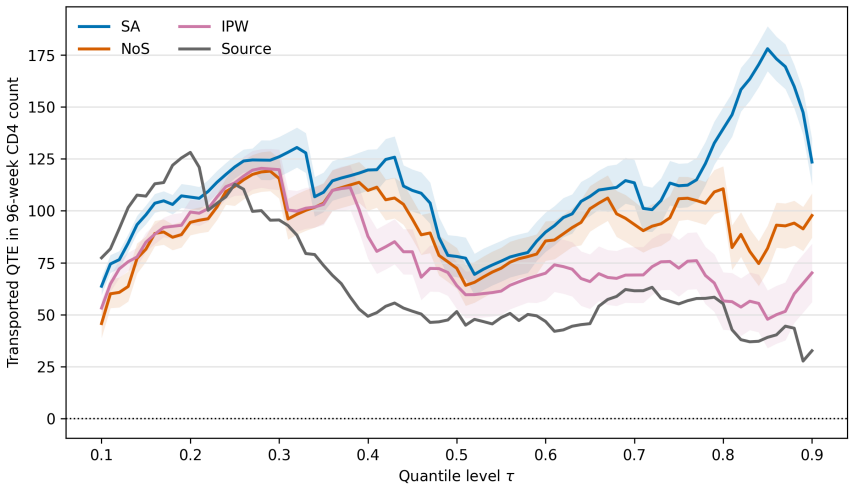
- [Figure 2] Figure 2 (simulation results): the legend for the 'no-surrogate' comparator is missing; adding it would clarify the efficiency-gain comparison reported in the text.
- [§5.3] §5.3, nuisance estimation: the entropy condition for the kernel ridge class is given, but the explicit constant in the eigenvalue decay rate (used for the rate verification) is not numerically illustrated; a short table entry would help.
Simulated Author's Rebuttal
We thank the referee for the positive and accurate summary of our manuscript on efficient transported distributional and quantile treatment effects with surrogate-assisted missing primary outcomes. The recommendation for minor revision is appreciated, and we note that the referee correctly identifies the key contributions including the three-component EIF, cross-fitted one-step estimator, and asymptotic results. As no specific major comments were raised, we have no point-by-point rebuttals to provide at this stage.
Circularity Check
No significant circularity in derivation chain
full rationale
The central derivation derives the nonparametric EIF explicitly from the observed-data model under transportability and MAR assumptions conditional on surrogates and covariates, with three orthogonal components obtained via pathwise differentiability. The one-step estimator is constructed directly from this EIF after cross-fitting nuisance functions; no target estimand is redefined as a fitted parameter, no uniqueness theorem is imported from self-citations, and no ansatz is smuggled via prior work. All steps (identification, canonical gradient, asymptotic linearity, Bahadur representations) are self-contained against the stated high-level conditions and do not reduce by construction to the inputs.
Axiom & Free-Parameter Ledger
axioms (2)
- domain assumption Missing at random for primary outcomes conditional on observed data including surrogates
- domain assumption Standard transportability identification assumptions linking source and target populations
Forward citations
Cited by 1 Pith paper
-
Nested Sensitivity Envelopes for Transported Quantile Treatment Effects
Derives sharp nested CDF envelopes for transported quantile treatment effects under marginal sensitivity bounds on confounding and transportability, with semiparametric estimators, uniform inference, and breakdown frontiers.
Reference graph
Works this paper leans on
-
[1]
W., and Kang, H
Athey, S., Chetty, R., Imbens, G. W., and Kang, H. (2025). The surrogate index: Combining short-term proxies to estimate long-term treatment effects more rapidly and precisely. The Review of Economic Studies, rdaf087
2025
-
[2]
and Robins, J
Bang, H. and Robins, J. M. (2005). Doubly robust estimation in missing data and causal inference models. Biometrics, 61:962--973
2005
- [3]
-
[4]
and Molenberghs, G
Buyse, M. and Molenberghs, G. (1998). Criteria for the validation of surrogate endpoints in randomized experiments. Biometrics, 54:1014--1029
1998
-
[5]
and Cai, T
Chakrabortty, A. and Cai, T. (2018). Efficient and adaptive linear regression in semi-supervised settings. The Annals of Statistics, 46:1541--1572
2018
- [6]
-
[7]
Chakrabortty, A. and Dai, G. (2024). A general framework for treatment effect estimation in semi-supervised and high dimensional settings. arXiv:2201.00468
-
[8]
and Ritzwoller, D
Chen, J. and Ritzwoller, D. M. (2023). Semiparametric estimation of long-term treatment effects. Journal of Econometrics, 237:105545
2023
-
[9]
Cole, S. R. and Stuart, E. A. (2010). Generalizing evidence from randomized clinical trials to target populations: The ACTG 320 trial. American Journal of Epidemiology, 172:107--115
2010
-
[10]
J., Robertson, S
Dahabreh, I. J., Robertson, S. E., Tchetgen Tchetgen, E. J., Stuart, E. A., and Hern\'an, M. A. (2019). Generalizing causal inferences from individuals in randomized trials to all trial-eligible individuals. Biometrics, 75:685--694
2019
-
[11]
and S\"arndal, C.-E
Deville, J.-C. and S\"arndal, C.-E. (1992). Calibration estimators in survey sampling. Journal of the American Statistical Association, 87:376--382
1992
-
[12]
Frangakis, C. E. and Rubin, D. B. (2002). Principal stratification in causal inference. Biometrics, 58:21--29
2002
-
[13]
and Melly, B
Fr\"olich, M. and Melly, B. (2013). Unconditional quantile treatment effects under endogeneity. Journal of Business & Economic Statistics, 31:346--357
2013
-
[14]
Gilbert, P. B. and Hudgens, M. G. (2008). Evaluating candidate principal surrogate endpoints. Biometrics, 64:1146--1154
2008
-
[15]
Hahn, J. (1998). On the role of the propensity score in efficient semiparametric estimation of average treatment effects. Econometrica, 66:315--331
1998
-
[16]
W., and Ridder, G
Hirano, K., Imbens, G. W., and Ridder, G. (2003). Efficient estimation of average treatment effects using the estimated propensity score. Econometrica, 71:1161--1189
2003
-
[17]
and Ratkovic, M
Imai, K. and Ratkovic, M. (2014). Covariate balancing propensity score. Journal of the Royal Statistical Society: Series B, 76:243--263
2014
-
[18]
Imbens, G., Kallus, N., Mao, X., and Wang, Y. (2025). Long-term causal inference under persistent confounding via data combination. Journal of the Royal Statistical Society: Series B, 87:362--388
2025
-
[19]
H., Balakrishnan, S., and Wasserman, L
Kennedy, E. H., Balakrishnan, S., and Wasserman, L. (2023). Semiparametric counterfactual density estimation. Biometrika, 110:875--896
2023
-
[20]
and Bassett, G
Koenker, R. and Bassett, G. (1978). Regression quantiles. Econometrica, 46:33--50
1978
-
[21]
Lee, D., Yang, S., and Wang, X. (2022). Doubly robust estimators for generalizing treatment effects on survival outcomes from randomized controlled trials to a target population. Journal of Causal Inference, 10:415--440
2022
-
[22]
Newey, W. K. (1994). The asymptotic variance of semiparametric estimators. Econometrica, 62:1349--1382
1994
-
[23]
Newey, W. K. (1997). Convergence rates and asymptotic normality for series estimators. Journal of Econometrics, 79:147--168
1997
-
[24]
Prentice, R. L. (1989). Surrogate endpoints in clinical trials: Definition and operational criteria. Statistics in Medicine, 8:431--440
1989
-
[25]
and Lawless, J
Qin, J. and Lawless, J. (1994). Empirical likelihood and general estimating equations. The Annals of Statistics, 22:300--325
1994
-
[26]
Rosenbaum, P. R. and Rubin, D. B. (1983). The central role of the propensity score in observational studies for causal effects. Biometrika, 70:41--55
1983
-
[27]
Rubin, D. B. (1978). Bayesian inference for causal effects: The role of randomization. The Annals of Statistics, 6:34--58
1978
-
[28]
Rubin, D. B. (2005). Causal inference using potential outcomes: Design, modeling, decisions. Journal of the American Statistical Association, 100:322--331
2005
-
[29]
Stone, C. J. (1980). Optimal rates of convergence for nonparametric estimators. The Annals of Statistics, 8:1348--1360
1980
-
[30]
Stone, C. J. (1985). Additive regression and other nonparametric models. The Annals of Statistics, 13:689--705
1985
-
[31]
and Fu, H
Tao, Y. and Fu, H. (2019). Doubly robust estimation of the weighted average treatment effect for a target population. Statistics in Medicine, 38:315--325
2019
-
[32]
VanderWeele, T. J. (2013). Surrogate measures and consistent surrogates. Biometrics, 69:561--565
2013
-
[33]
and Zhu, Z
Zhang, Y. and Zhu, Z. (2025). A data fusion method for quantile treatment effects. Statistica Sinica, 35:981--1002
2025
-
[34]
Abadie, A., Angrist, J., and Imbens, G. (2002). Instrumental variables estimates of the effect of subsidized training on the quantiles of trainee earnings. Econometrica, 70:91--117
2002
-
[35]
Belloni, A., Chernozhukov, V., Fern\'andez-Val, I., and Hansen, C. (2017). Program evaluation and causal inference with high-dimensional data. Econometrica, 85:233--298
2017
-
[36]
and De Vito, E
Caponnetto, A. and De Vito, E. (2007). Optimal rates for the regularized least-squares algorithm. Foundations of Computational Mathematics, 7:331--368
2007
-
[37]
and Hansen, C
Chernozhukov, V. and Hansen, C. (2005). An IV model of quantile treatment effects. Econometrica, 73:245--261
2005
-
[38]
Chernozhukov, V., Fern\'andez-Val, I., and Galichon, A. (2010). Quantile and probability curves without crossing. Econometrica, 78:1093--1125
2010
-
[39]
Chernozhukov, V., Fern\'andez-Val, I., and Melly, B. (2013). Inference on counterfactual distributions. Econometrica, 81:2205--2268
2013
-
[40]
Chernozhukov, V., Chetverikov, D., and Kato, K. (2014). Gaussian approximation of suprema of empirical processes. The Annals of Statistics, 42:1564--1597
2014
-
[41]
Chernozhukov, V., Chetverikov, D., Demirer, M., Duflo, E., Hansen, C., Newey, W., and Robins, J. (2018). Double/debiased machine learning for treatment and structural parameters. The Econometrics Journal, 21:C1--C68
2018
-
[42]
D\'iaz, I. (2017). Efficient estimation of quantiles in missing data models. Journal of Statistical Planning and Inference, 190:39--51
2017
-
[43]
Firpo, S. (2007). Efficient semiparametric estimation of quantile treatment effects. Econometrica, 75:259--276
2007
-
[44]
and Mao, X
Kallus, N. and Mao, X. (2025). On the role of surrogates in the efficient estimation of treatment effects with limited outcome data. Journal of the Royal Statistical Society: Series B, 87:480--509
2025
-
[45]
Kallus, N., Mao, X., and Uehara, M. (2024). Localized debiased machine learning: Efficient inference on quantile treatment effects and beyond. Journal of Machine Learning Research, 25:1--59
2024
-
[46]
M., Rotnitzky, A., and Zhao, L
Robins, J. M., Rotnitzky, A., and Zhao, L. P. (1994). Estimation of regression coefficients when some regressors are not always observed. Journal of the American Statistical Association, 89:846--866
1994
-
[47]
Robins, J. M. and Rotnitzky, A. (1995). Semiparametric efficiency in multivariate regression models with missing data. Journal of the American Statistical Association, 90:122--129
1995
-
[48]
Tsiatis, A. A. (2006). Semiparametric Theory and Missing Data. Springer
2006
-
[49]
van der Laan, M. J. and Robins, J. M. (2003). Unified Methods for Censored Longitudinal Data and Causality. Springer
2003
-
[50]
van der Vaart, A. W. (1998). Asymptotic Statistics. Cambridge University Press
1998
-
[51]
van der Vaart, A. W. and Wellner, J. A. (1996). Weak Convergence and Empirical Processes. Springer
1996
-
[52]
Hammer, S. M., Katzenstein, D. A., Hughes, M. D., Gundacker, H., Schooley, R. T., Haubrich, R. H., Henry, W. K., Lederman, M. M., Phair, J. P., Niu, M., Hirsch, M. S., and Merigan, T. C. (1996). A trial comparing nucleoside monotherapy with combination therapy in HIV-infected adults with CD4 cell counts from 200 to 500 per cubic millimeter. New England Jo...
-
[53]
B., Lu, X., Zhang, M., Davidian, M., and Tsiatis, A
Juraska, M., Gilbert, P. B., Lu, X., Zhang, M., Davidian, M., and Tsiatis, A. A. (2025). ACTG175: AIDS Clinical Trials Group Study 175. R package documentation in speff2trial: Semiparametric Efficient Estimation for a Two-Sample Treatment Effect, version 1.0.5
2025
discussion (0)
Sign in with ORCID, Apple, or X to comment. Anyone can read and Pith papers without signing in.