Recognition: 2 theorem links
· Lean TheoremNested Sensitivity Envelopes for Transported Quantile Treatment Effects
Pith reviewed 2026-05-12 04:36 UTC · model grok-4.3
The pith
By nesting a source treatment-sensitivity map inside a target outcome-shift map, closed-form sharp envelopes for counterfactual CDFs yield attainable bounds on transported quantile treatment effects.
A machine-rendered reading of the paper's core claim, the machinery that carries it, and where it could break.
Core claim
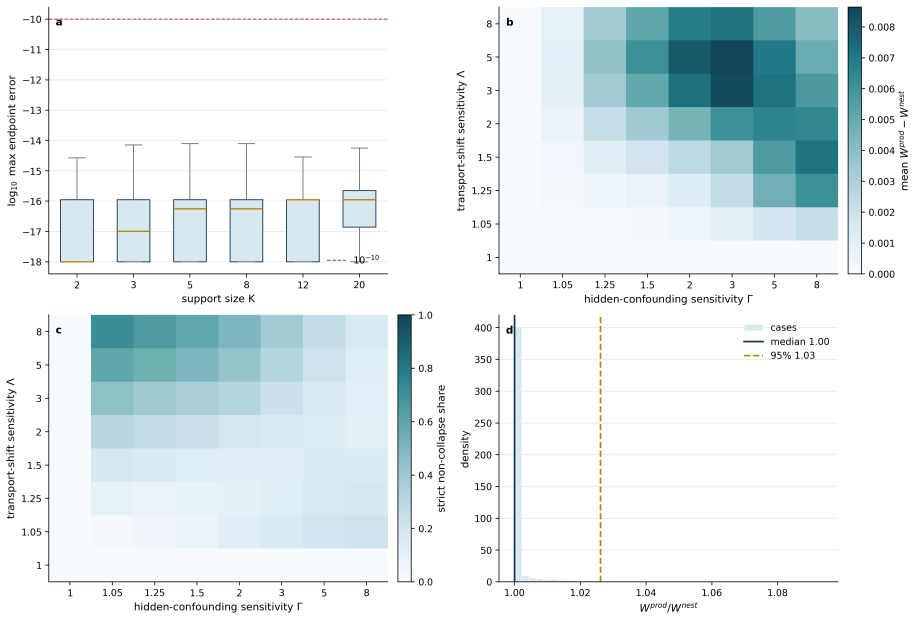
Under an odds-ratio bound Γ on source treatment assignment and a conditional likelihood-ratio bound Λ on source-to-target potential-outcome shift, a closed-form sharp target counterfactual CDF envelope is obtained by nesting a source marginal-sensitivity map inside a target outcome-shift map; the envelope preserves two normalizations, improves on a single product likelihood-ratio relaxation, is attainable as an entire CDF, and inverts to sharp target quantile bounds and sharp interval-hull QTE bounds.
What carries the argument
The nested sensitivity envelope for the target counterfactual CDF, which places a source marginal-sensitivity map inside a target outcome-shift map while preserving the two normalizations required by the marginal restrictions.
If this is right
- Inverting the CDF envelopes produces sharp bounds on target quantiles for each treatment arm.
- The same inversion yields sharp interval-hull bounds on the quantile treatment effect process.
- The canonical gradient includes the source propensity score contribution required for observational data.
- Cross-fitted Neyman-orthogonal one-step estimators achieve uniform Gaussian approximation on regular index sets.
- Simultaneous monotone CDF bands invert to honest confidence sets for the quantile and QTE processes; the breakdown frontier in the (Γ, Λ) plane is obtained via level-set inference.
Where Pith is reading between the lines
- The nesting construction may extend to other transported functionals such as means or survival probabilities by replacing the quantile inversion step with the appropriate functional.
- The two-dimensional breakdown frontier offers a way to report how much confounding and shift would be needed to overturn a qualitative finding, which could be plotted directly from the level sets of the interval-hull process.
- When the target sample is large relative to the source, the procedure effectively reduces to standard marginal sensitivity analysis on the source with only a reweighting adjustment for the target covariate distribution.
Load-bearing premise
The two marginal sensitivity restrictions hold exactly: an odds-ratio bound on source treatment assignment and a conditional likelihood-ratio bound on the source-to-target shift in potential-outcome distributions.
What would settle it
A concrete data-generating process in which the true target counterfactual CDF lies strictly outside the derived envelope for some treatment arm and threshold while still satisfying the stated odds-ratio and likelihood-ratio bounds.
Figures
read the original abstract
We study target-population quantile treatment effects when a source study may have unmeasured treatment confounding and may not transport to a target population after conditioning on observed covariates. The observed data consist of a source sample with treatment, outcome and covariates, and a target sample with covariates only. We impose two marginal sensitivity restrictions: an odds-ratio bound \(\Gam\) for source treatment assignment and a conditional likelihood-ratio bound \(\Lam\) for source-to-target potential-outcome distribution shift. For each treatment arm and threshold \(y\), we derive a closed-form sharp target counterfactual CDF envelope. The envelope nests a source marginal-sensitivity map inside a target outcome-shift map, preserving two normalizations and generally improving on a single product likelihood-ratio relaxation. We prove process-level sharpness, so the envelopes are attainable as entire CDFs and can be inverted to obtain sharp target quantile bounds and sharp interval-hull QTE bounds. We then develop semiparametric theory for these nonsmooth bound processes. On regular index sets, we give the canonical gradient, including the source propensity contribution required in observational studies, and construct cross-fitted Neyman-orthogonal one-step estimators with uniform Gaussian approximation. On full index sets with active-set ties or mass points, we use Hadamard directional differentiability and subsampling-valid inference, with a primitive finite-support route for the required weak convergence. Finally, we invert simultaneous monotone CDF bands to obtain honest confidence sets for quantile and QTE interval-hull processes, and formulate the two-dimensional \((\Gam,\Lam)\) breakdown frontier as level-set inference for interval-hull non-refutation.
Editorial analysis
A structured set of objections, weighed in public.
Referee Report
Summary. The manuscript develops a nested sensitivity framework for bounding quantile treatment effects transported from a source study (with treatment, outcome, and covariates) to a target population (covariates only). Under an odds-ratio bound Γ on source treatment assignment and a conditional likelihood-ratio bound Λ on source-to-target potential-outcome shifts, it derives closed-form sharp envelopes for the target counterfactual CDFs by nesting the source marginal-sensitivity map inside the target outcome-shift map. The paper proves process-level sharpness (attainability as entire CDF processes), inverts these to sharp quantile and interval-hull QTE bounds, and supplies semiparametric theory: canonical gradients (including propensity scores), cross-fitted Neyman-orthogonal estimators with uniform Gaussian approximation on regular index sets, and Hadamard directional differentiability plus subsampling inference on full index sets with ties or mass points. It concludes with honest simultaneous confidence sets obtained by inverting monotone CDF bands and a two-dimensional (Γ, Λ) breakdown frontier.
Significance. If the closed-form derivations and process-level sharpness hold, the work advances partial identification and sensitivity analysis for transported quantile effects, which are policy-relevant yet technically demanding. The nesting construction yields tighter bounds than a single product likelihood-ratio relaxation while preserving normalizations, and the accompanying semiparametric efficiency results, uniform inference procedures, and breakdown-frontier formulation provide a complete, practical toolkit. These features address a genuine gap between existing mean-focused transport sensitivity methods and the needs of quantile analysis.
major comments (2)
- [§3] §3, main envelope theorem: the claim that the nested map preserves both normalizations (CDF limits at 0 and 1) and is strictly sharper than the product relaxation requires an explicit algebraic verification or counter-example check for discrete outcomes with mass points; the current argument appears to rely on continuity assumptions that may not be stated.
- [§5.3] §5.3, subsampling procedure: when active-set ties occur on the full index set, the primitive finite-support route for weak convergence must specify how the directional derivative is computed at points of non-differentiability to guarantee that the subsampling quantiles remain valid for the interval-hull QTE process.
minor comments (3)
- Notation for the sensitivity parameters alternates between Γ/Λ and script letters; a single consistent font throughout would reduce reader confusion.
- The abstract and introduction cite the improvement over product relaxations but do not reference the closest prior nested or composite sensitivity models (e.g., recent work on marginal sensitivity for transport); adding two or three targeted citations would clarify novelty.
- Figure captions for the envelope plots should explicitly label the source map, target map, and nested envelope curves so that the visual comparison to the product bound is immediate.
Simulated Author's Rebuttal
We thank the referee for the careful reading and constructive comments on our manuscript. We address the two major comments point by point below.
read point-by-point responses
-
Referee: [§3] §3, main envelope theorem: the claim that the nested map preserves both normalizations (CDF limits at 0 and 1) and is strictly sharper than the product relaxation requires an explicit algebraic verification or counter-example check for discrete outcomes with mass points; the current argument appears to rely on continuity assumptions that may not be stated.
Authors: We agree that an explicit algebraic verification for discrete outcomes with mass points would strengthen the presentation. Theorem 3.1 establishes process-level sharpness under general conditions that encompass atoms, but the normalization preservation and strict improvement over the product relaxation are shown via the nested construction without an isolated discrete-case lemma. In the revision we will add a short algebraic verification (new Lemma 3.2) confirming that the nested envelopes attain the CDF limits 0 and 1 at the boundaries for any finite-support distribution and remain strictly sharper than the product relaxation, with a simple two-point counter-example illustrating the improvement. revision: yes
-
Referee: [§5.3] §5.3, subsampling procedure: when active-set ties occur on the full index set, the primitive finite-support route for weak convergence must specify how the directional derivative is computed at points of non-differentiability to guarantee that the subsampling quantiles remain valid for the interval-hull QTE process.
Authors: We appreciate the request for additional detail on the directional derivative. Section 5.3 already invokes Hadamard directional differentiability of the interval-hull map and supplies a primitive finite-support route for weak convergence. To address the concern explicitly, the revision will expand the exposition to state that, at points of non-differentiability induced by active-set ties or mass points, the directional derivative is obtained as the support function of the tangent cone to the active constraint set; we will include a brief illustrative calculation for a two-point mass example to confirm that the resulting subsampling quantiles remain valid for the interval-hull QTE process. revision: yes
Circularity Check
No significant circularity identified
full rationale
The derivation begins from two explicitly imposed user-specified marginal sensitivity bounds (odds-ratio Γ on source treatment assignment and conditional likelihood-ratio Λ on source-to-target shift). From these, the paper constructs closed-form nested envelopes for the target counterfactual CDF, proves process-level sharpness by direct verification that the envelopes are attainable as entire processes, and inverts them to quantile and QTE bounds. Subsequent semiparametric theory supplies canonical gradients and Neyman-orthogonal estimators whose first-order influence functions are independent of nuisance estimation error. No step reduces a claimed result to a fitted parameter, a self-citation chain, or a definitional tautology; all load-bearing objects (envelopes, sharpness, gradients) are derived from the stated assumptions and standard semiparametric arguments without circular reduction.
Axiom & Free-Parameter Ledger
free parameters (2)
- Γ
- Λ
axioms (2)
- domain assumption Observed data consist of a source sample with treatment, outcome and covariates, and a target sample with covariates only.
- domain assumption Standard causal consistency and no-interference assumptions hold for defining potential outcomes.
Lean theorems connected to this paper
-
IndisputableMonolith/Cost/FunctionalEquation.leanwashburn_uniqueness_aczel echoesThe sharp source-population potential-outcome CDF bounds are C_Γ^−(p,e)=max{ℓ_Γ(e)p,1−u_Γ(e)(1−p)} ... The sharp transport-shift CDF maps are T_Λ^−(q)=max{Λ^{−1}q,1−Λ(1−q)} ... b_a,s^−(y,x)=T_Λ^−{C_Γ^−(p_a(y,x),e_a(x))}
-
IndisputableMonolith/Foundation/AbsoluteFloorClosure.leanabsolute_floor_iff_bare_distinguishability echoesWe prove that the sharp target conditional CDF envelope is ... process-level sharpness, so the envelopes are attainable as entire CDFs
Reference graph
Works this paper leans on
-
[1]
Asiaee, A., Pal, S., Beck, C. and Huling, J. D. (2026). Sharp bounds for treatment effect generalization under outcome distribution shift.Proceedings of the 5th Conference on Causal Learning and Reasoning (CLeaR), PMLR
work page 2026
- [2]
-
[3]
Bareinboim, E. and Pearl, J. (2016). Causal inference and the data-fusion problem.Pro- ceedings of the National Academy of Sciences113, 7345–7352
work page 2016
-
[4]
Bitler, M. P., Gelbach, J. B. and Hoynes, H. W. (2006). What mean impacts miss: Distri- butional effects of welfare reform experiments.American Economic Review96, 988–1012
work page 2006
-
[5]
Goodfellow, I., Bengio, Y. and Courville, A. (2016).Deep Learning. MIT Press
work page 2016
-
[6]
Bonvini, M. and Kennedy, E. H. (2022). Sensitivity analysis via the proportion of unmeasured confounding.Journal of the American Statistical Association117, 1540–1550
work page 2022
-
[7]
Adimora, A. A., Eron, J. J. and Mugavero, M. J. (2018). Generalizing evidence from randomized trials using inverse probability of sampling weights.Journal of the Royal Statistical Society: Series A181, 1193–1209
work page 2018
-
[8]
Chernozhukov, V., Fern´ andez-Val, I. and Melly, B. (2013). Inference on counterfactual distributions.Econometrica81, 2205–2268
work page 2013
-
[9]
Chernozhukov, V., Fern´ andez-Val, I. and Luo, Y. (2018). The sorted effects method: Dis- covering heterogeneous effects beyond their averages.Econometrica86, 1911–1938
work page 2018
-
[10]
Robins, J. (2018). Double/debiased machine learning for treatment and structural param- eters.The Econometrics Journal21, C1–C68
work page 2018
-
[11]
Cole, S. R. and Stuart, E. A. (2010). Generalizing evidence from randomized clinical trials to target populations: The ACTG 320 trial.American Journal of Epidemiology172, 107–115
work page 2010
-
[12]
Dahabreh, I. J., Robertson, S. E., Tchetgen Tchetgen, E. J., Stuart, E. A. and Hern´ an, M. A. (2019). Generalizing causal inferences from individuals in randomized trials to all trial-eligible individuals.Biometrics75, 685–694
work page 2019
-
[13]
Degtiar, I. and Rose, S. (2023). A review of generalizability and transportability.Annual Review of Statistics and Its Application10, 501–524
work page 2023
-
[14]
Dahabreh, I. J., Robins, J. M., Haneuse, S. J.-P. A., Saeed, I., Robertson, S. E., Stuart, E. A. and Hern´ an, M. A. (2023). Sensitivity analysis using bias functions for studies extending inferences from a randomized trial to a target population.Statistics in Medicine42, 2029–2043. 47
work page 2023
-
[15]
Franks, A. M., D’Amour, A. and Feller, A. (2020). Flexible sensitivity analysis for ob- servational studies without observable implications.Journal of the American Statistical Association115, 1730–1746
work page 2020
-
[16]
Frauen, D., Melnychuk, V. and Feuerriegel, S. (2023). Sharp bounds for generalized causal sensitivity analysis.Advances in Neural Information Processing Systems36, 40556–40586
work page 2023
-
[17]
Huang, M. Y. (2024). Sensitivity analysis for the generalization of experimental results. Journal of the Royal Statistical Society Series A: Statistics in Society187, 900–918
work page 2024
-
[18]
Dorn, J. and Guo, K. (2023). Sharp sensitivity analysis for inverse propensity weighting via quantile balancing.Journal of the American Statistical Association118, 2645–2657
work page 2023
-
[19]
Dorn, J. and Yap, L. (2024). Sensitivity analysis for linear estimators. arXiv:2309.06305
-
[20]
Dorn, J., Guo, K. and Kallus, N. (2025). Doubly-valid/doubly-sharp sensitivity analysis for causal inference with unmeasured confounding.Journal of the American Statistical Association120, 331–342
work page 2025
-
[21]
Fang, Z. and Santos, A. (2019). Inference on directionally differentiable functions.Review of Economic Studies86, 377–412
work page 2019
-
[22]
Firpo, S. (2007). Efficient semiparametric estimation of quantile treatment effects.Econo- metrica75, 259–276
work page 2007
-
[23]
Lanners, Q., Rudin, C., Volfovsky, A. and Parikh, H. (2025). Data fusion for partial identi- fication of causal effects. arXiv:2505.24296
-
[24]
Manski, C. F. (2003).Partial Identification of Probability Distributions. Springer
work page 2003
-
[25]
Masten, M. A. and Poirier, A. (2018). Identification of treatment effects under conditional partial independence.Econometrica86, 317–351
work page 2018
-
[26]
Masten, M. A. and Poirier, A. (2020). Inference on breakdown frontiers.Quantitative Economics11, 41–111
work page 2020
-
[27]
Masten, M. A., Poirier, A. and Ren, M. (2025). A general approach to relaxing unconfound- edness. arXiv:2501.15400
-
[28]
Q., Ackerman, B., Schmid, I., Cole, S
Nguyen, T. Q., Ackerman, B., Schmid, I., Cole, S. R. and Stuart, E. A. (2018). Sensitiv- ity analyses for effect modifiers not observed in the target population when generalizing treatment effects from a randomized controlled trial.PLOS ONE13, e0208795
work page 2018
-
[29]
Nie, X., Imbens, G. and Wager, S. (2021). Covariate balancing sensitivity analysis for extrapolating randomized trials across locations. arXiv:2112.04723
-
[30]
Pearl, J. and Bareinboim, E. (2011). Transportability of causal and statistical relations: A formal approach.Proceedings of the Twenty-Fifth AAAI Conference on Artificial Intelli- gence, 247–254. 48
work page 2011
-
[31]
Politis, D. N., Romano, J. P. and Wolf, M. (1999).Subsampling. Springer
work page 1999
-
[32]
Rothe, C. (2010). Nonparametric estimation of distributional policy effects.Journal of Econometrics155, 56–70
work page 2010
-
[33]
Stuart, E. A., Cole, S. R., Bradshaw, C. P. and Leaf, P. J. (2011). The use of propensity scores to assess the generalizability of results from randomized trials.Journal of the Royal Statistical Society: Series A174, 369–386
work page 2011
-
[34]
Tan, Z. (2006). A distributional approach for causal inference using propensity scores.Jour- nal of the American Statistical Association101, 1619–1637
work page 2006
-
[35]
Tsiatis, A. A. (2006).Semiparametric Theory and Missing Data. Springer. van der Vaart, A. W. (2000).Asymptotic Statistics. Cambridge University Press. van der Vaart, A. W. and Wellner, J. A. (1996).Weak Convergence and Empirical Processes: With Applications to Statistics. Springer
work page 2006
-
[36]
Wang, P. (2026). Efficient transported distributional and quantile treatment effects with surrogate-assisted missing primary outcomes. arXiv:2605.02154
work page internal anchor Pith review Pith/arXiv arXiv 2026
-
[37]
Zeng, Z., Kennedy, E. H., Bodnar, L. M. and Naimi, A. I. (2023). Efficient generalization and transportation. arXiv:2302.00092
-
[38]
Zhao, Q., Small, D. S. and Bhattacharya, B. B. (2019). Sensitivity analysis for inverse prob- ability weighting estimators via the percentile bootstrap.Journal of the Royal Statistical Society: Series B81, 735–761. Centers for Disease Control and Prevention, National Center for Health Statistics (2024). NHANES I Epidemiologic Follow-up Study. Public-use d...
work page 2019
-
[39]
Huntington-Klein, N. and Barrett, M. (2024).causaldata: Example Data Sets for Causal Inference Textbooks. R package version 0.1.4,https://github.com/NickCH-K/ causaldata. 49
work page 2024
discussion (0)
Sign in with ORCID, Apple, or X to comment. Anyone can read and Pith papers without signing in.