Recognition: 3 theorem links
· Lean TheoremConstraints on Ultralight Scalar and Dark Photon Dark Matter from PPTA-DR3 and EPTA-DR2
Pith reviewed 2026-05-08 19:25 UTC · model grok-4.3
The pith
PTA data from PPTA-DR3 and EPTA-DR2 show no evidence for ultralight scalar or dark photon dark matter, yielding new 95% upper limits on their parameters.
A machine-rendered reading of the paper's core claim, the machinery that carries it, and where it could break.
Core claim
Bayesian analysis of the PPTA-DR3 and EPTA-DR2 timing residuals finds no significant evidence for the oscillatory gravitational potential of scalar ULDM or the fifth-force signal of dark photon dark matter. This absence of detection produces 95% confidence upper limits on the scalar ULDM mass-coupling plane and on DPDM parameters. The scalar ULDM window in which the particles comprise the entire dark matter density remains consistent with the data.
What carries the argument
Bayesian search for ULDM-induced signals in PTA timing residuals, with pulsar distances used to model local density for the oscillatory potential and fifth-force effects.
If this is right
- The PPTA-DR3 limits improve substantially over the earlier PPTA-DR2 results for most ULDM masses.
- The derived bounds remain consistent with uncorrelated upper limits reported by other PTAs.
- EPTA-DR2 supplies the first DPDM constraints from that data set, comparable in strength to existing bounds.
- Scalar ULDM is still allowed to constitute all dark matter within the new limits.
Where Pith is reading between the lines
- Continued accumulation of PTA data at higher precision could either reveal a ULDM signal or push the remaining allowed parameter space to smaller values.
- The same timing-residual framework could be applied to future PTA upgrades or to data from other gravitational-wave detectors for independent cross-checks.
- These constraints test one proposed solution to small-scale structure problems in galaxy formation without requiring new particle-physics experiments.
Load-bearing premise
The expected timing-residual signatures from scalar ULDM and DPDM are modeled accurately, including the incorporation of pulsar distances to set the local dark matter density.
What would settle it
A statistically significant, correlated signal appearing in multiple pulsar timing residuals at a frequency set by the ULDM mass and with an amplitude matching the predicted coupling strength would support the presence of ultralight dark matter.
Figures




read the original abstract
The cold dark matter model successfully describes the Universe on large scales, yet faces challenges at sub-galactic scales. Ultralight dark matter (ULDM), with particle masses around $10^{-22} \mathrm{eV}$, offers a promising solution to these small-scale issues. Pulsar Timing Arrays (PTAs), designed to detect nanohertz gravitational waves, can also provide a sensitive probe for ULDM signals. In this work, we perform a Bayesian search for ULDM using PTA data sets, focusing on two types of signals: the oscillatory gravitational potential from scalar ULDM and the fifth-force interaction mediated by dark photon dark matter (DPDM). We incorporate pulsar distances in the analysis to better model the ULDM density. No statistically significant evidence for ULDM has been found, therefore we place 95% confidence-level upper limits on the relevant parameters. For scalar ULDM, our analysis does not exclude the scenario in which ULDM constitutes all of dark matter. The constraints from PPTA-DR3 show significant improvements over the earlier PPTA-DR2 (2018 Preview) across most of the mass range, and are consistent with the recent uncorrelated limits from other PTAs. We also present for the first time the DPDM constraints using EPTA data. The obtained bounds on the DPDM from the EPTA-DR2 and PPTA-DR3 are comparable to existing constraints.
Editorial analysis
A structured set of objections, weighed in public.
Referee Report
Summary. The manuscript reports a Bayesian search for ultralight scalar dark matter (via oscillatory gravitational potential) and dark photon dark matter (via fifth-force) signals in PPTA-DR3 and EPTA-DR2 pulsar timing data. Pulsar distances are incorporated to model local ULDM density variations. No statistically significant evidence for ULDM is found, yielding 95% CL upper limits on the relevant parameters; scalar ULDM is not excluded as comprising all dark matter. The PPTA-DR3 limits improve on prior PPTA-DR2 results and are consistent with other PTAs, while EPTA-DR2 provides the first DPDM constraints from that array.
Significance. If the signal modeling and distance incorporation hold, the work delivers improved PTA-based constraints on ULDM across a wide mass range and novel DPDM bounds, helping test whether ultralight scalars can constitute all dark matter while addressing small-scale CDM issues. The use of two independent PTA datasets and explicit distance modeling strengthens the result relative to earlier analyses.
major comments (2)
- [§3.2] §3.2 (Signal Modeling and Pulsar Distances): The central claim that scalar ULDM remains allowed as 100% of DM rests on the predicted timing-residual amplitude being correctly computed from local density ρ evaluated at Earth and each pulsar using measured distances. The manuscript states distances are incorporated but provides no explicit propagation of distance uncertainties (typically 10-30% for many pulsars) into the likelihood or limits; since amplitude ∝ √ρ and ρ ∝ 1/d_p, unquantified errors could rescale the signal template and shift the 95% bounds.
- [§4.1] §4.1, Figure 5 (Scalar ULDM Limits): The reported non-exclusion of the all-DM scenario for m_φ ~ 10^{-22} eV is presented without a sensitivity test varying pulsar distances within their error bars. This is load-bearing because the coherence length and local density contrast directly affect the cross-pulsar correlation and amplitude; without it, the headline statement that 'our analysis does not exclude' full DM is not fully secured.
minor comments (2)
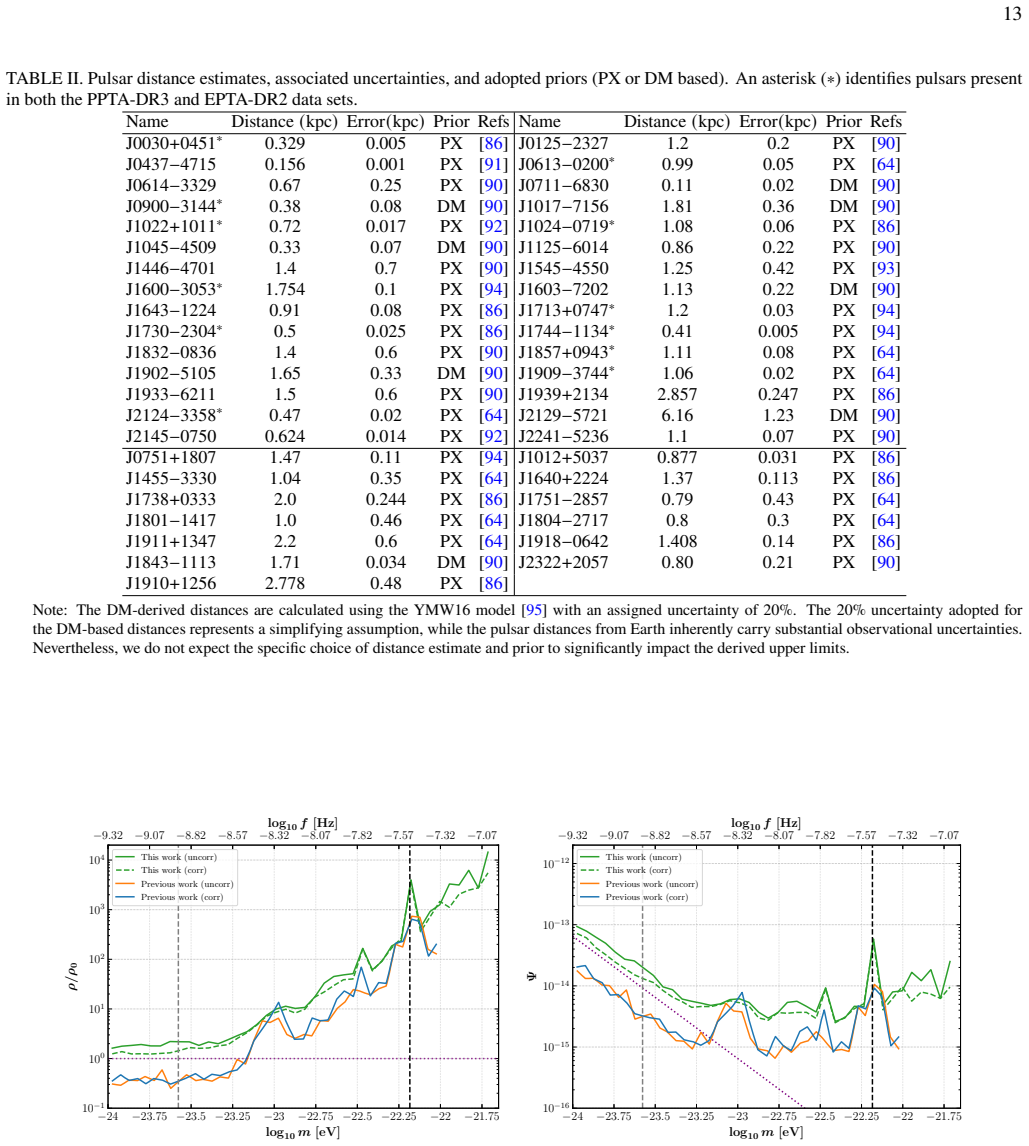
- [Table 1] Table 1: The pulsar list omits the reference for each distance measurement; adding a column or footnote would improve reproducibility.
- [§2.3] §2.3: The notation for the fifth-force coupling strength in the DPDM model is introduced without an explicit equation linking it to the timing residual; a short derivation or reference to the standard expression would aid clarity.
Simulated Author's Rebuttal
We thank the referee for their careful and constructive review of our manuscript. We address each major comment point by point below and will incorporate the recommended improvements in the revised version to strengthen the robustness of our results.
read point-by-point responses
-
Referee: [§3.2] §3.2 (Signal Modeling and Pulsar Distances): The central claim that scalar ULDM remains allowed as 100% of DM rests on the predicted timing-residual amplitude being correctly computed from local density ρ evaluated at Earth and each pulsar using measured distances. The manuscript states distances are incorporated but provides no explicit propagation of distance uncertainties (typically 10-30% for many pulsars) into the likelihood or limits; since amplitude ∝ √ρ and ρ ∝ 1/d_p, unquantified errors could rescale the signal template and shift the 95% bounds.
Authors: We agree that explicit propagation of pulsar distance uncertainties is important for fully securing the amplitude calculations and the associated limits. In the current analysis (Section 3.2), we use the best-measured pulsar distances to evaluate the local ULDM density at Earth and each pulsar location, thereby incorporating distance-dependent density variations into the signal model. However, we did not marginalize over the reported distance uncertainties (typically 10-30%) within the likelihood. Since the timing residual amplitude scales as √ρ and ρ scales inversely with distance, this omission could in principle rescale the templates. To address this, we will perform a sensitivity analysis by sampling pulsar distances within their error bars, recompute the limits, and add a discussion of the impact on the 95% CL bounds. This will be included in the revised manuscript. revision: yes
-
Referee: [§4.1] §4.1, Figure 5 (Scalar ULDM Limits): The reported non-exclusion of the all-DM scenario for m_φ ~ 10^{-22} eV is presented without a sensitivity test varying pulsar distances within their error bars. This is load-bearing because the coherence length and local density contrast directly affect the cross-pulsar correlation and amplitude; without it, the headline statement that 'our analysis does not exclude' full DM is not fully secured.
Authors: We thank the referee for this observation. The non-exclusion of the all-DM scenario at m_φ ≈ 10^{-22} eV relies on the nominal distances used to model local densities and the resulting cross-pulsar correlations (governed by the coherence length). While the manuscript uses measured distances to capture density variations, we did not conduct an explicit sensitivity test varying distances within uncertainties. We will add such a test in the revised version—varying distances within error bars, recomputing the posterior for the all-DM case, and updating or supplementing Figure 5 to demonstrate robustness against changes in amplitude and correlations. This will secure the headline statement. revision: yes
Circularity Check
No circularity: standard Bayesian upper limits from direct data comparison
full rationale
The paper reports a Bayesian search for ULDM signals (oscillatory potential for scalars, fifth-force for DPDM) in PTA timing residuals, incorporating measured pulsar distances to model local density. No significant detection is claimed, yielding 95% CL upper limits. This is a direct likelihood comparison of observed residuals to theoretical templates; no equations reduce a prediction to a fitted parameter by construction, no self-citation chain justifies the central result, and no ansatz or uniqueness theorem is smuggled in. The derivation remains self-contained against external PTA data.
Axiom & Free-Parameter Ledger
axioms (2)
- standard math Bayesian inference can be used to set upper limits on signal amplitudes in the presence of noise
- domain assumption Ultralight scalar and dark photon dark matter produce specific, predictable effects on pulsar timing residuals
Reference graph
Works this paper leans on
-
[1]
With particle masses 𝑚≲10 −22 eV, the coherence time𝜏 𝑐 ≳10 6 yr, far exceeding typical observational baselines. ULDM exhibits coherent os- cillations on spatial scales smaller than the coherence length 𝑙𝑐, the coherence length𝑙 𝑐 is, 𝑙𝑐 = 2𝜋 𝑚𝑣 0 ≈0.4 kpc 𝑚 10−22 eV −1 (2) In this work, we consider two simplified regimes based on the relative scale of th...
-
[2]
Planck 2018 results. VI. Cosmological parameters
Planck Collaborationet al., “Planck 2018 results. VI. Cos- mological parameters,” Astron. Astrophys.641, A6 (2020), arXiv:1807.06209
work page Pith review arXiv 2018
-
[3]
The Cosmic Triangle: Revealing the State of the Universe,
N. A. Bahcall, J. P. Ostriker, S. Perlmutter, and P. J. Steinhardt, “The Cosmic Triangle: Revealing the State of the Universe,” Science284, 1481 (1999), arXiv:astro-ph/9906463
-
[4]
Observational and theoretical constraints on singular dark matter halos,
R. A. Flores and J. R. Primack, “Observational and Theoretical Constraints on Singular Dark Matter Halos,” Astrophys. J. Lett. 427, L1 (1994), arXiv:astro-ph/9402004
-
[5]
Evidence against dissipation-less dark matter from observations of galaxy haloes,
B. Moore, “Evidence against dissipation-less dark matter from observations of galaxy haloes,” Nature370, 629 (1994)
1994
- [6]
-
[7]
Dark Matter Substructure in Galactic Halos
B. Moore, S. Ghigna, F. Governato, G. Lake, T. Quinn, J. Stadel, and P. Tozzi, “Dark Matter Substructure within Galactic Halos,” Astrophys. J. Lett.524, L19 (1999), arXiv:astro-ph/9907411
work page Pith review arXiv 1999
-
[8]
M. Boylan-Kolchin, J. S. Bullock, and M. Kaplinghat, “Too big to fail? The puzzling darkness of massive Milky Way subhaloes,” Mon. Not. Roy. Astron. Soc.415, L40 (2011), arXiv:1103.0007
-
[9]
J. S. Bullock and M. Boylan-Kolchin, “Small-Scale Challenges to theΛCDM Paradigm,” Ann. Rev. Astron. Astrophys.55, 343 (2017), arXiv:1707.04256
-
[10]
T. K. Chan, D. Kere ˇs, J. O ˜norbe, P. F. Hopkins, A. L. Mura- tov, C. A. Faucher-Gigu `ere, and E. Quataert, “The impact of baryonic physics on the structure of dark matter haloes: the view from the FIRE cosmological simulations,” Mon. Not. Roy. Astron. Soc.454, 2981 (2015), arXiv:1507.02282
work page Pith review arXiv 2015
-
[11]
Halo Formation in Warm Dark Matter Models,
P. Bode, J. P. Ostriker, and N. Turok, “Halo Formation in Warm Dark Matter Models,” Astrophys. J.556, 93 (2001), arXiv:astro- ph/0010389
-
[12]
S. Tulin and H.-B. Yu, “Dark matter self-interactions and small scale structure,” Phys. Rept.730, 1 (2018), arXiv:1705.02358
-
[13]
W. Hu, R. Barkana, and A. Gruzinov, “Fuzzy Cold Dark Matter: The Wave Properties of Ultralight Particles,” Phys. Rev. Lett.85, 1158 (2000), arXiv:astro-ph/0003365
work page Pith review arXiv 2000
-
[14]
Cold dark matter: controversies on small scales
D. H. Weinberg, J. S. Bullock, F. Governato, R. Kuzio de Naray, and A. H. G. Peter, “Cold dark matter: Controversies on small scales,” Proc. Nat. Acad. Sci.112, 12249 (2015), arXiv:1306.0913
work page Pith review arXiv 2015
-
[15]
D. J. E. Marsh, “Axion Cosmology,” Phys. Rept.643, 1 (2016), arXiv:1510.07633
work page Pith review arXiv 2016
-
[16]
Ultralight scalars as cosmological dark matter
L. Hui, J. P. Ostriker, S. Tremaine, and E. Witten, “Ultralight scalars as cosmological dark matter,” Phys. Rev. D95, 043541 (2017), arXiv:1610.08297
work page Pith review arXiv 2017
-
[17]
L. Hui, “Wave Dark Matter,” Annu. Rev. Astron. Astrophys.59, 247 (2021), arXiv:2101.11735
-
[18]
E. G. M. Ferreira, “Ultra-light dark matter,” Astron. Astrophys. Rev.29, 7 (2021), arXiv:2005.03254
-
[19]
Cosmic Structure as the Quantum Interference of a Coherent Dark Wave
H.-Y. Schive, T. Chiueh, and T. Broadhurst, “Cosmic structure as the quantum interference of a coherent dark wave,” Nature Physics10, 496 (2014), arXiv:1406.6586
work page Pith review arXiv 2014
-
[20]
Understanding the Core-Halo Relation of Quantum Wave Dark Matter, $\psi$DM, from 3D Simulations
H.-Y. Schive, M.-H. Liao, T.-P. Woo, S.-K. Wong, T. Chiueh, T. Broadhurst, and W. Y. P. Hwang, “Understanding the Core- Halo Relation of Quantum Wave Dark Matter from 3D Simula- tions,” Phys. Rev. Lett.113, 261302 (2014), arXiv:1407.7762
work page Pith review arXiv 2014
-
[21]
Ultralight Axion Dark Matter and Its Impact on Dark Halo Structure in N-body Simulations,
J. Zhang, Y.-L. Sming Tsai, J.-L. Kuo, K. Cheung, and M.-C. Chu, “Ultralight Axion Dark Matter and Its Impact on Dark Halo Structure in N-body Simulations,” Astrophys. J.853, 51 (2018), arXiv:1611.00892
-
[22]
Upper limits on the isotropic gravitational radiation background from pulsar timing analysis
R. W. Hellings and G. S. Downs, “Upper limits on the isotropic gravitational radiation background from pulsar timing analysis.” Astrophys. J. Lett.265, L39 (1983)
1983
-
[23]
Pulsar tim- ing signal from ultralight scalar dark matter,
A. Khmelnitsky and V. Rubakov, “Pulsar timing signal from ultralight scalar dark matter,” J. Cosmol. Astropart. Phys.2014, 019 (2014), arXiv:1309.5888
-
[24]
C. Smarraet al., “Constraints on conformal ultralight dark mat- ter couplings from the European Pulsar Timing Array,” Phys. Rev. D110, 043033 (2024), arXiv:2405.01633
-
[25]
High-precision search for dark photon dark mat- ter with the Parkes Pulsar Timing Array,
X. Xueet al., “High-precision search for dark photon dark mat- ter with the Parkes Pulsar Timing Array,” Phys. Rev. Res.4, L012022 (2022), arXiv:2112.07687
-
[26]
Constraining fundamental constant variations from ultralight dark matter with pulsar timing arrays,
D. E. Kaplan, A. Mitridate, and T. Trickle, “Constraining fundamental constant variations from ultralight dark matter with pulsar timing arrays,” Phys. Rev. D106, 035032 (2022), arXiv:2205.06817. 10
-
[27]
Constraints on ul- tralight scalar dark matter from pulsar timing,
N. K. Porayko and K. A. Postnov, “Constraints on ultralight scalar dark matter from pulsar timing,” Phys. Rev. D90, 062008 (2014), arXiv:1408.4670
-
[28]
Parkes Pulsar Timing Array constraints on ultralight scalar-field dark mat- ter,
N. K. Poraykoet al., “Parkes Pulsar Timing Array constraints on ultralight scalar-field dark matter,” Phys. Rev. D98, 102002 (2018), arXiv:1810.03227
-
[29]
Search for ultralight scalar dark matter with NANOGrav pulsar timing arrays,
R. Kato and J. Soda, “Search for ultralight scalar dark matter with NANOGrav pulsar timing arrays,” J. Cosmol. Astropart. Phys.2020, 036 (2020), arXiv:1904.09143
-
[30]
Pulsar timing residual induced by ultralight vector dark matter,
K. Nomura, A. Ito, and J. Soda, “Pulsar timing residual induced by ultralight vector dark matter,” Eur. Phys. J. C.80, 419 (2020), arXiv:1912.10210
-
[31]
Constraining ultralight vector dark matter with the Parkes Pulsar Timing Array second data release,
Y.-M. Wuet al., “Constraining ultralight vector dark matter with the Parkes Pulsar Timing Array second data release,” Phys. Rev. D106, L081101 (2022), arXiv:2210.03880
-
[32]
C. Smarraet al., “Second Data Release from the Euro- pean Pulsar Timing Array: Challenging the Ultralight Dark Matter Paradigm,” Phys. Rev. Lett.131, 171001 (2023), arXiv:2306.16228
-
[33]
Afzalet al.(NANOGrav), Astrophys
A. Afzalet al., “The NANOGrav 15 yr Data Set: Search for Signals from New Physics,” Astrophys. J. Lett.951, L11 (2023), arXiv:2306.16219
-
[34]
Constraining ultralight dark matter using the Fermi-LAT pulsar timing array,
Z.-Q. Xia, T.-P. Tang, X. Huang, Q. Yuan, and Y.-Z. Fan, “Constraining ultralight dark matter using the Fermi-LAT pulsar timing array,” Phys. Rev. D107, L121302 (2023), arXiv:2303.17545
-
[35]
Stochastic Wave Dark Matter with Fermi-LAT𝛾- Ray Pulsar Timing Array,
H. N. Luu, T. Liu, J. Ren, T. Broadhurst, R. Yang, J.-S. Wang, and Z. Xie, “Stochastic Wave Dark Matter with Fermi-LAT𝛾- Ray Pulsar Timing Array,” Astrophys. J. Lett.963, L46 (2024), arXiv:2304.04735
-
[36]
Revealing the Dark Matter Halo with Axion Direct Detection,
J. W. Foster, N. L. Rodd, and B. R. Safdi, “Revealing the dark matter halo with axion direct detection,” Phys. Rev. D97, 123006 (2018), arXiv:1711.10489
-
[37]
J. W. Foster, Y. Kahn, R. Nguyen, N. L. Rodd, and B. R. Safdi, “Dark matter interferometry,” Phys. Rev. D103, 076018 (2021), arXiv:2009.14201
-
[38]
Stochastic fluctuations of bosonic dark matter,
G. P. Centerset al., “Stochastic fluctuations of bosonic dark matter,” Nature Commun.12, 7321 (2021), arXiv:1905.13650
-
[39]
Gravitational interaction of ultralight dark matter with interferometers,
H. Kim, “Gravitational interaction of ultralight dark matter with interferometers,” J. Cosmol. Astropart. Phys.2023, 018 (2023), arXiv:2306.13348
- [40]
-
[41]
The Structure of Cold Dark Matter Halos
J. F. Navarro, C. S. Frenk, and S. D. M. White, “The Structure of Cold Dark Matter Halos,” Astrophys. J.462, 563 (1996), arXiv:astro-ph/9508025
work page Pith review arXiv 1996
-
[42]
P.-Y. Liao, G.-M. Su, H.-Y. Schive, A. Kunkel, H. Huang, and T. Chiueh, “Deciphering the Soliton-Halo Relation in Fuzzy Dark Matter,” Phys. Rev. Lett.135, 061002 (2025), arXiv:2412.09908
-
[43]
H.-Y. Schive, “Fuzzy dark matter simulations,” (2025), arXiv:2509.23231
work page internal anchor Pith review Pith/arXiv arXiv 2025
-
[44]
T. Liu, X. Lou, and J. Ren, “Pulsar Polarization Arrays,” Phys. Rev. Lett.130, 121401 (2023), arXiv:2111.10615
-
[45]
The Dark Matter halo of the Milky Way, AD 2013,
F. Nesti and P. Salucci, “The Dark Matter halo of the Milky Way, AD 2013,” J. Cosmol. Astropart. Phys.2013, 016 (2013), arXiv:1304.5127
-
[46]
On the Local Dark Matter Density,
J. Bovy and S. Tremaine, “On the Local Dark Matter Density,” Astrophys. J.756, 89 (2012), arXiv:1205.4033
-
[47]
J. I. Read, “The Local Dark Matter Density,” J. Phys. G41, 063101 (2014), arXiv:1404.1938
work page Pith review arXiv 2014
-
[48]
The localdark matter density from SDSS-SEGUE G-dwarfs,
S. Sivertsson, H. Silverwood, J. I. Read, G. Bertone, and P. Steger, “The local dark matter density from SDSS-SEGUE G-dwarfs,” Mon. Not. Roy. Astron. Soc.478, 1677 (2018), arXiv:1708.07836
-
[49]
Dark matter local density determination based on recent observations,
P. F. de Salas, “Dark matter local density determination based on recent observations,” J. Phys. Conf. Ser.1468, 012020 (2020), arXiv:1910.14366
-
[50]
A. Zicet al., “The Parkes Pulsar Timing Array third data release,” Publ. Astron. Soc. Australia.40, e049 (2023), arXiv:2306.16230
-
[51]
Z. Arzoumanianet al., “The NANOGrav 12.5 yr Data Set: Bayesian Limits on Gravitational Waves from Individual Su- permassive Black Hole Binaries,” Astrophys. J. Lett.951, L28 (2023), arXiv:2301.03608
-
[52]
G. Agazieet al., “The NANOGrav 15 yr Data Set: Bayesian Limits on Gravitational Waves from Individual Supermassive Black Hole Binaries,” Astrophys. J. Lett.951, L50 (2023), arXiv:2306.16222
-
[53]
Searching for continuous gravitational waves in the parkes pulsar timing array data release 3,
S.-Y. Zhaoet al., “Searching for continuous gravitational waves in the parkes pulsar timing array data release 3,” Astrophys. J. 992, 181 (2025), arXiv:2508.13944
-
[54]
Hellings-Downs curve deformed by ultralight vector dark matter,
H. Omiya, K. Nomura, and J. Soda, “Hellings-Downs curve deformed by ultralight vector dark matter,” Phys. Rev. D108, 104006 (2023), arXiv:2307.12624
-
[55]
Oscillating Spin-2 Dark Matter,
L. Marzola, M. Raidal, and F. R. Urban, “Oscillating spin-2 dark matter,” Phys. Rev. D97, 024010 (2018), arXiv:1708.04253
-
[56]
Angular correlation and deformed Hellings-Downs curve from spin-2 ultralight dark matter,
R.-G. Cai, J.-R. Zhang, and Y.-L. Zhang, “Angular correlation and deformed Hellings-Downs curve from spin-2 ultralight dark matter,” Phys. Rev. D110, 044052 (2024), arXiv:2402.03984
-
[57]
Continuous global symmetries and hyperweak interactions in string compactifications,
C. P. Burgess, J. P. Conlon, L. Y. Hung, C. H. Kom, A. Maharana, and F. Quevedo, “Continuous global symmetries and hyperweak interactions in string compactifications,” Journal of High Energy Physics2008, 073 (2008), arXiv:0805.4037
-
[58]
M. Goodsell, J. Jaeckel, J. Redondo, and A. Ringwald, “Natu- rally light hidden photons in LARGE volume string compact- ifications,” Journal of High Energy Physics2009, 027 (2009), arXiv:0909.0515
-
[59]
Testing string vacua in the lab: from a hidden CMB to dark forces in flux compactifications,
M. Cicoli, M. Goodsell, J. Jaeckel, and A. Ringwald, “Testing string vacua in the lab: from a hidden CMB to dark forces in flux compactifications,” Journal of High Energy Physics2011, 114 (2011), arXiv:1103.3705
- [60]
-
[61]
The Parkes Pulsar Timing Array project: second data release,
M. Kerret al., “The Parkes Pulsar Timing Array project: second data release,” Publ. Astron. Soc. Australia.37, e020 (2020), arXiv:2003.09780
-
[62]
An ultra-wide bandwidth (704 to 4 032 MHz) receiver for the Parkes radio telescope,
G. Hobbset al., “An ultra-wide bandwidth (704 to 4 032 MHz) receiver for the Parkes radio telescope,” Publ. Astron. Soc. Aus- tralia.37, e012 (2020), arXiv:1911.00656
-
[63]
The Parkes pulsar timing array second data release: timing analysis,
D. J. Reardonet al., “The Parkes pulsar timing array second data release: timing analysis,” Mon. Not. Roy. Astron. Soc.507, 2137 (2021), arXiv:2107.04609
-
[64]
Assessing the Role of Spin Noise in the Precision Timing of Millisecond Pulsars,
R. M. Shannon and J. M. Cordes, “Assessing the Role of Spin Noise in the Precision Timing of Millisecond Pulsars,” Astro- phys. J.725, 1607 (2010), arXiv:1010.4794
-
[65]
Antoniadiset al.(EPTA), Astron
EPTA Collaborationet al., “The second data release from the European Pulsar Timing Array. I. The dataset and timing anal- ysis,” Astron. Astrophys.678, A48 (2023), arXiv:2306.16224
-
[66]
LEAP: the Large European Array for Pulsars,
C. G. Bassaet al., “LEAP: the Large European Array for Pulsars,” Mon. Not. Roy. Astron. Soc.456, 2196 (2016), arXiv:1511.06597
-
[67]
High-precision timing of 42 millisecond pulsars with the European Pulsar Timing Array
G. Desvigneset al., “High-precision timing of 42 millisecond pulsars with the European Pulsar Timing Array,” Mon. Not. Roy. Astron. Soc.458, 3341 (2016), arXiv:1602.08511. 11
work page Pith review arXiv 2016
-
[68]
The JPL Planetary and Lunar Ephemerides DE440 and DE441,
R. S. Park, W. M. Folkner, J. G. Williams, and D. H. Boggs, “The JPL Planetary and Lunar Ephemerides DE440 and DE441,” Astron. J.161, 105 (2021)
2021
-
[69]
D. J. Reardonet al., “The Gravitational-wave Background Null Hypothesis: Characterizing Noise in Millisecond Pulsar Arrival Times with the Parkes Pulsar Timing Array,” Astrophys. J. Lett. 951, L7 (2023), arXiv:2306.16229
-
[70]
Antoniadiset al.(EPTA, InPTA), The second data release from the European Pulsar Timing Array - II
EPTA Collaborationet al., “The second data release from the European Pulsar Timing Array. II. Customised pulsar noise models for spatially correlated gravitational waves,” Astron. As- trophys.678, A49 (2023), arXiv:2306.16225
-
[72]
Antoniadiset al.(EPTA, InPTA:), Astron
EPTA Collaborationet al., “The second data release from the European Pulsar Timing Array. III. Search for gravita- tional wave signals,” Astron. Astrophys.678, A50 (2023), arXiv:2306.16214
-
[73]
Search for an isotropic gravitational-wave background with the Parkes Pulsar Timing Array
D. J. Reardonet al., “Search for an Isotropic Gravitational-wave Background with the Parkes Pulsar Timing Array,” Astrophys. J. Lett.951, L6 (2023), arXiv:2306.16215
work page internal anchor Pith review arXiv 2023
-
[74]
The NANOGrav 15-year Data Set: Evidence for a Gravitational-Wave Background
G. Agazieet al., “The NANOGrav 15 yr Data Set: Evidence for a Gravitational-wave Background,” Astrophys. J. Lett.951, L8 (2023), arXiv:2306.16213
work page internal anchor Pith review arXiv 2023
-
[75]
H. Xuet al., “Searching for the Nano-Hertz Stochastic Gravita- tional Wave Background with the Chinese Pulsar Timing Array Data Release I,” Res. Astron. Astrophys.23, 075024 (2023), arXiv:2306.16216
work page internal anchor Pith review arXiv 2023
-
[76]
M. T. Mileset al., “The MeerKAT Pulsar Timing Array: the first search for gravitational waves with the MeerKAT radio telescope,” Mon. Not. Roy. Astron. Soc.536, 1489 (2025), arXiv:2412.01153
-
[77]
The NANOGrav Nine-year Data Set: Limits on the Isotropic Stochastic Gravitational Wave Back- ground,
Z. Arzoumanianet al., “The NANOGrav Nine-year Data Set: Limits on the Isotropic Stochastic Gravitational Wave Back- ground,” Astrophys. J.821, 13 (2016), arXiv:1508.03024
-
[78]
S. R. Taylor, L. Lentati, S. Babak, P. Brem, J. R. Gair, A. Sesana, and A. Vecchio, “All correlations must die: As- sessing the significance of a stochastic gravitational-wave back- ground in pulsar timing arrays,” Phys. Rev. D95, 042002 (2017), arXiv:1606.09180
-
[79]
The Nanohertz Gravitational Wave Astronomer,
S. R. Taylor, “The Nanohertz Gravitational Wave Astronomer,” arXiv e-prints , arXiv:2105.13270 (2021), arXiv:2105.13270
-
[80]
En- terprise: Enhanced numerical toolbox enabling a robust pulsar inference suite,
J. A. Ellis, M. Vallisneri, S. R. Taylor, and P. T. Baker, “En- terprise: Enhanced numerical toolbox enabling a robust pulsar inference suite,” Zenodo (2020)
2020
-
[81]
Enterprise extensions,
S. R. Taylor, P. T. Baker, J. S. Hazboun, J. Simon, and S. J. Vigeland, “Enterprise extensions,” (2021), v2.4.3
2021
discussion (0)
Sign in with ORCID, Apple, or X to comment. Anyone can read and Pith papers without signing in.