Recognition: 2 theorem links
· Lean TheoremMultiSense-Pneumo: A Multimodal Learning Framework for Pneumonia Screening in Resource-Constrained Settings
Pith reviewed 2026-05-08 19:35 UTC · model grok-4.3
The pith
The paper describes MultiSense-Pneumo, an offline-capable multimodal framework that fuses symptom triage, audio classification, speech recognition, and radiograph analysis for pneumonia screening in low-resource settings.
A machine-rendered reading of the paper's core claim, the machinery that carries it, and where it could break.
Core claim
MultiSense-Pneumo is a multimodal framework for pneumonia oriented screening and triage support that integrates structured symptom descriptors, cough audio, spoken language, and chest radiographs and can operate fully offline on standard laptop class hardware.
Load-bearing premise
That the normalized risk signals from each modality can be meaningfully aggregated into a unified screening estimate that improves triage decisions in real resource-constrained environments, an assumption stated in the abstract but without supporting performance data or validation studies.
Figures


read the original abstract
Pneumonia remains a leading global cause of morbidity and mortality, particularly in low resource settings where access to imaging, laboratory testing, and specialist care is limited. Clinical assessment relies on heterogeneous evidence, including symptoms, respiratory patterns, and chest imaging, making screening inherently multimodal. However, many existing computational approaches remain unimodal and focus primarily on radiographs. In this work, we present MultiSense-Pneumo, a multimodal framework for pneumonia oriented screening and triage support that integrates structured symptom descriptors, cough audio, spoken language, and chest radiographs. The system combines deterministic symptom triage, LightGBM based acoustic classification, domain adversarial radiograph analysis using ResNet 18, transformer based speech recognition, and an interpretable multimodal fusion operator. Each modality is transformed into a normalized risk signal and aggregated into a unified screening estimate, enabling transparent and modular decision support. MultiSense-Pneumo is designed for real world deployment under modest computational constraints and can operate fully offline on standard laptop class hardware, making it suitable for community health workers, rural clinics, and emergency response settings. Experimental results demonstrate robustness of the radiograph pathway under domain shifts, while highlighting limitations in minority class recall for acoustic signals. MultiSense-Pneumo is intended as a research prototype for screening and triage support rather than a clinically validated diagnostic system.
Editorial analysis
A structured set of objections, weighed in public.
Axiom & Free-Parameter Ledger
Lean theorems connected to this paper
-
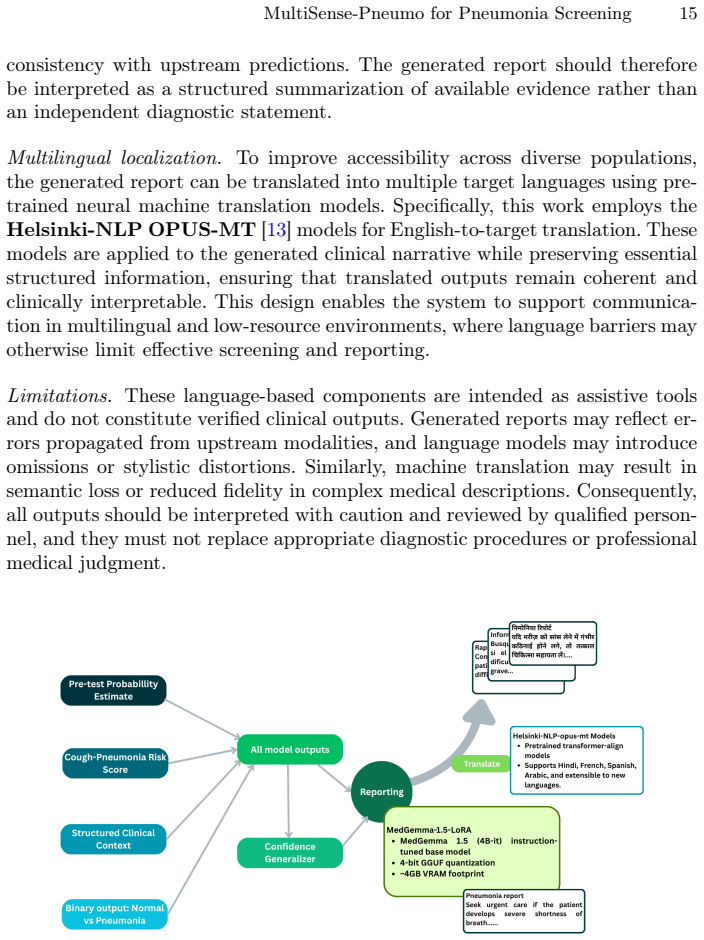
IndisputableMonolith.Cost (Jcost = ½(x+x⁻¹)−1)washburn_uniqueness_aczel unclearS = Σ w_m ŝ_m with w_img=0.40, w_sym=0.20, w_cgh=0.20, w_sp=0.20; HIGH if S≥0.75, MODERATE if 0.50≤S<0.75, LOW if S<0.50
Reference graph
Works this paper leans on
-
[1]
JMIR research protocols7(10), e10191 (2018)
Baker, K., Akasiima, M., Wharton-Smith, A., Habte, T., Matata, L., Nanyumba, D., Okwir, M., Sebsibe, A., Marasciulo, M., Petzold, M., et al.: Performance, ac- ceptability, and usability of respiratory rate timers and pulse oximeters when used by frontline health workers to detect symptoms of pneumonia in sub-saharan africa and southeast asia: protocol for...
2018
-
[2]
Scientific data10(1), 397 (2023)
Bhattacharya, D., Sharma, N.K., Dutta, D., Chetupalli, S.R., Mote, P., Ganap- athy, S., Chandrakiran, C., Nori, S., Suhail, K., Gonuguntla, S., et al.: Coswara: A respiratory sounds and symptoms dataset for remote screening of sars-cov-2 infection. Scientific data10(1), 397 (2023)
2023
-
[3]
Cillóniz, C.: World pneumonia day 2025: The global burden of a persistent and preventable threat.https://communities.springernature.com/posts/ the-global-burden-of-pneumonia-a-persistent-and-preventable-threat (2025), research Communities by Springer Nature, Accessed: 2026-03-29
2025
-
[4]
European Respiratory Journal57(6) (2021)
Cilloniz, C., Simonds, A., Hansen, K., Alouch, J., Zar, H., Nakanishi, Y., Levine, S., Cohen, M., Cruz, C.D., Evans, S.E., et al.: Pulse oximetry is an essential tool that saves lives: a call for standardisation. European Respiratory Journal57(6) (2021)
2021
-
[5]
The Lancet406(10513), 1811–1872 (2025)
GBD 2023 Causes of Death Collaborators: Global burden of 292 causes of death in 204 countries and territories and 660 subnational locations, 1990–2023: a system- atic analysis for the global burden of disease study 2023. The Lancet406(10513), 1811–1872 (2025)
2023
-
[6]
The Lancet Global Health11(12), e1849–e1850 (2023)
Ginsburg, A.S., McCollum, E.D.: Artificial intelligence and pneumonia: a rapidly evolving frontier. The Lancet Global Health11(12), e1849–e1850 (2023)
2023
-
[7]
cell172(5), 1122–1131 (2018)
Kermany, D.S., Goldbaum, M., Cai, W., Valentim, C.C., Liang, H., Baxter, S.L., McKeown, A., Yang, G., Wu, X., Yan, F., et al.: Identifying medical diagnoses and treatable diseases by image-based deep learning. cell172(5), 1122–1131 (2018)
2018
-
[8]
Journal of global health13, 04016 (2023)
Khan, A.M., Sultana, S., Ahmed, S., Shi, T., McCollum, E.D., Baqui, A.H., Cun- ningham, S., Campbell, H., Collaboration, R., et al.: The ability of non-physician health workers to identify chest indrawing to detect pneumonia in children below MultiSense-Pneumo for Pneumonia Screening 19 five years of age in low-and middle-income countries: A systematic re...
2023
-
[9]
In: Encyclopedia of Respiratory Medicine, pp
Lim, W.S.: Pneumonia—overview. In: Encyclopedia of Respiratory Medicine, pp. 185–197. Elsevier (2022).https://doi.org/10.1016/B978-0-12-801238-3. 11636-8
-
[10]
Nafade, V., Sen, P., Arentz, M., et al.: The value of diagnostic imaging for en- hancing primary care in low- and middle-income countries. eClinicalMedicine 77, 102899 (November 2024).https://doi.org/10.1016/j.eclinm.2024.102899, https://doi.org/10.1016/j.eclinm.2024.102899
-
[11]
In: International conference on machine learning
Radford,A.,Kim,J.W.,Xu,T.,Brockman,G.,McLeavey,C.,Sutskever,I.:Robust speech recognition via large-scale weak supervision. In: International conference on machine learning. pp. 28492–28518. PMLR (2023)
2023
-
[12]
Sellergren, A., Kazemzadeh, S., Jaroensri, T., Kiraly, A., Traverse, M., Kohlberger, T., Xu, S., Jamil, F., Hughes, C., Lau, C., et al.: Medgemma technical report. arXiv preprint arXiv:2507.05201 (2025)
work page internal anchor Pith review Pith/arXiv arXiv 2025
-
[13]
In: Proceedings of the 22nd annual conference of the European Association for Machine Translation
Tiedemann, J., Thottingal, S.: Opus-mt–building open translation services for the world. In: Proceedings of the 22nd annual conference of the European Association for Machine Translation. pp. 479–480 (2020)
2020
-
[14]
UNICEF: Pneumonia in children statistics.https://data.unicef.org/topic/ child-health/pneumonia/(2025), accessed: 2026-03-29
2025
-
[15]
World Health Organization: Pneumonia in children.https://www.who.int/ news-room/fact-sheets/detail/pneumonia(2022), accessed: 2026-03-29
2022
-
[16]
World Health Organization: Integrated manage- ment of childhood illness.https://www.who.int/teams/ maternal-newborn-child-adolescent-health-and-ageing/child-health/ integrated-management-of-childhood-illness(nd), accessed: 2026-03-29
2026
-
[17]
World Health Organization: Pneumonia.https://www.who.int/health-topics/ pneumonia(nd), accessed: 2026-03-29
2026
-
[18]
In: 2021 IEEE 18th international sympo- sium on biomedical imaging (ISBI)
Yang, J., Shi, R., Ni, B.: Medmnist classification decathlon: A lightweight automl benchmark for medical image analysis. In: 2021 IEEE 18th international sympo- sium on biomedical imaging (ISBI). pp. 191–195. IEEE (2021)
2021
discussion (0)
Sign in with ORCID, Apple, or X to comment. Anyone can read and Pith papers without signing in.