Recognition: unknown
Toward Fine-Grained Speech Inpainting Forensics:A Dataset, Method, and Metric for Multi-Region Tampering Localization
Pith reviewed 2026-05-08 03:03 UTC · model grok-4.3
The pith
Partial speech inpainting at word granularity evades existing deepfake detectors, but a new iterative method recovers the tampered regions.
A machine-rendered reading of the paper's core claim, the machinery that carries it, and where it could break.
Core claim
Existing deepfake detectors trained on fully synthesized speech assign near zero fake probability to MIST utterances containing only 2-7% manipulated content at the word level. The ISA method, which performs iterative segment analysis via gap-tolerant region proposal and boundary refinement, recovers all tampered regions without prior knowledge of their count and outperforms non-iterative baselines when evaluated with the SF1@tau segment-level F1 metric based on temporal IoU matching.
What carries the argument
ISA (Iterative Segment Analysis) framework that applies coarse-to-fine sliding-window classification with gap-tolerant region proposal and boundary refinement to localize an unknown number of inpainted segments.
Load-bearing premise
The MIST utterances generated via LLM-guided semantic replacement and neural voice cloning represent realistic adversarial partial tampering, and the gap-tolerant proposals in ISA can recover every region without prior knowledge of how many exist.
What would settle it
Running utterance-level classifiers trained on full synthesis on MIST samples and confirming they assign near-zero fake scores, or measuring whether ISA's SF1@tau scores exceed those of non-iterative baselines on the same test set.
Figures


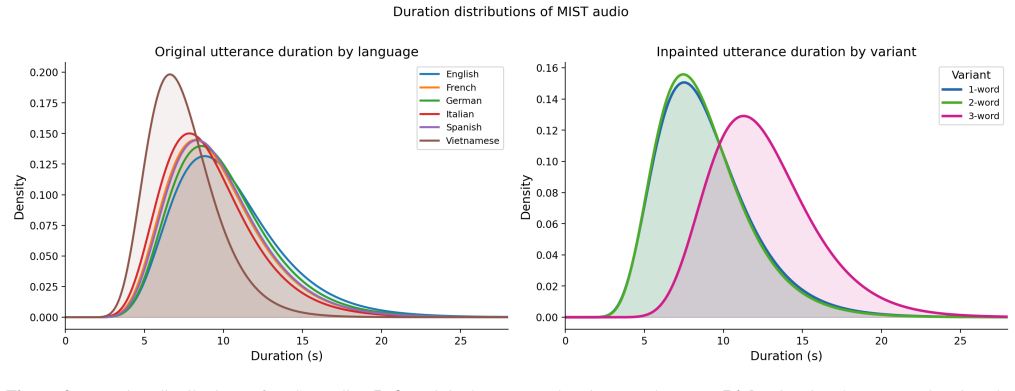


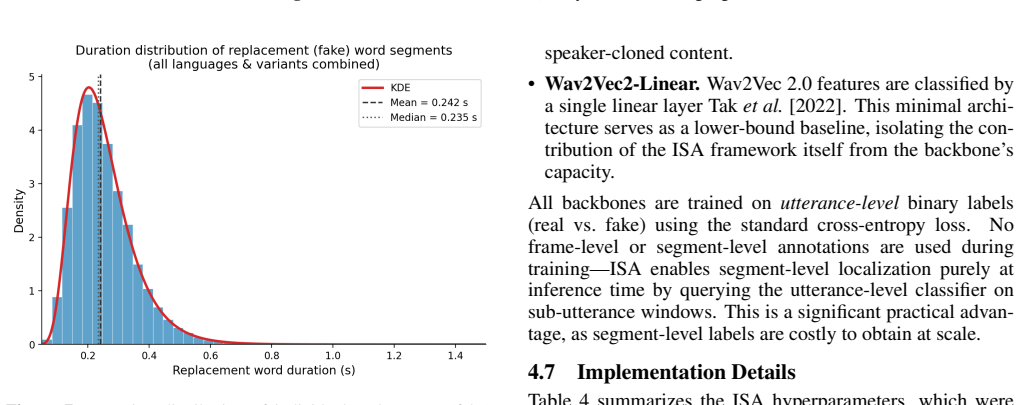


read the original abstract
Recent advances in voice cloning and text-to-speech synthesis have made partial speech manipulation - where an adversary replaces a few words within an utterance to alter its meaning while preserving the speaker's identity - an increasingly realistic threat. Existing audio deepfake detection benchmarks focus on utterance-level binary classification or single-region tampering, leaving a critical gap in detecting and localizing multiple inpainted segments whose count is unknown a priori. We address this gap with three contributions. First, we introduce MIST (Multiregion Inpainting Speech Tampering), a large-scale multilingual dataset spanning 6 languages with 1-3 independently inpainted word-level segments per utterance, generated via LLM-guided semantic replacement and neural voice cloning, with fake content constituting only 2-7% of each utterance. Second, we propose ISA (Iterative Segment Analysis), a backbone-agnostic framework that performs coarse-to-fine sliding-window classification with gap-tolerant region proposal and boundary refinement to recover all tampered regions without prior knowledge of their count. Third, we define SF1@tau, a segment-level F1 metric based on temporal IoU matching that jointly evaluates region count accuracy and localization precision. Zero-shot evaluation reveals that partial inpainting at word granularity remains unsolved by existing deepfake detectors: utterance-level classifiers trained on fully synthesized speech assign near zero fake probability to MIST utterances where only 2-7% of content is manipulated. ISA consistently outperforms non-iterative baselines in this challenging setting, and the dataset, code, and evaluation toolkit are publicly released.
Editorial analysis
A structured set of objections, weighed in public.
Referee Report
Summary. The paper introduces the MIST dataset, a large-scale multilingual collection of speech utterances with 1-3 independently inpainted word-level segments (constituting 2-7% of content) generated via LLM-guided semantic replacement and neural voice cloning. It proposes the ISA framework, a backbone-agnostic iterative method using coarse-to-fine sliding-window classification, gap-tolerant region proposal, and boundary refinement to localize an unknown number of tampered regions. It also defines the SF1@tau metric, a segment-level F1 score based on temporal IoU matching that evaluates both region count accuracy and localization precision. Zero-shot experiments show existing utterance-level deepfake detectors assign near-zero fake probability to MIST samples, while ISA outperforms non-iterative baselines; the dataset, code, and toolkit are released publicly.
Significance. If the central claims hold, the work fills an important gap in speech forensics by shifting focus from utterance-level binary detection or single-region tampering to multi-region word-granularity localization under realistic partial manipulation. The public release of MIST, ISA implementation, and SF1@tau evaluation toolkit is a clear strength that supports reproducibility and future benchmarking. The empirical demonstration that current detectors fail on low-percentage inpainting highlights a practical limitation and motivates fine-grained approaches.
major comments (2)
- [§3] §3 (MIST Dataset Generation): The claim that partial inpainting at word granularity remains unsolved by existing detectors rests on MIST being a faithful proxy for realistic adversarial tampering. However, the generation pipeline (LLM semantic replacement + neural voice cloning) is presented without human naturalness ratings, ablations across cloning backbones, or comparisons against real-world editing tools. This is load-bearing for interpreting the near-zero detection rates as evidence of an inherent limitation rather than a possible artifact of the specific synthesis process.
- [§5] §5 (Evaluation and Baselines): The abstract states that ISA consistently outperforms non-iterative baselines and that existing detectors fail, yet the manuscript provides insufficient quantitative tables, error analysis, or implementation details for the baselines and potential dataset biases. Without these, the central empirical claims cannot be fully verified or reproduced from the reported results.
minor comments (1)
- [§4] The definition and computation of SF1@tau (including the role of the tau threshold) could be clarified with an explicit equation or pseudocode to avoid ambiguity in the IoU matching procedure.
Simulated Author's Rebuttal
We thank the referee for the constructive comments and for recognizing the importance of addressing multi-region word-level speech inpainting. We respond to each major comment below and outline revisions to strengthen the manuscript.
read point-by-point responses
-
Referee: The claim that partial inpainting at word granularity remains unsolved by existing detectors rests on MIST being a faithful proxy for realistic adversarial tampering. However, the generation pipeline (LLM semantic replacement + neural voice cloning) is presented without human naturalness ratings, ablations across cloning backbones, or comparisons against real-world editing tools. This is load-bearing for interpreting the near-zero detection rates as evidence of an inherent limitation rather than a possible artifact of the specific synthesis process.
Authors: We acknowledge that additional validation would further support the claim that low detection rates reflect the inherent difficulty of partial manipulations. The MIST pipeline uses established, reproducible components (LLM-guided replacement and neural cloning) to create semantically coherent, speaker-consistent edits at 2-7% content. The near-zero probabilities are consistent across multiple independent detectors. In revision we will add human naturalness ratings on a sampled subset, ablations across cloning backbones, and a discussion relating the pipeline to real-world editing tools. These additions will clarify that the results are not artifacts of the specific synthesis process. revision: yes
-
Referee: The abstract states that ISA consistently outperforms non-iterative baselines and that existing detectors fail, yet the manuscript provides insufficient quantitative tables, error analysis, or implementation details for the baselines and potential dataset biases. Without these, the central empirical claims cannot be fully verified or reproduced from the reported results.
Authors: We agree that expanded empirical details will improve verifiability. Section 5 reports the main zero-shot and comparative results, but we will augment it with additional quantitative tables (including per-language and per-region-count breakdowns), systematic error analysis (e.g., failure modes by region size and count), full hyper-parameter and implementation details for all baselines, and an explicit discussion of potential dataset biases such as language effects or cloning artifacts. The already-released code and toolkit enable exact reproduction of the reported experiments. revision: yes
Circularity Check
No significant circularity: empirical dataset, method, and metric contributions are self-contained
full rationale
The paper's core contributions consist of constructing the MIST dataset via LLM-guided replacement and neural voice cloning, proposing the ISA iterative framework for multi-region localization, and defining the SF1@tau metric as a segment-level F1 based on temporal IoU matching. These are presented as engineering and evaluation steps rather than a derivation chain. No equations, fitted parameters renamed as predictions, or self-citations appear as load-bearing elements in the provided text. The zero-shot failure claim on existing detectors and ISA's outperformance are tied directly to experimental results on the new dataset and baselines, without reducing to self-definition or imported uniqueness theorems. The metric follows a standard IoU formulation without claiming novel derivation. This is a typical empirical forensics paper with independent content.
Axiom & Free-Parameter Ledger
free parameters (1)
- tau threshold in SF1@tau
axioms (1)
- domain assumption LLM-guided semantic replacement combined with neural voice cloning produces inpainted segments that mimic realistic adversarial tampering.
Reference graph
Works this paper leans on
-
[1]
Av-deepfake1m: A large-scale llm-driven audio-visual deepfake dataset,
Zhixi Cai, Shreya Ghosh, Aman Pankaj Adatia, Mu- nawar Hayat, Abhinav Dhall, and Kalin Stefanov. A V- Deepfake1M: A large-scale LLM-driven audio-visual deepfake dataset.arXiv preprint arXiv:2311.15308,
-
[2]
Zhihao Du, Qian Chen, Shiliang Zhang, Kai Hu, Heng Lu, Yexin Yang, Hangrui Hu, Siqi Zheng, Yue Gu, Ziyang Ma, et al. CosyV oice: A scalable multilingual zero-shot text-to- speech synthesizer based on supervised semantic tokens. arXiv preprint arXiv:2407.05407,
-
[3]
Zhihao Du, Changfeng Gao, Yuxuan Wang, Fan Yu, Tianyu Zhao, Hao Wang, Xiang Lv, Hui Wang, Xian Shi, Keyu An, et al. CosyV oice 3: Towards in-the-wild speech gen- eration via scaling-up and post-training.arXiv preprint arXiv:2505.17589,
-
[4]
Hieu-Thi Luong, Haoqin Chua, Junlin Lee, Haibin Lin, et al. LlamaPartialSpoof: An LLM-driven fake speech dataset simulating disinformation generation.arXiv preprint arXiv:2409.14743,
-
[5]
ASVspoof 2019: Spoofing countermeasures for the detection of synthesized, converted and replayed speech
Andreas Nautsch, Xin Wang, Nicholas Evans, Tomi Kin- nunen, Ville Vestman, Massimiliano Todisco, H´ector Del- gado, Md Sahidullah, Junichi Yamagishi, and Kong Aik Lee. ASVspoof 2019: Spoofing countermeasures for the detection of synthesized, converted and replayed speech. IEEE Transactions on Biometrics, Behavior, and Identity Science, 3(2):252–265,
2019
-
[6]
Hemlata Tak, Massimiliano Todisco, Xin Wang, Jee-weon Jung, Junichi Yamagishi, and Nicholas Evans. Automatic speaker verification spoofing and deepfake detection us- ing wav2vec 2.0 and data augmentation.arXiv preprint arXiv:2202.12233,
-
[7]
Gemini: A Family of Highly Capable Multimodal Models
Gemini Team, Rohan Anil, Sebastian Borgeaud, Yonghui Wu, Jean-Baptiste Alayrac, Jiahui Yu, Radu Soricut, Jo- han Schalkwyk, Andrew M Dai, Neil Houlsby, et al. Gem- ini: A family of highly capable multimodal models.arXiv preprint arXiv:2312.11805,
work page internal anchor Pith review arXiv
-
[8]
ASVspoof 2019: A large-scale public database of synthe- sized, converted and replayed speech.Computer Speech & Language, 64:101114,
Xin Wang, Junichi Yamagishi, Massimiliano Todisco, H´ector Delgado, Andreas Nautsch, Nicholas Evans, Md Sahidul- lah, Ville Vestman, Tomi Kinnunen, Kong Aik Lee, et al. ASVspoof 2019: A large-scale public database of synthe- sized, converted and replayed speech.Computer Speech & Language, 64:101114,
2019
-
[9]
ASVspoof 2021: Accelerating progress in spoofed and deepfake speech detection
Junichi Yamagishi, Xin Wang, Massimiliano Todisco, Md Sahidullah, Jose Patino, Andreas Nautsch, Xuechen Liu, Kong Aik Lee, Tomi Kinnunen, Nicholas Evans, and H´ector Delgado. ASVspoof 2021: Accelerating progress in spoofed and deepfake speech detection. InProc. ASVspoof Workshop,
2021
-
[10]
Asvspoof 2021: accelerating progress in spoofed and deepfake speech detection,
Junichi Yamagishi, Xin Wang, Massimiliano Todisco, Md Sahidullah, Jose Patino, Andreas Nautsch, Xuechen Liu, Kong Aik Lee, Tomi Kinnunen, Nicholas Evans, and H´ector Delgado. Asvspoof 2021: accelerating progress in spoofed and deepfake speech detection,
2021
-
[11]
Fooled Twice: People Cannot Detect Deepfakes but Think They Can
Jiangyan Yi, Ruibo Fu, Jianhua Tao, Shuai Nie, Haoxin Ma, Chenglong Wang, Tao Wang, Zhengkun Tian, Ye Bai, Cun- hang Fan, et al. Audio deepfake detection: A survey.arXiv preprint arXiv:2308.14970,
-
[12]
Zhiyuan Zhao, Lijian Lin, Ye Zhu, Kai Xie, Yunfei Liu, and Yu Li. LEMAS: A 150k-hour large-scale extensible mul- tilingual audio suite with generative speech models.arXiv preprint arXiv:2601.04233, 2026
discussion (0)
Sign in with ORCID, Apple, or X to comment. Anyone can read and Pith papers without signing in.