Recognition: 3 theorem links
· Lean TheoremPractical Boundary Degeneracy and Reverse-Martingale Limits in Sequential Binary Models
Pith reviewed 2026-05-08 19:22 UTC · model grok-4.3
The pith
Finite sequential binary data justify practical statements like p at most epsilon but never exact boundary values of zero or one.
A machine-rendered reading of the paper's core claim, the machinery that carries it, and where it could break.
Core claim
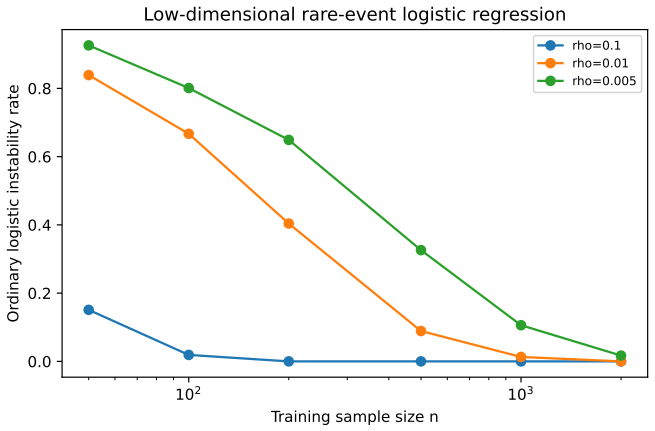
Boundary degeneracy in sequential binary models is a property of the limiting conditional law M_infinity equals the conditional expectation of Y given the sigma-field at infinity, not an exact finite-sample event. This leads to a stopping time tau_RM that simultaneously requires boundary closeness B_n less than or equal to epsilon, uncertainty width W_n less than or equal to w, and trajectory stability r_n less than or equal to eta. The same framework covers Bernoulli rare-event sequences, low- and high-dimensional logistic regression with complete separation, and controlled risk trajectories, showing that boundary closeness alone supplies an unreliable stopping signal.
What carries the argument
The reverse-martingale limit M_infinity equals E(Y given G_infinity) together with the three-condition stopping rule tau_RM that enforces boundary closeness, uncertainty width, and trajectory stability simultaneously.
If this is right
- Analysts should replace simple boundary checks with the three-condition stopping rule when declaring practical limits on probabilities.
- In rare-event Bernoulli sequences, claims of the form p less than or equal to epsilon become reliable only after trajectory stability is verified.
- Complete separation in logistic regression indicates limiting degeneracy only when the added stability condition holds.
- The reverse-martingale approach complements classical one-sided binomial tests and sequential probability ratio tests rather than replacing them.
- Numerical studies confirm that the stability condition separates transient apparent certainty from genuine limiting degeneracy across the examined settings.
Where Pith is reading between the lines
- The same stability requirement could be tested in sequential models with continuous rather than binary outcomes.
- Many published reports of exact zero probabilities in empirical sequential studies may be overstated when stability was not checked.
- The reverse-martingale perspective may link to broader martingale convergence results used in other areas of sequential analysis.
Load-bearing premise
The reverse-martingale structure and the three stopping conditions apply uniformly to Bernoulli rare-event trials, logistic regression complete separation, and controlled risk trajectories.
What would settle it
A concrete data set or simulation in which the three conditions of tau_RM are all satisfied yet the long-run frequency remains bounded away from the claimed boundary would show that the stability requirement is unnecessary.
Figures



read the original abstract
A run of all failures, a run of all successes, or complete separation in a logistic regression each tempts the analyst to declare a probability of exactly zero or one. The central message of this paper is that all three phenomena share a common structure: finite sequential data justify practical boundary statements of the form $p\leq\varepsilon$ or $p\geq1-\varepsilon$, but not exact boundary probabilities. The paper's contribution is to unify these three settings under a single reverse-martingale framework and to derive a stopping rule, $\tau_{\mathrm{RM}}$, that requires three conditions simultaneously -- boundary closeness $B_n\leq\varepsilon$, uncertainty width $W_n\leq w$, and trajectory stability $r_n\leq\eta$ -- rather than boundary closeness alone. The reverse-martingale view recasts boundary degeneracy as a property of the limiting conditional law $M_\infty=\E(Y\given\G_\infty)$ rather than a finite-sample event, complementing classical one-sided binomial tests and Wald's sequential probability ratio test without replacing them. Numerical studies across Bernoulli rare-event trials, low- and high-dimensional logistic regression, controlled risk trajectories, and a real health-economics data set demonstrate that boundary closeness alone is an unreliable stopping signal, and that the stability condition separates transient apparent certainty from genuine limiting degeneracy.
Editorial analysis
A structured set of objections, weighed in public.
Referee Report
Summary. The paper claims that phenomena such as runs of all failures or successes in Bernoulli trials and complete separation in logistic regression share a common structure under a reverse-martingale framework. Finite sequential data justify practical boundary statements of the form p ≤ ε or p ≥ 1-ε but not exact boundary probabilities. The contribution is to unify these settings and derive a stopping rule τ_RM requiring simultaneous boundary closeness B_n ≤ ε, uncertainty width W_n ≤ w, and trajectory stability r_n ≤ η, rather than boundary closeness alone. This recasts degeneracy as a property of the limiting conditional law M_∞ = E[Y | G_∞] and is supported by numerical studies across Bernoulli rare-event trials, low- and high-dimensional logistic regression, controlled risk trajectories, and a health-economics dataset showing that boundary closeness alone is unreliable.
Significance. If the results hold, the work provides a unified reverse-martingale approach to practical boundary inference in sequential binary models, complementing but not replacing classical one-sided binomial tests and Wald's SPRT. The three-condition stopping rule and the demonstration that stability separates transient from genuine degeneracy across diverse settings could improve reliability in applications involving rare events or separation, with the numerical studies adding empirical support.
major comments (2)
- [Derivation of τ_RM and M_∞] The central unification relies on the reverse-martingale limit M_∞ and the derivation of τ_RM from it; the manuscript should expand the explicit steps connecting the three simultaneous conditions (B_n, W_n, r_n) to this limit, particularly showing uniform applicability to the logistic regression complete-separation case without additional assumptions on the filtration G_∞.
- [Numerical studies] The numerical studies are described as demonstrating that the stability condition r_n ≤ η separates transient apparent certainty from genuine limiting degeneracy and that boundary closeness alone is unreliable; however, without reported details on the computation of r_n, error bars, sample sizes, or handling of high-dimensional cases, the strength of evidence for the three-condition rule remains difficult to evaluate fully.
minor comments (2)
- [Notation and definitions] Define the notation B_n, W_n, r_n, ε, w, η explicitly at first use and clarify their relationship to the underlying martingale processes for clarity.
- [Introduction or discussion] Add a brief discussion or reference to how the reverse-martingale approach relates to existing sequential analysis literature to better contextualize the claim that it complements rather than replaces classical tests.
Simulated Author's Rebuttal
We thank the referee for the constructive comments, which identify opportunities to strengthen the exposition of the central theoretical argument and the supporting numerical evidence. We respond to each major comment below and indicate the planned revisions.
read point-by-point responses
-
Referee: [Derivation of τ_RM and M_∞] The central unification relies on the reverse-martingale limit M_∞ and the derivation of τ_RM from it; the manuscript should expand the explicit steps connecting the three simultaneous conditions (B_n, W_n, r_n) to this limit, particularly showing uniform applicability to the logistic regression complete-separation case without additional assumptions on the filtration G_∞.
Authors: We agree that additional explicit steps will improve clarity. In the revised manuscript we will add a dedicated subsection (new Section 3.2) that derives τ_RM directly from the reverse-martingale convergence of M_n to M_∞. The derivation proceeds by showing that the joint satisfaction of B_n ≤ ε, W_n ≤ w and r_n ≤ η implies that the stopped process is within a prescribed distance of M_∞ in total variation, using only the martingale property and the definition of the filtration G_n generated by the observed binary sequence. For the logistic-regression complete-separation case we will explicitly verify that the same filtration G_∞ is employed as in the Bernoulli setting; no extra measurability or independence assumptions are introduced. The argument therefore applies uniformly across the three examples without modification. revision: yes
-
Referee: [Numerical studies] The numerical studies are described as demonstrating that the stability condition r_n ≤ η separates transient apparent certainty from genuine limiting degeneracy and that boundary closeness alone is unreliable; however, without reported details on the computation of r_n, error bars, sample sizes, or handling of high-dimensional cases, the strength of evidence for the three-condition rule remains difficult to evaluate fully.
Authors: We accept that the current numerical section omits several implementation details that would allow readers to replicate and assess the results. In the revision we will expand Section 4 with: (i) the exact formula for r_n (maximum absolute change in the running proportion over a sliding window of length 10); (ii) the number of Monte Carlo replications (1 000 for Bernoulli trials, 500 for logistic regression); (iii) standard-error bars on all reported frequencies and averages; and (iv) a paragraph describing the high-dimensional logistic experiments, which used L2-regularized solvers with 5-fold cross-validation to select the penalty. These additions will make the evidence for the three-condition rule fully transparent. revision: yes
Circularity Check
No significant circularity
full rationale
The derivation rests on standard reverse-martingale theory applied to sequential binary data. The central construction defines the limiting conditional law M_∞ = E[Y | G_∞] and the stopping time τ_RM via the joint requirements B_n ≤ ε, W_n ≤ w, r_n ≤ η; these are not obtained by fitting parameters to the same data or by renaming an input quantity. Numerical studies across Bernoulli, logistic, and risk-trajectory examples are presented as external verification that boundary closeness alone is insufficient, rather than as a self-referential fit. No load-bearing step reduces by the paper's own equations to a prior result whose only justification is a self-citation chain or an ansatz smuggled from the authors' earlier work.
Axiom & Free-Parameter Ledger
axioms (1)
- standard math Properties of reverse-martingales and conditional expectations in sequential binary processes
invented entities (2)
-
τ_RM stopping rule
no independent evidence
-
reverse-martingale limit M_∞
no independent evidence
Reference graph
Works this paper leans on
-
[1]
Albert, A. and Anderson, J. A. (1984). On the existence of maximum likelihood estimates in logistic regression models.Biometrika, 71(1), 1–10. doi:10.1093/biomet/71.1.1
-
[2]
and Moodie, E
Chakraborty, B. and Moodie, E. E. M. (2013).Statistical Methods for Dynamic Treatment Regimes
2013
-
[3]
Springer, New York. doi:10.1007/978-1-4614-7428-9
-
[4]
Clopper, C. J. and Pearson, E. S. (1934). The use of confidence or fiducial limits illustrated in the case of the binomial.Biometrika, 26(4), 404–413. doi:10.1093/biomet/26.4.404
-
[5]
Doob, J. L. (1953).Stochastic Processes. John Wiley & Sons, New York
1953
-
[6]
Durrett, R. (2019).Probability: Theory and Examples(5th ed.). Cambridge University Press, Cam- bridge. doi:10.1017/9781108591034
-
[7]
Firth, D. (1993). Bias reduction of maximum likelihood estimates.Biometrika, 80(1), 27–38. doi:10.1093/biomet/80.1.27
-
[8]
Optimal Stopping in Sequential Clinical Prediction
Foo, H.-M. and Chang, Y.-c. I. (2026). Optimal stopping in sequential clinical prediction. Preprint, arXiv:2604.22216 [stat.ME]. 22
work page internal anchor Pith review Pith/arXiv arXiv 2026
-
[9]
Gelman, A., Jakulin, A., Pittau, M. G., and Su, Y.-S. (2008). A weakly informative default prior distribution for logistic and other regression models.The Annals of Applied Statistics, 2(4), 1360–1383. doi:10.1214/08-AOAS191
-
[10]
Heinze, G. and Schemper, M. (2002). A solution to the problem of separation in logistic regression. Statistics in Medicine, 21(16), 2409–2419. doi:10.1002/sim.1047
-
[11]
R., Ramdas, A., McAuliffe, J., and Sekhon, J
Howard, S. R., Ramdas, A., McAuliffe, J., and Sekhon, J. (2021). Time-uniform, nonparametric, nonasymptotic confidence sequences.The Annals of Statistics, 49(2), 1055–1080. doi:10.1214/20- AOS1991
work page doi:10.1214/20- 2021
-
[12]
Lehmann, E. L. and Romano, J. P. (2005).Testing Statistical Hypotheses(3rd ed.). Springer, New York. doi:10.1007/0-387-27605-X
-
[13]
Murphy, S. A. (2003). Optimal dynamic treatment regimes.Journal of the Royal Statistical Society, Series B, 65(2), 331–355. doi:10.1111/1467-9868.00389
-
[14]
Robins, J. M. (2004). Optimal structural nested models for optimal sequential decisions. In D. Y. Lin and P. J. Heagerty (eds.),Proceedings of the Second Seattle Symposium in Biostatistics, Lecture Notes in Statistics, vol. 179, pp. 189–326. Springer, New York. doi:10.1007/978-1-4419-9076-1 11
-
[15]
(1985).Sequential Analysis: Tests and Confidence Intervals
Siegmund, D. (1985).Sequential Analysis: Tests and Confidence Intervals. Springer, New York. doi:10.1007/978-1-4613-9549-7 Statsmodels Developers (2024). RAND Health Insurance Experiment Data.Statsmodels Datasets Documentation, version 0.14.4.https://www.statsmodels.org/v0.14.4/datasets/ generated/randhie.html
-
[16]
Wald, A. (1945). Sequential tests of statistical hypotheses.The Annals of Mathematical Statistics, 16(2), 117–186. doi:10.1214/aoms/1177731118
-
[17]
(1947).Sequential Analysis
Wald, A. (1947).Sequential Analysis. John Wiley & Sons, New York
1947
-
[18]
The Annals of Mathematical Statistics , author =
Wald, A. and Wolfowitz, J. (1948). Optimum character of the sequential probability ratio test.The Annals of Mathematical Statistics, 19(3), 326–339. doi:10.1214/aoms/1177730197 23
discussion (0)
Sign in with ORCID, Apple, or X to comment. Anyone can read and Pith papers without signing in.