Recognition: 3 theorem links
· Lean TheoremWhen Attention Collapses: Residual Evidence Modeling for Compositional Inference
Pith reviewed 2026-05-08 18:26 UTC · model grok-4.3
The pith
Standard attention collapses on additively mixed signals because it is memoryless with respect to explained evidence, but adding multiplicative depletion with an attention bias prevents collapse and enables multi-source inference.
A machine-rendered reading of the paper's core claim, the machinery that carries it, and where it could break.
Core claim
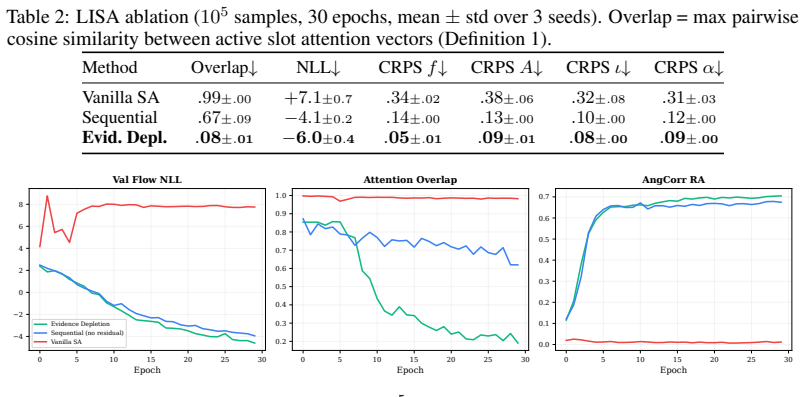
evidence depletion reduces slot collapse by up to an order of magnitude, generalizing beyond synthetic settings. On gravitational-wave source inference for the ESA/NASA LISA mission, under identical architectures, data, and losses, standard attention fails while evidence depletion prevents collapse and enables multi-source posterior estimation.
Load-bearing premise
The assumption that the proposed evidence depletion (multiplicative depletion plus attention bias) is a minimal change that does not introduce new failure modes or require extensive hyperparameter tuning across domains, and that the synthetic and FUSS/LISA benchmarks sufficiently represent general additive superposition cases.
Figures


read the original abstract
Compositional inference - the decomposition of observations into an unknown number of latent components - is central to perception and scientific data analysis. Attention-based models perform well when components are approximately separable, as in object-centric vision. Under additive superposition, however - where multiple components contribute to every observation - we identify a structural failure mode we term slot collapse: multiple slots converge to the same dominant component while weaker ones remain unrepresented. We trace this to a general limitation: attention is memoryless with respect to explained evidence. All slots repeatedly operate on the same input without accounting for what has already been explained, so gradients are dominated by the strongest component, inducing shared fixed points across slots. As a result, attention fails to enforce non-redundant allocation under additive superposition. We address this by introducing residual evidence modeling, instantiated via evidence depletion - a minimal modification combining multiplicative depletion with an attention bias. Controlled ablations show that parallel attention, sequential processing alone, and loss-based regularization fail to resolve collapse; evidence depletion, which adds residual state to sequential attention, consistently succeeds. Across synthetic benchmarks and real-world audio mixtures (FUSS), evidence depletion reduces slot collapse by up to an order of magnitude, generalizing beyond synthetic settings. On gravitational-wave source inference for the ESA/NASA LISA mission, under identical architectures, data, and losses, standard attention fails while evidence depletion prevents collapse and enables multi-source posterior estimation. These results show that under additive superposition, residual evidence tracking is the operative ingredient for preventing collapse and enabling compositional inference.
Editorial analysis
A structured set of objections, weighed in public.
Referee Report
Summary. The paper claims that attention-based models for compositional inference suffer from slot collapse under additive superposition because attention is memoryless with respect to explained evidence. It proposes residual evidence modeling via evidence depletion (multiplicative depletion with attention bias) as a minimal fix. Controlled ablations show this succeeds where parallel attention, sequential processing, and loss regularization fail. It reports up to an order of magnitude reduction in collapse on synthetic and FUSS audio data, and success on LISA gravitational-wave source inference under identical setups.
Significance. This result, if substantiated, identifies a key limitation in standard attention for handling superimposed components and offers a practical solution with residual state. The paper earns credit for its controlled ablations that pinpoint the operative mechanism and for testing on real data from audio mixtures and the LISA mission, moving beyond synthetic settings. This has potential significance for improving inference in domains with additive signals.
major comments (2)
- [Ablations] The central empirical claim relies on evidence depletion being robust, but the manuscript does not provide sensitivity analysis on the depletion rate (see the description of the method and results on FUSS and LISA). This is necessary to support the generalization claim, as performance may depend on domain-specific tuning of this parameter.
- [Results on LISA] The LISA experiment is presented as a strong test case where standard attention fails but depletion succeeds. However, the lack of error bars or details on the number of runs (as noted in the reader's assessment) weakens the quantitative assessment of the improvement.
minor comments (2)
- [Notation] The definition of residual state could be made more explicit with an equation for the depletion operation.
- Ensure all acronyms like FUSS and LISA are defined at first use in the main text.
Simulated Author's Rebuttal
We thank the referee for the constructive feedback and positive evaluation of the paper's significance. We address each major comment below and will incorporate revisions to strengthen the empirical support.
read point-by-point responses
-
Referee: [Ablations] The central empirical claim relies on evidence depletion being robust, but the manuscript does not provide sensitivity analysis on the depletion rate (see the description of the method and results on FUSS and LISA). This is necessary to support the generalization claim, as performance may depend on domain-specific tuning of this parameter.
Authors: We agree that sensitivity analysis on the depletion rate is needed to substantiate robustness and generalization. In the revised manuscript we will add experiments that sweep the depletion rate over a range of values (e.g., 0.1 to 0.9) while keeping all other hyperparameters fixed, and we will report the resulting slot-collapse metrics on both the FUSS and LISA datasets. These results will be placed in a new subsection of the experimental evaluation. revision: yes
-
Referee: [Results on LISA] The LISA experiment is presented as a strong test case where standard attention fails but depletion succeeds. However, the lack of error bars or details on the number of runs (as noted in the reader's assessment) weakens the quantitative assessment of the improvement.
Authors: We acknowledge that error bars and explicit reporting of the number of runs would strengthen the LISA results. We will rerun the LISA experiments with at least five independent random seeds, add standard-deviation error bars to all reported metrics, and state the exact number of runs and seeds in the experimental protocol section of the revised manuscript. revision: yes
Circularity Check
No significant circularity; empirical validation supports claims without self-referential reduction.
full rationale
The paper's core argument identifies slot collapse as arising from attention's lack of residual evidence tracking under additive superposition, then introduces evidence depletion (multiplicative depletion plus bias) as a targeted fix. This is validated through ablations demonstrating failure of parallel attention, sequential processing, and regularization, plus quantitative improvements on synthetic data, FUSS audio, and LISA gravitational-wave inference under matched architectures and losses. No load-bearing step reduces by construction to fitted inputs, self-citations, or renamed known results; the derivation chain consists of conceptual diagnosis followed by independent experimental falsification. The provided text contains no equations or uniqueness theorems that collapse into the proposed method itself. This is the expected non-circular outcome for an empirical methods paper.
Axiom & Free-Parameter Ledger
axioms (2)
- domain assumption Attention mechanisms are memoryless with respect to previously explained evidence when operating on the same input repeatedly.
- ad hoc to paper Multiplicative depletion combined with an attention bias constitutes a minimal modification that adds residual state without altering core attention.
Lean theorems connected to this paper
-
IndisputableMonolith/Cost (Jcost)washburn_uniqueness_aczel / Jcost = ½(x+x⁻¹)−1 unclear?
unclearRelation between the paper passage and the cited Recognition theorem.
evidence depletion ... combining multiplicative depletion with an attention bias ... e_ℓ ← max(e_ℓ·(1−α²_sℓ), ε)
-
IndisputableMonolith/Foundation/BranchSelectionRCLCombiner_isCoupling_iff (RS forces a unique combiner; paper treats form as tunable) unclear?
unclearRelation between the paper passage and the cited Recognition theorem.
We also evaluate linear (1−α), cubic, and binary variants ... Linear depletion (1−α) achieves the lowest collapse on these benchmarks. We use quadratic (1−α²) for the LISA experiments based on its softer exploration–commitment trade-off
-
IndisputableMonolith/Foundation (RealityFromDistinction)reality_from_one_distinction (RS scope: spacetime/c/ℏ/G; not amortized inference) unclear?
unclearRelation between the paper passage and the cited Recognition theorem.
On gravitational-wave source inference for the ESA/NASA LISA mission ... evidence depletion prevents collapse and enables multi-source posterior estimation.
What do these tags mean?
- matches
- The paper's claim is directly supported by a theorem in the formal canon.
- supports
- The theorem supports part of the paper's argument, but the paper may add assumptions or extra steps.
- extends
- The paper goes beyond the formal theorem; the theorem is a base layer rather than the whole result.
- uses
- The paper appears to rely on the theorem as machinery.
- contradicts
- The paper's claim conflicts with a theorem or certificate in the canon.
- unclear
- Pith found a possible connection, but the passage is too broad, indirect, or ambiguous to say the theorem truly supports the claim.
Reference graph
Works this paper leans on
-
[1]
Laser Interferometer Space Antenna
Laser. arXiv preprint arXiv:1702.00786 , year=
work page internal anchor Pith review arXiv
-
[2]
Astronomy & Astrophysics , volume=
The gravitational wave signal from the Galactic disk population of binaries containing two compact objects , author=. Astronomy & Astrophysics , volume=
-
[3]
and Rossi, E
Korol, V. and Rossi, E. M. and Groot, P. J. and others , journal=. Prospects for detection of detached double white dwarf binaries with
-
[4]
and Crowder, Jeff , journal=
Cornish, Neil J. and Crowder, Jeff , journal=
-
[5]
and Cornish, Neil J
Littenberg, Tyson B. and Cornish, Neil J. , journal=. Prototype global analysis of. 2023 , doi=
2023
-
[6]
Physical Review D , volume=
Bayesian inference for spectral estimation of gravitational wave detector noise , author=. Physical Review D , volume=
-
[7]
and Liu, Chang , journal=
Robson, Travis and Cornish, Neil J. and Liu, Chang , journal=. The construction and use of
-
[8]
Living Reviews in Relativity , volume=
Time-delay interferometry , author=. Living Reviews in Relativity , volume=. 2021 , doi=
2021
-
[9]
Proceedings of the National Academy of Sciences , volume=
The frontier of simulation-based inference , author=. Proceedings of the National Academy of Sciences , volume=
-
[10]
Journal of Machine Learning Research , volume=
Normalizing flows for probabilistic modeling and inference , author=. Journal of Machine Learning Research , volume=
-
[11]
Proceedings of the 32nd International Conference on Machine Learning , pages=
Variational Inference with Normalizing Flows , author=. Proceedings of the 32nd International Conference on Machine Learning , pages=
-
[12]
Physical Review Letters , volume=
Real-Time Gravitational Wave Science with Neural Posterior Estimation , author=. Physical Review Letters , volume=
-
[13]
and Gair, Jonathan , journal=
Green, Stephen R. and Gair, Jonathan , journal=. Complete parameter inference for
-
[14]
Advances in Neural Information Processing Systems , volume=
Object-Centric Learning with Slot Attention , author=. Advances in Neural Information Processing Systems , volume=
-
[15]
ICML , year=
Challenging Common Assumptions in the Unsupervised Learning of Disentangled Representations , author=. ICML , year=
-
[16]
Astronomy and Astrophysics Supplement Series , volume=
Aperture synthesis with a non-regular distribution of interferometer baselines , author=. Astronomy and Astrophysics Supplement Series , volume=
-
[17]
Houba, Niklas and Giarda, Giovanni and Speri, Lorenzo , journal=
-
[18]
Advances in Neural Information Processing Systems , volume=
Neural Spline Flows , author=. Advances in Neural Information Processing Systems , volume=
-
[19]
Naval Research Logistics Quarterly , volume=
The Hungarian method for the assignment problem , author=. Naval Research Logistics Quarterly , volume=
-
[20]
IEEE Transactions on Pattern Analysis and Machine Intelligence , volume=
Focal Loss for Dense Object Detection , author=. IEEE Transactions on Pattern Analysis and Machine Intelligence , volume=
-
[21]
and Rubbo, Louis J
Cornish, Neil J. and Rubbo, Louis J. , journal=
-
[22]
doi:10.5281/zenodo.18343479 , publisher=
Bayle, Jean-Baptiste and Le Jeune, Maude and Menu, Jonathan , year=. doi:10.5281/zenodo.18343479 , publisher=
-
[23]
lisaorbits: LISA orbit computation , howpublished=
-
[24]
LISAanalysistools: LISA sensitivity and analysis tools , author=
-
[25]
nflows: normalizing flows in PyTorch , author=
-
[26]
Advances in Neural Information Processing Systems , volume=
PyTorch: An Imperative Style, High-Performance Deep Learning Library , author=. Advances in Neural Information Processing Systems , volume=
-
[27]
The Mock
Babak, Stanislav and others , journal=. The Mock
-
[28]
ICML , year=
Multi-Object Representation Learning with Iterative Variational Inference , author=. ICML , year=
-
[29]
MONet: Unsupervised Scene Decomposition and Representation
MONet: Unsupervised Scene Decomposition and Representation , author=. arXiv preprint arXiv:1901.11390 , year=
work page Pith review arXiv 1901
-
[30]
NeurIPS , year=
Simple Unsupervised Object-Centric Learning for Complex and Naturalistic Videos , author=. NeurIPS , year=
-
[31]
NeurIPS , year=
SAVi++: Towards End-to-End Object-Centric Learning from Real-World Videos , author=. NeurIPS , year=
-
[32]
NeurIPS , year=
Genesis-V2: Inferring Unordered Object Representations without Iterative Refinement , author=. NeurIPS , year=
-
[33]
ICASSP , year=
Deep clustering: Discriminative embeddings for segmentation and separation , author=. ICASSP , year=
-
[34]
Houba, N. , note=. Amortised
-
[35]
Density estimation using
Dinh, Laurent and Sohl-Dickstein, Jascha and Bengio, Samy , booktitle=. Density estimation using
-
[36]
IEEE Transactions on Signal Processing , volume=
Matching pursuits with time-frequency dictionaries , author=. IEEE Transactions on Signal Processing , volume=
-
[37]
and Laird, Nan M
Dempster, Arthur P. and Laird, Nan M. and Rubin, Donald B. , journal=. Maximum likelihood from incomplete data via the
-
[38]
ECCV , year=
End-to-End Object Detection with Transformers , author=. ECCV , year=
-
[39]
ICML , year=
Iterative Amortized Inference , author=. ICML , year=
-
[40]
ICLR , year=
Efficient Streaming Language Models with Attention Sinks , author=. ICLR , year=
-
[41]
Nature Reviews Neuroscience , volume=
Computational modelling of visual attention , author=. Nature Reviews Neuroscience , volume=
-
[42]
Trends in Cognitive Sciences , volume=
Inhibition of return , author=. Trends in Cognitive Sciences , volume=
-
[43]
Neural Networks , volume=
Independent component analysis: algorithms and applications , author=. Neural Networks , volume=
-
[44]
Illiterate
Singh, Gautam and Deng, Fei and Ahn, Sungjin , booktitle=. Illiterate
-
[45]
ICML , year=
Invariant Slot Attention: Object Discovery with Slot-Centric Reference Frames , author=. ICML , year=
-
[46]
ICML , year=
Unlocking Slot Attention by Changing Optimal Transport Costs , author=. ICML , year=
-
[47]
Transactions on Machine Learning Research , year=
Attention Normalization Impacts Cardinality Generalization in Slot Attention , author=. Transactions on Machine Learning Research , year=
-
[48]
Wisdom, Scott and Erdogan, Hakan and Ellis, Daniel P. W. and Serizel, Romain and Turpault, Nicolas and Fonseca, Eduardo and Salamon, Justin and Seetharaman, Prem and Hershey, John R. , booktitle=. What's All the
-
[49]
ACL , year=
Modeling Coverage for Neural Machine Translation , author=. ACL , year=
discussion (0)
Sign in with ORCID, Apple, or X to comment. Anyone can read and Pith papers without signing in.