Recognition: unknown
Measurement of isolated-prompt photon-hadron correlations in Pb-Pb collisions at mathbf{sqrt{textit{s}_{rm NN}} = 5.02} TeV
Pith reviewed 2026-05-08 01:51 UTC · model grok-4.3
The pith
Isolated prompt photons show strong suppression of associated hadrons in central Pb-Pb collisions.
A machine-rendered reading of the paper's core claim, the machinery that carries it, and where it could break.
Core claim
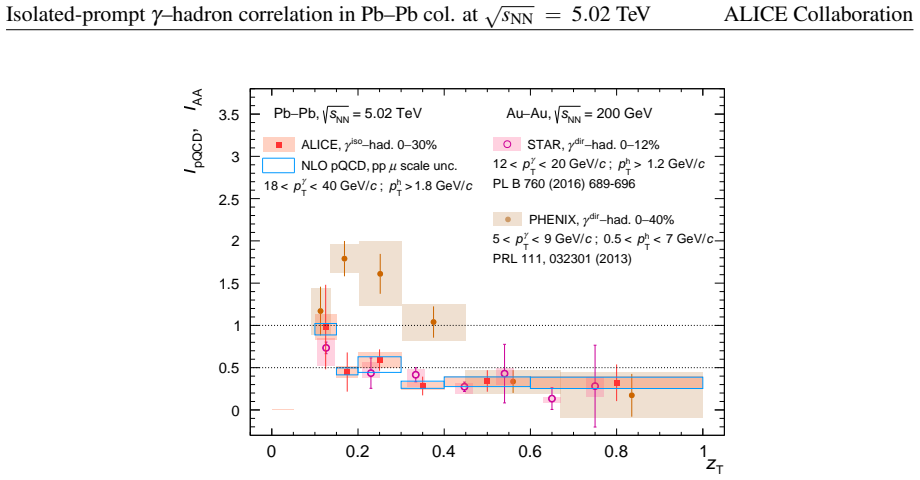
The central claim is that the ratio approximating I_AA for isolated-prompt photon-hadron pairs is strongly suppressed in central (0-30 percent) Pb-Pb collisions relative to peripheral (50-90 percent) collisions, with the photon transverse-momentum coverage extended to the interval 18-40 GeV/c.
What carries the argument
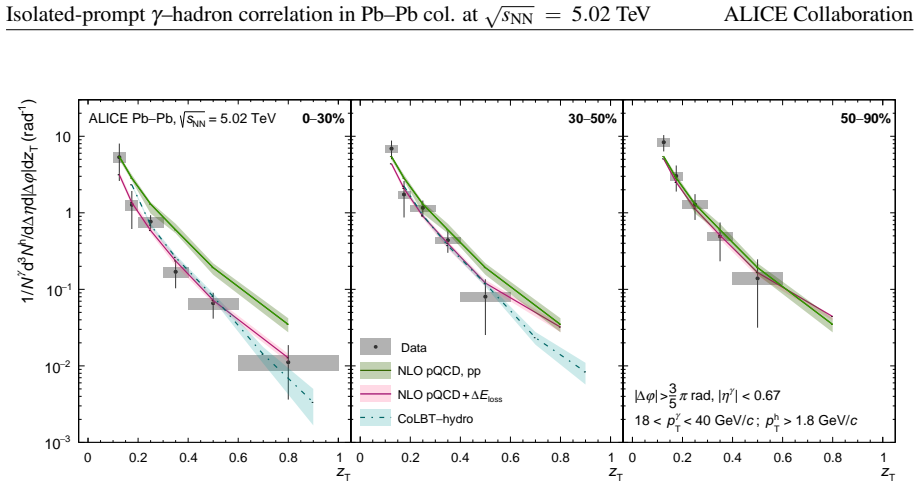
The conditional yield D(z_T) of associated charged hadrons per trigger photon (with z_T = p_T^h / p_T^γ), from which an I_AA approximation is extracted using an NLO pQCD pp reference to isolate medium-induced modifications.
If this is right
- The observed centrality dependence signals that the recoiling parton experiences significant energy loss or modified fragmentation inside the quark-gluon plasma.
- Agreement with NLO calculations that incorporate energy loss and with the CoLBT-hydro model supports the picture of jet quenching.
- The suppression pattern is consistent with photon-jet and Z^0-hadron correlation results reported by CMS at the LHC.
- Extension to lower photon p_T supplies new constraints on energy-loss mechanisms at intermediate momentum scales.
Where Pith is reading between the lines
- If the suppression strength tracks the average path length through the medium, the measurement could help constrain the spatial geometry of the collision fireball.
- Repeating the analysis with varied isolation cones or at higher collision energies would test the transition between perturbative and non-perturbative regimes of QCD matter.
- Discrepancies among different energy-loss models could distinguish radiative from collisional contributions once the data precision improves.
Load-bearing premise
NLO pQCD calculations furnish an accurate pp reference baseline free of large higher-order or nuclear corrections that would change the extracted suppression, and the charged-particle isolation cleanly tags prompt photons with negligible fragmentation contamination.
What would settle it
A measurement that finds the hadron yield ratio independent of centrality class, or that shows large variation when the isolation momentum threshold is changed, would indicate that the reported suppression does not arise from medium effects.
Figures



read the original abstract
The ALICE Collaboration has measured the azimuthal correlation between trigger isolated-prompt photons and associated charged hadrons in Pb$-$Pb collisions at the CERN LHC, at a centre-of-mass energy per nucleon pair of \snnfive. The trigger isolated-prompt photons are measured in the transverse-momentum range $18< p_{\rm T}^{\gamma} < 40$ GeV/$c$ and pseudorapidity range $|\eta^{\gamma}| <0.67$. The isolation selection is based on a charged particle isolation momentum threshold $p_{\rm T}^{\rm iso, ch} = 1.5$ GeV/$c$ within a cone of radius $R=0.2$. The associated charged particles are measured in the transverse-momentum ranges $p_{\rm T}^{\rm h} > 1.8$ GeV/$c$ and pseudorapidity $|\eta^{\rm h}| <0.9$. The yield D$(z_{\rm T})$ of associated hadrons per trigger, with $z_{\rm T} = p_{\rm T}^{\rm h}/p_{\rm T}^{\gamma}$, is measured in three Pb$-$Pb collision centrality classes: central (0$-$30%), semicentral (30$-$50%), and peripheral (50$-$90%). An approximation to the standard $I_{\rm AA}$ is computed from the D$(z_{\rm T})$ conditional yields, using NLO pQCD predictions as pp reference. A strong suppression of this ratio is observed in central collisions compared to peripheral collisions. The result extends to a lower $p_{\rm T}^{\gamma}$ relative to those reported in previously published Pb$-$Pb collisions measurements at $\sqrt{s_{\rm NN}}=5.02$ TeV. The measurement is compared to NLO pQCD calculations that include energy loss, and to the CoLBT-hydro model. The results from central collisions are also compared with measurements of jets correlated with isolated-prompt photons and of hadrons correlated with Z$^0$ bosons, both reported by the CMS Collaboration at the LHC, as well as with direct photon$-$hadron correlation measurements reported by the PHENIX and STAR Collaborations at RHIC.
Editorial analysis
A structured set of objections, weighed in public.
Referee Report
Summary. The ALICE Collaboration measures azimuthal correlations between isolated-prompt photons (18 < p_T^γ < 40 GeV/c, |η^γ| < 0.67, isolated with p_T^iso,ch < 1.5 GeV/c in R=0.2) and associated charged hadrons (p_T^h > 1.8 GeV/c, |η^h| < 0.9) in Pb-Pb collisions at √s_NN = 5.02 TeV. The conditional yield D(z_T) with z_T = p_T^h / p_T^γ is reported in three centrality classes (0-30%, 30-50%, 50-90%). An approximate I_AA is formed by dividing the Pb-Pb D(z_T) by NLO pQCD pp predictions. A strong suppression of this ratio is observed in central relative to peripheral collisions, extending prior measurements to lower p_T^γ. Results are compared to NLO calculations with energy loss, the CoLBT-hydro model, and other LHC/RHIC photon-hadron and jet measurements.
Significance. If the results hold, the work supplies new constraints on medium-induced suppression at lower photon p_T than previous √s_NN = 5.02 TeV Pb-Pb studies. The headline observation of suppression in central versus peripheral collisions follows directly from the measured D(z_T) yields (the common NLO denominator cancels in the ratio of ratios), so the skeptic's concern about NLO baseline accuracy does not undermine the central claim. The data-driven extraction, model comparisons, and consistency with CMS photon-jet and Z^0-hadron results enhance its value for QGP energy-loss studies.
minor comments (1)
- [Abstract] Abstract: the statement that the isolation criterion 'cleanly selects prompt photons' would benefit from a brief quantitative remark on residual fragmentation-photon contamination estimated from simulation or data-driven methods.
Simulated Author's Rebuttal
We thank the referee for the positive review and recommendation to accept the manuscript. The assessment correctly identifies the extension to lower photon p_T and the robustness of the central suppression observation, which does not rely on the absolute accuracy of the NLO pp baseline.
Circularity Check
No significant circularity; purely data-driven measurement with external NLO reference
full rationale
The paper reports direct extraction of conditional yields D(z_T) from Pb-Pb data using fixed isolation cuts on photons and hadrons. The I_AA approximation is formed by dividing measured Pb-Pb yields by external NLO pQCD pp predictions; no parameter is fitted inside the paper and then renamed as a prediction of the same or related observable. No self-citation chain, uniqueness theorem, or ansatz smuggling supports the central suppression result. The measurement chain is self-contained against external benchmarks and does not reduce to its inputs by construction.
Axiom & Free-Parameter Ledger
axioms (2)
- domain assumption NLO pQCD calculations accurately describe isolated prompt photon production in pp collisions
- domain assumption Charged-particle isolation with p_T^iso,ch < 1.5 GeV/c within R=0.2 selects prompt photons with high purity
Reference graph
Works this paper leans on
-
[1]
The exploration of hot nuclear matter
B. V . Jacak and B. Muller, “The exploration of hot nuclear matter”,Science337(2012) 310–314
2012
-
[2]
First Results from Pb+Pb Collisions at the LHC
B. Müller, J. Schukraft, and B. Wysłouch, “First Results from Pb+Pb Collisions at the LHC”, Annu. Rev. Nucl. Part. S.62(2012) 361–386
2012
-
[3]
Properties of hot and dense matter from relativistic heavy ion collisions,
P. Braun-Munzinger, V . Koch, T. Schäfer, and J. Stachel, “Properties of hot and dense matter from relativistic heavy ion collisions”,Phys. Rept.621(2016) 76–126,arXiv:1510.00442
-
[4]
Heavy Ion Collisions: The Big Picture, and the Big Questions
W. Busza, K. Rajagopal, and W. van der Schee, “Heavy Ion Collisions: The Big Picture, and the Big Questions”,Ann. Rev. Nucl. Part. Sci.68(2018) 339–376,arXiv:1802.04801 [hep-ph]. [6]PHENIXCollaboration, K. Adcoxet al., “Formation of dense partonic matter in relativistic nucleus-nucleus collisions at RHIC: Experimental evaluation by the PHENIX Collaboratio...
work page Pith review arXiv 2018
-
[5]
Collisional energy loss in a finite size QCD matter
M. Djordjevic, “Collisional energy loss in a finite size QCD matter”,Phys. Rev. C74(2006) 064907,arXiv:nucl-th/0603066
-
[6]
Understanding mass hierarchy in collisional energy loss through heavy flavor data
B. Ilic and M. Djordjevic, “Understanding mass hierarchy in collisional energy loss through heavy flavor data”,Phys. Rev. C106(2022) 014902,arXiv:2203.06646 [hep-ph]
-
[7]
Energy loss of energetic partons in quark-gluon plasma: Possible extinction of highp T jets in hadron-hadron collisions
J. D. Bjorken, “Energy loss of energetic partons in quark-gluon plasma: Possible extinction of highp T jets in hadron-hadron collisions”, Fermilab report FERMILAB-PUB-82-059-T, Fermilab report, 1982.https://lss.fnal.gov/archive/1982/pub/Pub-82-059-T.pdf
1982
-
[8]
M. Gyulassy, P. Levai, and I. Vitev, “Jet quenching in thin plasmas”,Nucl. Phys. A661(1999) 637–640,arXiv:hep-ph/9907343
-
[9]
d’Enterria, Jet quenching, Landolt-Bornstein 23 (2010) 471 [0902.2011]
D. d’Enterria, “Jet quenching”,Landolt-Bornstein23(2010) 471,arXiv:0902.2011 [nucl-ex]. [15]STARCollaboration, J. Adamset al., “Transverse-momentum and collision-energy dependence of high-pT hadron suppression in Au+Au collisions at ultrarelativistic energies”,Phys. Rev. Lett.91 (2003) 172302,arXiv:nucl-ex/0305015 [nucl-ex]. [16]PHENIXCollaboration, A. Ad...
-
[10]
Quenching of photon and pion spectra at intermediate RHIC energy
F. Arleo, “Quenching of photon and pion spectra at intermediate RHIC energy”,JHEP07(2007) 032,arXiv:0706.1848 [hep-ph]. [31]ATLASCollaboration, G. Aadet al., “Centrality, rapidity and transverse momentum dependence of isolated prompt photon production in lead-lead collisions at √sNN =2.76 TeV measured with the ATLAS detector”,Phys. Rev. C93(2016) 034914,a...
-
[11]
Inclusive prompt photon production in nuclear collisions at RHIC and LHC
F. Arleo, K. J. Eskola, H. Paukkunen, and C. A. Salgado, “Inclusive prompt photon production in nuclear collisions at RHIC and LHC”,JHEP04(2011) 055,arXiv:1103.1471 [hep-ph]
-
[12]
Direct photon production in d+A and A+A collisions at RHIC
B.-W. Zhang and I. Vitev, “Direct photon production in d+A and A+A collisions at RHIC”,Mod. Phys. Lett. A24(2009) 2649–2658,arXiv:0810.3194 [nucl-th]. [34]PHENIXCollaboration, S. S. Adleret al., “Centrality dependence of direct photon production in√sNN =200 GeV Au+Au collisions”,Phys. Rev. Lett.94(2005) 232301, arXiv:nucl-ex/0503003 [nucl-ex]. [35]PHENIXC...
-
[13]
R. Ichou and D. d’Enterria, “Sensitivity of isolated photon production at TeV hadron colliders to the gluon distribution in the proton”,Phys. Rev. D82(2010) 014015,arXiv:1005.4529 [hep-ph]. [55]ALICECollaboration, D. A. H. Abdallahet al., “Supplemental figures: Measurement of the isolated photon–hadron correlations in Pb–Pb collisions at √sNN = 5.02 TeV”,...
-
[14]
J. Almeet al., “The ALICE TPC, a large 3-dimensional tracking device with fast readout for ultra-high multiplicity events”,Nucl. Instrum. Meth. A622(2010) 316–367,arXiv:1001.1950 [physics.ins-det]. [61]ALICECollaboration, E. Abbaset al., “Performance of the ALICE VZERO system”,JINST8 (2013) P10016,arXiv:1306.3130 [nucl-ex]. [62]ALICECollaboration, B. Abel...
-
[15]
Methods for analyzing anisotropic flow in relativistic nuclear collisions
A. M. Poskanzer and S. A. V oloshin, “Methods for analyzing anisotropic flow in relativistic nuclear collisions”,Phys. Rev. C58(1998) 1671–1678,arXiv:nucl-ex/9805001
work page Pith review arXiv 1998
-
[16]
T. Sjöstrandet al., “An Introduction to PYTHIA 8.2”,Comput. Phys. Commun.191(2015) 159–177,arXiv:1410.3012 [hep-ph]
work page internal anchor Pith review arXiv 2015
-
[17]
Tuning PYTHIA 8.1: the Monash 2013 Tune
P. Skands, S. Carrazza, and J. Rojo, “Tuning PYTHIA 8.1: the Monash 2013 tune”,Eur . Phys. J. C 74(2014) 3024,arXiv:1404.5630 [hep-ph]
work page Pith review arXiv 2013
-
[18]
GEANT Detector Description and Simulation Tool
R. Brun, F. Carminati, and S. Giani, “GEANT Detector Description and Simulation Tool.” 1994. https://cds.cern.ch/record/1082634. W5013, W-5013, CERN-W5013, CERN-W-5013
-
[19]
γ-hadron spectra inp+Pb collisions at √sNN =5.02 TeV
M. Xie, X.-N. Wang, and H.-Z. Zhang, “γ-hadron spectra inp+Pb collisions at √sNN =5.02 TeV”,Phys. Rev. C103(2021) 034911,arXiv:2003.02441 [hep-ph]
-
[20]
Tomography of high-energy nuclear collisions with photon-hadron correlations
H. Zhang, J. F. Owens, E. Wang, and X.-N. Wang, “Tomography of high-energy nuclear collisions with photon-hadron correlations”,Phys. Rev. Lett.103(2009) 032302,arXiv:0902.4000 [nucl-th]
-
[21]
Multiple Parton Scattering in Nuclei: Modified DGLAP Evolution for Fragmentation Functions
W.-t. Deng and X.-N. Wang, “Multiple Parton Scattering in Nuclei: Modified DGLAP Evolution for Fragmentation Functions”,Phys. Rev. C81(2010) 024902,arXiv:0910.3403 [hep-ph]
-
[22]
M. Xie, W. Ke, H. Zhang, and X.-N. Wang, “Global constraint on the jet transport coefficient from single-hadron, dihadron, andγ-hadron spectra in high-energy heavy-ion collisions”,Phys. Rev. C 109(2024) 064917,arXiv:2208.14419 [hep-ph]
-
[23]
Information-field-based global Bayesian inference of the jet transport coefficient
M. Xie, W. Ke, H. Zhang, and X.-N. Wang, “Information-field-based global Bayesian inference of the jet transport coefficient”,Phys. Rev. C108(2023) L011901,arXiv:2206.01340 [hep-ph]
-
[24]
Why the observed jet quenching at RHIC is due to parton energy loss
X.-N. Wang, “Why the observed jet quenching at RHIC is due to parton energy loss”,Phys. Lett. B 579(2004) 299–308,arXiv:nucl-th/0307036
-
[25]
T.-J. Houet al., “New CTEQ global analysis of quantum chromodynamics with high-precision data from the LHC”,Phys. Rev. D103(2021) 014013,arXiv:1912.10053 [hep-ph]
-
[26]
Fragmentation functions for pions, kaons, and protons at next-to-leading order
B. A. Kniehl, G. Kramer, and B. Potter, “Fragmentation functions for pions, kaons, and protons at next-to-leading order”,Nucl. Phys. B582(2000) 514–536,arXiv:hep-ph/0010289
-
[27]
Effects of jet-induced medium excitation inγ-hadron correlation in A+A collisions
W. Chen, S. Cao, T. Luo, L.-G. Pang, and X.-N. Wang, “Effects of jet-induced medium excitation inγ-hadron correlation in A+A collisions”,Phys. Lett. B777(2018) 86–90,arXiv:1704.03648 [nucl-th]
-
[28]
EPPS21: a global QCD analysis of nuclear PDFs
K. J. Eskola, P. Paakkinen, H. Paukkunen, and C. A. Salgado, “EPPS21: a global QCD analysis of nuclear PDFs”,Eur . Phys. J. C82(2022) 413,arXiv:2112.12462 [hep-ph]. 19 Isolated-promptγ–hadron correlation in Pb–Pb col. at √sNN =5.02 TeV ALICE Collaboration A The ALICE Collaboration D.A.H. Abdallah 134, I.J. Abualrob 112, S. Acharya 49, K. Agarwal II,23, G....
discussion (0)
Sign in with ORCID, Apple, or X to comment. Anyone can read and Pith papers without signing in.