Recognition: 2 theorem links
· Lean TheoremDevelopment and performance of npd for the evaluation of models with ordinal data
Pith reviewed 2026-05-08 18:58 UTC · model grok-4.3
The pith
Jittering adapts normalised prediction distribution errors to categorical data for model evaluation
A machine-rendered reading of the paper's core claim, the machinery that carries it, and where it could break.
Core claim
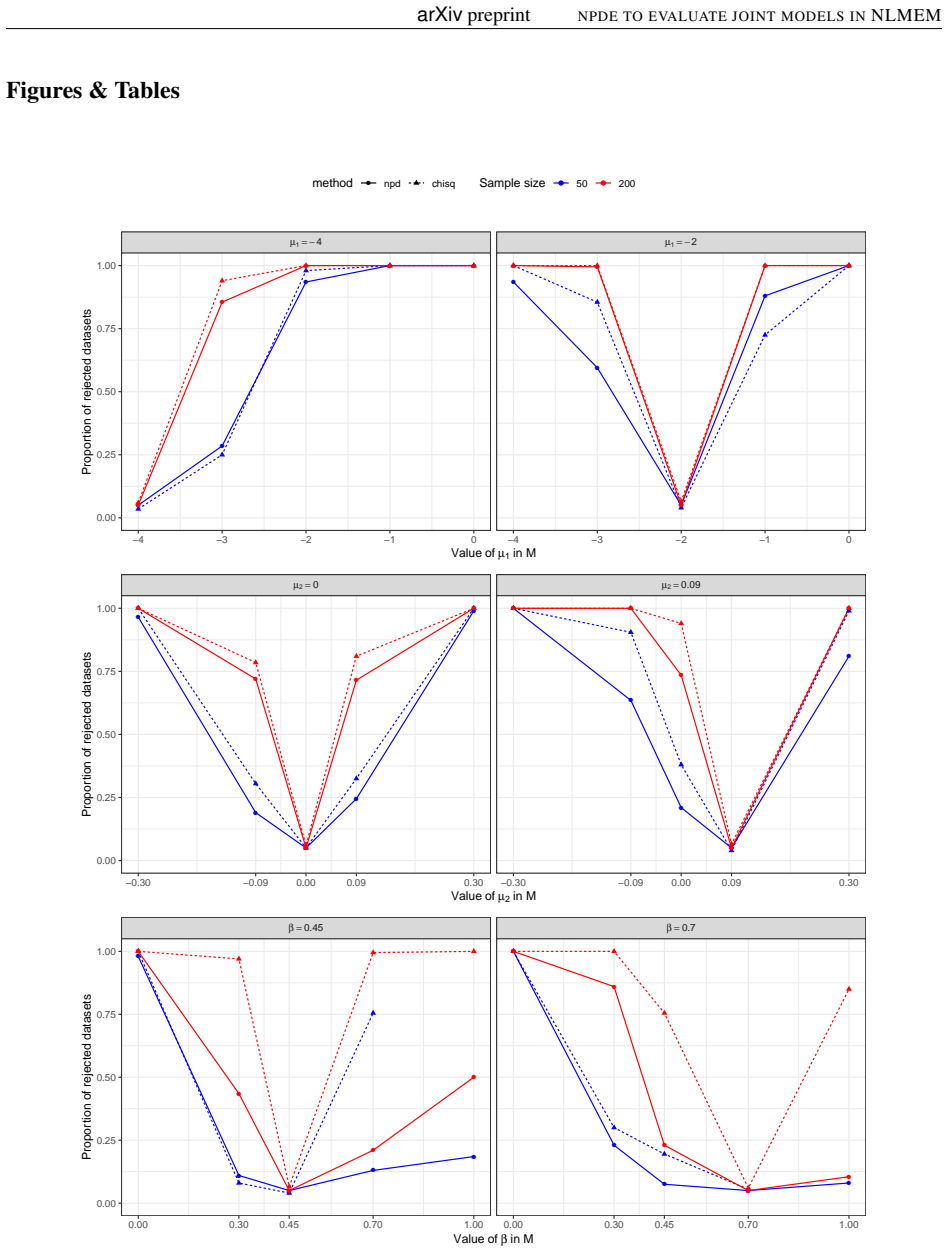
Normalised prediction distribution errors can be adapted to categorical observations using jittering techniques to produce npd residuals whose theoretical distribution under the null hypothesis is standard normal. The Kolmogorov-Smirnov test then evaluates whether observations in dataset V are described by model M, and graphs of these residuals allow visual assessment of fit. Simulations confirm increasing power to detect misspecifications with larger sample sizes and greater differences in probability shapes, and the approach is illustrated on unbalanced clinical data from a toenail infection study.
What carries the argument
Jittering applied to categorical observations to generate normalised prediction distribution errors (npd) that support Kolmogorov-Smirnov testing and graphical model evaluation under the null hypothesis of correct model specification.
If this is right
- npd detects misspecifications in the structural model and in parameter values.
- Power to detect misspecifications increases with sample size and with larger differences in the shape of the probability distributions.
- The method can be applied in unbalanced designs common in clinical settings.
- Graphs of npd residuals can evaluate covariate effects in addition to overall model fit.
Where Pith is reading between the lines
- The extension may enable routine application of npde-style diagnostics in pharmacometric analyses of ordinal clinical endpoints.
- Combining npd graphs with other residual-based checks could help isolate specific sources of model inadequacy.
- Alternative jittering schemes could be explored to improve approximation quality for particular ordinal response scales.
Load-bearing premise
Jittering categorical observations produces npd residuals whose distribution under the correct model is close enough to standard normal for the Kolmogorov-Smirnov test to have valid type I error and power.
What would settle it
Generate repeated datasets from a known correct categorical model, apply the jittering procedure and npd computation, then check whether the Kolmogorov-Smirnov test rejects at rates near the nominal significance level across replications.
Figures


read the original abstract
Introduction: Normalised prediction distribution errors (npde) are used to graphically and statistically evaluate continuous responses in non-linear mixed effect models. Here, our aim was to extend npde for categorical data and to evaluate their performance. We applied our approach to a real case-study describing the evolution of severe onychomycosis (toenail infection) in a trial comparing two treatment groups. Methods: Let V denote a dataset with categorical observations. The null hypothesis H0 is that observations in V can be described by a model M. Residuals called npde can be adapted to categorical observations using jittering techniques. Their theoretical standard normal distribution can be evaluated through the Kolmogorov-Smirnov test. We evaluated the performance in terms of power through a simulation and compared it to a Chi-square. We illustrated the test and graphs on a real case-study. Results: npd were able to detect misspecifications in the structural model and model parameter value. As expected, the power to detect model misspecifications increased both with the difference in the shape of the probability, and with the sample size. Chi-square test performed better but npd could be readily applied in all type of design. Based on the toe-nail data, graphs reveal a huge discrepancy of the base model, and a good adequation for the best model we found. Conclusions: npde can be extended to categorical data, particularly in clinical settings with unbalanced design and graphs can be useful to evaluate the model as well as the covariate effects.
Editorial analysis
A structured set of objections, weighed in public.
Referee Report
Summary. The manuscript proposes extending normalized prediction distribution errors (npde) to ordinal and categorical data via jittering techniques, enabling Kolmogorov-Smirnov testing and graphical diagnostics for model evaluation in nonlinear mixed-effects models. Performance is assessed through simulations demonstrating power to detect structural misspecifications and incorrect parameter values (increasing with probability shape differences and sample size), compared against a chi-square test, and illustrated on a real toenail onychomycosis dataset showing graphical detection of base-model discrepancies and adequacy of an improved model.
Significance. If the post-jittering residuals are shown to have a distribution sufficiently close to N(0,1) under the null, the extension would provide a valuable addition to model-checking tools for clinical and pharmacometric applications involving ordinal outcomes, particularly unbalanced longitudinal designs where chi-square tests may not apply. The dual statistical and graphical approach could aid diagnosis of both model misspecification and covariate effects, addressing a recognized gap in existing npde methodology limited to continuous responses.
major comments (3)
- [Methods] Methods: The jittering procedure for adapting npde to categorical observations is described, but no verification (analytic, simulation-based, or diagnostic) is provided that the resulting residuals follow a distribution close enough to standard normal under H0 for the Kolmogorov-Smirnov test to have correct size. This assumption is load-bearing for both the formal test and the claimed power results, especially given potential residual discreteness or asymmetry in ordinal data with unbalanced designs or small per-subject counts.
- [Results] Results: Power behavior is summarized qualitatively (increasing with shape difference and sample size), yet no quantitative power values, simulation details (replicates, specific misspecification scenarios, design structures), type-I error rates, or QQ-plot diagnostics under the null are reported. Without these, the performance claims and the comparison stating that the chi-square test 'performed better' cannot be evaluated.
- [Abstract] Abstract/Results: The statement that npd 'could be readily applied in all type of design' while chi-square cannot is asserted without supporting evidence on the simulation designs used or explicit demonstration of chi-square inapplicability in unbalanced cases; this weakens the practical-advantage claim.
minor comments (3)
- [Abstract] Abstract: Inconsistent abbreviation ('npde' early, 'npd' later and in conclusions); standardize throughout.
- [Abstract] Abstract: Minor phrasing issues ('adequation' better rendered as 'adequacy'; 'toe-nail' hyphenation inconsistent with 'toenail' in title).
- [Methods] Methods: Additional detail on the exact jittering bounds (uniform noise within category intervals) and software implementation would aid reproducibility.
Simulated Author's Rebuttal
We thank the referee for their constructive and detailed comments on our manuscript extending npde to categorical data. The points raised are valid and have prompted us to strengthen the presentation with additional verification, quantitative results, and clarification of claims. We address each major comment below.
read point-by-point responses
-
Referee: [Methods] Methods: The jittering procedure for adapting npde to categorical observations is described, but no verification (analytic, simulation-based, or diagnostic) is provided that the resulting residuals follow a distribution close enough to standard normal under H0 for the Kolmogorov-Smirnov test to have correct size. This assumption is load-bearing for both the formal test and the claimed power results, especially given potential residual discreteness or asymmetry in ordinal data with unbalanced designs or small per-subject counts.
Authors: We acknowledge that explicit verification of the post-jittering npde distribution under the null was not included in the original submission. While jittering is a standard technique for enabling continuous diagnostics on discrete data, we have added a dedicated subsection in the revised Methods describing simulation-based checks: data were generated under the true model across the range of designs considered, and the resulting npde were assessed via QQ-plots, histograms, and empirical KS p-value distributions. These confirm that the residuals are sufficiently close to N(0,1) for the test to have appropriate size in the scenarios examined, with a brief discussion of potential limitations in very small per-subject samples. revision: yes
-
Referee: [Results] Results: Power behavior is summarized qualitatively (increasing with shape difference and sample size), yet no quantitative power values, simulation details (replicates, specific misspecification scenarios, design structures), type-I error rates, or QQ-plot diagnostics under the null are reported. Without these, the performance claims and the comparison stating that the chi-square test 'performed better' cannot be evaluated.
Authors: We agree that the original Results section lacked sufficient quantitative detail. The revised manuscript now includes tables reporting power values (e.g., 0.25–0.92 across shape differences and sample sizes), simulation settings (1000 replicates per scenario), explicit misspecification types (structural probability shape changes and parameter value errors), design structures (balanced and unbalanced longitudinal), and type-I error rates near the nominal 0.05 level. QQ-plots under the null are provided in a new supplementary figure. The chi-square comparison is now supported by these numbers, noting its higher power in the tested cases while highlighting npde advantages elsewhere. revision: yes
-
Referee: [Abstract] Abstract/Results: The statement that npd 'could be readily applied in all type of design' while chi-square cannot is asserted without supporting evidence on the simulation designs used or explicit demonstration of chi-square inapplicability in unbalanced cases; this weakens the practical-advantage claim.
Authors: This criticism is well-taken. We have revised the Abstract and Conclusions to a more precise statement: 'npde can be applied across balanced and unbalanced designs, whereas chi-square tests may be limited when expected counts are low.' The Methods now explicitly describe the simulation designs used (including unbalanced longitudinal structures) and explain the conditions under which chi-square tests become unreliable (sparse cells in categorical longitudinal data), supported by standard references. This provides the requested evidence without overstating generality. revision: partial
Circularity Check
Minor self-citation of npde foundation; extension via jittering remains independent
full rationale
The derivation chain consists of adapting the pre-existing npde framework (cited as established) to categorical observations through standard jittering, followed by application of the Kolmogorov-Smirnov test against the theoretical N(0,1) null. No equation or central quantity is defined in terms of itself, no fitted parameter is relabeled as a prediction, and the simulation-based power evaluation is performed on independent replicates rather than the same data used to construct the residuals. The presence of an original npde author among the current authors constitutes a self-citation, but it is not load-bearing for the new extension, which rests on external jittering techniques and a standard goodness-of-fit test.
Axiom & Free-Parameter Ledger
axioms (1)
- domain assumption Jittering techniques transform categorical observations so that the resulting npd follow a distribution close enough to standard normal for the Kolmogorov-Smirnov test to be applicable under the null hypothesis.
Reference graph
Works this paper leans on
-
[1]
Journal of Pharmacokinetics and Pharmacodynamics , author =
Extension of. Journal of Pharmacokinetics and Pharmacodynamics , author =. 2012 , PAGES =
2012
-
[2]
Journal of Pharmacokinetics and Pharmacodynamics , author =
Prediction. Journal of Pharmacokinetics and Pharmacodynamics , author =. 2006 , PAGES =
2006
-
[3]
Computer Methods and Programs in Biomedicine , author =
Computing normalised prediction distribution errors to evaluate nonlinear mixed-effect models:. Computer Methods and Programs in Biomedicine , author =. 2008 , PAGES =
2008
-
[4]
Journal of Pharmacokinetics and Pharmacodynamics , author =
Evaluation of different tests based on observations for external model evaluation of population analyses , volume =. Journal of Pharmacokinetics and Pharmacodynamics , author =. 2010 , PAGES =
2010
-
[5]
Model evaluation in nonlinear mixed effect models, with applications to pharmacokinetics , volume =
Comets, Emmanuelle and Brendel, Karl and Mentré, France , journal =. Model evaluation in nonlinear mixed effect models, with applications to pharmacokinetics , volume =. 2010 , PAGES =
2010
-
[6]
Clin Pharmacokinet , author =
Are population pharmacokinetic and/or pharmacodynamic models adequately evaluated?. Clin Pharmacokinet , author =. 2007 , pmid =
2007
-
[7]
The American Association of Pharmaceutical Scientists Journal , author =
Nonlinear. The American Association of Pharmaceutical Scientists Journal , author =. 2015 , PAGES =
2015
-
[8]
CPT: pharmacometrics & systems pharmacology , author =
Model. CPT: pharmacometrics & systems pharmacology , author =. 2017 , PAGES =
2017
-
[9]
Pharmaceutical Research , author =
Metrics for external model evaluation with an application to the population pharmacokinetics of gliclazide , volume =. Pharmaceutical Research , author =. 2006 , pmid =
2006
-
[10]
Pharmaceutical Research , author =
Development and performance of npde for the evaluation of time-to-event models , volume =. Pharmaceutical Research , author =. 2018 , PAGES =
2018
-
[11]
Biometrics , author =
Using the. Biometrics , author =. 2017 , pmid =
2017
-
[12]
Clinical Pharmacology & Therapeutics , author =
Association between tumor size kinetics and survival in urothelial carcinoma patients treated with atezolizumab: implication for patient's follow-up , AAissn =. Clinical Pharmacology & Therapeutics , author =. 2019 , pmid =
2019
-
[13]
BMC Med Res Methodol , author =
Joint models for longitudinal and time-to-event data: a review of reporting quality with a view to meta-analysis , volume =. BMC Med Res Methodol , author =. 2016 , pmid =
2016
-
[14]
J Psychiatr Res , author =
Statistical. J Psychiatr Res , author =. 2007 , pmid =
2007
-
[15]
World Psychiatry , author =
Has the rising placebo response impacted antidepressant clinical trial outcome?. World Psychiatry , author =. 2017 , pmid =
2017
-
[16]
Journal of Psychiatric Research , author =
Severity of depressive symptoms and response to antidepressants and placebo in antidepressant trials , volume =. Journal of Psychiatric Research , author =. 2005 , keywords =
2005
-
[17]
Neuropsychopharmacology , author =
Effect of. Neuropsychopharmacology , author =. 2003 , PAGES =
2003
-
[18]
Annu Rev Public Health , author =
The epidemiology of depression across cultures , volume =. Annu Rev Public Health , author =. 2013 , pmid =
2013
-
[19]
Educational Measurement: Issues and Practice , author =
A. Educational Measurement: Issues and Practice , author =. 1997 , PAGES =
1997
-
[20]
JAMA , author =
Cross-national epidemiology of major depression and bipolar disorder , volume =. JAMA , author =. 1996 , pmid =
1996
-
[21]
Social Science & Medicine , author =
Gender differences in depression in 23. Social Science & Medicine , author =. 2010 , keywords =
2010
-
[22]
Am J Psychiatry , author =
Multiple recurrences of major depressive disorder , volume =. Am J Psychiatry , author =. 2000 , PAGES =
2000
-
[23]
World J Biol Psychiatry , author =
Mode of action of agomelatine: synergy between melatonergic and 5-. World J Biol Psychiatry , author =. 2011 , PAGES =
2011
-
[24]
Lancet , author =
Comparative efficacy and acceptability of 21 antidepressant drugs for the acute treatment of adults with major depressive disorder: a systematic review and network meta-analysis , volume =. Lancet , author =. 2018 , PAGES =
2018
-
[25]
Br Med J , author =
Antidepressant efficacy of agomelatine: meta-analysis of published and unpublished studies , volume =. Br Med J , author =. 2014 , PAGES =
2014
-
[26]
J Nerv Ment Dis , author =
Placebo response and antidepressant clinical trial outcome , volume =. J Nerv Ment Dis , author =. 2003 , PAGES =
2003
-
[27]
J Clin Psychiatry , author =
Correlation between different levels of placebo response rate and clinical trial outcome in major depressive disorder: a meta-analysis , volume =. J Clin Psychiatry , author =. 2012 , PAGES =
2012
-
[28]
J Neurol Neurosurg Psychiatry , author =
A rating scale for depression , volume =. J Neurol Neurosurg Psychiatry , author =. 1960 , PAGES =
1960
-
[29]
Acta Psychiatr Scand , author =
The use of rating scales exemplified by a comparison of the. Acta Psychiatr Scand , author =. 1980 , PAGES =
1980
-
[30]
J Psychiatr Res , author =
Exactly what does the. J Psychiatr Res , author =. 1993 , PAGES =
1993
-
[31]
Br J Psychiatry , author =
A new depression scale designed to be sensitive to change , volume =. Br J Psychiatry , author =. 1979 , PAGES =
1979
-
[32]
Pharmacopsychiatry , author =
Improving the assessment of severity of depressive states: a reduction of the. Pharmacopsychiatry , author =. 1985 , PAGES =
1985
-
[33]
Am J Psychiatry , author =
The. Am J Psychiatry , author =. 2004 , PAGES =
2004
-
[34]
J Psychiatr Res , author =
The responsiveness of the. J Psychiatr Res , author =. 2000 , PAGES =
2000
-
[35]
Dialogues Clin Neurosci , author =
Core symptoms of major depressive disorder: relevance to diagnosis and treatment , volume =. Dialogues Clin Neurosci , author =. 2008 , PAGES =
2008
-
[36]
J Psychiatry Neurosci , author =
Assessing full remission , volume =. J Psychiatry Neurosci , author =. 2002 , PAGES =
2002
-
[37]
Pharmaceutical Research , author =
Improved utilization of. Pharmaceutical Research , author =. 2014 , PAGES =
2014
-
[38]
Pharmaceutical Research , author =
Item response theory as an efficient tool to describe a heterogeneous clinical rating scale in de novo idiopathic. Pharmaceutical Research , author =. 2017 , PAGES =
2017
-
[39]
Alzheimer's Res Ther , author =
New scoring methodology improves the sensitivity of the. Alzheimer's Res Ther , author =. 2015 , PAGES =
2015
-
[40]
Neurology , author =
Differences in. Neurology , author =. 2015 , PAGES =
2015
-
[41]
Psychol Assess , author =
An approach for estimating item sensitivity to within-person change over time:. Psychol Assess , author =. 2016 , PAGES =
2016
-
[42]
The American Association of Pharmaceutical Scientists Journal , author =
Application of item response theory to modeling of expanded disability status scale in multiple sclerosis , volume =. The American Association of Pharmaceutical Scientists Journal , author =. 2017 , PAGES =
2017
-
[43]
The American Association of Pharmaceutical Scientists Journal , author =
Modeling a. The American Association of Pharmaceutical Scientists Journal , author =. 2017 , PAGES =
2017
-
[44]
Br J Clin Pharmacol , author =
Model-based assessment of the benefits and risks of recombinant tissue plasminogen activator treatment in acute ischaemic stroke , volume =. Br J Clin Pharmacol , author =. 2018 , keywords =
2018
-
[45]
Journal of Pharmacokinetics and Pharmacodynamics , author =
An item response theory based integrated model of headache, nausea, photophobia, and phonophobia in migraine patients , volume =. Journal of Pharmacokinetics and Pharmacodynamics , author =. 2018 , PAGES =
2018
-
[46]
The basics of item response theory , publisher =
Baker, Frank B , year =. The basics of item response theory , publisher =
-
[47]
A double-blind comparison of paroxetine with imipramine in the long-term treatment of depression
Claghorn, James L and Feighner, John P , year =. A double-blind comparison of paroxetine with imipramine in the long-term treatment of depression. , journal =
-
[48]
Psychiatry Res , author =
Nocebo in clinical trials for depression: a meta-analysis , volume =. Psychiatry Res , author =. 2014 , PAGES =
2014
-
[49]
Journal of Pharmacokinetics and Pharmacodynamics , author =
A joint model for nonlinear longitudinal data with informative dropout , volume =. Journal of Pharmacokinetics and Pharmacodynamics , author =. 2003 , PAGES =
2003
-
[50]
The American Association of Pharmaceutical Scientists Journal , author =
Performance of nonlinear mixed effects models in the presence of informative dropout , volume =. The American Association of Pharmaceutical Scientists Journal , author =. 2015 , PAGES =
2015
-
[51]
Eur J Pharm Sci , author =
Modelling placebo response in depression trials using a longitudinal model with informative dropout , volume =. Eur J Pharm Sci , author =. 2009 , PAGES =
2009
-
[52]
, volume =
Agomelatine prevents relapse in patients with major depressive disorder without evidence of a discontinuation syndrome: a 24-week randomized, double-blind, placebo-controlled trial. , volume =. J Clin Psychiatry , author =. 2009 , PAGES =
2009
-
[53]
Int J Neuropsychopharmacol , author =
Efficacy of agomelatine, a. Int J Neuropsychopharmacol , author =. 2007 , PAGES =
2007
-
[54]
Eur Neuropsychopharmacol , author =
Placebo-controlled trial of agomelatine in the treatment of major depressive disorder , volume =. Eur Neuropsychopharmacol , author =. 2006 , PAGES =
2006
-
[55]
, volume =
The efficacy of agomelatine in elderly patients with recurrent major depressive disorder: a placebo-controlled study. , volume =. J Clin Psychiatry , author =. 2013 , PAGES =
2013
-
[56]
Journal of Pharmacokinetics and Pharmacodynamics , author =
Comparison of proportional and differential odds models for mixed-effects analysis of categorical data , volume =. Journal of Pharmacokinetics and Pharmacodynamics , author =. 2008 , keywords =
2008
-
[57]
Abstracts of the XI annual meeting of the population approach group in Europe , author =
Population disease progress models for the time course of. Abstracts of the XI annual meeting of the population approach group in Europe , author =
-
[58]
Br J Clin Pharmacol , author =
Bayesian modelling and. Br J Clin Pharmacol , author =. 2007 , PAGES =
2007
-
[59]
Developing models of disease progression , journal =
Mould, Diane R , year =. Developing models of disease progression , journal =
-
[60]
Journal of Pharmacokinetics and Pharmacodynamics , author =
Modelling response time proAAfiles in the absence of drug concentrations: definition and performance evaluation of the. Journal of Pharmacokinetics and Pharmacodynamics , author =. 2007 , PAGES =
2007
-
[61]
Proc Natl Acad Sci U S A , author =
Methodologic aspects of a population pharmacodynamic model for cognitive effects in. Proc Natl Acad Sci U S A , author =. 1992 , PAGES =
1992
-
[62]
Clinical Pharmacology & Therapeutics , author =
Joint. Clinical Pharmacology & Therapeutics , author =. 2012 , PAGES =
2012
-
[63]
Journal of Pharmacokinetics and Pharmacodynamics , author =
Evaluation of structural models to describe the effect of placebo upon the time course of major depressive disorder , volume =. Journal of Pharmacokinetics and Pharmacodynamics , author =. 2009 , PAGES =
2009
-
[64]
and ICON, Development, Solutions , AAmonth = mar, year =
Bauer, J.R. and ICON, Development, Solutions , AAmonth = mar, year =
-
[65]
Statistical power analysis for the behavioral sciences 2nd edn , publisher =
Cohen, Jacob , year =. Statistical power analysis for the behavioral sciences 2nd edn , publisher =
-
[66]
J Affect Disord , author =
Severity classification on the. J Affect Disord , author =. 2013 , PAGES =
2013
-
[67]
Med Clin North Am , author =
Major depression , volume =. Med Clin North Am , author =. 2014 , PAGES =
2014
-
[68]
Int J Neuropsychopharmacol , author =
Efficacy of agomelatine in major depressive disorder: meta-analysis and appraisal , volume =. Int J Neuropsychopharmacol , author =. 2012 , PAGES =
2012
-
[69]
Br J Psychiatry , author =
Agomelatine efficacy and acceptability revisited: systematic review and meta-analysis of published and unpublished randomised trials , volume =. Br J Psychiatry , author =. 2013 , PAGES =
2013
-
[70]
Rating scales for depression , booktitle =
Cusin, Cristina and Yang, Huaiyu and Yeung, Albert and Fava, Maurizio , year =. Rating scales for depression , booktitle =
-
[71]
Lavielle, Marc , publisher =
-
[72]
Generalized Linear Models , author =
-
[73]
Nat Rev Drug Discov , author =
Agomelatine, the first melatonergic antidepressant: discovery, characterization and development , volume =. Nat Rev Drug Discov , author =. 2010 , PAGES =
2010
-
[74]
J Am Stat Assoc , author =
Modeling the drop-out mechanism in repeated-measures studies , volume =. J Am Stat Assoc , author =. 1995 , PAGES =
1995
-
[75]
version 2016R1 , year =
-
[76]
Mixed effects models for the population approach: models, tasks, methods and tools , publisher =
Lavielle, Marc , year =. Mixed effects models for the population approach: models, tasks, methods and tools , publisher =
-
[77]
Guideline on reporting the results of population pharmacokinetic analysis
EMA , journal =. Guideline on reporting the results of population pharmacokinetic analysis
-
[78]
American Conference on Pharmacometrics, October 4-7, 2009, Mashantucket, USA , author =
Prediction. American Conference on Pharmacometrics, October 4-7, 2009, Mashantucket, USA , author =
2009
-
[79]
A tutorial on
Karlsson, M and Holford, N , year =. A tutorial on. 17 ^
-
[80]
Clinical Pharmacology & Therapeutics , author =
Diagnosing model diagnostics , volume =. Clinical Pharmacology & Therapeutics , author =. 2007 , PAGES =
2007
discussion (0)
Sign in with ORCID, Apple, or X to comment. Anyone can read and Pith papers without signing in.