Recognition: 3 theorem links
· Lean TheoremAnomaly-Preference Image Generation
Pith reviewed 2026-05-08 18:40 UTC · model grok-4.3
The pith
Reformulating anomaly image generation as preference learning allows diffusion models to create more realistic and diverse anomalous samples from limited data.
A machine-rendered reading of the paper's core claim, the machinery that carries it, and where it could break.
Core claim
Anomaly Preference Optimization reformulates anomaly generation as a preference learning problem. An implicit preference alignment mechanism leverages real anomalies as positive references to derive optimization signals directly from denoising trajectory deviations. A Time-Aware Capacity Allocation module dynamically distributes model capacity along the diffusion timeline, prioritizing structural diversity in high-noise phases and fine-grained fidelity in low-noise stages. During inference, a hierarchical sampling strategy provides control over the coherence-alignment trade-off.
What carries the argument
Anomaly Preference Optimization, an implicit preference alignment mechanism that uses real anomalies to guide denoising trajectories, augmented by a Time-Aware Capacity Allocation module that adjusts capacity based on noise levels.
Load-bearing premise
That using real anomalies as positive references can provide reliable optimization signals from denoising deviations without causing distribution misalignment or overfitting, while the time-aware module effectively balances fidelity and diversity.
What would settle it
Compare the accuracy of anomaly detectors trained on this method's outputs versus previous methods on a standard benchmark dataset; if no improvement is seen in detection rates or if diversity metrics do not increase, the claims would be challenged.
Figures
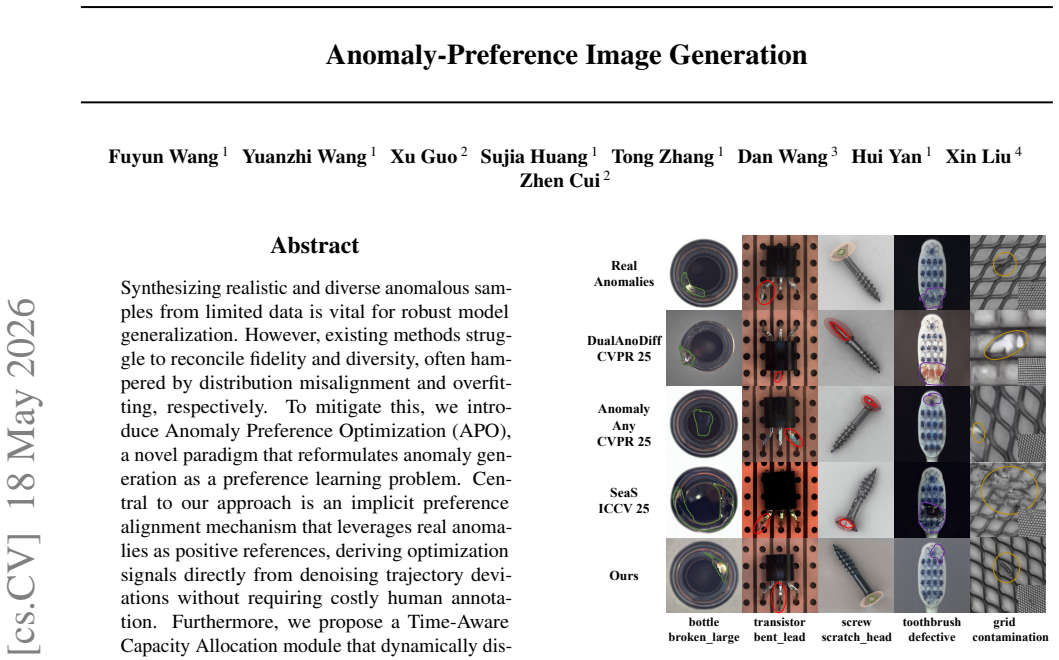


read the original abstract
Synthesizing realistic and diverse anomalous samples from limited data is vital for robust model generalization. However, existing methods struggle to reconcile fidelity and diversity, often hampered by distribution misalignment and overfitting, respectively.To mitigate this, we introduce Anomaly Preference Optimization,a novel paradigm that reformulates anomaly generation as a preference learning problem.Central to our approach is an implicit preference alignment mechanism that leverages real anomalies as positive references, deriving optimization signals directly from denoising trajectory deviations without requiring costly human annotation. Furthermore, we propose a Time-Aware Capacity Allocation module that dynamically distributes model capacity along the diffusion timeline,prioritizing structural diversity during highnoise phases while enhancing fine-grained fidelity in low-noise stages. During inference, a hierarchical sampling strategy modulates the coherencealignment trade-off, enabling precise control over generation. Extensive experiments demonstrate that significantly outperforms existing baselines,achieving state-of-the-art performance in both realism and diversity.
Editorial analysis
A structured set of objections, weighed in public.
Referee Report
Summary. The paper introduces Anomaly Preference Optimization (APO), a paradigm that reformulates anomaly image generation as an implicit preference learning problem over diffusion trajectories. It uses real anomalies as positive references to derive optimization signals from denoising deviations without human annotation, proposes a Time-Aware Capacity Allocation module to dynamically balance structural diversity (high-noise stages) and fine-grained fidelity (low-noise stages), and employs hierarchical sampling for coherence-fidelity control. The central claim is that extensive experiments show APO significantly outperforms baselines and achieves SOTA results in both realism and diversity.
Significance. If the experimental results hold, the work could advance anomaly synthesis in computer vision by addressing fidelity-diversity trade-offs without explicit annotations. The implicit alignment from trajectory deviations and time-aware capacity allocation are plausible mechanisms for mitigating distribution misalignment and overfitting. These elements, if validated, would strengthen diffusion-based generation for downstream tasks like robust anomaly detection.
major comments (1)
- Abstract: the assertion that the method 'significantly outperforms existing baselines, achieving state-of-the-art performance in both realism and diversity' is unsupported by any quantitative metrics, baselines, evaluation protocols, tables, or figures. Without this evidence the central claim cannot be assessed.
minor comments (1)
- Abstract: typographical issues include missing subject in 'that significantly outperforms' (should read 'APO significantly outperforms' or equivalent), 'highnoise' (should be 'high-noise'), and 'coherencealignment' (should be 'coherence-alignment').
Simulated Author's Rebuttal
We thank the referee for the constructive feedback on our manuscript. We address the major comment point by point below, providing clarifications and indicating revisions where appropriate.
read point-by-point responses
-
Referee: Abstract: the assertion that the method 'significantly outperforms existing baselines, achieving state-of-the-art performance in both realism and diversity' is unsupported by any quantitative metrics, baselines, evaluation protocols, tables, or figures. Without this evidence the central claim cannot be assessed.
Authors: We agree that the abstract's claim should be clearly grounded in the manuscript's evidence. The full paper details extensive experiments in Section 4, including quantitative metrics (e.g., FID and LPIPS for realism, MS-SSIM and diversity indices), comparisons to baselines such as standard diffusion models and prior anomaly synthesis methods, explicit evaluation protocols, and supporting tables and figures that demonstrate the performance gains. The abstract summarizes these results. To directly address the concern, we will revise the abstract to include a brief, specific reference to key quantitative improvements (e.g., relative gains in the primary metrics) while preserving its length constraints. This revision will make the support explicit without altering the underlying claims. revision: yes
Circularity Check
No significant circularity detected
full rationale
The paper reformulates anomaly generation as a preference learning problem with an implicit alignment mechanism that takes real anomalies as external positive references and extracts signals from denoising trajectory deviations. The Time-Aware Capacity Allocation module is introduced as a new dynamic allocation strategy along the diffusion timeline. No self-definitional equations, fitted parameters renamed as predictions, or load-bearing self-citations appear in the provided material that would reduce the central claims to their own inputs by construction. The SOTA performance assertion rests on experimental results rather than internal redefinition. This constitutes a standard non-circular proposal of a new paradigm and module.
Axiom & Free-Parameter Ledger
invented entities (2)
-
Anomaly Preference Optimization
no independent evidence
-
Time-Aware Capacity Allocation module
no independent evidence
Lean theorems connected to this paper
-
IndisputableMonolith/Cost (Jcost, J(x) = ½(x+x⁻¹)-1)washburn_uniqueness_aczel unclearL_APO = E[-log sigmoid(-β_t (||ε_θ - ε||² - ||ε_ref - ε||²))], where β_t = -½βλ'_t
-
IndisputableMonolith/Foundation/DimensionForcing (8-tick period, parameter-free)n/a unclearTime-Aware Capacity Allocation: k(t) = ⌊k_min + (k_max - k_min)·(T-t)/T⌋ with k_min=4, k_max=32 as tuned hyperparameters
-
RS forcing chain (zero adjustable parameters)reality_from_one_distinction unclearWe initialize APO with the pre-trained weights from Stable Diffusion v1-4 ... guidance scale s_text = 6.5 and s_align = 3
Forward citations
Cited by 2 Pith papers
-
Mixture Prototype Flow Matching for Open-Set Supervised Anomaly Detection
MPFM uses flow matching with a Gaussian mixture prior on the velocity field and a mutual information maximizer to improve open-set anomaly detection over unimodal prototype methods.
-
Mixture Prototype Flow Matching for Open-Set Supervised Anomaly Detection
MPFM transforms normal features into a structured Gaussian mixture prototype space via a mixture velocity field and mutual information regularization to achieve state-of-the-art open-set supervised anomaly detection.
Reference graph
Works this paper leans on
-
[1]
Langley , title =
P. Langley , title =. Proceedings of the 17th International Conference on Machine Learning (ICML 2000) , address =. 2000 , pages =
2000
-
[2]
T. M. Mitchell. The Need for Biases in Learning Generalizations. 1980
1980
-
[3]
M. J. Kearns , title =
-
[4]
Machine Learning: An Artificial Intelligence Approach, Vol. I. 1983
1983
-
[5]
R. O. Duda and P. E. Hart and D. G. Stork. Pattern Classification. 2000
2000
-
[6]
Suppressed for Anonymity , author=
-
[7]
Newell and P
A. Newell and P. S. Rosenbloom. Mechanisms of Skill Acquisition and the Law of Practice. Cognitive Skills and Their Acquisition. 1981
1981
-
[8]
A. L. Samuel. Some Studies in Machine Learning Using the Game of Checkers. IBM Journal of Research and Development. 1959
1959
-
[9]
International conference on machine learning , pages=
Learning transferable visual models from natural language supervision , author=. International conference on machine learning , pages=. 2021 , organization=
2021
-
[10]
Proceedings of the AAAI conference on artificial intelligence , volume=
Anomalydiffusion: Few-shot anomaly image generation with diffusion model , author=. Proceedings of the AAAI conference on artificial intelligence , volume=
-
[11]
Proceedings of the Computer Vision and Pattern Recognition Conference , pages=
Dual-Interrelated Diffusion Model for Few-Shot Anomaly Image Generation , author=. Proceedings of the Computer Vision and Pattern Recognition Conference , pages=
-
[12]
Proceedings of the Computer Vision and Pattern Recognition Conference , pages=
Distribution Prototype Diffusion Learning for Open-set Supervised Anomaly Detection , author=. Proceedings of the Computer Vision and Pattern Recognition Conference , pages=
-
[13]
Advances in neural information processing systems , volume=
Direct preference optimization: Your language model is secretly a reward model , author=. Advances in neural information processing systems , volume=
-
[14]
Constitutional AI: Harmlessness from AI Feedback
Constitutional ai: Harmlessness from ai feedback , author=. arXiv preprint arXiv:2212.08073 , year=
work page internal anchor Pith review arXiv
-
[15]
the method of paired comparisons , author=
Rank analysis of incomplete block designs: I. the method of paired comparisons , author=. Biometrika , volume=. 1952 , publisher=
1952
-
[16]
Proceedings of the Computer Vision and Pattern Recognition Conference , pages=
Unseen Visual Anomaly Generation , author=. Proceedings of the Computer Vision and Pattern Recognition Conference , pages=
-
[17]
arXiv:2410.14987 doi:10.48550/ARXIV.2410.14987
SeaS: few-shot industrial anomaly image generation with separation and sharing fine-tuning , author=. arXiv preprint arXiv:2410.14987 , year=
-
[18]
Proceedings of the AAAI conference on artificial intelligence , volume=
Few-shot defect image generation via defect-aware feature manipulation , author=. Proceedings of the AAAI conference on artificial intelligence , volume=
-
[19]
Proceedings of the IEEE/CVF conference on computer vision and pattern recognition , pages=
Cutpaste: Self-supervised learning for anomaly detection and localization , author=. Proceedings of the IEEE/CVF conference on computer vision and pattern recognition , pages=
-
[20]
Proceedings of the IEEE/CVF conference on computer vision and pattern recognition , pages=
MVTec AD--A comprehensive real-world dataset for unsupervised anomaly detection , author=. Proceedings of the IEEE/CVF conference on computer vision and pattern recognition , pages=
-
[21]
Advances in neural information processing systems , volume=
Deep reinforcement learning from human preferences , author=. Advances in neural information processing systems , volume=
-
[22]
Training a Helpful and Harmless Assistant with Reinforcement Learning from Human Feedback
Training a helpful and harmless assistant with reinforcement learning from human feedback , author=. arXiv preprint arXiv:2204.05862 , year=
-
[23]
Aligning Text-to-Image Models using Human Feedback
Aligning text-to-image models using human feedback , author=. arXiv preprint arXiv:2302.12192 , year=
work page internal anchor Pith review arXiv
-
[24]
SLiC-HF : Sequence likelihood calibration with human feedback
Slic-hf: Sequence likelihood calibration with human feedback , author=. arXiv preprint arXiv:2305.10425 , year=
-
[25]
Orpo: Monolithic preference optimization without reference model , author=. arXiv preprint arXiv:2403.07691 , year=
-
[26]
Advances in Neural Information Processing Systems , volume=
Dpok: Reinforcement learning for fine-tuning text-to-image diffusion models , author=. Advances in Neural Information Processing Systems , volume=
-
[27]
Proceedings of the IEEE/CVF Conference on Computer Vision and Pattern Recognition , pages=
Diffusion model alignment using direct preference optimization , author=. Proceedings of the IEEE/CVF Conference on Computer Vision and Pattern Recognition , pages=
-
[28]
European conference on computer vision , pages=
Spot-the-difference self-supervised pre-training for anomaly detection and segmentation , author=. European conference on computer vision , pages=. 2022 , organization=
2022
-
[29]
Proceedings of the IEEE/CVF conference on computer vision and pattern recognition , pages=
High-resolution image synthesis with latent diffusion models , author=. Proceedings of the IEEE/CVF conference on computer vision and pattern recognition , pages=
-
[30]
Denoising Diffusion Implicit Models
Denoising diffusion implicit models , author=. arXiv preprint arXiv:2010.02502 , year=
work page Pith review arXiv 2010
-
[31]
Adam: A Method for Stochastic Optimization
Adam: A method for stochastic optimization , author=. arXiv preprint arXiv:1412.6980 , year=
work page internal anchor Pith review arXiv
-
[32]
2021 IEEE International Conference on Multimedia and Expo (ICME) , pages=
Few-shot defect segmentation leveraging abundant defect-free training samples through normal background regularization and crop-and-paste operation , author=. 2021 IEEE International Conference on Multimedia and Expo (ICME) , pages=. 2021 , organization=
2021
-
[33]
Proceedings of the IEEE/CVF international conference on computer vision , pages=
Draem-a discriminatively trained reconstruction embedding for surface anomaly detection , author=. Proceedings of the IEEE/CVF international conference on computer vision , pages=
-
[34]
Proceedings of the IEEE/CVF conference on computer vision and pattern recognition , pages=
Self-supervised predictive convolutional attentive block for anomaly detection , author=. Proceedings of the IEEE/CVF conference on computer vision and pattern recognition , pages=
-
[35]
IEEE Access , volume=
Cfa: Coupled-hypersphere-based feature adaptation for target-oriented anomaly localization , author=. IEEE Access , volume=. 2022 , publisher=
2022
-
[36]
Proceedings of the IEEE/CVF conference on computer vision and pattern recognition , pages=
Anomaly detection via reverse distillation from one-class embedding , author=. Proceedings of the IEEE/CVF conference on computer vision and pattern recognition , pages=
-
[37]
Proceedings of the IEEE/CVF conference on computer vision and pattern recognition , pages=
Towards total recall in industrial anomaly detection , author=. Proceedings of the IEEE/CVF conference on computer vision and pattern recognition , pages=
-
[38]
The Twelfth International Conference on Learning Representations , year=
Musc: Zero-shot industrial anomaly classification and segmentation with mutual scoring of the unlabeled images , author=. The Twelfth International Conference on Learning Representations , year=
-
[39]
arXiv preprint arXiv:2108.00462 , year=
Explainable deep few-shot anomaly detection with deviation networks , author=. arXiv preprint arXiv:2108.00462 , year=
-
[40]
Proceedings of the IEEE/CVF conference on computer vision and pattern recognition , pages=
Catching both gray and black swans: Open-set supervised anomaly detection , author=. Proceedings of the IEEE/CVF conference on computer vision and pattern recognition , pages=
-
[41]
Proceedings of the IEEE/CVF Conference on Computer Vision and Pattern Recognition , pages=
Prototypical residual networks for anomaly detection and localization , author=. Proceedings of the IEEE/CVF Conference on Computer Vision and Pattern Recognition , pages=
discussion (0)
Sign in with ORCID, Apple, or X to comment. Anyone can read and Pith papers without signing in.