Recognition: 3 theorem links
· Lean TheoremStochastic first-passage modeling of single-event burnout in SiC power MOSFETs
Pith reviewed 2026-05-08 18:10 UTC · model grok-4.3
The pith
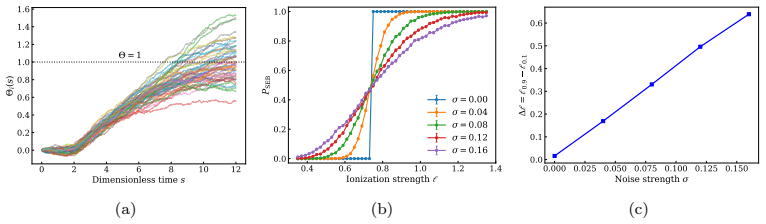
Finite fluctuations broaden the deterministic burnout threshold in SiC power MOSFETs into a probabilistic transition band.
A machine-rendered reading of the paper's core claim, the machinery that carries it, and where it could break.
Core claim
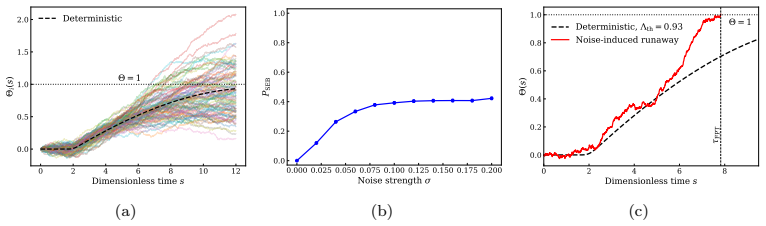
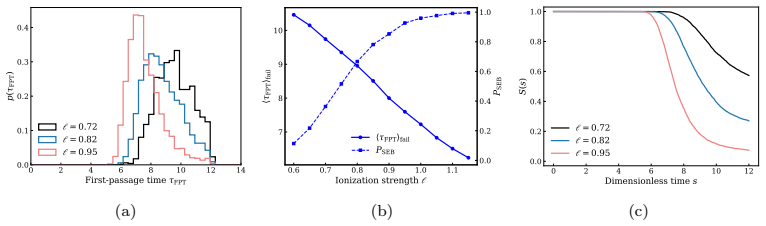
The central claim is that finite fluctuations in a reduced electrothermal feedback-relaxation model with stochastic carrier and thermal terms broaden the deterministic burnout threshold into a probabilistic transition band. Noise-induced subthreshold runaway appears, so that nominally recoverable conditions can still produce failure through rare stochastic excursions. First-passage-time distributions resolve the time scale of burnout while survival probabilities distinguish rapid feedback-dominated runaway from delayed stochastic failure. A feedback-relaxation phase diagram organizes the recoverable, probabilistic, and rapidly unstable regimes.
What carries the argument
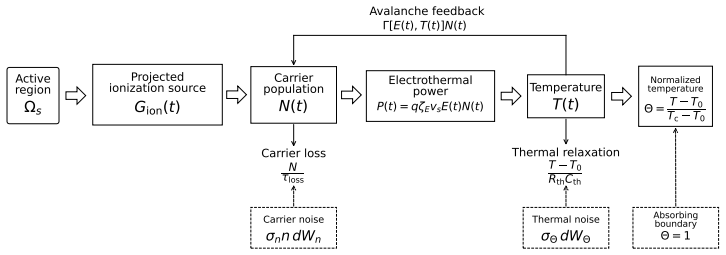
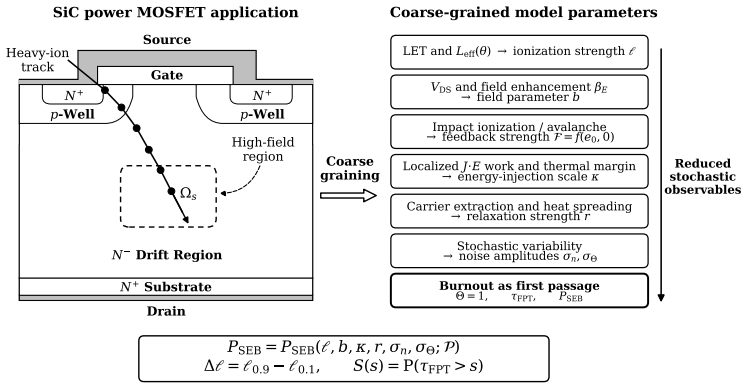
A reduced electrothermal feedback-relaxation model with an absorbing boundary and stochastic terms for unresolved carrier and thermal variability.
If this is right
- Burnout occurs with finite probability under conditions previously viewed as safe.
- First-passage time distributions give the characteristic time scales for both rapid and delayed failures.
- Survival probabilities quantify the likelihood of avoiding runaway.
- The phase diagram maps boundaries between recoverable, transitional, and unstable operating regimes.
Where Pith is reading between the lines
- Similar stochastic broadening may appear in avalanche or thermal runaway processes in other semiconductor devices.
- Device design could target reduced fluctuation amplitudes to shrink the width of the probabilistic failure band.
- Systematic measurements of failure rates versus strike energy near threshold could map the band width directly.
Load-bearing premise
The reduced electrothermal feedback-relaxation model with its chosen stochastic carrier and thermal terms is sufficient to capture the essential variability near the burnout boundary.
What would settle it
A high-statistics single-event test that finds zero burnout probability below the deterministic threshold and an abrupt step in failure rate would contradict the predicted probabilistic band and noise-induced subthreshold runaway.
Figures
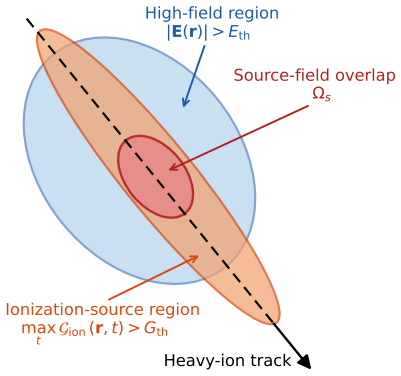



read the original abstract
Single-event burnout (SEB) in silicon carbide (SiC) power MOSFETs is often characterized by deterministic threshold quantities. Near the boundary between recovery and runaway, stochastic variability can make this threshold description probabilistic rather than sharp. This work introduces a first-passage perspective for stochastic threshold broadening in burnout. The process is described by a reduced electrothermal feedback-relaxation model with an absorbing boundary. The model combines carrier multiplication, avalanche feedback, localized heating, carrier loss, and thermal relaxation. Stochastic carrier and thermal terms represent unresolved event-level variability. The main finding is that finite fluctuations broaden the deterministic burnout threshold into a probabilistic transition band. Noise-induced subthreshold runaway also emerges, where nominally recoverable conditions can still fail through rare stochastic excursions. First-passage-time distributions resolve the time scale of burnout and survival probabilities further distinguish rapid feedback-dominated runaway from delayed stochastic failure. A feedback-relaxation phase diagram organizes recoverable, probabilistic, and rapidly unstable regimes. This framework provides a statistical-physics interpretation of threshold dispersion in single-event burnout of SiC power MOSFETs by linking coarse-grained electrothermal dynamics to probabilistic and time-resolved failure observables.
Editorial analysis
A structured set of objections, weighed in public.
Referee Report
Summary. The paper introduces a reduced electrothermal feedback-relaxation model augmented with stochastic carrier and thermal noise terms and an absorbing boundary to analyze single-event burnout (SEB) in SiC power MOSFETs via first-passage statistics. It claims that finite fluctuations convert the deterministic burnout threshold into a probabilistic transition band, that noise-induced subthreshold runaway occurs under nominally recoverable conditions, and that first-passage-time distributions and survival probabilities distinguish rapid feedback-driven failure from delayed stochastic events; a feedback-relaxation phase diagram organizes the regimes.
Significance. If the central construction holds, the work supplies a statistical-physics framework that links coarse-grained electrothermal dynamics to probabilistic failure observables and time scales. This perspective on threshold dispersion is potentially useful for reliability modeling of power devices, where deterministic thresholds are known to be insufficient near the recovery-runaway boundary. The explicit framing as an illustrative coarse-grained model rather than a quantitative predictor is appropriate and strengthens the contribution.
minor comments (3)
- [§2] The abstract and introduction refer to 'stochastic carrier and thermal terms' and 'first-passage-time distributions' without specifying the precise form of the noise (additive vs. multiplicative, white vs. colored) or the exact definition of the absorbing boundary; these should be stated explicitly in §2 or §3 with the governing SDEs.
- [Figures 3-5] Figure captions and axis labels for the phase diagram and survival-probability plots should include the precise parameter values or ranges used (e.g., noise amplitudes, feedback rates) so that the plotted regimes can be reproduced from the text alone.
- [§3] A brief statement on the numerical method used to integrate the stochastic equations and to compute first-passage times (e.g., Euler-Maruyama with fixed step or adaptive scheme) would improve reproducibility.
Simulated Author's Rebuttal
We thank the referee for the positive and constructive assessment of our manuscript. We are pleased that the statistical-physics framing, the broadening of the burnout threshold into a probabilistic band, and the utility for reliability modeling near the recovery-runaway boundary are viewed favorably. The recommendation for minor revision is appreciated, and we will incorporate any editorial or minor clarifications in the revised version.
Circularity Check
No significant circularity; derivation self-contained from model definition
full rationale
The paper constructs a reduced electrothermal feedback-relaxation model by combining explicit physical processes (carrier multiplication, avalanche feedback, localized heating, carrier loss, thermal relaxation) plus added stochastic carrier and thermal noise terms, then applies first-passage analysis with an absorbing boundary to obtain emergent observables such as broadened probabilistic thresholds, first-passage-time distributions, survival probabilities, and a feedback-relaxation phase diagram. These outputs are consequences of the stochastic dynamics rather than inputs, with no evidence of fitted parameters renamed as predictions, self-definitional loops, or load-bearing self-citations that reduce the central claim to its own assumptions. The modeling is explicitly coarse-grained to illustrate statistical-physics effects, keeping the chain independent of the target failure statistics.
Axiom & Free-Parameter Ledger
free parameters (2)
- stochastic carrier and thermal noise amplitudes
- electrothermal feedback and relaxation rates
axioms (1)
- domain assumption The reduced electrothermal feedback-relaxation model with absorbing boundary captures the essential dynamics near the burnout threshold.
Lean theorems connected to this paper
-
IndisputableMonolith/Cost/FunctionalEquation.lean (J-cost uniqueness) — no overlap; the paper's drift is an exp-of-inverse Chynoweth avalanche term, not the ratio-symmetric J(x)=½(x+x⁻¹)−1.washburn_uniqueness_aczel uncleardn = [g(s;ℓ) + (f(e,Θ)-1)n] ds + σ_n n dW_n(s); dΘ = [κ e(s) n − r Θ] ds + σ_Θ dW_Θ(s) ... Burnout was represented by an absorbing thermal boundary at Θ=1.
-
IndisputableMonolith/Foundation/AlphaCoordinateFixation.lean — RS forces zero free parameters; this paper has ~10 tunable phenomenological parameters chosen by hand.alpha_pin_under_high_calibration unclearTable 1 baseline normalized parameters: s0=2, σs=0.18, b=1.20, η_n=0.35, n_s=1, κ=0.16, r=0.18, A_f=5.50, B_f=2.20, a_Θ=0.12, s_c=12 ... selected to place the reduced electrothermal system near the feedback-relaxation transition.
-
IndisputableMonolith/Foundation/Atomicity.lean — addresses discrete event serialization with precedence; no shared machinery with continuous-time absorbing-boundary first-passage.atomic_tick_countable unclearFirst-passage time τ_FPT = inf{s>0 : Θ(s) ≥ 1}; P_SEB = P[τ_FPT ≤ s_c]. Survival S(s) = P(τ_FPT > s).
Reference graph
Works this paper leans on
-
[1]
Hänggi, P
P. Hänggi, P. Talkner, M. Borkovec, Reaction-rate theory: fifty years after kramers, Rev. Mod. Phys. 62 (1990) 251–341.doi:10.1103/ RevModPhys.62.251
1990
-
[2]
O. E. Gabriel, D. R. Huitink, Failure mechanisms driven reliability mod- els for power electronics: A review, Journal of Electronic Packaging 145 (2) (2023) 020801.doi:10.1115/1.4055774
-
[3]
A. Padovani, P. La Torraca, J. Strand, L. Larcher, A. L. Shluger, Di- electric breakdown of oxide films in electronic devices, Nature Reviews Materials 9 (9) (2024) 607–627.doi:10.1038/s41578-024-00702-0
-
[4]
S. Zapperi, P. Ray, H. E. Stanley, A. Vespignani, Avalanches in break- downandfractureprocesses, PhysicalReviewE59(5)(1999)5049–5057. doi:10.1103/PhysRevE.59.5049
-
[5]
A. Spang, M. Thielmann, D. Kiss, Rapid ductile strain localization due to thermal runaway, Journal of Geophysical Research: Solid Earth 129 (10) (2024) e2024JB028846.doi:10.1029/2024JB028846
-
[6]
J. Fu, W. Du, H. Hou, X. Zhao, Avalanche scaling law for heterogeneous interfacial fracture, Physica A: Statistical Mechanics and its Applica- tions 639 (2024) 129682.doi:10.1016/j.physa.2024.129682
-
[7]
C. Kuehn, A mathematical framework for critical transitions: Bifurca- tions, fast–slow systems and stochastic dynamics, Physica D: Nonlinear Phenomena 240 (12) (2011) 1020–1035.doi:10.1016/j.physd.2011. 02.012
-
[8]
T. Shoji, S. Nishida, K. Hamada, H. Tadano, Analysis of neutron- induced single-event burnout in sic power mosfets, Microelectronics Re- liability 55 (9–10) (2015) 1517–1521.doi:10.1016/j.microrel.2015. 06.081
-
[9]
C. Peng, X. Zhang, H. Guo, F. Zhang, X. Pan, Y. Liu, Z. Gu, A. Ju, X. Ouyang, Experimental and simulation studies of radiation-induced single event burnout in sic-based power mosfets, IET Power Electronics 14 (9) (2021) 1700–1712.doi:10.1049/pel2.12147. 38
-
[10]
D. T. Gillespie, Exact stochastic simulation of coupled chemical reac- tions, The Journal of Physical Chemistry 81 (25) (1977) 2340–2361. doi:10.1021/j100540a008
-
[11]
R. A. Weller, A. L. Sternberg, L. W. Massengill, R. D. Schrimpf, D. M. Fleetwood, Evaluating average and atypical response in radiation effects simulations, IEEE Transactions on Nuclear Science 50 (6) (2003) 2265– 2271.doi:10.1109/TNS.2003.821576
-
[12]
R. D. Schrimpf, R. A. Weller, M. H. Mendenhall, R. A. Reed, L. W. Massengill, Physical mechanisms of single-event effects in advanced mi- croelectronics, Nuclear Instruments and Methods in Physics Research SectionB:BeamInteractionswithMaterialsandAtoms261(1–2)(2007) 1133–1136.doi:10.1016/j.nimb.2007.04.050
-
[13]
L. Ham, M. A. Coomer, K. Öcal, R. Grima, M. P. H. Stumpf, A stochas- tic vs deterministic perspective on the timing of cellular events, Nature Communications 15 (2024) 5286.doi:10.1038/s41467-024-49624-z
-
[14]
R. A. Reed, R. A. Weller, M. H. Mendenhall, J.-M. Lauenstein, K. M. Warren, J. A. Pellish, R. D. Schrimpf, B. D. Sierawski, L. W. Massengill, P. E. Dodd, M. R. Shaneyfelt, J. A. Felix, J. R. Schwank, N. F. Haddad, R. K. Lawrence, J. H. Bowman, R. Conde, Impact of ion energy and species on single event effects analysis, IEEE Transactions on Nuclear Science...
-
[15]
S. Redner, A first look at first-passage processes, Physica A: Statistical Mechanics and its Applications 631 (2023) 128545.doi:10.1016/j. physa.2023.128545
work page doi:10.1016/j 2023
-
[16]
Z. Schuss, A. Singer, D. Holcman, The narrow escape problem for diffu- sion in cellular microdomains, Proceedings of the National Academy of Sciences 104 (41) (2007) 16098–16103.doi:10.1073/pnas.0706599104
-
[17]
C. W. Gardiner, Stochastic Methods: A Handbook for the Natural and Social Sciences, 4th Edition, Springer, Berlin, 2009
2009
-
[18]
N. G. van Kampen, Stochastic Processes in Physics and Chemistry, 3rd Edition, North-Holland, Amsterdam, 2007. 39
2007
-
[19]
Risken, The Fokker–Planck Equation: Methods of Solution and Applications, 2nd Edition, Springer, Berlin, 1996.doi:10.1007/ 978-3-642-61544-3
H. Risken, The Fokker–Planck Equation: Methods of Solution and Applications, 2nd Edition, Springer, Berlin, 1996.doi:10.1007/ 978-3-642-61544-3
1996
-
[20]
Cambri dge University Press, Cambridge (2001)
S. Redner, A Guide to First-Passage Processes, Cambridge University Press, Cambridge, 2001.doi:10.1017/CBO9780511606014
-
[21]
J. A. McPherson, C. W. Hitchcock, T. P. Chow, W. Ji, A. A. Wood- worth, Mechanisms of heavy ion-induced single event burnout in 4h-sic power mosfets, Materials Science Forum 1004 (2020) 889–896.doi: 10.4028/www.scientific.net/MSF.1004.889
-
[22]
C.A.Grome, W.Ji, Abriefreviewofsingle-eventburnoutfailuremecha- nisms and design tolerances of silicon carbide power mosfets, Electronics 13 (8) (2024) 1414.doi:10.3390/electronics13081414
-
[23]
B. J. Baliga, Fundamentals of Power Semiconductor Devices, Springer, New York, 2008.doi:10.1007/978-0-387-47314-7
-
[24]
T. Kimoto, J. A. Cooper, Fundamentals of Silicon Carbide Technology: Growth, Characterization, Devices and Applications, Wiley, Singapore, 2014.doi:10.1002/9781118313534
-
[25]
H. Wang, J. Gu, X. Huang, et al., Single-event burnout resilient design of 4h-sic mosfets through staircase-like buffer layer, Microelectronics Re- liability 154 (2024) 115344.doi:10.1016/j.microrel.2024.115344
-
[26]
M. Li, R. Yang, X. Chen, X. Liu, Q. Wang, J. Liu, Y. Wang, Sin- gle event burnout in sic mosfets induced by nuclear reactions with high-energy oxygen ions, Chinese Physics B (2025).doi:10.1088/ 1674-1056/adcd45
2025
-
[27]
H. Zhang, H.-X. Guo, F.-Q. Zhang, X.-Y. Pan, Y.-T. Liu, Z.-Q. Gu, A.-A. Ju, X.-P. Ouyang, Sensitivity of heavy-ion-induced single event burnout in sic mosfet, Chinese Physics B 31 (1) (2022) 018501.doi: 10.1088/1674-1056/ac051d
- [28]
-
[29]
F. W. Sexton, Destructive single-event effects in semiconductor devices and ics, IEEE Transactions on Nuclear Science 50 (3) (2003) 603–621. doi:10.1109/TNS.2003.813137
-
[30]
M. Pocaterra, M. Ciappa, Single event burnout failures caused in silicon carbide power devices by alpha particles emitted from radionuclides, e- Prime: Advances in Electrical Engineering, Electronics and Energy 5 (2023) 100203.doi:10.1016/j.prime.2023.100203
-
[31]
S. Kuboyama, S. Matsuda, T. Kanno, T. Ishii, Mechanism for single- event burnout of power mosfet’s and its characterization technique, IEEE Transactions on Nuclear Science 39 (6) (1992) 1698–1703.doi: 10.1109/23.211356
-
[32]
H. Wang, Z. Nie, X. Huang, J. Gu, Z. Tan, H. Jing, L. Mo, Z. Hu, X. Wang, The impact of negative gate voltage on neutron-induced sin- gle event effects for sic mosfets, Microelectronics Reliability 163 (2024) 115547.doi:10.1016/j.microrel.2024.115547
-
[33]
R. Coq Germanicus, A. Michez, K. Niskanen, M. Chaudhary, G. Bas- coul, V. Chazal, F. Wrobel, J. Boch, Single event effects of sic power mosfets: From neutron interaction to destruction at the die level, IEEE Transactions on Nuclear Science 72 (8) (2025) 2368–2376.doi: 10.1109/TNS.2025.3561583
-
[34]
Yuan, J.-K
Z. Yuan, J.-K. Lim, A. Metreveli, H. Krishna Murthy, M. Bakowski, A. Hallén, Single event effects in 3.3 kv 4h-sic mosfets due to mev ion impact, Solid State Phenomena 361 (2024) 77–83.doi:10.4028/ p-90Xrjk
2024
-
[35]
C. Martinella, S. Race, R. Stark, R. García Alía, A. Javanainen, U. Grossner, High-energy proton and atmospheric-neutron irradiations of sic power mosfets: Seb study and impact on channel and drift resis- tances, IEEE Transactions on Nuclear Science 70 (8) (2023) 1844–1851. doi:10.1109/TNS.2023.3267144
-
[36]
Y. Wang, M. Lin, X. J. Li, X. Wu, J. Q. Yang, M. T. Bao, C. H. Yu, F. Cao, Single-event burnout hardness for the 4h-sic trench-gate mosfets based on the multi-island buffer layer, IEEE Transactions on Electron Devices 66 (10) (2019) 4264–4272.doi:10.1109/TED.2019.2933026. 41
-
[37]
J.-X. Bi, Y. Wang, X. Wu, X.-J. Li, J.-Q. Yang, M.-T. Bao, F. Cao, Single-event burnout hardening method and evaluation in sic power mosfet devices, IEEE Transactions on Electron Devices 67 (10) (2020) 4340–4345.doi:10.1109/TED.2020.3015718
-
[38]
S. Sun, F. Chen, Y. Sun, Y. Li, K. Yang, X. Tang, Single event effects hardening in sic double-trench mosfets, Microelectronics Reliability 164 (2025) 115569.doi:10.1016/j.microrel.2024.115569
-
[39]
J. Kim, K. Kim, Single-event burnout hardening 4h-sic umosfet struc- ture, IEEE Transactions on Device and Materials Reliability 22 (2) (2022) 164–168.doi:10.1109/TDMR.2022.3151704
-
[40]
Q. Liao, H. Liu, Research on single-event burnout reinforcement struc- ture of sic mosfet, Micromachines 15 (5) (2024) 642.doi:10.3390/ mi15050642
2024
-
[41]
S. G. Alberton, V. A. P. Aguiar, N. H. Medina, N. Added, E. L. A. Macchione, R. Menegasso, G. J. Cesário, H. C. Santos, V. B. Scarduelli, J. A. Alcántara-Núñez, M. A. Guazzelli, R. B. B. Santos, D. Flechas, Charge deposition analysis of heavy-ion-induced single-event burnout in low-voltage power vdmosfet, Microelectronics Reliability 137 (2022) 114784.doi...
-
[42]
A. Sengupta, D. R. Ball, A. L. Sternberg, S. Islam, A. S. Senarath, R. A. Reed, M. W. McCurdy, E. X. Zhang, J. M. Hutson, M. L. Alles, J. M. Osheroff, B. Jacob, C. W. Hitchcock, S. Goswami, R. D. Schrimpf, K. F. Galloway, A. F. Witulski, Let and voltage dependence of single- event burnout and single-event leakage current in high-voltage sic power devices,...
-
[43]
Memory effects in irreversible thermodynamics.Phys
R. Zwanzig, Memory effects in irreversible thermodynamics, Physical Review 124 (4) (1961) 983–992.doi:10.1103/PhysRev.124.983
-
[44]
Transport, collective motion, and brownian motion
H. Mori, Transport, collective motion, and brownian motion, Progress of Theoretical Physics 33 (3) (1965) 423–455.doi:10.1143/PTP.33.423
-
[45]
E. L. Petersen, Single Event Effects in Aerospace, Wiley, Hoboken, 2011. doi:10.1002/9781118084328. 42
-
[46]
J. L. Titus, An updated perspective of single event gate rupture and single event burnout in power mosfets, IEEE Transactions on Nuclear Science 60 (3) (2013) 1912–1928.doi:10.1109/TNS.2013.2252194
-
[47]
R. J. Hardy, Formulas for determining local properties in molecular- dynamics simulations: Shock waves, The Journal of Chemical Physics 76 (1) (1982) 622–628.doi:10.1063/1.442714
-
[48]
G. C. Messenger, M. S. Ash, The Effects of Radiation on Electronic Systems, 2nd Edition, Van Nostrand Reinhold, New York, 1992
1992
-
[49]
S. M. Sze, K. K. Ng, Physics of Semiconductor Devices, 3rd Edition, Wiley, Hoboken, 2006.doi:10.1002/0470068329
-
[50]
J. F. Ziegler, M. D. Ziegler, J. P. Biersack, SRIM – the stopping and range of ions in matter (2010), Nuclear Instruments and Methods in Physics Research Section B: Beam Interactions with Materials and Atoms 268 (11–12) (2010) 1818–1823.doi:10.1016/j.nimb.2010.02. 091
-
[51]
S. Agostinelli, et al, GEANT4 – a simulation toolkit, Nuclear Instru- ments and Methods in Physics Research Section A: Accelerators, Spec- trometers, Detectors and Associated Equipment 506 (3) (2003) 250–303. doi:10.1016/S0168-9002(03)01368-8. 43
discussion (0)
Sign in with ORCID, Apple, or X to comment. Anyone can read and Pith papers without signing in.