Recognition: 2 theorem links
· Lean TheoremEfficient Temporal Datalog Materialisation for Composite Event Recognition
Pith reviewed 2026-05-08 18:31 UTC · model grok-4.3
The pith
Mapping fragments of event languages to Temporal Datalog enables one uniform engine for composite event recognition in streams.
A machine-rendered reading of the paper's core claim, the machinery that carries it, and where it could break.
Core claim
Practical fragments of prominent event specification languages can be mapped into Temporal Datalog->-, and Streaming Trigger Graphs extend Datalog materialisation to support efficient evaluation over streams of symbolic events, producing a uniform recognition mechanism that has the potential to generalise across a wide range of languages.
What carries the argument
Streaming Trigger Graphs, an extension of Datalog materialisation techniques that maintains correctness and efficiency gains when evaluating Temporal Datalog->- over streaming data with no future dependencies.
If this is right
- Multiple event languages can share a single recognition engine instead of requiring separate implementations.
- Expressivity comparisons between languages become direct through their common mappings.
- Timely detection of composite events remains feasible even on high-velocity symbolic streams.
- Optimisations developed for Datalog materialisation can be reused for event recognition tasks.
Where Pith is reading between the lines
- The common mapping may expose which temporal features in existing languages are redundant or interchangeable.
- The technique could be tested on live streams from domains like IoT monitoring to check whether efficiency holds beyond the evaluated cases.
- If the mappings scale, it suggests a route toward standardised event-processing platforms that accept input in several specification styles.
Load-bearing premise
That fragments of event specification languages can be mapped to Temporal Datalog->- while keeping their original meaning and that Streaming Trigger Graphs continue to deliver both correctness and efficiency on real streaming inputs.
What would settle it
A concrete pattern from one of the source languages that has no equivalent in Temporal Datalog->- without changing its semantics, or a test stream where the trigger-graph method produces different recognition results than the original language-specific reasoner.
Figures
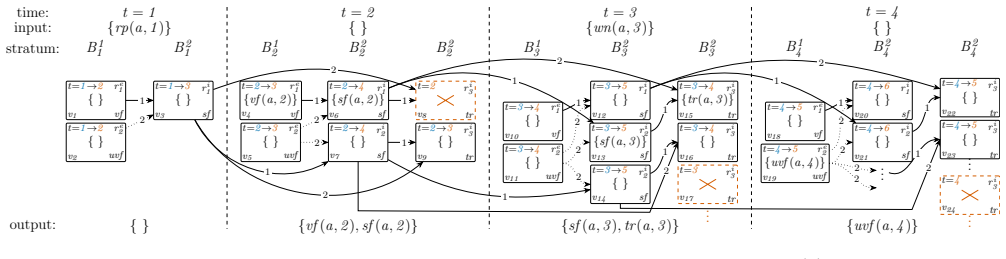
read the original abstract
Several applications demand the timely detection of critical situations, such as threats to safety and transparency, over high-velocity streams of symbolic events. This demand has motivated the development of (i) event specification languages, which define composite events via temporal patterns over simpler events, and (ii) stream reasoning frameworks, evaluating patterns expressed in these languages. However, event specification languages are typically studied in isolation, complicating their comparison in terms of expressivity and obscuring the scope of their associated stream reasoners. To mitigate this issue, we map practical fragments of prominent event specification languages into Temporal Datalog->-, a temporal Datalog with stratified negation and no future dependencies. To support efficient stream reasoning over Temporal Datalog->-, we propose Streaming Trigger Graphs, an extension of a state-of-the-art technique for Datalog materialisation. Our approach yields a uniform composite event recognition mechanism that has the potential to generalise across a wide range of practical event specification languages.
Editorial analysis
A structured set of objections, weighed in public.
Referee Report
Summary. The paper maps practical fragments of prominent event specification languages to Temporal Datalog->- (a temporal Datalog variant with stratified negation and no future dependencies) and introduces Streaming Trigger Graphs as an extension of existing Datalog materialisation techniques to support efficient evaluation over high-velocity event streams. It claims this yields a uniform composite event recognition mechanism with potential to generalise across a wide range of event specification languages.
Significance. If the semantic mappings are shown to be faithful and the Streaming Trigger Graphs are proven correct and efficient on unbounded streams, the work would provide a valuable unifying framework for comparing and implementing composite event recognition systems, reducing fragmentation in the field and enabling reuse of optimised Datalog engines for temporal pattern matching in safety-critical streaming applications.
major comments (2)
- [Abstract and mapping description] The uniformity and generalisation claim rests on the existence of semantics-preserving translations from event languages (including temporal patterns, negation, and ordering) into Temporal Datalog->-. No formal statement of these mappings, nor any theorem establishing equivalence of the composite-event semantics, appears in the abstract or is referenced in the provided text; without such a result the central claim cannot be evaluated.
- [Streaming Trigger Graphs section] Streaming Trigger Graphs are presented as the key extension for streaming materialisation, yet the manuscript supplies no proof or argument that they preserve correctness under streaming semantics (e.g., handling of overlapping intervals or absence of future references) while delivering the claimed efficiency gains. This is load-bearing for the efficiency and correctness assertions.
Simulated Author's Rebuttal
We thank the referee for the thoughtful and constructive report. The two major comments highlight important points about the clarity and completeness of our formal claims. We address each below and will revise the manuscript accordingly to make the central results more accessible and rigorously presented.
read point-by-point responses
-
Referee: [Abstract and mapping description] The uniformity and generalisation claim rests on the existence of semantics-preserving translations from event languages (including temporal patterns, negation, and ordering) into Temporal Datalog->-. No formal statement of these mappings, nor any theorem establishing equivalence of the composite-event semantics, appears in the abstract or is referenced in the provided text; without such a result the central claim cannot be evaluated.
Authors: The referee is correct that the abstract does not reference the formal mappings or equivalence theorems. These are defined and proven in the full manuscript (Section 3 defines the translations for each practical fragment of the event languages, including handling of temporal patterns, negation and ordering; Theorems 3.1 and 3.2 establish semantics preservation and equivalence of composite-event recognition). We will revise the abstract to explicitly cite these results (e.g., adding 'as formalised in Theorems 3.1–3.2') so that the uniformity claim can be evaluated directly from the abstract. revision: yes
-
Referee: [Streaming Trigger Graphs section] Streaming Trigger Graphs are presented as the key extension for streaming materialisation, yet the manuscript supplies no proof or argument that they preserve correctness under streaming semantics (e.g., handling of overlapping intervals or absence of future references) while delivering the claimed efficiency gains. This is load-bearing for the efficiency and correctness assertions.
Authors: We agree that a self-contained correctness argument for Streaming Trigger Graphs under streaming semantics is essential. The manuscript currently provides an informal argument in Section 5 that relies on the no-future-dependency property of Temporal Datalog->- and the ordered processing of events to handle overlapping intervals. However, we acknowledge that this falls short of a full proof. We will add a dedicated subsection (and appendix) containing a formal correctness proof that explicitly addresses streaming semantics, interval overlap, and the absence of future references, together with a clearer link to the measured efficiency gains. revision: yes
Circularity Check
No significant circularity; derivation is self-contained
full rationale
The paper defines mappings from fragments of event specification languages into Temporal Datalog->- and extends prior Datalog materialisation with Streaming Trigger Graphs. These are presented as new constructions whose correctness and efficiency are argued from the definitions themselves rather than by reducing any claim to a fitted parameter, self-referential definition, or unverified self-citation chain. No equation or central result is shown to be equivalent to its inputs by construction. The uniformity/generalisation claim rests on the proposed mappings and algorithm, which remain independent of the target results they are intended to support.
Axiom & Free-Parameter Ledger
axioms (2)
- standard math Semantics of Temporal Datalog with stratified negation and no future dependencies
- domain assumption Trigger graphs are a correct and efficient materialisation technique for (non-temporal) Datalog
invented entities (1)
-
Streaming Trigger Graphs
no independent evidence
Lean theorems connected to this paper
-
IndisputableMonolith.Foundation.Atomicityatomic_tick / exists_sequential_schedule echoes?
echoesECHOES: this paper passage has the same mathematical shape or conceptual pattern as the Recognition theorem, but is not a direct formal dependency.
Atomic tick (finite history): any finite recognition history admits a serialization with exactly one posting per tick that respects precedence (RS Foundation/Atomicity.lean, theorem atomic_tick).
What do these tags mean?
- matches
- The paper's claim is directly supported by a theorem in the formal canon.
- supports
- The theorem supports part of the paper's argument, but the paper may add assumptions or extra steps.
- extends
- The paper goes beyond the formal theorem; the theorem is a base layer rather than the whole result.
- uses
- The paper appears to rely on the theorem as machinery.
- contradicts
- The paper's claim conflicts with a theorem or certificate in the canon.
- unclear
- Pith found a possible connection, but the passage is too broad, indirect, or ambiguous to say the theorem truly supports the claim.
Reference graph
Works this paper leans on
-
[1]
Kowalski and Marek J
Robert A. Kowalski and Marek J. Sergot , title =. New Gener. Comput. , volume =. 1986 , keywords =
1986
-
[2]
Sergot and Georgios Paliouras , title =
Alexander Artikis and Marek J. Sergot and Georgios Paliouras , title =. 2015 , keywords =
2015
-
[3]
Przymusinski , title =
Teodor C. Przymusinski , title =. Foundations of Deductive Databases and Logic Programming , publisher =. 1988 , keywords =
1988
-
[4]
Clark , title =
Keith L. Clark , title =. Logic and Data Bases , pages =. 1977 , keywords =
1977
-
[5]
Logic-based event recognition , journal =
Alexander Artikis and Anastasios Skarlatidis and Fran. Logic-based event recognition , journal =. 2012 , keywords =
2012
-
[6]
Efthimis Tsilionis and Alexander Artikis and Georgios Paliouras , title =. J. Artif. Intell. Res. , volume =. 2022 , keywords =
2022
-
[7]
Composite Event Recognition for Maritime Monitoring , booktitle =
Manolis Pitsikalis and Alexander Artikis and Richard Dreo and Cyril Ray and Elena Camossi and Anne. Composite Event Recognition for Maritime Monitoring , booktitle =. 2019 , keywords =
2019
-
[8]
Santipantakis and Akrivi Vlachou and Christos Doulkeridis and Alexander Artikis and Ioannis Kontopoulos and George A
Georgios M. Santipantakis and Akrivi Vlachou and Christos Doulkeridis and Alexander Artikis and Ioannis Kontopoulos and George A. Vouros , title =. TIME , volume =. 2018 , keywords =
2018
-
[9]
CIKM , pages =
Giannis Fikioris and Kostas Patroumpas and Alexander Artikis and Georgios Paliouras and Manolis Pitsikalis , title =. CIKM , pages =. 2020 , keywords =
2020
-
[10]
GeoInformatica , volume =
Giannis Fikioris and Kostas Patroumpas and Alexander Artikis and Manolis Pitsikalis and Georgios Paliouras , title =. GeoInformatica , volume =
-
[11]
Adrian Paschke and Martin Bichler , title =. Decis. Support Syst. , volume =. 2008 , keywords =
2008
-
[12]
CoRR , volume =
Adrian Paschke , title =. CoRR , volume =. 2006 , keywords =
2006
-
[13]
Data Sci
Daniele Dell'Aglio and Emanuele Della Valle and Frank van Harmelen and Abraham Bernstein , title =. Data Sci. , volume =. 2017 , keywords =
2017
-
[14]
Marios Fragkoulis and Paris Carbone and Vasiliki Kalavri and Asterios Katsifodimos , title =
-
[15]
2020 , keywords =
Alessandro Ronca , title =. 2020 , keywords =
2020
-
[16]
IJCAI , Year =
Chronicle Recognition Improvement Using Temporal Focusing and Hierarchisation , Author =. IJCAI , Year =
-
[17]
Sergot , title =
Marek J. Sergot , title =
-
[18]
Pitt and Lloyd Daniel Kamara and Marek J
Jeremy V. Pitt and Lloyd Daniel Kamara and Marek J. Sergot and Alexander Artikis , title =. 2005 , keywords =
2005
-
[19]
Chopra and Samuel H
Amit K. Chopra and Samuel H. Christie and Munindar P. Singh , title =. J. Artif. Intell. Res. , volume =. 2020 , keywords =
2020
-
[20]
Gianpaolo Cugola and Alessandro Margara , title =
-
[21]
Fabio Aurelio D'Asaro and Antonis Bikakis and Luke Dickens and Rob Miller , title =. Artif. Intell. , volume =. 2020 , keywords =
2020
-
[22]
Singh , title =
Pinar Yolum and Munindar P. Singh , title =. Ann. Math. Artif. Intell. , volume =
-
[23]
Singh , title =
Pinar Yolum and Munindar P. Singh , title =. AAMAS , pages =
-
[24]
On the Expressiveness of Languages for Complex Event Recognition , booktitle =
Alejandro Grez and Cristian Riveros and Mart. On the Expressiveness of Languages for Complex Event Recognition , booktitle =
-
[25]
A Formal Framework for Complex Event Processing , booktitle =
Alejandro Grez and Cristian Riveros and Mart. A Formal Framework for Complex Event Processing , booktitle =
-
[26]
Temporal Composite Actions with Constraints , booktitle =
Patrick Doherty and Jonas Kvarnstr. Temporal Composite Actions with Constraints , booktitle =
-
[27]
Semantic Web , volume =
Daniele Dell'Aglio and Thomas Eiter and Fredrik Heintz and Danh Le Phuoc , title =. Semantic Web , volume =. 2019 , keywords =
2019
-
[28]
Harald Beck and Minh Dao. Artif. Intell. , volume =. 2018 , keywords =
2018
-
[29]
Answer Update for Rule-Based Stream Reasoning , booktitle =
Harald Beck and Minh Dao. Answer Update for Rule-Based Stream Reasoning , booktitle =
-
[30]
Theory Pract
Thomas Eiter and Paul Ogris and Konstantin Schekotihin , title =. Theory Pract. Log. Program. , volume =. 2019 , keywords =
2019
-
[31]
Bazoobandi and Harald Beck and Jacopo Urbani , title =
Hamid R. Bazoobandi and Harald Beck and Jacopo Urbani , title =. 2017 , keywords =
2017
-
[32]
TPLP , volume =
Carmine Dodaro and Thomas Eiter and Paul Ogris and Konstantin Schekotihin , title =. TPLP , volume =. 2020 , keywords =
2020
-
[33]
Thomas Eiter and Rafael Kiesel , title =
-
[34]
Joohyung Lee and Ravi Palla , title =. J. Artif. Intell. Res. , volume =. 2012 , keywords =
2012
-
[35]
2000 , keywords =
Iliano Cervesato and Angelo Montanari , title =. 2000 , keywords =
2000
-
[36]
Nikoleta Tsampanaki and Theodore Patkos and Giorgos Flouris and Dimitris Plexousakis , title =. Ann. Math. Artif. Intell. , volume =
-
[37]
Federico Chesani and Paola Mello and Marco Montali and Paolo Torroni , title =. Auton. Agents Multi Agent Syst. , volume =
-
[38]
RuleML , volume =
Stefano Bragaglia and Federico Chesani and Paola Mello and Davide Sottara , title =. RuleML , volume =
-
[39]
Federico Chesani and Paola Mello and Marco Montali and Paolo Torroni , title =. Fundam. Informaticae , volume =. 2010 , keywords =
2010
-
[40]
2019 , author =
Heterogeneous integrated dataset for Maritime Intelligence, surveillance, and reconnaissance , journal =. 2019 , author =
2019
-
[41]
ACM Transactions on Cyber-Physical Systems , author =
Long-Term Event Processing over Data Streams in Cyber-Physical Systems , volume =. ACM Transactions on Cyber-Physical Systems , author =. 2018 , pages =
2018
-
[42]
Patrick Doherty and Jonas Kvarnström and Andrzej Szalas , title =
-
[43]
Mueller , title =
Erik T. Mueller , title =. J. Log. Comput. , volume =
-
[44]
Progressive Temporal Window Widening , journal=
Tolpin, David , year=. Progressive Temporal Window Widening , journal=
-
[45]
AAAI , pages =
Alessandro Ronca and Mark Kaminski and Bernardo Cuenca Grau and Boris Motik and Ian Horrocks , title =. AAAI , pages =
-
[46]
System f2lp - computing answer sets of first-order formulas
Joohyung Lee and Ravi Palla. System f2lp - computing answer sets of first-order formulas. LPNMR. 2009
2009
-
[47]
2009 , booktitle =
Kim, Tae-Won and Lee, Joohyung and Palla, Ravi , title =. 2009 , booktitle =
2009
-
[48]
Mueller , editor =
Erik T. Mueller , editor =. A Tool for Satisfiability-Based Commonsense Reasoning in the Event Calculus , booktitle =
-
[49]
Murray Shanahan and Mark Witkowski , title =. J. Log. Comput. , volume =
-
[50]
Theory Pract
Theodore Patkos and Dimitris Plexousakis and Abdelghani Chibani and Yacine Amirat , title =. Theory Pract. Log. Program. , volume =
-
[51]
Expert Systems with Applications , volume =
Daniela Loreti and Federico Chesani and Paola Mello and Luca Roffia and Francesco Antoniazzi and Tullio Salmon Cinotti and Giacomo Paolini and Diego Masotti and Alessandra Costanzo , title =. Expert Systems with Applications , volume =
-
[52]
AMAI , volume =
Luca Chittaro and Carlo Combi , title =. AMAI , volume =
-
[53]
Efthimis Tsilionis and Alexander Artikis and Georgios Paliouras , title =
-
[54]
Theory Pract
Efthimis Tsilionis and Nikolaos Koutroumanis and Panagiotis Nikitopoulos and Christos Doulkeridis and Alexander Artikis , title =. Theory Pract. Log. Program. , volume =
-
[55]
Applied Artificial Intelligence , volume =
Darko Anicic and Sebastian Rudolph and Paul Fodor and Nenad Stojanovic , title =. Applied Artificial Intelligence , volume =. 2012 , pages =
2012
-
[56]
Christos Nomikos and Panos Rondogiannis and Manolis Gergatsoulis , title =. Theor. Comput. Sci. , volume =
-
[57]
Panos Rondogiannis , title =. Theor. Comput. Sci. , volume =
-
[58]
RR , volume =
Hui Wan , title =. RR , volume =. 2009 , publisher =
2009
-
[59]
Allowing Cyclic Dependencies in Modular Logic Programming , booktitle =
Jo. Allowing Cyclic Dependencies in Modular Logic Programming , booktitle =. 2015 , keywords =
2015
-
[60]
Theory Pract
Harald Beck and Thomas Eiter and Christian Folie , title =. Theory Pract. Log. Program. , volume =. 2017 , keywords =
2017
-
[61]
Davide Francesco Barbieri and Daniele Braga and Stefano Ceri and Emanuele Della Valle and Michael Grossniklaus , title =. Int. J. Semantic Comput. , volume =. 2010 , keywords =
2010
-
[62]
A Native and Adaptive Approach for Unified Processing of Linked Streams and Linked Data , booktitle =
Danh Le Phuoc and Minh Dao. A Native and Adaptive Approach for Unified Processing of Linked Streams and Linked Data , booktitle =. 2011 , keywords =
2011
-
[63]
1998 , keywords =
Lars Karlsson and Joakim Gustafsson and Patrick Doherty , title =. 1998 , keywords =
1998
-
[64]
2015 , author =
The Commonsense Law of Inertia , booktitle =. 2015 , author =
2015
-
[65]
Mueller , title =
Erik T. Mueller , title =
-
[66]
Darko Anicic , title =
-
[67]
Logic Journal of the IGPL , Year =
Executable Specification of Open Multi-Agent Systems , Author =. Logic Journal of the IGPL , Year =
-
[68]
AAMAS , pages =
Marco Montali and Diego Calvanese and Giuseppe De Giacomo , title =. AAMAS , pages =
-
[69]
Efficient Temporal Reasoning in the Cached Event Calculus , Author =. Comput. Intell. , Year =
-
[70]
International Journal of Cooperative Information Systems , Year =
Using the Event Calculus for Tracking the Normative State of Contracts , Author =. International Journal of Cooperative Information Systems , Year =
-
[71]
Garofalakis , title =
Nikos Giatrakos and Elias Alevizos and Alexander Artikis and Antonios Deligiannakis and Minos N. Garofalakis , title =. 2020 , keywords =
2020
-
[72]
A Logic-Based Calculus of Events , Author =. New Gen. Computing , Year =
-
[73]
Computational Logic: Logic Programming and Beyond, Essays in Honour of
Rob Miller and Murray Shanahan , title =. Computational Logic: Logic Programming and Beyond, Essays in Honour of. 2002 , keywords =
2002
-
[74]
Marco Montali and Fabrizio Maria Maggi and Federico Chesani and Paola Mello and Wil M. P. van der Aalst , title =. 2013 , keywords =
2013
-
[75]
Voting in Multi-Agent Systems , Author =. Comput. J. , Year =
-
[76]
Sirbu , Journal =
M. Sirbu , Journal =. Credits and debits on the. 1997 , Number =
1997
-
[77]
Maintaining knowledge about temporal intervals , Author =. Comm. of the. 1983 , Number =
1983
-
[78]
Baskar , title =
Ashwin Srinivasan and Michael Bain and A. Baskar , title =. Mach. Learn. , volume =. 2022 , keywords =
2022
-
[79]
Time Is Up! -- Norms with Deadlines in Action Languages
Knorr, Matthias and Gabaldon, Alfredo and Gon c alves, Ricardo and Leite, Jo \ a o and Slota, Martin. Time Is Up! -- Norms with Deadlines in Action Languages. CLIMA. 2013
2013
-
[80]
IJCAI , pages =
Federico Chesani and Paola Mello and Marco Montali and Paolo Torroni , title =. IJCAI , pages =. 2009 , keywords =
2009
discussion (0)
Sign in with ORCID, Apple, or X to comment. Anyone can read and Pith papers without signing in.