Recognition: 3 theorem links
Morphological and Star Formation Properties of Cosmic Noon Massive Quiescent Galaxies
Pith reviewed 2026-05-08 18:54 UTC · model grok-4.3
The pith
Massive quiescent galaxies at cosmic noon quench from the inside out.
A machine-rendered reading of the paper's core claim, the machinery that carries it, and where it could break.
Core claim
The authors conclude that the majority of these high-redshift quiescent galaxies follow an inside-out quenching pattern. Spatially resolved analysis indicates positive radial gradients in specific star formation rate for about 79 percent of the sample, with the mean value increasing by two orders of magnitude from half the effective radius to 4.5 times that radius. Formation time profiles confirm earlier assembly in the cores by roughly 0.5 Gyr on average, and the cores quenched more rapidly. The sample consists primarily of compact, bulge-dominated systems with a constant median Sersic index of around 4 from redshift 1.5 to 4, suggesting that morphological quenching has operated since early
What carries the argument
Radial specific star formation rate gradients that trace the sequence of quenching from center to outskirts.
If this is right
- The connection between bulge-dominated morphology and quiescence has been in place since at least redshift 4.
- Quenching timescales are shorter in galaxy cores than in their outer regions.
- These galaxies remain compact with average effective radii near 2 kiloparsecs.
- Possible AGN activity in some members is consistent with feedback contributing to the cessation of star formation.
Where Pith is reading between the lines
- If this pattern holds more broadly, inside-out quenching may be a standard pathway for massive galaxies to reach quiescence during the peak of cosmic star formation.
- The persistence of high Sersic indices implies that morphological transformation precedes or coincides with the end of star formation.
- Future resolved observations at even higher redshifts could test whether this inside-out signature appears earlier in cosmic history.
Load-bearing premise
The entire analysis rests on the assumption that the star formation rate threshold used to select quiescent galaxies correctly identifies systems that have truly ceased forming stars without being affected by modeling uncertainties in dust, age, or metallicity.
What would settle it
Finding a comparable sample of massive galaxies at z between 2 and 3 where most exhibit negative or flat radial sSFR gradients, or where outer regions formed stars earlier than inner ones, would falsify the inside-out quenching claim.
Figures






read the original abstract
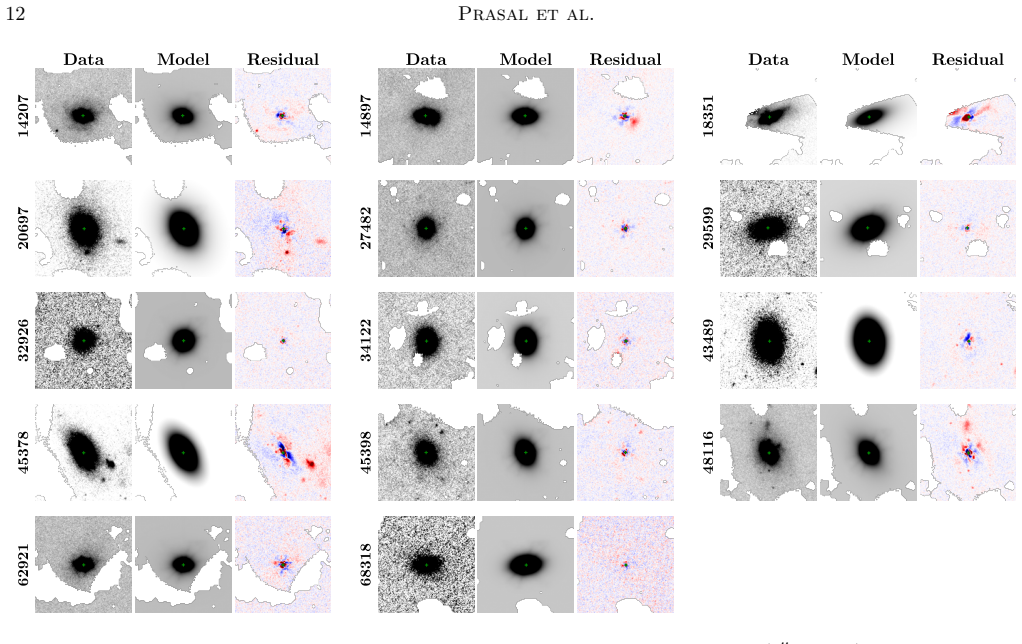
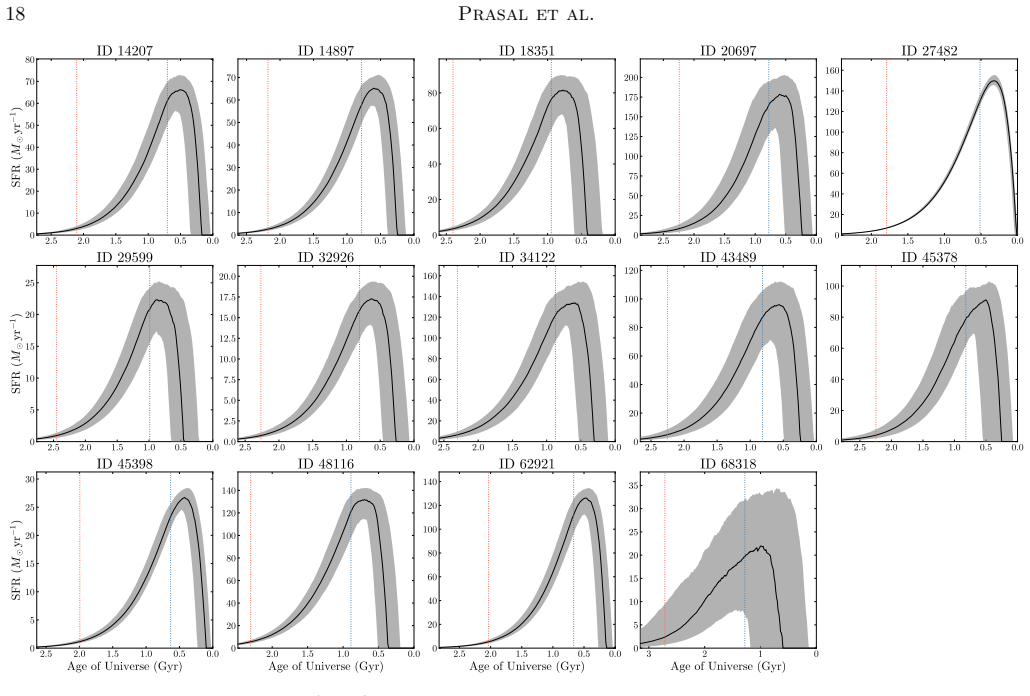
We analyze the star formation and morphological properties of massive quiescent galaxies at cosmic noon ($2 < z < 3$) in the Abell 2744 field, using deep JWST NIRCam broad-band and medium-band imaging from the UNCOVER Treasury program and the MegaScience survey, complemented by archival HST data. Using BAGPIPES SED modeling, we select 14 unique massive quiescent galaxies ($M_* \gtrsim 10^{10}$ M$_\odot$, $\mathrm{sSFR} < 0.2/t_\mathrm{age}$). Morphological analysis with statmorph and pysersic reveals that most galaxies are intermediate type or S0s with a median S\'ersic index $n \sim 4$, consistent with bulge-dominated systems. This value remains constant over $z \sim 1.5$--$4$, indicating that the morphology of massive galaxies is linked to their quiescence since at least $z \sim 4$. Spatially resolved SED modeling with piXedfit shows that $\sim 79\%$ of galaxies exhibit positive radial sSFR gradients, providing direct evidence for inside-out quenching, with the mean sSFR increasing by $\sim2$ dex from $R/R_e = 0.5$ to $4.5$. Formation time ($t_{50}$) profiles confirm that inner regions formed $\approx 0.5$ Gyr earlier, on average, than the outer regions, and quenching timescale profiles show that the cores were quenched more rapidly than the outskirts. Some galaxies show weak indications of possible AGN activity. Most galaxies are compact, with a mean half-mass radius of $R_e = 1.95 \pm 0.13$ kpc. The observed inside-out quenching pattern and possible AGN signatures are consistent with AGN feedback playing a role in star formation cessation, while the bulge-dominated morphologies suggest morphological quenching may also contribute.
Editorial analysis
A structured set of objections, weighed in public.
Referee Report
Summary. The manuscript analyzes 14 massive quiescent galaxies at 2 < z < 3 in the Abell 2744 field using JWST NIRCam broad- and medium-band imaging from UNCOVER and MegaScience plus archival HST data. BAGPIPES SED modeling selects galaxies with M* ≳ 10^10 M⊙ and sSFR < 0.2/t_age. Morphological fitting with statmorph and pysersic finds mostly bulge-dominated (median n ~ 4) systems whose Sérsic index is constant from z ~ 1.5 to 4. Spatially resolved piXedfit modeling shows ~79% of galaxies have positive radial sSFR gradients (mean rise of ~2 dex from R/Re = 0.5 to 4.5), with inner regions forming ~0.5 Gyr earlier on average according to t50 profiles; galaxies are compact (mean Re = 1.95 kpc) and the inside-out pattern plus possible AGN signatures are interpreted as evidence for AGN feedback and morphological quenching.
Significance. If the radial SED results hold, the paper supplies quantitative, spatially resolved evidence for inside-out quenching at cosmic noon, including concrete metrics (2 dex sSFR gradient, 0.5 Gyr t50 offset) derived from public deep imaging and named codes (BAGPIPES, piXedfit, statmorph). The constancy of morphology across redshift and the compact sizes are useful additions to the literature on early quiescence. The small sample and lack of reported robustness tests against outer-bin systematics limit broader impact, but the direct observational approach is a strength.
major comments (2)
- [Spatially resolved SED modeling with piXedfit] Spatially resolved SED modeling section: the central inside-out quenching claim rests on the reported mean ~2 dex sSFR increase from R/Re = 0.5 to 4.5 and the 0.5 Gyr t50 offset, yet no error bars, bootstrap tests, or checks against low-S/N outer annuli (R/Re = 4.5 reaches ~9 kpc for Re ~ 2 kpc galaxies) are described; piXedfit fits in these low-surface-brightness regions can be biased upward in sSFR by SFH/dust priors when JWST NIRCam S/N per resolution element is low, potentially creating an artificial gradient.
- [BAGPIPES selection and integrated properties] Galaxy selection and methods: the sSFR < 0.2/t_age threshold applied to integrated BAGPIPES fits is used to define the quiescent sample whose radial profiles are then interpreted as physical; without reported tests of how dust attenuation, metallicity assumptions, or alternative SFH priors affect either the selection or the recovered radial gradients, the assumption that the observed 79% positive-gradient fraction is free of modeling artifacts remains unverified and load-bearing for the quenching interpretation.
minor comments (3)
- [Abstract] Abstract and results: the mean Re = 1.95 ± 0.13 kpc is given without clarifying whether the uncertainty is the standard error on the mean or the typical per-galaxy uncertainty from the fits.
- [Spatially resolved results] Radial profile results: the ~79% fraction of positive gradients and the mean 2 dex / 0.5 Gyr values are presented without uncertainties or quantification of galaxy-to-galaxy scatter.
- [Morphological properties] Morphological analysis: the claim that Sérsic index remains constant over z ~ 1.5–4 would be strengthened by explicit reference to the comparison sample or a figure showing the redshift trend.
Simulated Author's Rebuttal
We thank the referee for their careful and constructive review of our manuscript. The two major comments raise valid points about the need for explicit robustness checks in our SED modeling and selection procedures. We have carried out the suggested additional tests and will incorporate the results, error bars, and expanded discussion into the revised manuscript.
read point-by-point responses
-
Referee: [Spatially resolved SED modeling with piXedfit] Spatially resolved SED modeling section: the central inside-out quenching claim rests on the reported mean ~2 dex sSFR increase from R/Re = 0.5 to 4.5 and the 0.5 Gyr t50 offset, yet no error bars, bootstrap tests, or checks against low-S/N outer annuli (R/Re = 4.5 reaches ~9 kpc for Re ~ 2 kpc galaxies) are described; piXedfit fits in these low-surface-brightness regions can be biased upward in sSFR by SFH/dust priors when JWST NIRCam S/N per resolution element is low, potentially creating an artificial gradient.
Authors: We agree that the original manuscript omitted explicit error bars on the mean profiles and formal robustness tests against low-S/N outer annuli. To address this, we have performed bootstrap resampling (1000 iterations, resampling galaxies with replacement) on the radial sSFR and t50 profiles; the mean 2 dex rise and 0.5 Gyr offset remain significant at >2 sigma. We have also computed per-annulus S/N profiles and find median S/N > 7 in F444W for the R/Re = 4.5 bin across the sample. Re-running piXedfit with a more restrictive SFH prior that limits recent star formation in low-S/N regions reduces the positive-gradient fraction from 79% to 71%, but the mean gradient amplitude and t50 offset are unchanged within uncertainties. We will add error bars to all mean profiles, a new robustness subsection, and the S/N analysis to the revised manuscript. revision: yes
-
Referee: [BAGPIPES selection and integrated properties] Galaxy selection and methods: the sSFR < 0.2/t_age threshold applied to integrated BAGPIPES fits is used to define the quiescent sample whose radial profiles are then interpreted as physical; without reported tests of how dust attenuation, metallicity assumptions, or alternative SFH priors affect either the selection or the recovered radial gradients, the assumption that the observed 79% positive-gradient fraction is free of modeling artifacts remains unverified and load-bearing for the quenching interpretation.
Authors: We concur that systematic tests of modeling assumptions are required to confirm that the 79% positive-gradient fraction is not driven by prior choices. We have therefore repeated the integrated BAGPIPES fits using (i) an alternative dust attenuation law, (ii) a broader metallicity prior, and (iii) a non-parametric SFH. The quiescent sample membership changes by at most two objects, and the fraction of galaxies showing positive sSFR gradients remains between 71% and 86%. When the same alternative priors are applied consistently to the piXedfit resolved fits, the mean t50 offset and gradient amplitude are recovered to within 0.1 dex and 0.1 Gyr. These tests will be described in an expanded Methods section and a new appendix of the revised manuscript. revision: yes
Circularity Check
No circularity: direct observational measurements from standard codes
full rationale
The paper applies established public codes (BAGPIPES for integrated selection, piXedfit for resolved SEDs, statmorph/pysersic for morphology) to JWST/HST imaging and reports measured gradients and profiles as direct outputs. No equations define a quantity in terms of a fitted parameter then treat the output as an independent prediction; no self-citation chains justify core claims; no ansatz or uniqueness theorem is smuggled in. The ~2 dex sSFR gradient and 0.5 Gyr t50 offset are reported results of the fitting pipeline, not forced by construction from the inputs. This is a standard observational analysis whose central claims remain independent of any self-referential loop.
Axiom & Free-Parameter Ledger
free parameters (1)
- quiescent sSFR threshold =
0.2
axioms (2)
- domain assumption BAGPIPES SED models recover unbiased star-formation histories and radial gradients from broadband photometry
- domain assumption Sersic index n~4 reliably indicates bulge-dominated morphology across the redshift range
Reference graph
Works this paper leans on
-
[1]
2017, MNRAS, 469, 2806, doi: 10.1093/mnras/stx936 Astropy Collaboration, Price-Whelan, A
2016, JWST User Documentation (JDox), JWST User Documentation Website Abdurro’uf, & Akiyama, M. 2017, Monthly Notices of the Royal Astronomical Society, 469, 2806, doi: 10.1093/mnras/stx936 Abdurro’uf, Lin, Y.-T., Wu, P.-F., & Akiyama, M. 2021, ApJS, 254, 15, doi: 10.3847/1538-4365/abebe2
-
[2]
Galaxy morphology to I=25 mag in the Hubble Deep Field
Abraham, R. G., Tanvir, N. R., Santiago, B. X., et al. 1996, MNRAS, 279, L47, doi: 10.1093/mnras/279.3.L47
-
[3]
Akhlaghi, M., & Ichikawa, T. 2015, ApJS, 220, 1, doi: 10.1088/0067-0049/220/1/1 Astropy Collaboration, Robitaille, T. P., Tollerud, E. J., et al. 2013, A&A, 558, A33, doi: 10.1051/0004-6361/201322068 Astropy Collaboration, Price-Whelan, A. M., Sipőcz, B. M., et al. 2018, AJ, 156, 123, doi: 10.3847/1538-3881/aabc4f Astropy Collaboration, Price-Whelan, A. M...
-
[4]
2017, MNRAS, 471, 2687, doi: 10.1093/mnras/stx1688
Bait, O., Barway, S., & Wadadekar, Y. 2017, MNRAS, 471, 2687, doi: 10.1093/mnras/stx1688
-
[5]
Baker, W. M., Valentino, F., Lagos, C. d. P., et al. 2025, A&A, 702, A270, doi: 10.1051/0004-6361/202555829
-
[6]
The Journal of Open Source Software , year = 2016, month = oct, volume =
Barbary, K. 2016, Journal of Open Source Software, 1, 58, doi: 10.21105/joss.00058
-
[7]
Belli, S., Park, M., Davies, R. L., et al. 2024, Nature, 630, 54, doi: 10.1038/s41586-024-07412-1
-
[8]
A., et al., 2000, @doi [ ] 10.1086/301386 , 119, 2645
Bershady, M. A., Jangren, A., & Conselice, C. J. 2000, The Astronomical Journal, 119, 2645, doi: 10.1086/301386
-
[9]
Bertin, E., & Arnouts, S. 1996, A&AS, 117, 393, doi: 10.1051/aas:1996164
-
[10]
Bezanson, R., Labbe, I., Whitaker, K. E., et al. 2024, ApJ, 974, 92, doi: 10.3847/1538-4357/ad66cf
-
[11]
Bower, R. G., Benson, A. J., Malbon, R., et al. 2006, MNRAS, 370, 645, doi: 10.1111/j.1365-2966.2006.10519.x
-
[12]
astropy/photutils: 2.3.0 , month = sep, year = 2025, publisher =
Bradley, L., Sipőcz, B., Robitaille, T., et al. 2025, astropy/photutils: 2.3.0, 2.3.0 Zenodo, doi: 10.5281/zenodo.17129028
-
[13]
2019, Grizli: Grism redshift and line analysis software„ Astrophysics Source Code Library, record ascl:1905.001 http://ascl.net/1905.001
Brammer, G. 2019, Grizli: Grism redshift and line analysis software„ Astrophysics Source Code Library, record ascl:1905.001 http://ascl.net/1905.001
2019
-
[14]
2023, msaexp: NIRSpec analyis tools, 0.6.17 Zenodo, doi: 10.5281/zenodo.8319596
Brammer, G. 2023, msaexp: NIRSpec analyis tools, 0.6.17 Zenodo, doi: 10.5281/zenodo.8319596
-
[15]
2021, Zenodo, doi: 10.5281/zenodo.5012699
Brammer, G., & Matharu, J. 2021, gbrammer/grizli: Release 2021, 1.3.2 Zenodo, doi: 10.5281/zenodo.5012699
-
[16]
2003, MNRAS, 340, 1214, doi: 10.1046/j.1365-8711.2003.06380.x
Bruzual, G., & Charlot, S. 2003, Monthly Notices of the Royal Astronomical Society, 344, 1000, doi: 10.1046/j.1365-8711.2003.06897.x
-
[17]
Buchner, J., Georgakakis, A., Nandra, K., et al. 2014, Astronomy & Astrophysics, 564, A125, doi: 10.1051/0004-6361/201322971
-
[18]
Byler, N., Dalcanton, J. J., Conroy, C., & Johnson, B. D. 2017, ApJ, 840, 44, doi: 10.3847/1538-4357/aa6c66
-
[19]
Calzetti, D., Armus, L., Bohlin, R. C., et al. 2000, The Astrophysical Journal, 533, 682, doi: 10.1086/308692
-
[20]
Cao, N. D., Titov, I., & Aziz, W. 2019, Block Neural Autoregressive Flow, https://arxiv.org/abs/1904.04676
-
[21]
2003, MNRAS, 340, 1214, doi: 10.1046/j.1365-8711.2003.06380.x
Cappellari, M., & Copin, Y. 2003, Monthly Notices of the Royal Astronomical Society, 342, 345, doi: 10.1046/j.1365-8711.2003.06541.x
-
[22]
Carnall, A. C., McLure, R. J., Dunlop, J. S., & Davé, R. 2018, Monthly Notices of the Royal Astronomical Society, 480, 4379, doi: 10.1093/mnras/sty2169
work page internal anchor Pith review doi:10.1093/mnras/sty2169 2018
-
[23]
Carnall, A. C., McLeod, D. J., McLure, R. J., et al. 2023a, MNRAS, 520, 3974, doi: 10.1093/mnras/stad369 26 Prasal et al
-
[24]
Carnall, A. C., McLure, R. J., Dunlop, J. S., et al. 2023b, Nature, 619, 716, doi: 10.1038/s41586-023-06158-6
-
[25]
2004, Nature, 430, 184, doi: 10.1038/nature02668
Cimatti, A., Daddi, E., Renzini, A., et al. 2004, Nature, 430, 184, doi: 10.1038/nature02668
-
[26]
Modeling the Panchromatic Spectral Energy Distributions of Galaxies
Conroy, C. 2013, ARA&A, 51, 393, doi: 10.1146/annurev-astro-082812-141017
work page Pith review doi:10.1146/annurev-astro-082812-141017 2013
-
[27]
Conroy, C., & Gunn, J. E. 2010, The Astrophysical Journal, 712, 833, doi: 10.1088/0004-637X/712/2/833
-
[28]
Conroy, C., Gunn, J. E., & White, M. 2009, The Astrophysical Journal, 699, 486, doi: 10.1088/0004-637X/699/1/486
work page internal anchor Pith review doi:10.1088/0004-637x/699/1/486 2009
-
[29]
Conselice, C. J. 2003, ApJS, 147, 1, doi: 10.1086/375001
-
[30]
Croton, D. J., Springel, V., White, S. D. M., et al. 2006, MNRAS, 365, 11, doi: 10.1111/j.1365-2966.2005.09675.x
-
[31]
Cutler, S. E., Whitaker, K. E., Weaver, J. R., et al. 2024, ApJL, 967, L23, doi: 10.3847/2041-8213/ad464c Davé, R., Anglés-Alcázar, D., Narayanan, D., et al. 2019, MNRAS, 486, 2827, doi: 10.1093/mnras/stz937 de Graaff, A., Rix, H.-W., Carniani, S., et al. 2024, A&A, 684, A87, doi: 10.1051/0004-6361/202347755 de Graaff, A., Setton, D. J., Brammer, G., et a...
-
[32]
Draine, B. T., & Li, A. 2007, ApJ, 657, 810, doi: 10.1086/511055
-
[33]
Dubois, Y., Peirani, S., Pichon, C., et al. 2016, MNRAS, 463, 3948, doi: 10.1093/mnras/stw2265
-
[34]
2021, ApJL, 908, L35, doi: 10.3847/2041-8213/abe11e
Esdaile, J., Glazebrook, K., Labbé, I., et al. 2021, ApJL, 908, L35, doi: 10.3847/2041-8213/abe11e
-
[35]
Fabian, A. C. 2012, ARA&A, 50, 455, doi: 10.1146/annurev-astro-081811-125521 Falcón-Barroso, J., Sánchez-Blázquez, P., Vazdekis, A., et al. 2011, A&A, 532, A95, doi: 10.1051/0004-6361/201116842
work page Pith review doi:10.1146/annurev-astro-081811-125521 2012
-
[36]
Ferland, G. J., Korista, K. T., Verner, D. A., et al. 1998, PASP, 110, 761, doi: 10.1086/316190
-
[37]
Ferland, G. J., Porter, R. L., van Hoof, P. A. M., et al. 2013, RMxAA, 49, 137, doi: 10.48550/arXiv.1302.4485
-
[38]
Feroz, F., & Hobson, M. P. 2008, MNRAS, 384, 449, doi: 10.1111/j.1365-2966.2007.12353.x
-
[39]
2009, MNRAS, 396, 1383, doi:10.1111/j.1365-2966.2009.14843.x
Feroz, F., Hobson, M. P., & Bridges, M. 2009, MNRAS, 398, 1601, doi: 10.1111/j.1365-2966.2009.14548.x
-
[40]
Feroz, F., Hobson, M. P., Cameron, E., & Pettitt, A. N. 2019, The Open Journal of Astrophysics, 2, 10, doi: 10.21105/astro.1306.2144
-
[41]
2014, Zenodo, doi:10.5281/zenodo.12157
Foreman-Mackey, D., Sick, J., & Johnson, B. 2014, python-fsps: Python bindings to FSPS (v0.1.1), v0.1.1 Zenodo, doi: 10.5281/zenodo.12157
-
[42]
Franx, M., van Dokkum, P. G., Förster Schreiber, N. M., et al. 2008, The Astrophysical Journal, 688, 770, doi: 10.1086/592431
-
[43]
Furtak, L. J., Zitrin, A., Weaver, J. R., et al. 2023, MNRAS, 523, 4568, doi: 10.1093/mnras/stad1627
-
[44]
Kelson, D. D. 2014, The Astrophysical Journal, 788, 72, doi: 10.1088/0004-637X/788/1/72
-
[45]
Girardi, L., Bressan, A., Bertelli, G., & Chiosi, C. 2000, A&AS, 141, 371, doi: 10.1051/aas:2000126
-
[46]
Glazebrook, K., Abraham, R. G., McCarthy, P. J., et al. 2004, Nature, 430, 181, doi: 10.1038/nature02667 González Delgado, R. M., García-Benito, R., Pérez, E., et al. 2015, A&A, 581, A103, doi: 10.1051/0004-6361/201525938 González Delgado, R. M., Cid Fernandes, R., Pérez, E., et al. 2016, A&A, 590, A44, doi: 10.1051/0004-6361/201628174
-
[47]
S., Akiyama, M., Abdurro’uf, et al
Haryana, N. S., Akiyama, M., Abdurro’uf, et al. 2025, The Astrophysical Journal, 994, 215, doi: 10.3847/1538-4357/ae03ad
-
[48]
Heintz, K. E., Watson, D., Brammer, G., et al. 2024, Science, 384, 890, doi: 10.1126/science.adj0343
-
[49]
Hopkins, P. F., Hernquist, L., Cox, T. J., & Kereš, D. 2008, ApJS, 175, 356, doi: 10.1086/524362
work page internal anchor Pith review doi:10.1086/524362 2008
-
[50]
Hopkins, P. F., Kereš, D., Oñorbe, J., et al. 2014, MNRAS, 445, 581, doi: 10.1093/mnras/stu1738
-
[51]
2024, Research Notes of the American Astronomical Society, 8, 10, doi: 10.3847/2515-5172/ad1aae
Infante-Sainz, R., & Akhlaghi, M. 2024, Research Notes of the American Astronomical Society, 8, 10, doi: 10.3847/2515-5172/ad1aae
-
[52]
2024, ApJ, 964, 192, doi: 10.3847/1538-4357/ad2512 26
Ito, K., Valentino, F., Brammer, G., et al. 2024, ApJ, 964, 192, doi: 10.3847/1538-4357/ad2512
-
[53]
G., Pacifici, C., Calistro-Rivera, G., & Lovell, C
Iyer, K. G., Pacifici, C., Calistro-Rivera, G., & Lovell, C. C. 2025, arXiv e-prints, arXiv:2502.17680, doi: 10.48550/arXiv.2502.17680
-
[54]
Johnson, B. D. 2021, bd-j/sedpy: sedpy v0.2.0, v0.2.0 Zenodo, doi: 10.5281/zenodo.4582723
-
[55]
S., et al., 2023, @doi [ ] 10.3847/2041-8213/acad01 , 946, L15
Kartaltepe, J. S., Rose, C., Vanderhoof, B. N., et al. 2023, ApJL, 946, L15, doi: 10.3847/2041-8213/acad01
-
[56]
Kawinwanichakij, L., Glazebrook, K., Nanayakkara, T., et al. 2026, ApJ, 997, 29, doi: 10.3847/1538-4357/ae0a18
-
[57]
Kroupa, P., & Boily, C. M. 2002, Monthly Notices of the Royal Astronomical Society, 336, 1188, doi: 10.1046/j.1365-8711.2002.05848.x
-
[58]
2025, arXiv e-prints, arXiv:2512.18805, doi: 10.48550/arXiv.2512.18805
Laishram, R., Koyama, Y., Naufal, A., et al. 2025, arXiv e-prints, arXiv:2512.18805, doi: 10.48550/arXiv.2512.18805
-
[59]
Lee, B., Giavalisco, M., Williams, C. C., et al. 2013, ApJ, 774, 47, doi: 10.1088/0004-637X/774/1/47 MQGs at Cosmic Noon: Morphology & SF 27
-
[60]
2019, ApJ, 872, 50, doi: 10.3847/1538-4357/aafa84
Lin, L., Hsieh, B.-C., Pan, H.-A., et al. 2019, ApJ, 872, 50, doi: 10.3847/1538-4357/aafa84 López Fernández, R., González Delgado, R. M., Pérez, E., et al. 2018, A&A, 615, A27, doi: 10.1051/0004-6361/201732358
-
[61]
Lotz, J. M., Primack, J., & Madau, P. 2004, AJ, 128, 163, doi: 10.1086/421849
-
[62]
Lotz, J. M., Davis, M., Faber, S. M., et al. 2008, ApJ, 672, 177, doi: 10.1086/523659
-
[63]
Lustig, P., Strazzullo, V., D’Eugenio, C., et al. 2021, MNRAS, 501, 2659, doi: 10.1093/mnras/staa3766
-
[64]
, archivePrefix = "arXiv", eprint =
Madau, P., & Dickinson, M. 2014, ARA&A, 52, 415, doi: 10.1146/annurev-astro-081811-125615 Maíz Apellániz, J. 2006, AJ, 131, 1184, doi: 10.1086/499158
work page Pith review doi:10.1146/annurev-astro-081811-125615 2014
-
[65]
2007, A&A, 469, 239, doi: 10.1051/0004-6361:20066772
Marigo, P., & Girardi, L. 2007, A&A, 469, 239, doi: 10.1051/0004-6361:20066772
-
[66]
2008, A&A, 482, 883, doi: 10.1051/0004-6361:20078467
Marigo, P., Girardi, L., Bressan, A., et al. 2008, A&A, 482, 883, doi: 10.1051/0004-6361:20078467
-
[67]
C., Marchesini, D., Muzzin, A., et al
Marsan, Z. C., Marchesini, D., Muzzin, A., et al. 2019, ApJ, 871, 201, doi: 10.3847/1538-4357/aaf808
-
[68]
Martig, M., Bournaud, F., Teyssier, R., & Dekel, A. 2009, ApJ, 707, 250, doi: 10.1088/0004-637X/707/1/250
-
[69]
S., Withers, S., Bradač, M., et al
Martis, N. S., Withers, S., Bradač, M., et al. 2025, ApJ, 990, 83, doi: 10.3847/1538-4357/adf32a
-
[70]
2024, ApJ, 972, 134, doi: 10.3847/1538-4357/ad5c6a
Martorano, M., van der Wel, A., Baes, M., et al. 2024, ApJ, 972, 134, doi: 10.3847/1538-4357/ad5c6a
-
[71]
McDermid, R. M., Alatalo, K., Blitz, L., et al. 2015, MNRAS, 448, 3484, doi: 10.1093/mnras/stv105
-
[72]
Naab, T., Johansson, P. H., & Ostriker, J. P. 2009, ApJL, 699, L178, doi: 10.1088/0004-637X/699/2/L178
-
[73]
P., Matthee, J., Kramarenko, I., et al
Naidu, R. P., Matthee, J., Kramarenko, I., et al. 2024, arXiv e-prints, arXiv:2410.01874, doi: 10.48550/arXiv.2410.01874
-
[74]
Nelson, E. J., Tacchella, S., Diemer, B., et al. 2021, MNRAS, 508, 219, doi: 10.1093/mnras/stab2131
-
[75]
Oser, L., Naab, T., Ostriker, J. P., & Johansson, P. H. 2012, ApJ, 744, 63, doi: 10.1088/0004-637X/744/1/63
-
[76]
2018, ApJ, 854, 159, doi: 10.3847/1538-4357/aaa9bc
Pan, H.-A., Lin, L., Hsieh, B.-C., et al. 2018, ApJ, 854, 159, doi: 10.3847/1538-4357/aaa9bc
-
[77]
Park, M., Belli, S., Conroy, C., et al. 2024, ApJ, 976, 72, doi: 10.3847/1538-4357/ad7e15
-
[78]
Pasha, I., & Miller, T. B. 2023, Journal of Open Source Software, 8, 5703, doi: 10.21105/joss.05703
-
[79]
2018b, MNRAS, 473, 4077, doi: 10.1093/mnras/stx2656
Pillepich, A., Springel, V., Nelson, D., et al. 2018, MNRAS, 473, 4077, doi: 10.1093/mnras/stx2656 Planck Collaboration, Aghanim, N., Akrami, Y., et al. 2020, A&A, 641, A6, doi: 10.1051/0004-6361/201833910
-
[80]
H., Bezanson, R., Labbe, I., et al
Price, S. H., Bezanson, R., Labbe, I., et al. 2025, ApJ, 982, 51, doi: 10.3847/1538-4357/adaec1
discussion (0)
Sign in with ORCID, Apple, or X to comment. Anyone can read and Pith papers without signing in.