Recognition: unknown
Static Type Checking for Database Access Code
Pith reviewed 2026-05-08 02:08 UTC · model grok-4.3
The pith
An extension to the Checker Framework statically verifies correct Java types in JDBC database access code.
A machine-rendered reading of the paper's core claim, the machinery that carries it, and where it could break.
Core claim
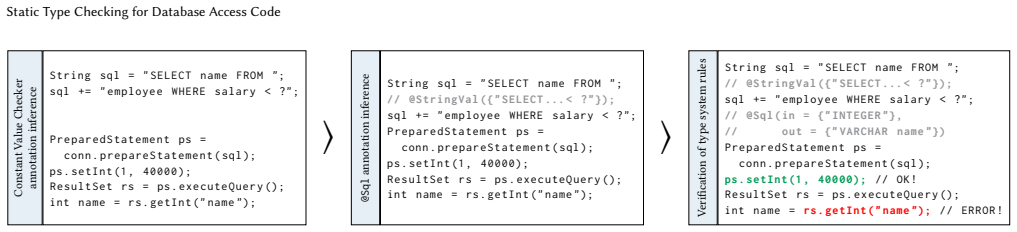
We propose an extension of the Java compiler, based on the established Checker Framework, which allows us to bridge this gap. Our approach verifies statically that the correct Java types are used when setting prepared statement parameters or when getting values from result sets. This allows us to lift a practically important class of runtime errors to compile time. Our approach is sound and, therefore, is guaranteed not to produce false negatives.
What carries the argument
The JDBC type checker extension to the Checker Framework, which models the mappings between SQL types and Java types for parameter setting and result retrieval operations.
Load-bearing premise
The Checker Framework's type system extension must correctly model all JDBC type mappings, and any schema or annotation information must accurately reflect the actual database dictionary.
What would settle it
A program containing a JDBC type mismatch that passes the checker without error but causes a runtime type error when executed.
Figures





read the original abstract
JDBC remains a key technology for database access in Java applications. Since the database dictionary and the Java type system have distinct scopes, developers inevitably need to deal with bugs in SQL-to-Java type mappings. We propose an extension of the Java compiler, based on the established Checker Framework, which allows us to bridge this gap. Our approach verifies statically that the correct Java types are used when setting prepared statement parameters or when getting values from result sets. This allows us to lift a practically important class of runtime errors to compile time. Our approach is sound and, therefore, is guaranteed not to produce false negatives. Our prototype implementation also offers a degraded mode for type-checking legacy software, if developers are only interested in a subset of errors. Our experiments show that our approach detects a wide range of type mismatches in realworld application code and can indeed prevent errors which might otherwise surface as runtime errors. From the perspective of the developer, our approach is extremely lightweight: it processes the unmodified Java code, yet developers may add their own annotations. This allows us to perform type-checking even across method boundaries, whereas commercial developer tools are restricted to local checks. Finally, we show that we can type-check real-world JDBC software with reasonable overhead during compilation.
Editorial analysis
A structured set of objections, weighed in public.
Referee Report
Summary. The paper presents an extension of the Checker Framework that adds custom type qualifiers for static verification of JDBC calls in Java. It checks that Java types passed to PreparedStatement.setXXX methods and returned by ResultSet.getXXX methods are compatible with the underlying database schema (via annotations or provided metadata), with the goal of catching type-mismatch errors at compile time rather than runtime. The manuscript claims the system is sound with no false negatives, supports a degraded mode for legacy code, processes unmodified source, enables cross-method checking, and reports positive results on real-world applications with acceptable compilation overhead.
Significance. If the soundness claim holds, the work offers a practical, lightweight way to prevent a common source of runtime failures in Java database code. Strengths include reuse of the established Checker Framework, support for unmodified code plus optional annotations, and experimental validation on real applications. These elements could make the technique adoptable by developers and superior to purely local IDE checks.
major comments (2)
- [Abstract] Abstract: The central claim that the approach 'is sound and therefore guaranteed not to produce false negatives' is load-bearing. This guarantee rests on the assumption that the Checker Framework extension's qualifiers and subtyping relations completely and correctly encode every valid JDBC-to-Java mapping (including NULL semantics, numeric coercions, java.sql vs java.util date handling, getObject paths, and vendor extensions). The manuscript supplies no formal semantics for the type rules, no exhaustive enumeration against the JDBC specification, and no machine-checked proof or completeness argument; an omitted mapping would silently accept a runtime error.
- [Experiments] Experiments section: The paper states that the prototype 'detects a wide range of type mismatches in real-world application code' and prevents errors that would otherwise surface at runtime. However, without reported counts of errors found, false-positive rates, the specific applications or codebases tested, or a comparison against baseline tools, it is impossible to assess coverage, precision, or the practical impact of the soundness guarantee.
minor comments (2)
- The description of how schema or annotation information is supplied to the checker (e.g., via @DatabaseSchema or similar) could be clarified with a concrete example showing propagation across method boundaries.
- A table enumerating the supported JDBC type mappings and their Java qualifiers would improve readability and allow readers to spot potential gaps.
Simulated Author's Rebuttal
We thank the referee for the detailed and constructive review. We address each major comment below, clarifying our claims and indicating where the manuscript will be revised to strengthen the presentation.
read point-by-point responses
-
Referee: [Abstract] Abstract: The central claim that the approach 'is sound and therefore guaranteed not to produce false negatives' is load-bearing. This guarantee rests on the assumption that the Checker Framework extension's qualifiers and subtyping relations completely and correctly encode every valid JDBC-to-Java mapping (including NULL semantics, numeric coercions, java.sql vs java.util date handling, getObject paths, and vendor extensions). The manuscript supplies no formal semantics for the type rules, no exhaustive enumeration against the JDBC specification, and no machine-checked proof or completeness argument; an omitted mapping would silently accept a runtime error.
Authors: We acknowledge that the manuscript does not include a formal semantics, exhaustive enumeration, or machine-checked proof of the type system. Our soundness claim is grounded in the established soundness of the Checker Framework combined with a manual encoding of the core JDBC type mappings (as documented in the JDBC specification) into the qualifier hierarchy. The implementation handles standard cases for setXXX/getXXX, NULL semantics via nullable qualifiers, numeric coercions, and java.sql date types, while getObject is supported via a general Object qualifier. Vendor extensions are noted as out of scope due to their variability. To address the concern, we will revise the paper to add a dedicated subsection that explicitly enumerates the supported mappings and subtyping rules, including the cases mentioned. This provides transparency without requiring a full formalization, which is outside the scope of this practical systems paper. revision: yes
-
Referee: [Experiments] Experiments section: The paper states that the prototype 'detects a wide range of type mismatches in real-world application code' and prevents errors that would otherwise surface at runtime. However, without reported counts of errors found, false-positive rates, the specific applications or codebases tested, or a comparison against baseline tools, it is impossible to assess coverage, precision, or the practical impact of the soundness guarantee.
Authors: We agree that additional quantitative details would strengthen the evaluation. The current manuscript reports qualitative results on real-world code but lacks specific counts, false-positive analysis, and tool comparisons. We will revise the Experiments section to include: the exact number of type mismatches detected across the tested applications, the names and sizes of the specific open-source codebases evaluated, a manual verification of precision (including false-positive rate), and a brief comparison to local IDE checks. These additions will better demonstrate coverage and practical impact while remaining consistent with the paper's focus on feasibility. revision: yes
Circularity Check
No circularity: implementation relies on external Checker Framework foundations
full rationale
The paper describes an extension of the Checker Framework to add qualifiers and subtyping rules for JDBC type mappings in Java. Its central soundness claim rests on the modeling assumption that the added rules correctly capture all JDBC-to-Java conversions, which is an external modeling choice rather than a derivation that reduces to fitted parameters or self-referential equations. No equations, predictions, or self-citations are used to justify the core result; the work is a tool implementation whose guarantees are conditional on the completeness of the manually supplied type rules and the soundness of the underlying Checker Framework. This is the normal case of a non-circular engineering paper.
Axiom & Free-Parameter Ledger
axioms (1)
- domain assumption The Checker Framework extension correctly encodes JDBC type mappings without false negatives.
Reference graph
Works this paper leans on
-
[1]
Sayed Abdul-Aziz. 2021. JDBC-Course. https://github.com/sayedabdul- aziz/JDBC-Course/tree/04ed1613c612f8d9ae53ef7629c3cb254d6cad40
2021
-
[2]
Ambler and Pramodkumar J
Scott W. Ambler and Pramodkumar J. Sadalage. 2006. Refactoring Databases: Evolutionary Database Design . Addison-Wesley Professional
2006
-
[3]
Lance Andersen. 2017. Java Database Connectivity (JDBC) 4.3 Specification (Maintenance Release, JSR-221). https://download.oracle.com/otn-pub/jcp/jdbc- 4_3-mrel3-eval-spec/jdbc4.3-fr-spec.pdf . Accessed: May 5, 2026. 10https://jspecify.dev/ Static Type Checking for Database Access Code
2017
-
[4]
Aivar Annamaa, Andrey Breslav, Jevgeni Kabanov, and Varmo Vene. 2010. An Interactive Tool for Analyzing Embedded SQL Queries. In Programming Lan- guages and Systems , Kazunori Ueda (Ed.). Springer Berlin Heidelberg, Berlin, Heidelberg, 131–138
2010
-
[5]
Edmon Begoli, Jesús Camacho-Rodríguez, Julian Hyde, Michael J. Mior, and Daniel Lemire. 2018. Apache Calcite: A Foundational Framework for Optimized Query Processing Over Heterogeneous Data Sources. InProc. SIGMOD. 10 pages. doi:10.1145/3183713.3190662
-
[6]
Weber, and Anthony Cleve
Mathieu Beine, Nicolas Hames, Jens H. Weber, and Anthony Cleve. 2014. Bidi- rectional Transformations in Database Evolution: A Case Study ”At Scale”. In Proceedings of the Workshops of the EDBT/ICDT 2014 Joint Conference (EDBT/ICDT 2014), Athens, Greece, March 28, 2014 (CEUR Workshop Proceedings, Vol. 1133). CEUR-WS.org, 100–107. https://ceur-ws.org/Vol-1...
2014
- [7]
-
[8]
Gilad Bracha. 2004. Pluggable type systems. In Proc. OOPSLA’04 Workshop on Revival of Dynamic Languages
2004
-
[9]
Hassan, Mohamed Nasser, and Parminder Flora
Tse-Hsun Chen, Weiyi Shang, Zhen Ming Jiang, Ahmed E. Hassan, Mohamed Nasser, and Parminder Flora. 2014. Detecting performance anti-patterns for applications developed using object-relational mapping. In Proc. ICSE. doi:10.1 145/2568225.2568259
-
[10]
Tse-Hsun Chen, Weiyi Shang, Jinqiu Yang, Ahmed E. Hassan, Michael W. God- frey, Mohamed Nasser, and Parminder Flora. 2016. An Empirical Study on the Practice of Maintaining Object-Relational Mapping Code in Java Systems. In Proc. MSR. doi:10.1145/2901739.2901758
-
[11]
Schwartzbach
Aske Simon Christensen, Anders Møller, and Michael I. Schwartzbach. 2003. Precise Analysis of String Expressions. In Static Analysis, Radhia Cousot (Ed.). Springer Berlin Heidelberg, Berlin, Heidelberg, 1–18
2003
-
[12]
Justin Clarke, Kevvie Fowler, Erlend Oftedal, Rodrigo Marcos Alvarez, Dave Hartley, Alexander Kornbrust, Gary O’Leary-Steele, Alberto Revelli, Sumit Sid- dharth, and Marco Slaviero. 2009. SQL Injection Attacks and Defense (2 ed.). Syngress Publishing
2009
-
[13]
Anthony Cleve, Maxime Gobert, Loup Meurice, Jerome Maes, and Jens H. Weber
-
[14]
Understanding database schema evolution: A case study. Sci. Comput. Program. 97 (2015), 113–121. doi:10.1016/J.SCICO.2013.11.025
-
[15]
Carlo Curino, Hyun Jin Moon, and Carlo Zaniolo. 2008. Graceful database schema evolution: the PRISM workbench. Proc. VLDB Endow. 1, 1 (2008), 761–
2008
-
[16]
doi:10.14778/1453856.1453939
- [17]
-
[18]
Checker Framework developers. 2025. The Checker Framework Manual: Cus- tom pluggable types for Java. https://checkerframework.org/manual/. Version 3.49.1
2025
-
[19]
Ernst, Kivanç Muslu, and Todd Schiller
Werner Dietl, Stephanie Dietzel, Michael D. Ernst, Kivanç Muslu, and Todd Schiller. 2011. Building and Using Pluggable Type-Checkers. In Proc. ICSE . doi:10.1145/1985793.1985889
-
[20]
Jens Dittrich. 2025. How to get Rid of SQL, Relational Algebra, the Relational Model, ERM, and ORMs in a Single Paper - A Thought Experiment. CoRR abs/2504.12953 (2025). arXiv: 2504.12953 doi:10.48550/ARXIV.2504.12953
-
[21]
EISOP. 2026. The EISOP Checker Framework. https://eisop.github.io/cf/ . Accessed: 2026-04-28
2026
-
[22]
Maxime Gobert, Csaba Nagy, Henrique Rocha, Serge Demeyer, and Anthony Cleve. 2023. Best practices of testing database manipulation code. Inf. Syst. 111, C (Jan. 2023), 15 pages. doi:10.1016/j.is.2022.102105
-
[23]
Mathieu Goeminne, Alexandre Decan, and Tom Mens. 2014. Co-evolving code- related and database-related changes in a data-intensive software system. In 2014 Software Evolution Week - IEEE Conference on Software Maintenance, Reengi- neering, and Reverse Engineering, CSMR-WCRE . 353–357. doi:10.1109/CSMR- WCRE.2014.6747193
-
[24]
Mathieu Goeminne and Tom Mens. 2015. Towards a survival analysis of data- base framework usage in Java projects. In Proc. ICSME. doi:10.1109/ICSM.2015. 7332512
-
[25]
C. Gould, Z. Su, and P. Devanbu. 2004. Static checking of dynamically generated queries in database applications. In Proceedings. 26th International Conference on Software Engineering. 645–654. doi:10.1109/ICSE.2004.1317486
-
[26]
Carl Gould, Zhendong Su, and Premkumar T. Devanbu. 2004. JDBC Checker: A Static Analysis Tool for SQL/JDBC Applications. In Proc. ICSE. IEEE Computer Society. doi:10.1109/ICSE.2004.1317494
-
[27]
Mike Hinchey. 2018. Analyzing the Evolution of Database Usage in Data‐Intensive Software Systems. 208–240. doi:10.1002/9781119174240.ch12
-
[28]
JetBrains. 2024. IntelliJ IDEA 2024.3: Database Tools and SQL . JetBrains. https: //www.jetbrains.com/help/idea/2024.3/relational-databases.html
2024
-
[29]
Martin Kellogg, Vlastimil Dort, Suzanne Millstein, and Michael D. Ernst. 2018. Lightweight verification of array indexing. In International Symposium on Soft- ware Testing and Analysis (ISSTA). 3–14. doi:10.1145/3213846.3213849
-
[30]
Thomas James Kirz. 2025. OPSC: Catching the ”Oops” in JDBC PreparedState- ments with Static Code Analysis. In Proc. BTW, Student Track . doi:10.18420/B TW2025-64
work page doi:10.18420/b 2025
-
[31]
Florian Lanzinger, Alexander Weigl, Mattias Ulbrich, and Werner Dietl. 2021. Scalability and Precision by Combining Expressive Type Systems and Deductive Verification. Proc. OOPSLA (2021). doi:10.1145/3485520
-
[32]
McMaster University. 2025. OSCAR-EMR. https://bitbucket.org/oscaremr/osc ar/src/cca70ec9a265370992a8f55d5bcb82d011c4b6ac/
2025
-
[33]
Erik Meijer, Brian Beckman, and Gavin Bierman. 2006. LINQ: reconciling ob- ject, relations and XML in the .NET framework. In Proceedings of the 2006 ACM SIGMOD International Conference on Management of Data (Chicago, IL, USA) (SIGMOD ’06). New York, NY, USA, 706. doi:10.1145/1142473.1142552
-
[34]
Loup Meurice and Anthony Cleve. 2014. DAHLIA: A visual analyzer of data- base schema evolution. In 2014 Software Evolution Week - IEEE Conference on Software Maintenance, Reengineering, and Reverse Engineering, CSMR-WCRE 2014, Antwerp, Belgium, February 3-6, 2014 . IEEE Computer Society, 464–468. doi:10.1109/CSMR-WCRE.2014.6747219
-
[36]
Loup Meurice, Csaba Nagy, and Anthony Cleve. 2016. Detecting and Prevent- ing Program Inconsistencies under Database Schema Evolution. In 2016 IEEE International Conference on Software Quality, Reliability and Security, QRS 2016, Vienna, Austria, August 1-3, 2016 . IEEE, 262–273. doi:10.1109/QRS.2016.38
-
[37]
Loup Meurice, Csaba Nagy, and Anthony Cleve. 2016. Static Analysis of Dy- namic Database Usage in Java Systems. In Proc. CAISE. doi:10.1007/978-3-319- 39696-5_30
-
[38]
Csaba Nagy and Anthony Cleve. 2017. A Static Code Smell Detector for SQL Queries Embedded in Java Code. In Proc. SCAM. doi:10.1109/SCAM.2017.19
-
[39]
Csaba Nagy and Anthony Cleve. 2018. SQLInspect: a static analyzer to inspect database usage in Java applications. In Proceedings of the 40th International Con- ference on Software Engineering: Companion Proceeedings, ICSE 2018, Gothenburg, Sweden, May 27 - June 03, 2018 . ACM, 93–96. doi:10.1145/3183440.3183496
-
[40]
Csaba Nagy, Loup Meurice, and Anthony Cleve. 2015. Where was this SQL query executed? a static concept location approach. In 2015 IEEE 22nd Interna- tional Conference on Software Analysis, Evolution, and Reengineering (SANER) . 580–584. doi:10.1109/SANER.2015.7081881
-
[41]
Papi, Mahmood Ali, Telmo Luis Correa, Jeff H
Matthew M. Papi, Mahmood Ali, Telmo Luis Correa, Jeff H. Perkins, and Michael D. Ernst. 2008. Practical pluggable types for Java. In Proc. ISSTA . doi:10.1145/1390630.1390656
-
[42]
Dong Qiu, Bixin Li, and Zhendong Su. 2013. An empirical analysis of the co- evolution of schema and code in database applications. In Proceedings of the 2013 9th Joint Meeting on Foundations of Software Engineering (ESEC/FSE 2013) . New York, NY, USA, 125–135. doi:10.1145/2491411.2491431
-
[43]
George Reese. 2000. Database Programming with JDBC and Java, Second Edition. O’Reilly Media, Inc
2000
-
[44]
Ilkka Seppälä. 2022. Design Patterns Implemented in Java. https://github.com /iluwatar/java-design-patterns/blob/163c3017bb356937d876cd9a05905c012f3b 0af6/transaction-script/src/main/java/com/iluwatar/transactionscript/HotelD aoImpl.java
2022
-
[45]
The OpenNMS Group, Inc. 2025. OpenNMS. https://github.com/OpenNMS/ope nnms
2025
-
[46]
Stephen Thomas, Laurie A. Williams, and Tao Xie. 2009. On automated prepared statement generation to remove SQL injection vulnerabilities.Inf. Softw. Technol. 51, 3 (2009), 589–598. doi:10.1016/J.INFSOF.2008.08.002
-
[47]
Mario Linares Vásquez, Boyang Li, Christopher Vendome, and Denys Poshy- vanyk. 2016. Documenting database usages and schema constraints in database- centric applications. In Proceedings of the 25th International Symposium on Soft- ware Testing and Analysis, ISSTA 2016, Saarbrücken, Germany, July 18-20, 2016 . ACM, 270–281. doi:10.1145/2931037.2931072
-
[48]
Ricardo Vilaça. 2013. Escada TPC-C. https://github.com/rmpvilaca/EscadaTPC- C/tree/ff15fbf99b39c81725937e11b8eb9665834bfefb
2013
-
[49]
Tongtong Xiang, Jeff Y. Luo, and Werner Dietl. 2020. Precise inference of expres- sive units of measurement types. Proc. OOPSLA (2020). doi:10.1145/3428210
discussion (0)
Sign in with ORCID, Apple, or X to comment. Anyone can read and Pith papers without signing in.