Recognition: 3 theorem links
· Lean TheoremExecutor-Side Progressive Risk-Gated Actuation for Agentic AI in Wireless Supervisory Control
Pith reviewed 2026-05-08 17:56 UTC · model grok-4.3
The pith
PRGA structures AI intents into local checks, on-demand evidence, and off-path support to cut wireless control response times by 23-27 percent and data use by over 50 percent.
A machine-rendered reading of the paper's core claim, the machinery that carries it, and where it could break.
Core claim
PRGA provides an executor-side contract that breaks intents into C0 local triage, C1 on-demand coordination evidence, and C2 post-hoc provenance kept off the online path; a deterministic two-stage policy then verifies expiry, freshness, rollback validity, local conflicts, preconditions, and planner-executor risk divergence from C0 before retrieving C1 only if deadline and bandwidth allow, with mandatory gates rejecting when evidence is unavailable.
What carries the argument
Progressive Risk-Gated Actuation (PRGA), an executor contract that uses a three-level intent structure (C0, C1, C2) and a two-stage deterministic policy to gate evidence retrieval based on risk checks, deadlines, and bandwidth budgets.
If this is right
- Time-to-first-safe-action drops by 23.3-27.4 percent on the energy-saving and slice-SLA benchmarks.
- Per-commit control-plane bytes fall by 52.7-54.2 percent compared to a decision-identical full-evidence approach.
- All injected over-threshold stale inputs are rejected in the fault campaign.
- Unsafe-action rates remain non-inferior to static-threshold methods inside the declared 0.5 percentage-point margin.
- The efficiency gains come specifically from selective retrieval-cost accounting rather than changes in decision logic.
Where Pith is reading between the lines
- The off-path C2 layer could support later audits or learning from past actuations without slowing live control loops.
- The same progressive structure might help other domains with variable evidence costs, such as autonomous vehicle or industrial control systems.
- Refining the local C0 triage rules could further reduce the need for C1 retrieval in high-bandwidth scenarios.
Load-bearing premise
The 3GPP-parameterized benchmarks used and the pre-set 0.5 percentage-point limit on unsafe actions match the conditions and risk tolerance found in actual wireless supervisory control deployments.
What would settle it
A measurement on live 3GPP-based networks showing that PRGA either increases time-to-first-safe-action beyond the eager comparator or allows unsafe actions to exceed the 0.5 percentage-point margin would disprove the reported performance gains.
Figures

read the original abstract
Agentic artificial intelligence (AI) shows promise for automating O-RAN wireless supervisory control, but translated intents still require an executor-side decision before live network actuation. Existing control flows lack explicit semantics for whether an intent should commit, gate for evidence, or reject under stale telemetry, concurrent policies, deadline and bandwidth limits, and rollback constraints. We propose Progressive Risk-Gated Actuation (PRGA), an executor-side contract for risk-gated wireless intent execution. PRGA structures each intent into executable local triage (C0), on-demand coordination evidence (C1), and post-hoc provenance support (C2), with C2 kept off the online safety path. A deterministic two-stage policy checks expiry, freshness, rollback-handle validity, local conflict, blocking preconditions, and planner-executor risk divergence from C0, then retrieves C1 only for gated intents when deadline and bandwidth budgets allow; evidence-mandatory gates reject when required C1 is unavailable. On two 3GPP-parameterized energy-saving and slice-SLA benchmarks, PRGA reduces time-to-first-safe-action by 23.3-27.4% and per-commit control-plane bytes by 52.7-54.2% against a decision-identical eager full-evidence cost-overlay comparator, thereby isolating retrieval-cost accounting; remains non-inferior within a pre-declared 0.5 percentage-point unsafe-action margin against an invariant-respecting static-threshold comparator; and rejects 100% of injected over-threshold stale inputs in the stale-state fault campaign. On these benchmarks, PRGA improves supervisory responsiveness and control-plane efficiency within the evaluated unsafe-action boundary.
Editorial analysis
A structured set of objections, weighed in public.
Referee Report
Summary. The manuscript proposes Progressive Risk-Gated Actuation (PRGA), an executor-side contract for agentic AI in O-RAN wireless supervisory control. Each intent is structured into local triage (C0), on-demand coordination evidence (C1), and off-path provenance (C2). A deterministic two-stage policy performs checks for expiry, freshness, rollback validity, local conflicts, preconditions, and risk divergence before selectively retrieving C1 when budgets allow; evidence-mandatory gates reject otherwise. On two 3GPP-parameterized energy-saving and slice-SLA benchmarks, PRGA achieves 23.3-27.4% reduction in time-to-first-safe-action and 52.7-54.2% reduction in per-commit control-plane bytes versus a decision-identical eager full-evidence comparator, remains non-inferior to an invariant-respecting static-threshold comparator within a pre-declared 0.5 percentage-point unsafe-action margin, and rejects 100% of injected over-threshold stale inputs.
Significance. If the reported metrics hold, the work supplies a practical, lightweight contract that isolates retrieval-cost accounting while preserving safety bounds in wireless intent execution. The use of explicitly 3GPP-parameterized benchmarks, a pre-declared non-inferiority margin, and a scoped stale-state fault campaign strengthens reproducibility and falsifiability. The separation of C2 from the online path and the deterministic gating logic address a concrete gap in existing control flows for deadline- and bandwidth-constrained supervisory systems.
minor comments (3)
- [Abstract and §4] The abstract and evaluation sections would benefit from an explicit statement of the exact 3GPP parameters (e.g., specific TS numbers or configuration values) used to instantiate the energy-saving and slice-SLA benchmarks, to facilitate exact reproduction.
- [§3] Notation for the two-stage gate (C0/C1/C2) is introduced clearly in the abstract but should be accompanied by a compact pseudocode or state diagram in the main text to avoid ambiguity when describing the deterministic policy checks.
- [§4.2] The description of the 'decision-identical eager full-evidence cost-overlay comparator' would be strengthened by a short paragraph confirming that the comparator shares the identical C0 triage logic and only differs in evidence retrieval timing.
Simulated Author's Rebuttal
We thank the referee for the positive evaluation of our work on Progressive Risk-Gated Actuation (PRGA) and the recommendation for minor revision. The assessment correctly identifies the practical value of the executor-side contract, the use of 3GPP-parameterized benchmarks, the pre-declared non-inferiority margin, and the stale-state fault campaign. We will incorporate any minor editorial or clarification changes in the revised version.
Circularity Check
No significant circularity in derivation chain
full rationale
The paper proposes PRGA as an executor-side contract (C0 local triage, C1 on-demand evidence, C2 off-path provenance, deterministic two-stage gate) and reports empirical outcomes on two explicitly 3GPP-parameterized benchmarks. The claimed reductions (23.3-27.4% time-to-first-safe-action, 52.7-54.2% control-plane bytes) are measured against external comparators (eager full-evidence and static-threshold baselines) with a pre-declared unsafe-action margin; 100% stale-input rejection is likewise a direct campaign result. No equations, derivations, fitted parameters, or first-principles results appear that reduce these metrics to quantities defined by the same benchmarks or by self-citation chains. The evaluation environment is treated as given rather than derived from the method itself, rendering the central claims self-contained empirical observations.
Axiom & Free-Parameter Ledger
free parameters (1)
- 0.5 percentage-point unsafe-action margin
axioms (1)
- domain assumption 3GPP-parameterized energy-saving and slice-SLA scenarios are representative of real wireless supervisory control workloads.
invented entities (1)
-
Progressive Risk-Gated Actuation (PRGA) contract
no independent evidence
Lean theorems connected to this paper
-
IndisputableMonolith.Cost (Jcost = ½(x + x⁻¹) − 1)washburn_uniqueness_aczel unclear?
unclearRelation between the paper passage and the cited Recognition theorem.
r(a,s_t) = w_t φ(a) + w_s σ̂(s_t) + w_c ĉ(s_t) + w_n n̂(s_t) ... Default weights are (w_t, w_s, w_c, w_n) = (0.3,0.3,0.2,0.2), calibrated per use case.
-
IndisputableMonolith.Foundation.AlphaDerivationExplicitalphaProvenanceCert (parameter-free derivation discipline) unclear?
unclearRelation between the paper passage and the cited Recognition theorem.
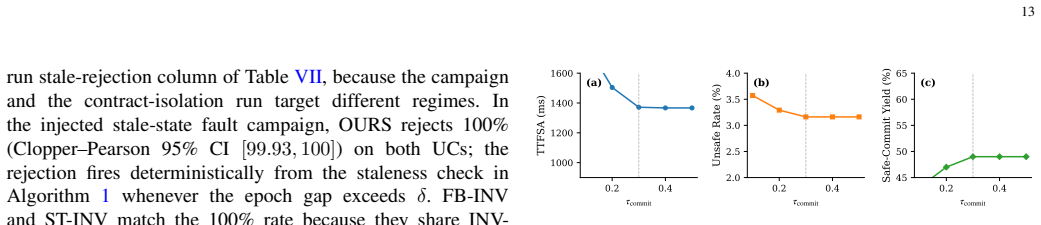
Threshold parameters τ_commit, τ_reject, τ_degraded, δ, d_min, b_min, ε_trust ... All thresholds are frozen before evaluation.
What do these tags mean?
- matches
- The paper's claim is directly supported by a theorem in the formal canon.
- supports
- The theorem supports part of the paper's argument, but the paper may add assumptions or extra steps.
- extends
- The paper goes beyond the formal theorem; the theorem is a base layer rather than the whole result.
- uses
- The paper appears to rely on the theorem as machinery.
- contradicts
- The paper's claim conflicts with a theorem or certificate in the canon.
- unclear
- Pith found a possible connection, but the passage is too broad, indirect, or ambiguous to say the theorem truly supports the claim.
Reference graph
Works this paper leans on
-
[1]
Un- derstanding O-RAN: Architecture, interfaces, algorithms, security, and research challenges,
M. Polese, L. Bonati, S. D’Oro, S. Basagni, and T. Melodia, “Un- derstanding O-RAN: Architecture, interfaces, algorithms, security, and research challenges,”IEEE Commun. Surveys Tuts., vol. 25, no. 2, pp. 1376–1421, 2023
2023
-
[2]
O-RAN WG2 non-RT RIC architecture description,
O-RAN Alliance, “O-RAN WG2 non-RT RIC architecture description,” Tech. Rep., 2024, o-RAN.WG2.Non-RT-RIC-ARCH
2024
-
[3]
ReAct: Synergizing Reasoning and Acting in Language Models
S. Yao, J. Zhao, D. Yu, N. Du, I. Shafran, K. Narasimhan, and Y . Cao, “ReAct: Synergizing reasoning and acting in language models,” inProc. Int. Conf. Learning Representations (ICLR), 2023, arXiv:2210.03629
work page internal anchor Pith review arXiv 2023
-
[4]
A survey on large language model based autonomous agents,
L. Wang, C. Ma, X. Feng, Z. Zhang, H. Yang, J. Zhang, Z. Chen, J. Tang, X. Chen, Y . Lin, W. X. Zhao, Z. Wei, and J.-R. Wen, “A survey on large language model based autonomous agents,”Frontiers of Computer Science, vol. 18, no. 6, p. 186345, 2024
2024
-
[5]
Co- mAgent: Multi-LLM based agentic AI empowered intelligent wireless networks,
H. Li, M. Xiao, K. Wang, R. Schober, D. I. Kim, and Y . L. Guan, “Co- mAgent: Multi-LLM based agentic AI empowered intelligent wireless networks,”arXiv preprint arXiv:2601.19607, 2026
-
[6]
AgentRAN: An agentic AI architecture for autonomous control of open 6G networks,
M. Elkael, S. D’Oro, L. Bonati, M. Polese, Y . Lee, K. Furueda, and T. Melodia, “AgentRAN: An agentic AI architecture for autonomous control of open 6G networks,”arXiv preprint arXiv:2508.17778, 2025
-
[7]
Multi-agentic ai for conflict- aware rapp policy orchestration in open ran,
H. Li, Y . Wu, and D. Simeonidou, “Multi-agentic AI for conflict-aware rApp policy orchestration in Open RAN,” inProc. IEEE Int. Conf. Commun. (ICC), 2026, accepted/in press; arXiv:2603.07375
-
[8]
Intent-based networking – concepts and definitions,
A. Clemm, L. Ciavaglia, L. Granville, and J. Tantsura, “Intent-based networking – concepts and definitions,” IETF RFC 9315, 2022, https: //www.rfc-editor.org/rfc/rfc9315
2022
-
[9]
A survey on intent-based networking,
A. Leivadeas and M. Falkner, “A survey on intent-based networking,” IEEE Commun. Surveys Tuts., vol. 25, no. 1, pp. 625–655, 2023
2023
-
[10]
Intent-driven autonomous network and service management in future cellular networks: A struc- tured literature review,
K. Mehmood, K. Kralevska, and D. Palma, “Intent-driven autonomous network and service management in future cellular networks: A struc- tured literature review,”Comput. Netw., vol. 220, p. 109477, 2023
2023
-
[11]
An AI-driven intent-based network architecture,
Y . Njah, A. Leivadeas, and M. Falkner, “An AI-driven intent-based network architecture,”IEEE Commun. Mag., vol. 63, no. 4, pp. 146– 153, 2025
2025
-
[12]
Agent2agent protocol (A2A) speci- fication, v0.3,
A2A Project (Linux Foundation), “Agent2agent protocol (A2A) speci- fication, v0.3,” https://github.com/a2aproject/A2A, 2025, open protocol for agent-to-agent interoperability
2025
-
[13]
Model context proto- col (MCP) specification, 2025-11-25,
Anthropic and Agentic AI Foundation, “Model context proto- col (MCP) specification, 2025-11-25,” https://modelcontextprotocol.io/ specification/2025-11-25, 2025, open protocol for LLM tool and re- source access
2025
-
[14]
AutoGen: Enabling next-gen LLM applications via multi- agent conversation,
Q. Wu, G. Bansal, J. Zhang, Y . Wu, B. Li, E. Zhu, L. Jiang, X. Zhang, S. Zhang, J. Liu, A. H. Awadallah, R. W. White, D. Burger, and C. Wang, “AutoGen: Enabling next-gen LLM applications via multi- agent conversation,” inProc. COLM, 2024
2024
-
[15]
Dynamic simplex: Balancing safety and perfor- mance in autonomous cyber physical systems,
B. Luo, S. Ramakrishna, A. Pettet, C. Kuhn, G. Karsai, and A. Mukhopadhyay, “Dynamic simplex: Balancing safety and perfor- mance in autonomous cyber physical systems,” inProc. ACM/IEEE Int. Conf. Cyber-Physical Syst. (ICCPS), 2023, pp. 177–186
2023
-
[16]
Safe multi-agent reinforcement learning for wireless applications against adversarial communications,
Z. Lv, L. Xiao, Y . Chen, H. Chen, and X. Ji, “Safe multi-agent reinforcement learning for wireless applications against adversarial communications,”IEEE Trans. Inf. Forensics Security, vol. 19, pp. 6824– 6839, 2024
2024
-
[17]
TRiSM for agentic AI: A review of trust, risk, and security management in LLM- based agentic multi-agent systems,
S. Raza, R. Sapkota, M. Karkee, and C. Emmanouilidis, “TRiSM for agentic AI: A review of trust, risk, and security management in LLM- based agentic multi-agent systems,”AI Open, vol. 7, pp. 71–95, 2026
2026
-
[18]
Semantic communications: Principles and challenges,
Z. Qin, X. Tao, J. Lu, W. Tong, and G. Y . Li, “Semantic communications: Principles and challenges,”IEEE J. Sel. Areas Commun., vol. 41, no. 1, pp. 1–32, 2023
2023
-
[19]
Semantic communications for future internet: Fundamentals, applications, and challenges,
W. Yang, H. Du, Z. Liew, W. Y . B. Lim, Z. Xiong, D. Niyato, X. Chi, X. S. Shen, and C. Miao, “Semantic communications for future internet: Fundamentals, applications, and challenges,”IEEE Commun. Surveys Tuts., vol. 25, no. 1, pp. 213–250, 2023
2023
-
[20]
Publicly available specification (PAS); A1 interface: General as- pects and principles (O-RAN.WG2.A1GAP-R004-v04.00),
ETSI, “Publicly available specification (PAS); A1 interface: General as- pects and principles (O-RAN.WG2.A1GAP-R004-v04.00),” Tech. Rep. ETSI TS 103 983 V4.0.0, 2025, may 2025
2025
-
[21]
Publicly available specification (PAS); A1 interface: Application protocol (O-RAN.WG2.A1AP-R004-v04.03),
——, “Publicly available specification (PAS); A1 interface: Application protocol (O-RAN.WG2.A1AP-R004-v04.03),” Tech. Rep. ETSI TS 103 987 V4.3.0, 2025, may 2025
2025
-
[22]
Safe reinforcement learning via shielding,
M. Alshiekh, R. Bloem, R. Ehlers, B. K ¨onighofer, S. Niekum, and U. Topcu, “Safe reinforcement learning via shielding,” inProc. AAAI Conf. Artif. Intell., vol. 32, no. 1, 2018, pp. 2669–2678
2018
-
[23]
Supervisory control of a class of discrete event processes,
P. J. G. Ramadge and W. M. Wonham, “Supervisory control of a class of discrete event processes,”SIAM J. Control Optim., vol. 25, no. 1, pp. 206–230, 1987
1987
-
[24]
Conflict mitigation framework and conflict detection in O-RAN near-RT RIC,
C. Adamczyk and A. Kliks, “Conflict mitigation framework and conflict detection in O-RAN near-RT RIC,”IEEE Commun. Mag., vol. 61, no. 12, pp. 199–205, 2023
2023
-
[25]
Study on network energy savings for NR,
3GPP, “Study on network energy savings for NR,” Tech. Rep. TR 38.864, 2023, release 18, v18.1.0
2023
-
[26]
Management and orchestration; 5G network resource model (NRM); stage 2 and stage 3,
——, “Management and orchestration; 5G network resource model (NRM); stage 2 and stage 3,” Tech. Rep. TS 28.541, 2026, release 18, V18.14.0, 2026-01-16
2026
-
[27]
Management and orchestration; 5G end to end key performance indicators,
——, “Management and orchestration; 5G end to end key performance indicators,” Tech. Rep. TS 28.554, 2026, release 18, V18.9.0, 2026-01- 16
2026
-
[28]
Real-time status: How often should one update?
S. Kaul, R. D. Yates, and M. Gruteser, “Real-time status: How often should one update?” inProc. IEEE INFOCOM, 2012, pp. 2731–2735
2012
-
[29]
A quantitative measure of fairness and discrimination for resource allocation in shared computer systems,
R. K. Jain, D.-M. W. Chiu, and W. R. Hawe, “A quantitative measure of fairness and discrimination for resource allocation in shared computer systems,” Eastern Research Laboratory, Digital Equipment Corporation, Tech. Rep. DEC-TR-301, 1984
1984
-
[30]
PROV-DM: The PROV data model,
W3C PROV Working Group, “PROV-DM: The PROV data model,” W3C Recommendation, World Wide Web Consortium, 2013, edited by Luc Moreau and Paolo Missier; 30 April 2013. [Online]. Available: https://www.w3.org/TR/prov-dm/
2013
-
[31]
Deterministic replay: A survey,
Y . Chen, S. Zhang, Q. Guo, L. Li, R. Wu, and T. Chen, “Deterministic replay: A survey,”ACM Comput. Surveys, vol. 48, no. 2, pp. 17:1–17:47, 2015
2015
-
[32]
Energy-efficient base-stations sleep-mode techniques in green cellular networks: A sur- vey,
J. Wu, Y . Zhang, M. Zukerman, and E. K.-N. Yung, “Energy-efficient base-stations sleep-mode techniques in green cellular networks: A sur- vey,”IEEE Commun. Surveys Tuts., vol. 17, no. 2, pp. 803–826, 2015
2015
-
[33]
Resource allocation for network slicing in 5G telecommunica- tion networks: A survey of principles and models,
R. Su, D. Zhang, R. Venkatesan, Z. Gong, C. Li, F. Ding, F. Jiang, and Z. Zhu, “Resource allocation for network slicing in 5G telecommunica- tion networks: A survey of principles and models,”IEEE Netw., vol. 33, no. 6, pp. 172–179, 2019
2019
-
[34]
Efron and R
B. Efron and R. J. Tibshirani,An Introduction to the Bootstrap. New York: Chapman and Hall, 1993
1993
-
[35]
The use of confidence or fiducial limits illustrated in the case of the binomial,
C. J. Clopper and E. S. Pearson, “The use of confidence or fiducial limits illustrated in the case of the binomial,”Biometrika, vol. 26, no. 4, pp. 404–413, 1934
1934
-
[36]
Interval estimation for a binomial proportion,
L. D. Brown, T. T. Cai, and A. DasGupta, “Interval estimation for a binomial proportion,”Statist. Sci., vol. 16, no. 2, pp. 101–133, 2001
2001
-
[37]
On the interpretation ofχ 2 from contingency tables, and the calculation of P,
R. A. Fisher, “On the interpretation ofχ 2 from contingency tables, and the calculation of P,”J. Roy. Stat. Soc., vol. 85, no. 1, pp. 87–94, 1922
1922
-
[38]
Simple and effective confidence intervals for proportions and differences of proportions result from adding two successes and two failures,
A. Agresti and B. Caffo, “Simple and effective confidence intervals for proportions and differences of proportions result from adding two successes and two failures,”Amer. Statist., vol. 54, no. 4, pp. 280–288, 2000
2000
-
[39]
Non- inferiority trials: Design concepts and issues—the encounters of aca- demic consultants in statistics,
R. B. D’Agostino, Sr., J. M. Massaro, and L. M. Sullivan, “Non- inferiority trials: Design concepts and issues—the encounters of aca- demic consultants in statistics,”Statist. Med., vol. 22, no. 2, pp. 169– 186, 2003
2003
discussion (0)
Sign in with ORCID, Apple, or X to comment. Anyone can read and Pith papers without signing in.