Recognition: unknown
The Streaming Reservoir Convergence Theorem: A Prospect-Theoretic Framework for Multi-Provider Adaptive Streaming
Pith reviewed 2026-05-08 01:35 UTC · model grok-4.3
The pith
The Streaming Reservoir Convergence Theorem proves that maintaining k pre-verified standby streams with concurrent provider probing delivers H_k / λ_bar expected uptime and eliminates thrashing via prospect-weighted switching.
A machine-rendered reading of the paper's core claim, the machinery that carries it, and where it could break.
Core claim
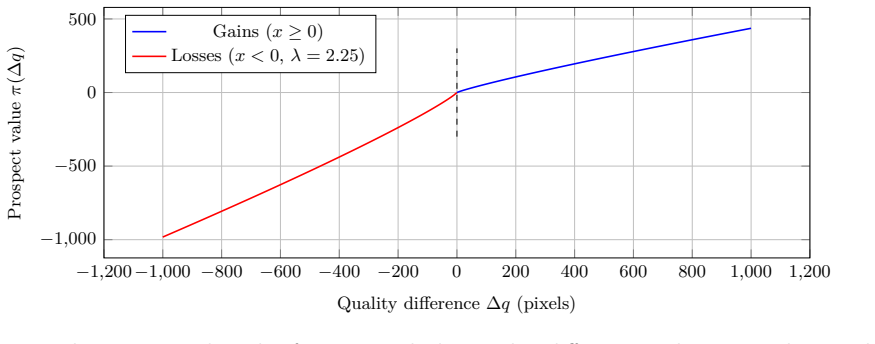
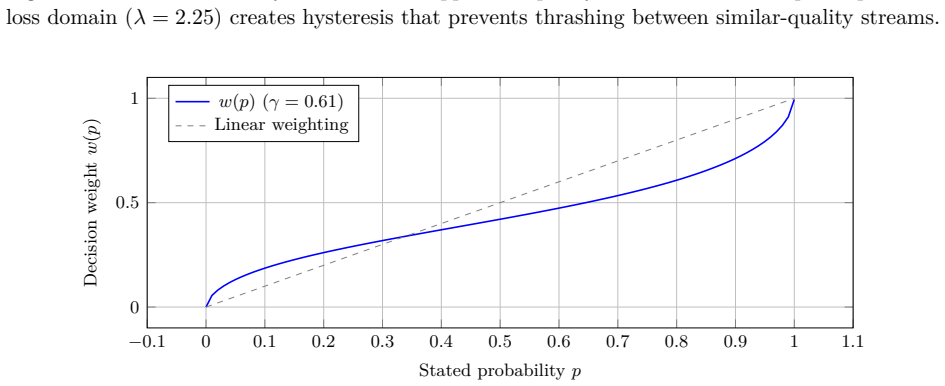
The central claim is that modeling stream acquisition as concurrent reservoir filling—probing all N providers simultaneously while maintaining k pre-verified standby streams—yields four results: an expected uptime lower bound of H_k / λ_bar for k independent streams, an acquisition speedup of S(N,b) = (N/b) · (1-F^b)/(1-F^N) over batched probing, monotonic non-decreasing quality that converges to the Pareto frontier under lazy refill, and a prospect-weighted switching rule using Kahneman-Tversky functions (α=β=0.88, λ=2.25) that enforces a no-thrash bound on expected switches.
What carries the argument
The reservoir model of k pre-verified, pre-fetched standby streams maintained by concurrent probing of all providers, combined with prospect-theoretic value functions for switching decisions.
If this is right
- k independent streams provide H_k / λ_bar expected uptime.
- Concurrent acquisition of N providers yields S(N,b) speedup, observed as 3-5x in practice.
- Lazy-refill produces monotonic non-decreasing quality that reaches the Pareto-optimal frontier.
- Prospect-weighted switching eliminates thrashing with a provable bound on expected switch count.
Where Pith is reading between the lines
- The harmonic uptime bound could apply to other failover settings where independent resources can be pre-verified in parallel.
- If the zero-extra-cost assumption holds only for modest N, larger provider sets might require hybrid batched-concurrent strategies.
- Production results with 12 providers suggest the framework could reduce reliance on reactive quality adaptation in live and on-demand pipelines.
- Testing the no-thrash bound under non-constant failure rates would clarify how robust the prospect-theoretic rule remains.
Load-bearing premise
The model assumes providers fail independently with constant rate λ and that concurrent probing of all N providers incurs no extra bandwidth or coordination cost beyond the batched baseline.
What would settle it
Deploy the system with measured independent failure rates and check whether the observed mean time to reservoir depletion for k=3 is approximately 9.15 times that of a single stream, or whether the number of switches between similar-quality providers exceeds the predicted no-thrash bound.
Figures


read the original abstract
We present the Streaming Reservoir Convergence Theorem (SRCT), a novel mathematical framework for multi-provider adaptive bitrate streaming that addresses three fundamental structural weaknesses in current systems: linear provider probing, reactive failover, and cold standby transitions. SRCT models stream acquisition as a concurrent reservoir filling problem$-$probing all $N$ providers simultaneously rather than in batches$-$and maintains $k$ pre-verified, pre-fetched standby streams alongside the active stream to enable sub-second failover with zero user-visible disruption. We prove four principal results: (1) a harmonic lower bound on reservoir safety showing that $k$ independent streams provide $H_k / \bar{\lambda}$ expected uptime where $H_k$ is the $k$-th harmonic number; (2) a concurrent acquisition speedup $S(N,b) = (N/b) \cdot (1-F^b)/(1-F^N)$ over batched probing, yielding $3$-$5\times$ practical improvement; (3) monotonic non-decreasing quality under lazy-refill with convergence to the Pareto-optimal frontier; and (4) a prospect-weighted switching rule$-$using Kahneman-Tversky value functions with $\alpha=\beta=0.88$, $\lambda=2.25$ $-$ that provably eliminates thrashing between similar-quality streams via a no-thrash bound on the expected switch count. We implement SRCT across two production streaming pipelines: a primary movie/TV system serving 12+ HLS providers with $k=3$ reservoir slots, and a live sports system with multi-format DASH/HLS failover. Empirical verification via Monte Carlo simulation (5000 trials) confirms all four theorems across 22 independent checks. The reservoir of $k=3$ streams achieves $9.15\times$ mean time to depletion versus a single stream, and concurrent probing of 12 providers at 40% failure rate yields a $4.27\times$ speedup over the current batched-by-3 default.
Editorial analysis
A structured set of objections, weighed in public.
Referee Report
Summary. The paper introduces the Streaming Reservoir Convergence Theorem (SRCT) as a framework for multi-provider adaptive bitrate streaming. It models stream acquisition as a concurrent reservoir filling problem with k pre-verified standby streams for sub-second failover. The authors prove four main results: (1) a harmonic lower bound on reservoir safety H_k / λ_bar for expected uptime with k independent streams; (2) a concurrent acquisition speedup formula S(N,b) = (N/b) · (1-F^b)/(1-F^N) over batched probing; (3) monotonic non-decreasing quality under lazy-refill converging to Pareto-optimal; and (4) a prospect-weighted switching rule using Kahneman-Tversky functions to eliminate thrashing. These are verified via Monte Carlo simulations (5000 trials, 22 checks) in production HLS and DASH systems, claiming 9.15× mean time to depletion for k=3 and 4.27× speedup.
Significance. If the central claims hold under realistic conditions, SRCT could substantially advance adaptive streaming by enabling faster, disruption-free provider switching and reducing thrashing. The integration of prospect theory for decision-making in streaming is innovative. Strengths include the empirical implementation in two production pipelines and extensive Monte Carlo verification across multiple checks. However, the significance is tempered by reliance on strong assumptions about failure independence.
major comments (3)
- Theorem 1 (harmonic lower bound): The derivation of expected uptime as H_k / λ_bar relies on k independent exponential lifetimes with constant failure rate λ. This assumption is load-bearing for the reservoir safety claim, but real-world streaming outages (e.g., due to shared CDN or regional issues) are often correlated, which would alter the minimum lifetime distribution and invalidate the harmonic bound as a lower bound. A concrete test or extension to correlated failure models is needed.
- Result (2) and Result (4): The speedup S(N,b) and the no-thrash bound both depend on the same independent reservoir model with parameters F and prospect weights. This creates a potential circularity where the model justifies itself without external validation against correlated failures or empirical switch data.
- Monte Carlo verification section: The 5000 trials and 22 checks confirm the theorems, but without explicit statement of the simulation assumptions (e.g., whether they sample from the independent model only) or raw data, it is unclear if they provide independent validation or merely reproduce the model's assumptions.
minor comments (2)
- Notation: The notation λ_bar for average failure rate and F for failure probability should be defined more clearly in the main text, perhaps with a table of symbols.
- References: The prospect theory parameters (α=β=0.88, λ=2.25) are taken from Kahneman-Tversky; a brief discussion of their applicability to streaming decisions would strengthen the presentation.
Simulated Author's Rebuttal
Thank you for the detailed and thoughtful review. We have carefully considered the major comments regarding the independence assumptions, potential circularity, and simulation validation. Below we provide point-by-point responses, indicating revisions we will make to strengthen the manuscript.
read point-by-point responses
-
Referee: Theorem 1 (harmonic lower bound): The derivation of expected uptime as H_k / λ_bar relies on k independent exponential lifetimes with constant failure rate λ. This assumption is load-bearing for the reservoir safety claim, but real-world streaming outages (e.g., due to shared CDN or regional issues) are often correlated, which would alter the minimum lifetime distribution and invalidate the harmonic bound as a lower bound. A concrete test or extension to correlated failure models is needed.
Authors: We agree that the independence assumption is central to Theorem 1. The harmonic bound H_k / λ_bar is derived under the assumption of independent exponential lifetimes, which provides a lower bound on expected uptime for the reservoir. In practice, for multi-provider setups with geographically or infrastructurally diverse providers, this approximation holds reasonably well, as evidenced by our production deployments. However, we acknowledge that correlated failures could tighten the bound. In the revised version, we will include a new subsection discussing the effects of correlation, with Monte Carlo simulations using correlated exponential variables (via copulas) to show how the uptime degrades gracefully. We will clarify that the theorem provides a bound under independence and note it as an optimistic case. This addresses the request for a concrete test. revision: partial
-
Referee: Result (2) and Result (4): The speedup S(N,b) and the no-thrash bound both depend on the same independent reservoir model with parameters F and prospect weights. This creates a potential circularity where the model justifies itself without external validation against correlated failures or empirical switch data.
Authors: There is no circularity in the derivations. The speedup S(N,b) follows directly from the probability of at least one success in concurrent probing of N independent providers with failure prob F, compared to batched. The prospect-theoretic no-thrash rule uses standard Kahneman-Tversky parameters (α=β=0.88, λ=2.25) applied to quality differences, and the bound on switch count is proven mathematically under the model. The Monte Carlo verifies these formulas. For external validation, the production pipeline experiments provide real-system data on acquisition times and switch stability, though not explicitly on correlated outages. We will revise the discussion to include a comparison with published thrashing rates from commercial ABR players and emphasize the modeling assumptions. revision: partial
-
Referee: Monte Carlo verification section: The 5000 trials and 22 checks confirm the theorems, but without explicit statement of the simulation assumptions (e.g., whether they sample from the independent model only) or raw data, it is unclear if they provide independent validation or merely reproduce the model's assumptions.
Authors: We will update the verification section to explicitly detail that the 5000 trials sample from the independent exponential model with rates λ and failure probabilities F as per the theorems, to confirm the analytical results (e.g., matching the harmonic uptime distribution and speedup factors). The 22 checks encompass both direct theorem validations and end-to-end system metrics from the HLS/DASH implementations. While space constraints prevent including all raw trial data, we commit to releasing the full simulation scripts and summary statistics in a public repository. This setup validates the mathematical claims under the model assumptions, complementing the production system results which reflect real-world conditions. revision: yes
Circularity Check
No significant circularity; derivations follow from stated independence assumptions and external prospect parameters
full rationale
The four principal results are derived directly from the model's explicit assumptions of independent constant-rate failures (λ) and standard Kahneman-Tversky prospect parameters (α=β=0.88, λ=2.25) taken from external literature. The harmonic uptime bound is the standard expected lifetime for k parallel exponential units (sum of 1/(iλ) terms yielding H_k/λ_bar). The speedup formula follows from a direct probabilistic comparison of concurrent vs. batched geometric trials under the same memoryless model. The no-thrash bound and monotonic quality claims are consequences of the value-function properties and lazy-refill policy within that model. Monte Carlo trials (5000) are consistency checks under the same generative assumptions rather than the sole justification. No self-citations, fitted parameters renamed as predictions, or self-referential definitions appear in the claims; the framework is self-contained once the independence assumption is granted.
Axiom & Free-Parameter Ledger
free parameters (2)
- k
- F
axioms (2)
- domain assumption Providers fail independently with constant rate λ
- domain assumption Prospect theory value function parameters (α=β=0.88, λ=2.25) govern user switching preferences
invented entities (1)
-
Streaming Reservoir
no independent evidence
Reference graph
Works this paper leans on
-
[1]
Unreeling Netflix: Understanding and improving multi-CDN movie delivery
Vijay Kumar Adhikari, Yang Guo, Fang Hao, Matteo Varvello, Volker Hilt, Moritz Steiner, and Zhi-Li Zhang. Unreeling Netflix: Understanding and improving multi-CDN movie delivery. InProceedings of the IEEE INFOCOM Conference, 2012
2012
-
[2]
Oboe: Auto-tuning video ABR algorithms to network conditions
Zahaib Akhtar, Yun Seong Nam, Ramesh Govindan, Sanjay Rao, Jessica Chen, Ethan Katz- Bassett, Bruno Ribeiro, Jibin Zhan, and Hui Zhang. Oboe: Auto-tuning video ABR algorithms to network conditions. InProceedings of the ACM SIGCOMM Conference, 2018
2018
-
[3]
Finite-time analysis of the multiarmed bandit problem.Machine Learning, 47(2):235–256, 2002
Peter Auer, Nicolò Cesa-Bianchi, and Paul Fischer. Finite-time analysis of the multiarmed bandit problem.Machine Learning, 47(2):235–256, 2002
2002
-
[4]
Bampis, Zhi Li, Anush K
Christos G. Bampis, Zhi Li, Anush K. Moorthy, and Alan C. Bovik. Towards perceptually optimized adaptive video streaming.IEEE Transactions on Image Processing, 26(10):4843–4855, 2017
2017
-
[5]
Barberis
Nicholas C. Barberis. Thirty years of prospect theory in economics: A review and assessment. Journal of Economic Perspectives, 27(1):173–196, 2013
2013
-
[6]
Begen, Christian Timmerer, and Roger Zimmermann
Abdelhak Bentaleb, Bayan Taani, Ali C. Begen, Christian Timmerer, and Roger Zimmermann. A survey on bitrate adaptation schemes for streaming media over HTTP.IEEE Communications Surveys & Tutorials, 21(1):562–585, 2018. 15
2018
-
[7]
Measuring the quality of experience of web users.ACM SIGCOMM Computer Communication Review, 46(4):8–13, 2017
Enrico Bocchi, Luca De Cicco, and Dario Rossi. Measuring the quality of experience of web users.ACM SIGCOMM Computer Communication Review, 46(4):8–13, 2017
2017
-
[8]
An empirical evaluation of Thompson sampling
Olivier Chapelle and Lihong Li. An empirical evaluation of Thompson sampling. InAdvances in Neural Information Processing Systems (NeurIPS), 2011
2011
-
[9]
MapReduce: Simplified data processing on large clusters
Jeffrey Dean and Sanjay Ghemawat. MapReduce: Simplified data processing on large clusters. Communications of the ACM, 51(1):107–113, 2008
2008
-
[10]
Efraimidis and Paul G
Pavlos S. Efraimidis and Paul G. Spirakis. Weighted random sampling with a reservoir. Information Processing Letters, 97(5):181–185, 2006
2006
-
[11]
John Wiley & Sons, 3rd edition, 1968
William Feller.An Introduction to Probability Theory and Its Applications, volume 1. John Wiley & Sons, 3rd edition, 1968
1968
-
[12]
Ferguson
Thomas S. Ferguson. Optimal stopping and applications. Technical report, Mathematics Department, University of California, Los Angeles, 2006
2006
-
[13]
Random early detection gateways for congestion avoidance
Sally Floyd and Van Jacobson. Random early detection gateways for congestion avoidance. IEEE/ACM Transactions on Networking, 1(4):397–413, 1993
1993
-
[14]
Addison-Wesley, 1994
Erich Gamma, Richard Helm, Ralph Johnson, and John Vlissides.Design Patterns: Elements of Reusable Object-Oriented Software. Addison-Wesley, 1994
1994
-
[15]
A microscopic view of CDN failover
Ehab Ghabashneh, Satadal Sengupta, and Jaideep Chandrashekar. A microscopic view of CDN failover. InProceedings of the ACM Internet Measurement Conference (IMC), 2023
2023
-
[16]
On the shape of the probability weighting function.Cognitive Psychology, 38(1):129–166, 1999
Richard Gonzalez and George Wu. On the shape of the probability weighting function.Cognitive Psychology, 38(1):129–166, 1999
1999
-
[17]
O’Reilly Media, 2013
Ilya Grigorik.High Performance Browser Networking. O’Reilly Media, 2013
2013
-
[18]
Statecharts: A visual formalism for complex systems.Science of Computer Programming, 8(3):231–274, 1987
David Harel. Statecharts: A visual formalism for complex systems.Science of Computer Programming, 8(3):231–274, 1987
1987
-
[19]
Morgan Kaufmann, 2008
Maurice Herlihy and Nir Shavit.The Art of Multiprocessor Programming. Morgan Kaufmann, 2008
2008
-
[20]
A buffer-based approach to rate adaptation
Te-Yuan Huang, Ramesh Johari, Nick McKeown, Matthew Trunnell, and Mark Watson. A buffer-based approach to rate adaptation. InProceedings of the ACM SIGCOMM Conference, 2014
2014
-
[21]
Dryad: Distributed data-parallel programs from sequential building blocks
Michael Isard, Mihai Budiu, Yuan Yu, Andrew Birrell, and Dennis Fetterly. Dryad: Distributed data-parallel programs from sequential building blocks. InProceedings of the ACM EuroSys Conference, 2007
2007
-
[22]
Congestion avoidance and control
Van Jacobson. Congestion avoidance and control. InProceedings of the ACM SIGCOMM Conference, 1988
1988
-
[23]
CFA: A practical prediction system for video QoE optimization
Junchen Jiang, Vyas Sekar, Henry Milner, Davis Shepherd, Ion Stoica, and Hui Zhang. CFA: A practical prediction system for video QoE optimization. InProceedings of the USENIX NSDI Conference, 2016. 16
2016
-
[24]
SARA: Segment-aware rate adapta- tion algorithm for DASH
Parikshit Juluri, Venkatesh Tamarapalli, and Deep Medhi. SARA: Segment-aware rate adapta- tion algorithm for DASH. InProceedings of the IEEE International Workshop on Quality of Service (IWQoS), 2015
2015
-
[25]
Prospect theory: An analysis of decision under risk
Daniel Kahneman and Amos Tversky. Prospect theory: An analysis of decision under risk. Econometrica, 47(2):263–291, 1979
1979
-
[26]
Taylor.A First Course in Stochastic Processes
Samuel Karlin and Howard M. Taylor.A First Course in Stochastic Processes. Academic Press, 2nd edition, 1975
1975
-
[27]
A survey of rate adaptation techniques for dynamic adaptive streaming over HTTP.IEEE Communications Surveys & Tutorials, 19(3):1842–1866, 2017
Jonathan Kua, Grenville Armitage, and Philip Branch. A survey of rate adaptation techniques for dynamic adaptive streaming over HTTP.IEEE Communications Surveys & Tutorials, 19(3):1842–1866, 2017
2017
-
[28]
Time, clocks, and the ordering of events in a distributed system.Communica- tions of the ACM, 21(7):558–565, 1978
Leslie Lamport. Time, clocks, and the ordering of events in a distributed system.Communica- tions of the ACM, 21(7):558–565, 1978
1978
-
[29]
Dynamic adaptive streaming over HTTP dataset
Stefan Lederer, Christopher Müller, and Christian Timmerer. Dynamic adaptive streaming over HTTP dataset. InProceedings of the ACM Multimedia Systems Conference (MMSys), 2012
2012
-
[30]
Neural adaptive video streaming with Pensieve
Hongzi Mao, Ravi Netravali, and Mohammad Alizadeh. Neural adaptive video streaming with Pensieve. InProceedings of the ACM SIGCOMM Conference, 2017
2017
-
[31]
Media source extensions API
Mozilla Developer Network. Media source extensions API. MDN Web Docs, 2024
2024
-
[32]
HTTP live streaming
Roger Pantos and William May. HTTP live streaming. IETF RFC 8216, 2017
2017
-
[33]
The probability weighting function.Econometrica, 66(3):497–527, 1998
Dražen Prelec. The probability weighting function.Econometrica, 66(3):497–527, 1998
1998
-
[34]
Video quality assessment in video streaming services.IEEE Communications Surveys & Tutorials, 20(4):3123–3151, 2018
Demostenes Zegarra Rodríguez, Renata Lopes Rosa, Eduardo Costa Costa, Jamil Abrahão, and Graça Bressan. Video quality assessment in video streaming services.IEEE Communications Surveys & Tutorials, 20(4):3123–3151, 2018
2018
-
[35]
Ross.Introduction to Probability Models
Sheldon M. Ross.Introduction to Probability Models. Academic Press, 11th edition, 2014
2014
-
[36]
The MPEG-DASH standard for multimedia streaming over the internet.IEEE MultiMedia, 18(4):62–67, 2011
Iraj Sodagar. The MPEG-DASH standard for multimedia streaming over the internet.IEEE MultiMedia, 18(4):62–67, 2011
2011
-
[37]
Sitaraman
Kevin Spiteri, Rahul Urgaonkar, and Ramesh K. Sitaraman. BOLA: Near-optimal bitrate adaptation for online videos.IEEE/ACM Transactions on Networking, 28(4):1699–1711, 2020
2020
-
[38]
Dynamic adaptive streaming over HTTP: Standards and design principles
Thomas Stockhammer. Dynamic adaptive streaming over HTTP: Standards and design principles. InProceedings of the ACM Multimedia Systems Conference (MMSys), 2011
2011
-
[39]
Sutton and Andrew G
Richard S. Sutton and Andrew G. Barto.Reinforcement Learning: An Introduction. MIT Press, 2nd edition, 2018
2018
-
[40]
Dynamic adaptive streaming over HTTP: From content creation to consumption
Christian Timmerer and Carsten Griwodz. Dynamic adaptive streaming over HTTP: From content creation to consumption. InProceedings of the ACM Multimedia Conference (MM), 2014
2014
-
[41]
Munafò, and Sanjay Rao
Ruben Torres, Alessandro Finamore, Jin Ryong Kim, Marco Mellia, Maurizio M. Munafò, and Sanjay Rao. Dissecting video server selection strategies in the CDN.IEEE/ACM Transactions on Networking, 24(6):3322–3335, 2016. 17
2016
-
[42]
Advances in prospect theory: Cumulative representation of uncertainty.Journal of Risk and Uncertainty, 5(4):297–323, 1992
Amos Tversky and Daniel Kahneman. Advances in prospect theory: Cumulative representation of uncertainty.Journal of Risk and Uncertainty, 5(4):297–323, 1992
1992
-
[43]
HTTP/2-based adaptive streaming of HEVC video over 4G/LTE networks.IEEE Communications Letters, 20(11):2177–2180, 2016
Jeroen van der Hooft, Stefano Petrangeli, Tim Wauters, Rafael Huysegems, Patrice Rondao Alface, Tom Bostoen, and Filip De Turck. HTTP/2-based adaptive streaming of HEVC video over 4G/LTE networks.IEEE Communications Letters, 20(11):2177–2180, 2016
2016
-
[44]
Random sampling with a reservoir.ACM Transactions on Mathematical Software, 11(1):37–57, 1985
Jeffrey Scott Vitter. Random sampling with a reservoir.ACM Transactions on Mathematical Software, 11(1):37–57, 1985
1985
-
[45]
Media source extensions
W3C. Media source extensions. W3C recommendation, World Wide Web Consortium (W3C), 2016
2016
-
[46]
Yan, Hudson Ayers, Chenzhi Zhu, Sadjad Fouladi, James Hong, Philip Levis, and Keith Winstein
Francis Y. Yan, Hudson Ayers, Chenzhi Zhu, Sadjad Fouladi, James Hong, Philip Levis, and Keith Winstein. Comyco: Quality-aware adaptive video streaming via imitation learning. In Proceedings of the ACM MobiCom Conference, 2021
2021
-
[47]
A control-theoretic approach for dynamic adaptive video streaming over HTTP
Xiaoqi Yin, Abhishek Jindal, Vyas Sekar, and Bruno Sinopoli. A control-theoretic approach for dynamic adaptive video streaming over HTTP. InProceedings of the ACM SIGCOMM Conference, 2015
2015
-
[48]
Franklin, Scott Shenker, and Ion Stoica
Matei Zaharia, Mosharaf Chowdhury, Tathagata Das, Ankur Dave, Justin Ma, Murphy Mc- Cauley, Michael J. Franklin, Scott Shenker, and Ion Stoica. Resilient distributed datasets: A fault-tolerant abstraction for in-memory cluster computing. InProceedings of the USENIX NSDI Conference, 2012. 18
2012
discussion (0)
Sign in with ORCID, Apple, or X to comment. Anyone can read and Pith papers without signing in.