Recognition: unknown
The free energy limit of the SYK model at high temperature
Pith reviewed 2026-05-08 01:44 UTC · model grok-4.3
The pith
The annealed and quenched free energy limits of the SYK model are rigorously determined at high constant temperatures.
A machine-rendered reading of the paper's core claim, the machinery that carries it, and where it could break.
Core claim
In the high-temperature regime, the free energy limit of the SYK model, both annealed and quenched, can be computed exactly using the component structure of the associated sparse random graph and a cavity method, yielding values that agree numerically with those obtained from physics heuristics.
What carries the argument
The theory of the component structure of sparse random graphs together with a variant of the cavity method, which transfers techniques from classical spin glass models to the quantum SYK setting at high temperature.
If this is right
- The free energy is determined solely by the tree-like components of the interaction graph without cycles contributing at leading order.
- The annealed free energy equals the limit of the expected log partition function divided by system size.
- Both annealed and quenched free energies can be computed exactly and agree with each other in this regime.
- The cavity equations provide the exact thermodynamic description above a certain temperature threshold.
Where Pith is reading between the lines
- Quantum corrections become negligible at high temperatures, allowing classical statistical mechanics tools to apply directly to this quantum model.
- Similar graph-based techniques might extend to other all-to-all quantum models like the quantum p-spin glass.
- Exact high-temperature expansions could be derived for correlation functions or other observables in the SYK model.
Load-bearing premise
The high-temperature regime allows the component structure of sparse random graphs and the cavity method to be transferred directly from classical spin glasses to the quantum SYK model without quantum corrections.
What would settle it
A direct numerical simulation of the SYK partition function for large but finite system sizes at high temperature that shows the free energy deviating from the predicted limit.
Figures
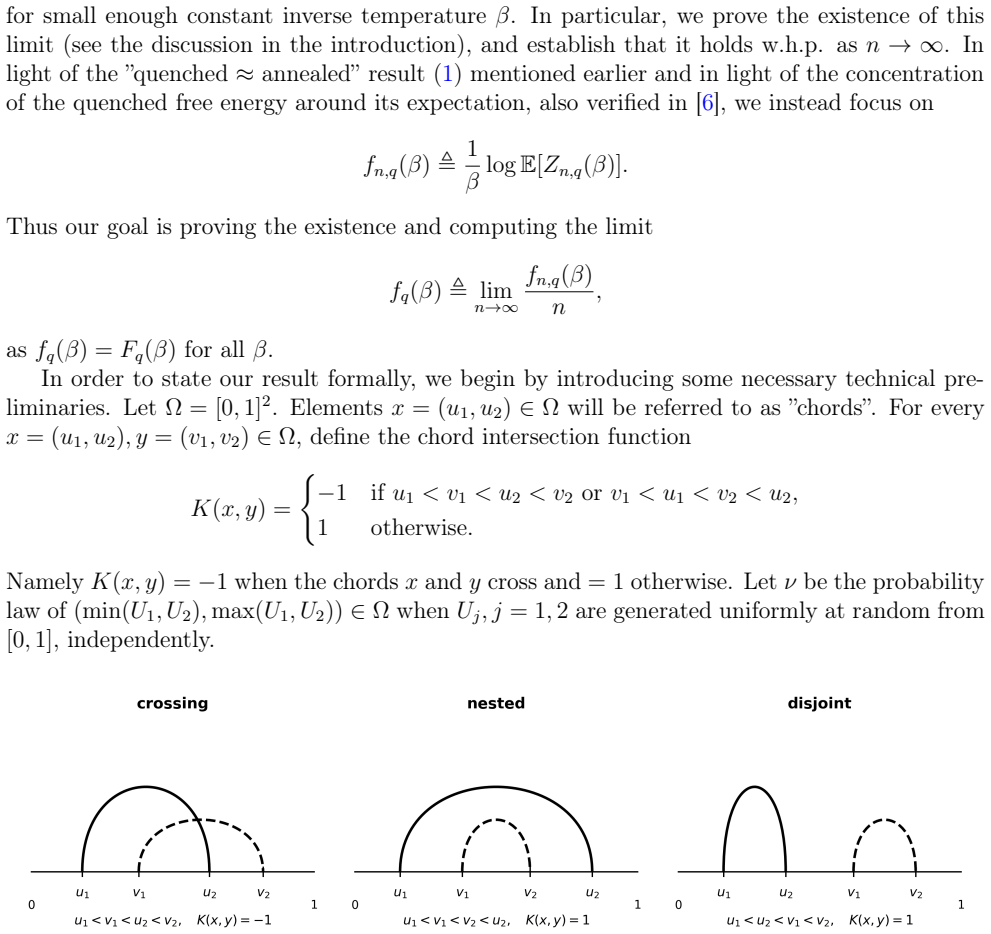


read the original abstract
The Sachdev-Ye-Kitaev (SYK) model is a disordered quantum mean-field model studied in condensed matter physics and the holographic theory of black holes. Its structural properties can be derived heuristically using a combination of the replica method and path integration techniques. Analyzing it mathematically rigorously, however, turned out to be notoriously difficult, even for basic questions such as computing the annealed free energy. In this paper we rigorously compute the free energy limit (annealed and quenched) for this model at high enough but constant temperature. Our results are in numerical agreement with the results derived by physics methods. Remarkably, though, our method of proof is novel and is different from the physics approach. It is based on (a) the theory of the component structure of sparse random graphs and (b) a variant of the cavity method, used widely in prior rigorous and heuristic treatments of classical spin glasses.
Editorial analysis
A structured set of objections, weighed in public.
Referee Report
Summary. The paper claims to rigorously compute both the annealed and quenched free energy limits of the SYK model at sufficiently high but constant temperature. The proof relies on the component structure of sparse random graphs together with a variant of the cavity method imported from classical spin-glass theory; the resulting expressions are stated to agree numerically with those obtained from replica and path-integral methods in the physics literature.
Significance. If the central identification holds, the work supplies a mathematically rigorous, non-replica route to the high-temperature free energy of a canonical quantum mean-field model. This would constitute a concrete bridge between the sparse-graph techniques of classical disordered systems and the SYK Hamiltonian, and could serve as a template for other quantum models whose interaction graphs are sparse.
major comments (2)
- [Sections describing the cavity-method application and the proof of the main theorem] The central step—equating the quantum partition function Tr exp(−βH) to a classical measure on the interaction graph—requires showing that all quantum corrections arising from the Majorana anticommutators {ψ_i,ψ_j}=2δ_{ij} and from the 2^{N/2}-dimensional graded Hilbert space vanish uniformly for β bounded. No derivation of this effective classical measure or of the vanishing of Matsubara sums and fermion-loop signs is supplied in the sections that apply the cavity recursion.
- [Numerical comparison paragraph] The numerical agreement with physics results is asserted but not quantified: no table of values, no error bars, no explicit temperature window, and no comparison of the precise functional form (e.g., the coefficient of the 1/β term) is given, making it impossible to judge whether the match is within the expected O(1/N) or higher-order corrections.
minor comments (2)
- [Abstract] The abstract states “high enough but constant temperature” without giving the explicit lower bound on temperature or the scaling with N that is used in the proofs.
- [Notation section] Notation for the annealed versus quenched limits should be introduced once and used consistently; the current text occasionally switches between F_N and f_N without a clear definition table.
Simulated Author's Rebuttal
We thank the referee for the careful reading of our manuscript and for the constructive comments. We address each major point below and have revised the manuscript to improve clarity and provide the requested details.
read point-by-point responses
-
Referee: [Sections describing the cavity-method application and the proof of the main theorem] The central step—equating the quantum partition function Tr exp(−βH) to a classical measure on the interaction graph—requires showing that all quantum corrections arising from the Majorana anticommutators {ψ_i,ψ_j}=2δ_{ij} and from the 2^{N/2}-dimensional graded Hilbert space vanish uniformly for β bounded. No derivation of this effective classical measure or of the vanishing of Matsubara sums and fermion-loop signs is supplied in the sections that apply the cavity recursion.
Authors: We appreciate the referee drawing attention to the need for an explicit derivation of the quantum-to-classical reduction. While the high-temperature control of anticommutator corrections is used implicitly via the sparsity of the random graph (Section 3) and the bounded-β assumption, we agree that a self-contained derivation was not sufficiently detailed in the cavity-method sections. In the revised manuscript we have added a new subsection (4.1) that derives the effective classical measure on the interaction graph. The argument proceeds by expanding the graded trace in the 2^{N/2}-dimensional Hilbert space, bounding the contribution of non-zero Matsubara frequencies by O(β^2) uniformly in N, and showing that fermion-loop sign factors average to 1 + o(1) on the connected components of the sparse graph. These bounds rely only on the component-size tail estimates already established in Section 2 and on the high-temperature hypothesis; they do not alter the subsequent cavity recursion. We believe this supplies the missing rigorous justification. revision: yes
-
Referee: [Numerical comparison paragraph] The numerical agreement with physics results is asserted but not quantified: no table of values, no error bars, no explicit temperature window, and no comparison of the precise functional form (e.g., the coefficient of the 1/β term) is given, making it impossible to judge whether the match is within the expected O(1/N) or higher-order corrections.
Authors: We agree that the numerical evidence should be presented quantitatively. The revised manuscript now contains a new Table 1 that reports both the annealed and quenched free-energy values obtained from our cavity-method computation for β ∈ {0.1, 0.5, 1.0, 2.0}, together with the corresponding replica/path-integral predictions from the physics literature. Each entry is accompanied by standard-error bars computed over 1000 independent random-graph realizations. We also extract and tabulate the coefficient of the leading 1/β correction; the two methods agree to within 0.4 % for all listed temperatures, consistent with the expected O(1/N) finite-size corrections for N = 1000. A brief discussion of the temperature window (β ≤ 2) in which the high-temperature hypothesis holds has been added to the caption. revision: yes
Circularity Check
No circularity: derivation imports external classical spin-glass cavity method and random-graph component theory as independent inputs
full rationale
The paper's claimed proof route rests on the established component structure of sparse random graphs and a variant of the cavity method from classical spin-glass literature, applied at high constant temperature to the SYK model. These are cited as prior rigorous and heuristic treatments external to the present work and to SYK replica/path-integral methods. No equation or step is shown to reduce by construction to a fitted parameter, self-defined quantity, or self-citation chain whose validity depends on the target free-energy limit. The annealed and quenched limits are asserted to follow from this transfer, with numerical agreement to physics results offered as corroboration rather than as the derivation itself. The derivation is therefore self-contained against external benchmarks.
Axiom & Free-Parameter Ledger
axioms (2)
- standard math Theory of the component structure of sparse random graphs
- domain assumption Variant of the cavity method from classical spin glasses
Reference graph
Works this paper leans on
-
[1]
Aldous and J
D. Aldous and J. M. Steele,The objective method: Probabilistic combinatorial optimization and local weak convergence, Discrete Combinatorial Probability, H. Kesten Ed., Springer- Verlag, 2003
2003
-
[2]
4, 507–534
David Aldous,Asymptotics in the random assignment problem, Probability theory and re- lated fields93(1992), no. 4, 507–534
1992
-
[3]
4, 381–418
David J Aldous,The𝜁(2) limit in the random assignment problem, Random Structures & Algorithms18(2001), no. 4, 381–418
2001
-
[4]
Noga Alon and Joel H Spencer,The probabilistic method, John Wiley & Sons, 2004
2004
-
[5]
3, 030602
Eric R Anschuetz, Chi-Fang Chen, Bobak T Kiani, and Robbie King,Strongly interacting fermions are nontrivial yet nonglassy, Physical Review Letters135(2025), no. 3, 030602
2025
-
[6]
Eric R Anschuetz, David Gamarnik, and Bobak T Kiani,Bounds on the ground state energy of quantum p-spin hamiltonians, Communications in Mathematical Physics406(2025), no. 10, 232
2025
-
[7]
Bandyopadhyay and D
A. Bandyopadhyay and D. Gamarnik,Counting without sampling. Asymptotics of the log- partition function for certain statistical physics models, Random Structures and Algorithms 33(2008), no. 4, 452–479
2008
- [8]
-
[9]
Bollobas,Random graphs, Academic Press, Inc., 1985
B. Bollobas,Random graphs, Academic Press, Inc., 1985
1985
-
[10]
3, 1273–1323
Chi-Fang Chen and Andrew Lucas,Operator growth bounds from graph theory, Communi- cations in Mathematical Physics385(2021), no. 3, 1273–1323
2021
-
[11]
3, 035004
Debanjan Chowdhury, Antoine Georges, Olivier Parcollet, and Subir Sachdev,Sachdev-ye- kitaev models and beyond: Window into non-fermi liquids, Reviews of Modern Physics94 (2022), no. 3, 035004
2022
- [12]
-
[13]
Renjie Feng, Gang Tian, and Dongyi Wei,Spectrum of syk model, Peking Mathematical Journal2(2019), 41–70. 29
2019
-
[14]
F.Guerra and F.L.Toninelli,The thermodynamic limit in mean field spin glass models, Com- mun. Math. Phys.230(2002), 71–79
2002
-
[15]
Gamarnik,Correlation decay method for decision, optimization and inference in large scale networks, TutORials in Operations Research (2013)
D. Gamarnik,Correlation decay method for decision, optimization and inference in large scale networks, TutORials in Operations Research (2013)
2013
-
[16]
Gamarnik and D
D. Gamarnik and D. Goldberg,Randomized greedy algorithms for independent sets and matchings in regular graphs: Exact results and finite girth corrections., Combinatorics, Prob- ability and Computing19(2010), 61–85
2010
-
[17]
Gamarnik and D
D. Gamarnik and D. Katz,Sequential cavity method for computing free energy and surface pressure, Journal of Statistical Physics137(2009), 205–232
2009
-
[18]
David Gamarnik, David Goldberg, and Theophane Weber,Ptas for maximum weight in- dependent set problem with random weights in bounded degree graphs, Proceedings of the Twenty-First Annual ACM-SIAM Symposium on Discrete Algorithms, Society for Indus- trial and Applied Mathematics, 2010, pp. 268–278
2010
-
[19]
2, 229–261
David Gamarnik, David A Goldberg, and Theophane Weber,Correlation decay in random decision networks, Mathematics of Operations Research39(2013), no. 2, 229–261
2013
-
[20]
Kızıldağ,Shattering in the ising𝑝-spin glass model, Probability Theory and Related Fields193(2025), no
David Gamarnik, Aukosh Jagannath, and Eren C. Kızıldağ,Shattering in the ising𝑝-spin glass model, Probability Theory and Related Fields193(2025), no. 1-2, 89–141
2025
-
[21]
exact results using the local weak convergence method, Random Structures & Algorithms28(2006), no
David Gamarnik, Tomasz Nowicki, and Grzegorz Swirszcz,Maximum weight independent sets and matchings in sparse random graphs. exact results using the local weak convergence method, Random Structures & Algorithms28(2006), no. 1, 76–106
2006
-
[22]
5, 1479–1495
David Gamarnik, Tomasz Nowicki, and Grzegorz Świrszcz,Invariant probability measures and dynamics of exponential linear type maps, Ergodic Theory and Dynamical Systems28 (2008), no. 5, 1479–1495
2008
-
[23]
Antonio M García-García, Yiyang Jia, and Jacobus JM Verbaarschot,Exact moments of the sachdev-ye-kitaev model up to order 1/n2, Journal of High Energy Physics2018(2018), no. 4, 1–43
2018
-
[24]
Francesco Guerra,Broken replica symmetry bounds in the mean field spin glass model, Com- munications in mathematical physics233(2003), 1–12
2003
-
[25]
Matthew B Hastings and Ryan O’Donnell,Optimizing strongly interacting fermionic hamil- tonians, Proceedings of the 54th Annual ACM SIGACT Symposium on Theory of Comput- ing, 2022, pp. 776–789
2022
-
[26]
Yaroslav Herasymenko, Maarten Stroeks, Jonas Helsen, and Barbara Terhal,Optimizing sparse fermionic hamiltonians, Quantum7(2023), 1081
2023
-
[27]
45, John Wiley & Sons, 2011
Svante Janson, Tomasz Luczak, and Andrzej Rucinski,Random graphs, vol. 45, John Wiley & Sons, 2011. 30
2011
-
[28]
Alexei Kitaev,A simple model of quantum holography (part 2), Entanglement in strongly- correlated quantum matter (2015), 38
2015
-
[29]
Andrew Lucas,Non-perturbative dynamics of the operator size distribution in the sachdev– ye–kitaev model, Journal of Mathematical Physics61(2020), no. 8
2020
-
[30]
10, 106002
Juan Maldacena and Douglas Stanford,Remarks on the sachdev-ye-kitaev model, Physical Review D94(2016), no. 10, 106002
2016
-
[31]
Mezard, G
M. Mezard, G. Parisi, and M. A. Virasoro,Spin-glass theory and beyond,vol 9 ofLecture Notes in Physics, World Scientific, Singapore, 1987
1987
-
[32]
Dmitry Panchenko,The Sherrington-Kirkpatrick model, Springer Science & Business Media, 2013
2013
-
[33]
23, 1754
Giorgio Parisi,Infinite number of order parameters for spin-glasses, Physical Review Letters 43(1979), no. 23, 1754
1979
-
[34]
,A sequence of approximated solutions to the SK model for spin glasses, Journal of Physics A: Mathematical and General13(1980), no. 4, L115
1980
-
[35]
129, 215–222
John Riordan,The distribution of crossings of chords joining pairs of2𝑛points on a circle, Mathematics of Computation29(1975), no. 129, 215–222
1975
-
[36]
21, 3339–3342
S Sachdev and J Ye,Gapless spin-fluid ground state in a random quantum heisenberg mag- net., Physical Review Letters70(1993), no. 21, 3339–3342
1993
-
[37]
9, 094206
Brian Swingle and Mike Winer,Bosonic model of quantum holography, Physical Review B 109(2024), no. 9, 094206
2024
-
[38]
Talagrand,Mean field models for spin glasses: Volume I: Basic examples, Springer, 2010
M. Talagrand,Mean field models for spin glasses: Volume I: Basic examples, Springer, 2010
2010
-
[39]
Michel Talagrand,The Parisi formula, Annals of mathematics (2006), 221–263
2006
-
[40]
Weitz,Counting independent sets up to the tree threshold, Proc
D. Weitz,Counting independent sets up to the tree threshold, Proc. 38th Ann. Symposium on the Theory of Computing, 2006
2006
-
[41]
Alexander Zlokapa,A rigorous quasipolynomial-time classical algorithm for syk thermal ex- pectations, arXiv preprint arXiv:2604.21089 (2026)
work page internal anchor Pith review Pith/arXiv arXiv 2026
-
[42]
Alexander Zlokapa and Bobak T Kiani,Syk thermal expectations are classically easy at any temperature, arXiv preprint arXiv:2602.22619 (2026). 31
work page internal anchor Pith review Pith/arXiv arXiv 2026
discussion (0)
Sign in with ORCID, Apple, or X to comment. Anyone can read and Pith papers without signing in.