Recognition: 2 theorem links
· Lean TheoremOptical activity, orbital modulation, and broadband SED constraints for RX J1553.0+4457
Pith reviewed 2026-05-08 18:23 UTC · model grok-4.3
The pith
RX J1553.0+4457 is a detached post-common-envelope binary whose rapid optical variability is dominated by magnetic activity on the late-type companion.
A machine-rendered reading of the paper's core claim, the machinery that carries it, and where it could break.
Core claim
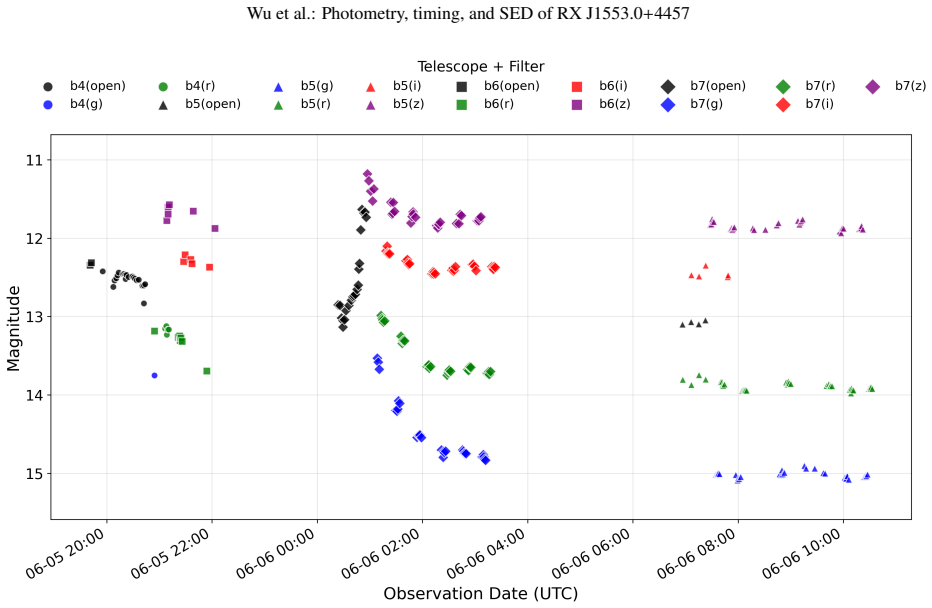
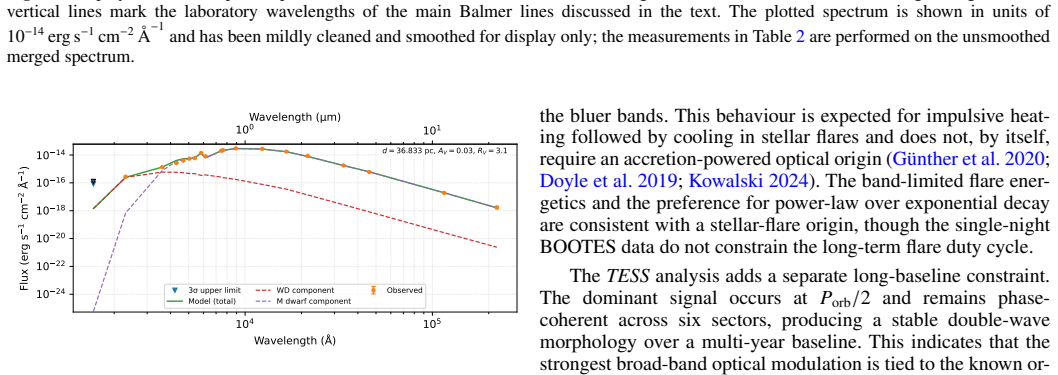
RX J1553.0+4457 is a nearby detached post-common-envelope binary containing a white dwarf and an active late-type companion. High-cadence BOOTES photometry shows two short optical flares separated by about 3 hours with amplitudes of roughly 1-1.5 mag and faster decay at shorter wavelengths. The combined TESS light curve exhibits a stable periodic signal at P = 0.083782 d consistent with the first harmonic of the known spectroscopic orbital period, with flares lying in the energetic regime of active M-dwarf flares. EP/FXT spectra during the same window reveal a factor-of-four decline in 0.3-10 keV flux linked to decreasing emission measures. The broadband SED is reproduced by a cool white-dw
What carries the argument
Multi-band light-curve analysis combined with broadband spectral energy distribution fitting that decomposes emission into a passive white dwarf and an active M-dwarf component without requiring accretion luminosity.
Load-bearing premise
That the observed flares, orbital signal, X-ray decline, and lack of mid-IR excess can be fully explained by standard M-dwarf activity plus a passive white dwarf without any accretion contribution, assuming the flare sample and SED components follow unmodified templates from isolated stars.
What would settle it
Detection of persistent mid-infrared excess or accretion-powered spectral features that exceed the M-dwarf template in new observations.
Figures



read the original abstract
RX J1553.0+4457 (TMTS J15530469+4457458) is a nearby detached post-common-envelope binary containing a white dwarf and an active late-type companion. We present a multi-wavelength study of its short-timescale optical activity, orbital modulation, X-ray behaviour, and broadband spectral energy distribution. The analysis combines high-cadence BOOTES multi-band photometry, six sectors of public TESS full-frame imaging, Einstein Probe/FXT X-ray observations obtained after the WXT detection, CAFOS optical spectroscopy, and archival UV-to-mid-IR photometry. The BOOTES data reveal two short optical flares separated by about 3 h, with amplitudes of roughly 1-1.5 mag and faster decay at shorter wavelengths. The combined TESS light curve shows a stable signal at P = 0.083782 d, consistent with the first harmonic of the known spectroscopic orbital period, and the TESS flare sample lies in the energetic regime of active M-dwarf flares. During the same activity window, the EP/FXT spectra show a factor of about four decline in the 0.3-10 keV flux, mainly associated with decreasing emission measures. The broadband SED is well reproduced by a cool white dwarf plus a late-type M dwarf, with no clear mid-infrared excess. RX J1553.0+4457 is therefore best interpreted as a detached post-common-envelope binary whose rapid optical variability is dominated by magnetic activity on the late-type companion. A weak wind-fed or intermittent accretion contribution remains possible, but the current data do not require a luminous accretion disc or a dominant accretion-powered optical component.
Editorial analysis
A structured set of objections, weighed in public.
Referee Report
Summary. The manuscript presents a multi-wavelength analysis of RX J1553.0+4457 combining BOOTES photometry, six sectors of TESS data, Einstein Probe/FXT X-ray observations, CAFOS spectroscopy, and archival UV-to-mid-IR photometry. It concludes that the system is a detached post-common-envelope binary whose rapid optical variability (including flares and orbital modulation at the first harmonic of the spectroscopic period) is dominated by magnetic activity on the late-type companion, with the broadband SED well fit by a cool white dwarf plus late M dwarf and no mid-IR excess; a weak wind-fed or intermittent accretion contribution is not ruled out but is not required by the data.
Significance. If the interpretation holds, the work strengthens the sample of well-characterized nearby PCEBs by showing that standard M-dwarf activity templates plus a passive white dwarf can account for the observed flares, stable orbital signal, X-ray decline via falling emission measure, and SED without invoking a luminous disk. The multi-instrument dataset (high-cadence optical, X-ray spectroscopy, and broadband photometry) provides a useful template for distinguishing activity from accretion in similar systems.
major comments (2)
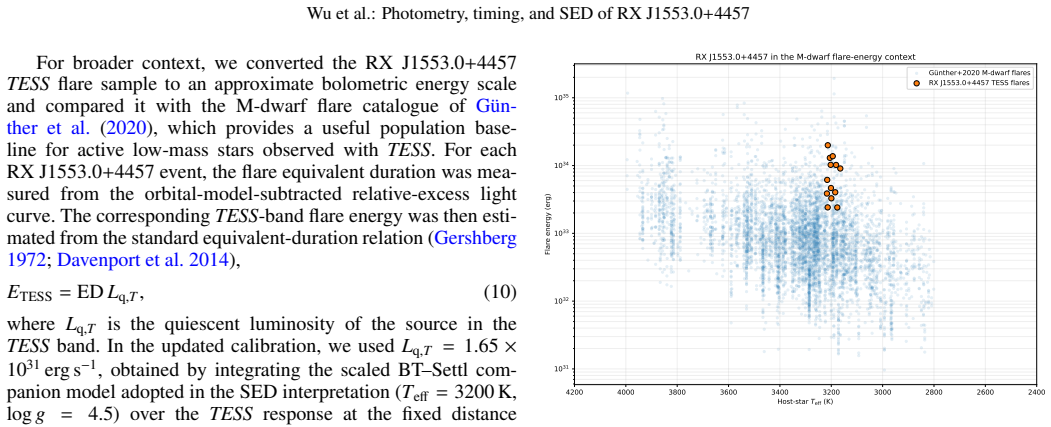
- [TESS flare analysis] TESS flare analysis (near the combined light-curve description): the claim that the flare sample lies in the energetic regime of isolated M-dwarf flares is central to ruling out dominant accretion-powered optical emission, yet the manuscript provides neither the explicit flare-energy calculation (including distance, bolometric correction, or integration limits) nor the comparison sample statistics or uncertainties; without these the attribution remains difficult to verify independently.
- [Broadband SED] Broadband SED section: the statement that the SED is well reproduced by a cool white dwarf plus late-type M dwarf with no clear mid-IR excess is load-bearing for the no-luminous-disk conclusion, but the fitting procedure, parameter values and uncertainties, reduced chi-squared, or residual analysis at mid-IR wavelengths are not reported; this prevents assessment of whether the fit is unique or whether a small accretion component could be accommodated.
minor comments (3)
- [Abstract and TESS light-curve section] The reported TESS period P = 0.083782 d is given without uncertainty or explicit statement of whether it was obtained from a periodogram, folding, or least-squares fit; adding this would clarify consistency with the spectroscopic orbital period.
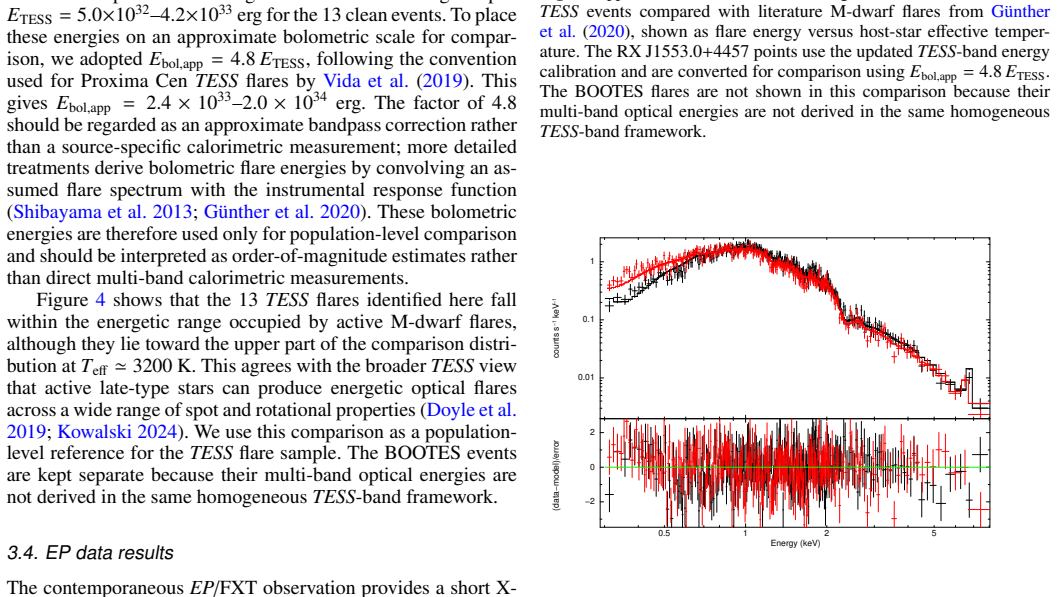
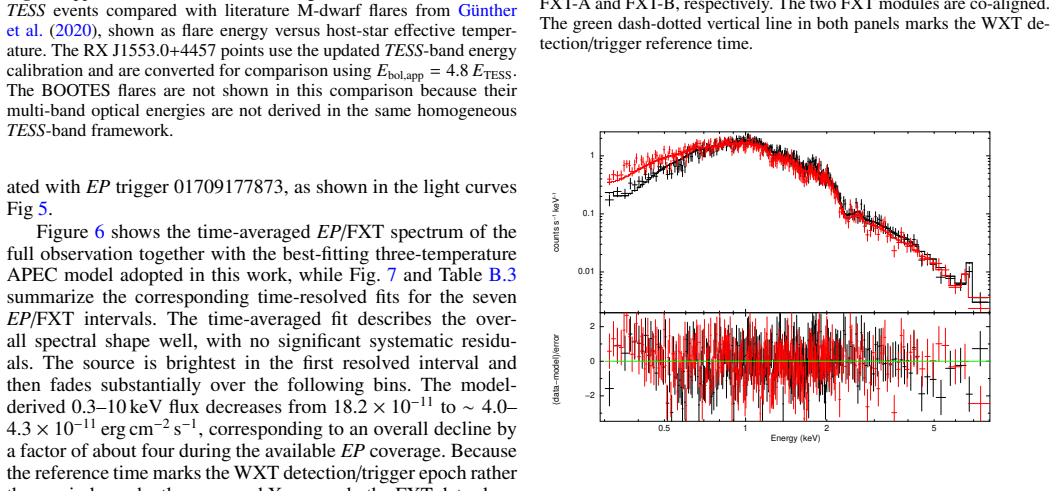
- [X-ray observations] The factor-of-four X-ray flux decline is attributed to decreasing emission measure, but the pre- and post-decline flux values, exact time intervals, and spectral-fit parameters (e.g., temperature and EM) are not tabulated; a short table would improve traceability.
- [BOOTES photometry] The two BOOTES flares are described with amplitudes ~1-1.5 mag and faster decay at shorter wavelengths, but no light-curve figures or decay-time measurements are referenced in the text; cross-referencing the figures explicitly would aid the reader.
Simulated Author's Rebuttal
We thank the referee for the positive summary, the assessment of significance, and the recommendation for minor revision. The comments identify two areas where additional detail will improve verifiability without altering the scientific conclusions. We address each point below and will incorporate the requested information in the revised manuscript.
read point-by-point responses
-
Referee: [TESS flare analysis] TESS flare analysis (near the combined light-curve description): the claim that the flare sample lies in the energetic regime of isolated M-dwarf flares is central to ruling out dominant accretion-powered optical emission, yet the manuscript provides neither the explicit flare-energy calculation (including distance, bolometric correction, or integration limits) nor the comparison sample statistics or uncertainties; without these the attribution remains difficult to verify independently.
Authors: We agree that the explicit flare-energy calculation and comparison statistics were not reported in sufficient detail. The TESS flares were identified and their energies computed by integrating the excess flux in the TESS bandpass over the flare duration, converting to bolometric energy using the Gaia distance and a standard M-dwarf bolometric correction drawn from the literature. In the revised manuscript we will add the precise integration limits, the numerical energies with uncertainties, the reference comparison sample (with its statistics), and the quantitative placement of our events relative to that sample. This addition will allow independent verification that the flares are consistent with the energetic regime of isolated M-dwarf activity. revision: yes
-
Referee: [Broadband SED] Broadband SED section: the statement that the SED is well reproduced by a cool white dwarf plus late-type M dwarf with no clear mid-IR excess is load-bearing for the no-luminous-disk conclusion, but the fitting procedure, parameter values and uncertainties, reduced chi-squared, or residual analysis at mid-IR wavelengths are not reported; this prevents assessment of whether the fit is unique or whether a small accretion component could be accommodated.
Authors: We acknowledge that the SED fitting details were omitted. The broadband SED was assembled from archival UV-to-mid-IR photometry and modeled as the sum of a cool white-dwarf atmosphere and a late-M-dwarf template. In the revised manuscript we will describe the fitting procedure, report the best-fit parameters and uncertainties, give the reduced chi-squared value, and present a residual analysis focused on the mid-IR bands. These additions will show that the two-component model reproduces the data adequately and that no luminous disk is required, while still noting that a weak accretion contribution remains possible but is not demanded by the observations. revision: yes
Circularity Check
No significant circularity; observational comparisons to external templates
full rationale
The paper's central interpretation—that RX J1553.0+4457 is a detached PCEB with optical variability dominated by companion magnetic activity—rests on direct matching of observed TESS flare energies, stable orbital signal at the spectroscopic period harmonic, X-ray flux decline, and broadband SED to standard M-dwarf activity templates and passive WD + M-dwarf models. No internal equations, fitted parameters renamed as predictions, or self-citation chains are used to derive the conclusion; the text explicitly qualifies that weak accretion remains possible. This is a standard observational consistency check against independent benchmarks, yielding no load-bearing reductions to the paper's own inputs.
Axiom & Free-Parameter Ledger
free parameters (1)
- component temperatures and radii in SED fit
axioms (2)
- domain assumption M-dwarf flares follow the same amplitude, duration, and color evolution as isolated active M dwarfs
- domain assumption Absence of mid-IR excess rules out a luminous accretion disk
Reference graph
Works this paper leans on
-
[1]
1995 , publisher =
Warner, Brian , title =. 1995 , publisher =
1995
-
[2]
Publications of the Astronomical Society of the Pacific , volume =
Osaki, Yoji , title =. Publications of the Astronomical Society of the Pacific , volume =
-
[3]
New Astronomy Reviews , volume =
Lasota, Jean‐Pierre , title =. New Astronomy Reviews , volume =
-
[4]
Astronomy and Astrophysics , volume =
Osaki, Yoji , title =. Astronomy and Astrophysics , volume =
-
[5]
Publications of the Astronomical Society of Japan , volume =
Kato, Taichi and others , title =. Publications of the Astronomical Society of Japan , volume =
- [6]
-
[7]
Astronomy and Astrophysics , volume =
Voges, Wolfgang and others , title =. Astronomy and Astrophysics , volume =
-
[8]
Cataclysmic Variables from the Sloan Digital Sky Survey. V. The Fifth Year (2004) , author=. The Astronomical Journal , volume=. 2006 , doi=
2004
-
[9]
Astronomy & Astrophysics , volume=
A post-common-envelope binary with double-peaked Balmer emission lines from TMTS , author=. Astronomy & Astrophysics , volume=. 2025 , month=. doi:10.1051/0004-6361/202553732 , arxiv=
-
[10]
Journal of Astronomical Telescopes, Instruments, and Systems , volume=
Transiting Exoplanet Survey Satellite (TESS) , author=. Journal of Astronomical Telescopes, Instruments, and Systems , volume=. 2015 , month=
2015
-
[11]
Publications of the Astronomical Society of the Pacific , volume=
The Tsinghua University--Ma Huateng Telescopes for Survey: Overview and Performance of the System , author=. Publications of the Astronomical Society of the Pacific , volume=. 2020 , month=
2020
-
[12]
and Conrow, T
Morrissey, P. and Conrow, T. and Barlow, T. A. and others , title =. The Astrophysical Journal Supplement Series , year =
-
[13]
and Schlegel, D
Padmanabhan, N. and Schlegel, D. J. and Finkbeiner, D. P. and others , title =. The Astrophysical Journal , year =
-
[14]
and Wheaton, W
Cohen, M. and Wheaton, W. A. and Megeath, S. T. , title =. The Astronomical Journal , year =
-
[15]
Explanatory Supplement to the WISE All-Sky Data Release Products , year =
-
[16]
Wright, E. L. and Eisenhardt, P. R. M. and Mainzer, A. K. and others , title =. The Astronomical Journal , year =
-
[17]
and De Angeli, F
Riello, M. and De Angeli, F. and Evans, D. W. and others , title =. Astronomy & Astrophysics , year =
-
[18]
The Eleventh and Twelfth Data Releases of the Sloan Digital Sky Survey: Final Data from SDSS-III. , archivePrefix = "arXiv", eprint =. doi:10.1088/0067-0049/219/1/12 , adsurl =
-
[19]
2008, title VOSA: virtual observatory SED analyzer
VOSA: virtual observatory SED analyzer. An application to the Collinder 69 open cluster. , archivePrefix = "arXiv", eprint =. doi:10.1051/0004-6361:200810395 , adsurl =
-
[20]
American Astronomical Society Meeting Abstracts \#228 , year = 2016, series =
APASS Data Release 9. American Astronomical Society Meeting Abstracts \#228 , year = 2016, series =
2016
-
[21]
2011, ApJ, 731, 53, doi: 10.1088/0004-637X/731/1/53
Preliminary Results from NEOWISE: An Enhancement to the Wide-field Infrared Survey Explorer for Solar System Science. , archivePrefix = "arXiv", eprint =. doi:10.1088/0004-637X/731/1/53 , adsurl =
-
[22]
The Galaxy Evolution Explorer: A Space Ultraviolet Survey Mission
The Galaxy Evolution Explorer: A Space Ultraviolet Survey Mission. , eprint =. doi:10.1086/426387 , adsurl =
-
[23]
The Two Micron All Sky Survey (2MASS). , keywords =. doi:10.1086/498708 , adsurl =
-
[24]
and Fern
Hu, Y.-D. and Fern. The Burst Observer and Optical Transient Exploring System in the multi-messenger astronomy era , journal =. 2023 , volume =
2023
-
[25]
Brasseur, C. E. and Phillip, Carlita and Fleming, Scott W. and Mullally, Susan E. and White, Richard L. , title =. 2019 , archivePrefix=. 1905.007 , adsurl =
2019
-
[26]
2018 , archivePrefix=
Lightkurve: Kepler and TESS time series analysis in Python , howpublished =. 2018 , archivePrefix=. 1812.013 , adsurl =
2018
-
[27]
2022 , volume =
The Astropy Project: Sustaining and Growing a Community-oriented Open-source Project and the Latest Major Release (v5.0) of the Core Package , journal =. 2022 , volume =
2022
-
[28]
Lomb, N. R. , title =. Astrophysics and Space Science , year =
-
[29]
Scargle, J. D. , title =. The Astrophysical Journal , year =
-
[30]
, title =
VanderPlas, Jacob T. , title =. The Astrophysical Journal Supplement Series , year =
-
[31]
Handbook of X-ray and Gamma-ray Astrophysics , editor =
Yuan, Weimin and Zhang, Chen and Chen, Yong and Ling, Zhixing , title =. Handbook of X-ray and Gamma-ray Astrophysics , editor =. 2022 , doi =
2022
-
[32]
2021 , volume =
Gaia Early Data Release 3: Summary of the contents and survey properties , journal =. 2021 , volume =
2021
-
[33]
Bailer-Jones, C. A. L. and Rybizki, J. and Fouesneau, M. and Demleitner, M. and Andrae, R. , title =. The Astronomical Journal , year =
-
[34]
Cardelli, J. A. and Clayton, G. C. and Mathis, J. S. , title =. The Astrophysical Journal , year =
-
[35]
, title =
Koester, D. , title =. Memorie della Societ. 2010 , volume =
2010
-
[36]
and Homeier, D
Allard, F. and Homeier, D. and Freytag, B. , title =. Philosophical Transactions of the Royal Society A , year =
-
[37]
Bellm, E. C. and Kulkarni, S. R. and Graham, M. J. and Dekany, R. and Smith, R. M. and Riddle, R. and others , title =. Publications of the Astronomical Society of the Pacific , year =
-
[38]
Graham, M. J. and Kulkarni, S. R. and Bellm, E. C. and Adams, S. M. and Barbarino, C. and Blagorodnova, N. and others , title =. Publications of the Astronomical Society of the Pacific , year =
-
[39]
Welch, P. D. , title =. IEEE Transactions on Audio and Electroacoustics , year =
-
[40]
Foreman-Mackey, Daniel and Hogg, David W. and Lang, Dustin and Goodman, Jonathan , title =. Publications of the Astronomical Society of the Pacific , year =. doi:10.1086/670067 , eprint =
-
[41]
Stellar Flares from the First TESS Data Release: Exploring a New Sample of M Dwarfs , journal =
G. Stellar Flares from the First TESS Data Release: Exploring a New Sample of M Dwarfs , journal =. 2020 , volume =
2020
-
[42]
Rebassa-Mansergas, A. and G. Post-common-envelope binaries from SDSS -- I. 101 white dwarf-main sequence binaries with multiple SDSS spectroscopy , journal =. 2007 , volume =
2007
-
[43]
Rebassa-Mansergas, A. and G. Post-common-envelope binaries from SDSS -- VII. A catalogue of white dwarf-main sequence binaries , journal =. 2010 , volume =
2010
-
[44]
and Schreiber, M
Zorotovic, M. and Schreiber, M. R. and G. Post-common-envelope binaries from SDSS. IX: Constraining the common-envelope efficiency , journal =. 2010 , volume =
2010
-
[45]
Tappert, C. and G. Accretion in the detached post-common-envelope binary LTT 560 , journal =. 2011 , volume =
2011
-
[46]
and Baptista, R
Ribeiro, T. and Baptista, R. and Kafka, S. and Dufour, P. and Gianninas, A. and Fontaine, G. , title =. A&A , year =
-
[47]
Parsons, S. G. and G. Magnetic white dwarfs in post-common-envelope binaries , journal =. 2021 , volume =
2021
-
[48]
and Ramsay, G
Doyle, L. and Ramsay, G. and Doyle, J. G. and Wu, K. , title =. MNRAS , year =
-
[49]
, title =
Kowalski, Adam F. , title =. Living Reviews in Solar Physics , year =
-
[50]
Timmer, J. and K. On generating power law noise , journal =. 1995 , volume =
1995
-
[51]
, title =
Vaughan, S. , title =. A&A , year =
-
[52]
2022 , volume =
Modeling the H and He 10830 Transmission Spectrum of WASP-52b , journal =. 2022 , volume =
2022
-
[53]
Castro-Tirado, A. J. and Jel. Building the BOOTES world-wide Network of Robotic Telescopes , booktitle =. 2012 , volume =
2012
-
[54]
Gershberg, R. E. , title =. Astrophysics and Space Science , year =
-
[55]
Davenport, J. R. A. and Hawley, S. L. and Hebb, L. and Wisniewski, J. P. and Kowalski, A. F. and Johnson, E. C. and Malatesta, M. and Peraza, J. and Keil, M. and Silverberg, S. M. and Jansen, T. C. and Scheffler, M. S. and Berdis, J. R. and Larsen, D. M. and Hilton, E. J. , title =. The Astrophysical Journal , year =
-
[56]
Arnaud, K. A. , title =. Astronomical Data Analysis Software and Systems V , editor =. 1996 , pages =
1996
-
[57]
Smith, R. K. and Brickhouse, N. S. and Liedahl, D. A. and Raymond, J. C. , title =. The Astrophysical Journal Letters , year =
-
[58]
and Brassard, P
Fontaine, G. and Brassard, P. and Bergeron, P. , title =. Publications of the Astronomical Society of the Pacific , year =
-
[59]
On the Spectral Evolution of Hot White Dwarf Stars
B. On the Spectral Evolution of Hot White Dwarf Stars. I. A Detailed Model Atmosphere Analysis of Hot White Dwarfs from SDSS DR12 , journal =. 2020 , volume =
2020
-
[60]
2025 , month = jun, note =
2025
-
[61]
Vida, K. and Ol. Flaring activity of Proxima Centauri from TESS observations: quasi-periodic oscillations during flare decay and inferences on the habitability of Proxima b , journal =. 2019 , volume =
2019
-
[62]
and Nogami, Daisaku and Shibata, Kazunari , title =
Shibayama, Takuya and Maehara, Hiroyuki and Notsu, Shota and Notsu, Yuta and Nagao, Takashi and Honda, Satoshi and Ishii, Takako T. and Nogami, Daisaku and Shibata, Kazunari , title =. , year =
-
[63]
2019, ApJ, 887, 93, doi: 10.3847/1538-4357/ab5362
A 3D Dust Map Based on Gaia, Pan-STARRS 1, and 2MASS. , year = 2019, month = dec, volume =. doi:10.3847/1538-4357/ab5362 , archivePrefix =. 1905.02734 , primaryClass =
-
[64]
<i>KEPLER</i>FLARES. I. ACTIVE AND INACTIVE M DWARFS
The Astrophysical Journal , year =. doi:10.1088/0004-637X/797/2/121 , adsurl =
-
[65]
The Astrophysical Journal , year =. doi:10.1088/0004-637X/797/2/122 , adsurl =
-
[66]
2009, MNRAS, 396, 1383, doi:10.1111/j.1365-2966.2009.14843.x
MNRAS , year =. doi:10.1111/j.1365-2966.2009.15598.x , archivePrefix =. 0903.2057 , primaryClass =
discussion (0)
Sign in with ORCID, Apple, or X to comment. Anyone can read and Pith papers without signing in.