Recognition: unknown
Tool Use as Action: Towards Agentic Control in Mobile Core Networks
Pith reviewed 2026-05-08 17:21 UTC · model grok-4.3
The pith
Agentic AI with tool interfaces enables intent-based tasks in mobile core networks
A machine-rendered reading of the paper's core claim, the machinery that carries it, and where it could break.
Core claim
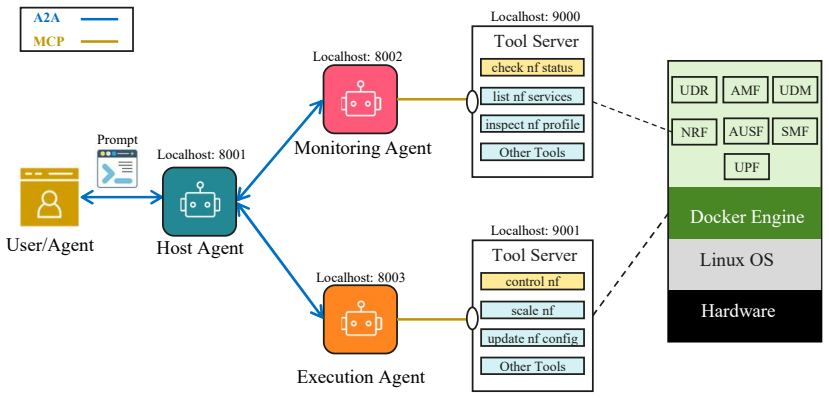
The paper presents a tool-based interface design and an experimental prototype based on agentic AI for the mobile core network, with the Model Context Protocol to design the interface between the agent and network tools and the Agent2Agent protocol for message exchange between AI agents. In this setup the authors analyze packet-level message flows between the agents, tools, and network functions and break down the latency of end-to-end operations starting from prompt injection until the completion of the input task. This demonstrates how an AI agent-based core network combined with network-specific tools can execute intent-based tasks in next-generation mobile systems.
What carries the argument
The tool-based interface design that converts network functions into accessible tools for AI agents, using the Model Context Protocol for agent-tool communication and the Agent2Agent protocol for inter-agent messaging to support planning, reasoning, and action on network operations.
If this is right
- AI agents can interact with network functions as tools to carry out intent-based operations end to end.
- Packet-level analysis reveals the specific message exchanges and timing involved in agent-driven core network control.
- Network functions become capable of delivering services beyond basic connectivity through agent-tool interactions.
- Latency breakdowns identify where overhead occurs in moving from prompt to completed network action.
Where Pith is reading between the lines
- The same tool-interface pattern could extend to radio access or transport segments for consistent agentic control across the full network.
- Real deployments would need additional checks on how these protocols perform under high load or with legacy equipment.
- Users could eventually specify goals at a high level and have the network autonomously configure and execute the required steps.
Load-bearing premise
Existing network functions can readily evolve into AI-enabled agents and tools that deliver both connectivity and beyond-connectivity services, and that the chosen protocols will scale effectively in real mobile core environments.
What would settle it
Observation of unacceptably high end-to-end latencies from prompt injection to task completion or failure of message flows to reliably complete intent-based tasks in the prototype would indicate the design does not support practical agentic control.
Figures
read the original abstract
Artificial Intelligence (AI) will play an essential role in 6G. It will fundamentally reshape the network architecture itself and drive major changes in the design of network entities, interfaces, and procedures. The adoption of agentic AI in next-generation networks is expected to enhance network intelligence and autonomy through agents capable of planning, reasoning, and acting, while also opening up new business opportunities. Under this vision, existing network functions are expected to evolve into AI-enabled agents and tools that deliver both connectivity and beyond-connectivity services. As an initial attempt to move toward this vision, this paper presents a tool-based interface design and an experimental prototype that are based on agentic AI for the mobile core network, with the Model Context Protocol (MCP) and the Agent2Agent (A2A) protocol as foundational protocols. MCP is selected to design the interface between the agent and network tools, and the A2A protocol is used for message exchange between AI agents. In such an experimental setup, we analyze packet-level message flows between the agents, tools, and network functions and break down the latency of end-to-end operations, starting from the prompt injection until the completion of the input task. This work demonstrates how an AI agent-based core network combined with network-specific tools can be utilized in next generation mobile systems to execute intent-based tasks.
Editorial analysis
A structured set of objections, weighed in public.
Referee Report
Summary. The paper presents a tool-based interface design and experimental prototype for agentic AI control in mobile core networks. It uses the Model Context Protocol (MCP) to interface AI agents with network tools and the Agent2Agent (A2A) protocol for inter-agent messaging. The work analyzes packet-level message flows between agents, tools, and network functions, and provides a latency breakdown for end-to-end operations from prompt injection to task completion, demonstrating execution of intent-based tasks as an initial step toward evolving network functions into AI-enabled agents and tools for 6G.
Significance. If the prototype's results hold under realistic conditions, the work provides a concrete starting point for integrating agentic AI into mobile core networks, with practical insights from latency measurements and message flows that could guide future designs for autonomous, intent-driven operations. The use of standardized protocols like MCP and A2A adds to its relevance for beyond-connectivity services.
major comments (1)
- [Experimental Prototype] The experimental prototype and latency analysis (as described in the abstract and experimental sections) rely on purpose-built custom tool wrappers rather than evolved 3GPP network functions such as AMF, SMF, or PCF. Without evidence that the tools preserve standard state machines, correctly handle SBI/HTTP/2 signaling, or manage mobility events, the reported packet-level flows and end-to-end latencies do not demonstrate feasible evolution of existing NFs into AI-enabled agents and tools, which is central to the paper's vision.
minor comments (2)
- [Abstract] The abstract and introduction could more explicitly note the distinction between the current custom-tool prototype and the longer-term goal of 3GPP-compliant NF evolution to avoid overstatement of immediate applicability.
- [Prototype Design] Clarify how the chosen MCP and A2A protocols map to specific network procedures (e.g., session management or policy enforcement) in the prototype description.
Simulated Author's Rebuttal
We thank the referee for the constructive and detailed feedback. We address the major comment below, providing an honest assessment of the prototype's scope while defending the contribution as an initial step.
read point-by-point responses
-
Referee: The experimental prototype and latency analysis (as described in the abstract and experimental sections) rely on purpose-built custom tool wrappers rather than evolved 3GPP network functions such as AMF, SMF, or PCF. Without evidence that the tools preserve standard state machines, correctly handle SBI/HTTP/2 signaling, or manage mobility events, the reported packet-level flows and end-to-end latencies do not demonstrate feasible evolution of existing NFs into AI-enabled agents and tools, which is central to the paper's vision.
Authors: We agree that the experimental prototype employs purpose-built custom tool wrappers to interface with simulated network functions, rather than fully evolved 3GPP NFs (AMF, SMF, PCF) that preserve standard state machines, handle SBI/HTTP/2 signaling, or manage mobility events. This design choice was deliberate for an initial prototype focused on demonstrating the agentic control paradigm via MCP for agent-tool interfaces and A2A for inter-agent messaging. The manuscript explicitly frames the work as 'an initial attempt' to explore intent-based task execution, with the packet-level flows and latency breakdown serving to illustrate the end-to-end operation of this tool-based approach in a controlled setting. The central vision of evolving NFs is presented as a future direction, not a claim of the current results. We will partially revise the manuscript to strengthen the clarification of these scope limitations in the introduction, experimental setup, and conclusion sections, while outlining concrete next steps for integration with compliant 3GPP functions. This revision will not alter the reported flows or latencies but will better contextualize them. revision: partial
Circularity Check
No circularity; prototype measurements rest on external protocols and custom implementation
full rationale
The paper describes an interface design and experimental prototype that invokes established external protocols (MCP for agent-tool interaction, A2A for agent-agent messaging) and then reports observed packet flows and end-to-end latencies from that concrete setup. No equations, fitted parameters, or first-principles derivations are presented whose outputs are forced by the inputs. The central demonstration is an empirical measurement exercise rather than a self-referential prediction or renamed ansatz. No self-citation chains or uniqueness theorems are invoked to justify the architecture.
Axiom & Free-Parameter Ledger
Reference graph
Works this paper leans on
-
[1]
Agentic AI: Autonomous in- telligence for complex goals—A comprehensive survey,
D. B. Acharya, K. Kuppan, and B. Divya, “Agentic AI: Autonomous in- telligence for complex goals—A comprehensive survey,”IEEE Access, vol. 13, 2025, doi: 10.1109/ACCESS.2025.3532853
-
[2]
Agentic AI: A paradigm shift in autonomous decision- making and intelligent systems,
S. Chahar, P. Gaba, K. S. Kaswan, J. S. Dhatterwal, and A. Baliyan, “Agentic AI: A paradigm shift in autonomous decision- making and intelligent systems,” inArtificial Intelligence and Smart Technologies for Sustainability Conference (AISTS), 2025, doi: 10.1109/AISTS66100.2025.11232814
-
[3]
AI Agent Tools and Frameworks,
Ken Huang and Jerry Huang, “AI Agent Tools and Frameworks,” in Agentic AI: Theories and Practices, Ken Huang, Ed. Cham: Springer Nature Switzerland, 2025, doi: 10.1007/978-3-031-90026-6 2
-
[4]
Experiential Networked Intelligence (ENI); Study on Multi- Agent Frameworks for Next-Generation Core Networks,
ETSI, “Experiential Networked Intelligence (ENI); Study on Multi- Agent Frameworks for Next-Generation Core Networks,” ETSI GR ENI 056 (v4.1.1), 2025
2025
-
[5]
Experiential Networked Intelligence (ENI); Study on AI Agents based Next-generation Network Slicing,
ETSI, “Experiential Networked Intelligence (ENI); Study on AI Agents based Next-generation Network Slicing,” ETSI GR ENI 051 (v4.1.1), 2025
2025
-
[6]
AI for 6G Architecture (FS 6G ARC/Rel-20),
3GPP SA WG 2, “AI for 6G Architecture (FS 6G ARC/Rel-20),” TDoc S2-2511244, Nov. 2025
2025
-
[7]
Ad- vanced Architectures Integrated With Agentic AI for Next-Generation Wireless Networks,
K. Dev, S. A. Khowaja, E. Zeydan, K. Singh, and M. Debbah, “Ad- vanced Architectures Integrated With Agentic AI for Next-Generation Wireless Networks,”IEEE Communications Standards Magazine, 2025, doi: 10.1109/MCOMSTD.2025.3632205
-
[8]
A-Core: A novel framework of agentic AI in the 6G core network,
W. Tonget al., “A-Core: A novel framework of agentic AI in the 6G core network,” inIEEE International Conference on Com- munications (IEEE ICC): Workshops, 2025, doi: 10.1109/ICCWork- shops67674.2025.11162291
-
[9]
[Online]
Model Context Protocol, “Specification (Version 2025-11-25), 2025. [Online]. Available: https://modelcontextprotocol.io/specification/2025- 11-25 (accessed Apr. 14, 2026)
2025
-
[10]
Agent2Agent (A2A) Protocol Specification (v0.3.0),
The Linux Foundation, “Agent2Agent (A2A) Protocol Specification (v0.3.0),” 2025. [Online]. Available: https://a2a- protocol.org/latest/specification/ (accessed Apr. 14, 2026)
2025
-
[11]
Model Context Protocol (MCP) reference server implementations,
Model Context Protocol, “Model Context Protocol (MCP) reference server implementations,” 2026. [Online]. Available: https://github.com/modelcontextprotocol/servers (accessed Apr. 14, 2026)
2026
-
[12]
System architecture for the 5G System (5GS); Stage 2,
3GPP, “System architecture for the 5G System (5GS); Stage 2,” 3GPP TS 23.501 (v20.0.0)
-
[13]
5G System; Principles and Guidelines for Services Definition; Stage 3,
3GPP, “5G System; Principles and Guidelines for Services Definition; Stage 3,” 3GPP TS 29.501 (v19.4.0)
-
[14]
ADK documentation,
Agent Development Kit (ADK), “ADK documentation,” 2025. [Online]. Available: https://google.github.io/adk-docs/ (accessed Apr. 14, 2026)
2025
discussion (0)
Sign in with ORCID, Apple, or X to comment. Anyone can read and Pith papers without signing in.