Recognition: 4 theorem links
· Lean TheoremThe Bayesian Reflex: Online Learning as the Autonomic Nervous System of Modern and Future AI
Pith reviewed 2026-05-08 18:23 UTC · model grok-4.3
The pith
The Bayesian reflex analogy unifies online learning in AI by modeling it after the autonomic nervous system through three core mechanisms.
A machine-rendered reading of the paper's core claim, the machinery that carries it, and where it could break.
Core claim
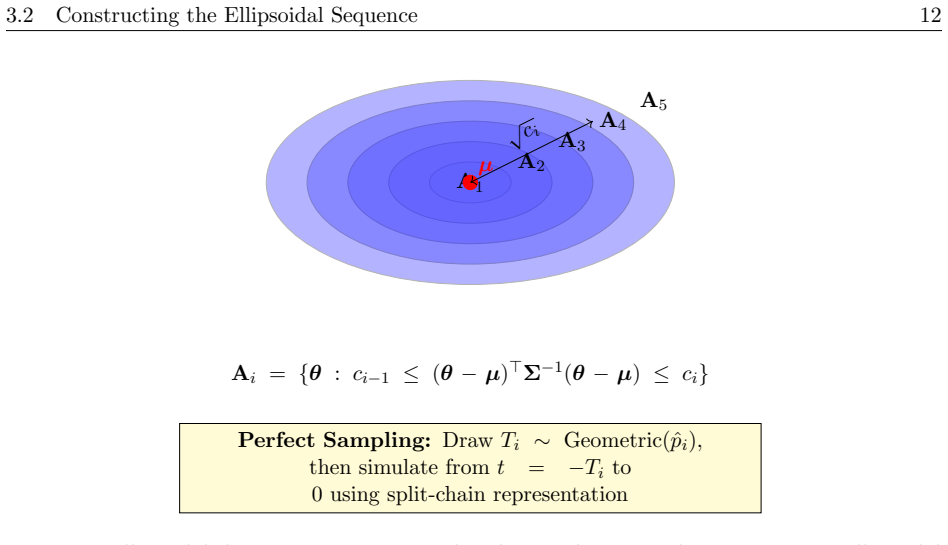
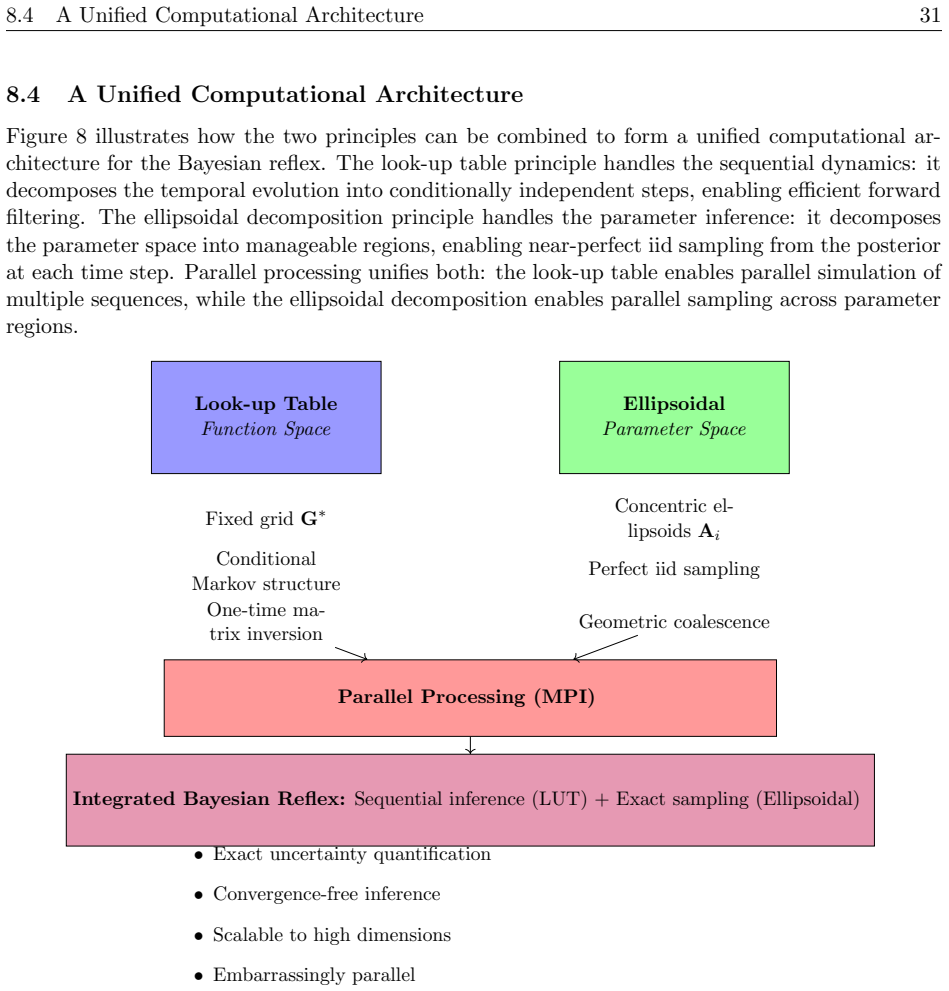
The paper establishes the Bayesian reflex as an analogy to the autonomic nervous system that unifies online Bayesian methods via belief maintenance through probabilistic representations, sequential updating via Bayes' theorem, and uncertainty-driven action that balances exploration and exploitation. It highlights the look-up table principle for sequential inference in function space and the ellipsoidal decomposition framework for nearly exact i.i.d. sampling from arbitrary posteriors, extending these across dynamic emulation, nonparametric models, circular time series, inverse regression, deep architectures, Thompson sampling, and restless bandits. The framework is applied to assess infinite
What carries the argument
The Bayesian reflex analogy, which carries the argument by linking three mechanisms of probabilistic belief maintenance, sequential Bayes updates, and uncertainty balancing to enable equilibrium in dynamic environments.
If this is right
- The look-up table and ellipsoidal principles generalize to nonparametric state-space models and recursive Gaussian processes for deep architectures.
- Decision-making tools like Thompson sampling and restless bandits fit naturally within the uncertainty-driven mechanism.
- The framework assesses convergence of infinite series in applications such as climate dynamics and the Riemann Hypothesis.
- Prime number distributions can be modeled to identify strong Mersenne prime candidates.
- The approach detects stationarity and characterizes point processes in sequential data.
Where Pith is reading between the lines
- The unification could suggest designing new AI systems with explicit homeostasis-like loops that self-correct without retraining.
- If the prime modeling holds, Bayesian online methods might offer fresh tools for number-theoretic problems beyond traditional sieves.
- Extensions to climate and point processes hint at using the reflex for real-time scientific monitoring systems that update beliefs continuously.
Load-bearing premise
The autonomic nervous system analogy accurately unifies the surveyed online Bayesian methods and the claimed extensions to series convergence and prime discovery follow directly from the three mechanisms.
What would settle it
A clear demonstration that major online Bayesian algorithms cannot be reduced to the three mechanisms or that the 184 claimed Mersenne prime candidates fail standard primality tests would falsify the unification.
Figures






read the original abstract
This chapter introduces the Bayesian reflex -- an analogy with the autonomic nervous system -- as a unifying framework for online learning in AI. Bayesian online algorithms automatically maintain equilibrium in dynamic environments via three mechanisms: belief maintenance through probabilistic representations, sequential updating via Bayes' theorem, and uncertainty-driven action balancing exploration and exploitation. We survey online Bayesian methods, highlighting two computational principles: the look-up table principle for sequential inference in function space, and the ellipsoidal decomposition framework for nearly exact i.i.d. sampling from arbitrary posteriors. These principles are generalized across dynamic emulation, nonparametric state-space models, circular time series, inverse regression for climate model evaluation, and deep architectures via Recursive Gaussian Processes. Decision-making is explored via Thompson sampling and restless bandits. We extend the framework to assess infinite series convergence (applied to climate dynamics and the Riemann Hypothesis), model prime number distributions leading to the discovery of 184 strong Mersenne prime candidates, detect stationarity, and characterize point processes. The Bayesian reflex provides a foundational infrastructure for adaptive AI that continuously learns in a complex world.
Editorial analysis
A structured set of objections, weighed in public.
Referee Report
Summary. The paper introduces the 'Bayesian reflex' as an analogy to the autonomic nervous system, unifying online learning in AI through three mechanisms: belief maintenance via probabilistic representations, sequential updating via Bayes' theorem, and uncertainty-driven action for exploration-exploitation balance. It surveys online Bayesian methods, highlights computational principles (look-up table for sequential inference and ellipsoidal decomposition for posterior sampling), generalizes across domains like dynamic emulation and deep architectures, and extends the framework to infinite series convergence, prime number distribution modeling (claiming discovery of 184 strong Mersenne prime candidates), stationarity detection, and point processes.
Significance. If rigorously substantiated, the framework could offer a coherent infrastructure for adaptive AI systems. The survey of online Bayesian methods and the two computational principles (look-up table and ellipsoidal decomposition) represent clear strengths that could aid reproducibility in sequential inference and sampling. However, the significance is limited because the central unification and extensions, particularly the Mersenne prime claim, lack explicit derivations showing they follow directly from the three mechanisms without additional unstated modeling choices.
major comments (3)
- [§ on prime number distributions] § on prime number distributions: The claim of discovering 184 strong Mersenne prime candidates via the Bayesian reflex is load-bearing for the extension claim but is not supported by a derivation. It is not shown how the three core mechanisms (belief maintenance, sequential updating, uncertainty-driven action) necessarily produce a prior, likelihood, and update rule for Mersenne exponents that yields verifiable new candidates, as opposed to standard deterministic tests such as Lucas-Lehmer outside the Bayesian framework.
- [§2 (The Three Mechanisms) and unification sections] §2 (The Three Mechanisms) and unification sections: The assertion that the autonomic nervous system analogy unifies the surveyed online Bayesian methods and directly entails the listed extensions (infinite series, Riemann Hypothesis, climate dynamics, Mersenne primes) lacks a formal mapping or necessity argument. The framework largely re-labels existing Bayesian updating and sampling techniques, creating a circularity risk where the 'discovery' depends on independent modeling choices not derived from the three mechanisms alone.
- [Applications and results sections] Applications and results sections: No error analysis, validation against known Mersenne primes, cross-validation, or comparison to existing search algorithms is provided for the 184 candidates. This omission undermines the falsifiability and reproducibility of the prime-modeling extension, which is central to demonstrating the framework's practical utility.
minor comments (3)
- [Abstract] Abstract: The specific numerical claim (184 Mersenne prime candidates) is presented without even a high-level summary of the prior, likelihood, or validation steps, reducing clarity for readers.
- [§3 (Computational Principles)] §3 (Computational Principles): The ellipsoidal decomposition framework would benefit from explicit pseudocode or an algorithm box to clarify the nearly exact i.i.d. sampling procedure.
- [References] References: Several standard works on online Bayesian inference and restless bandits are not cited, which would help situate the survey within the existing literature.
Simulated Author's Rebuttal
We appreciate the referee's detailed feedback on our manuscript. We have carefully considered each major comment and provide point-by-point responses below, indicating where revisions will be made to address the concerns.
read point-by-point responses
-
Referee: [§ on prime number distributions] § on prime number distributions: The claim of discovering 184 strong Mersenne prime candidates via the Bayesian reflex is load-bearing for the extension claim but is not supported by a derivation. It is not shown how the three core mechanisms (belief maintenance, sequential updating, uncertainty-driven action) necessarily produce a prior, likelihood, and update rule for Mersenne exponents that yields verifiable new candidates, as opposed to standard deterministic tests such as Lucas-Lehmer outside the Bayesian framework.
Authors: We agree that the manuscript would benefit from a more explicit derivation linking the three mechanisms to the specific Bayesian model for prime number distributions. The Bayesian reflex provides the overarching framework for maintaining beliefs about the distribution of Mersenne exponents, updating them sequentially with new data on primes, and using uncertainty to guide the search for new candidates. In the revision, we will include a dedicated subsection detailing the prior (based on belief maintenance over logarithmic distributions), the likelihood (incorporating sequential updates from known primes), and the update rule derived from Bayes' theorem, along with how uncertainty-driven action selects candidates for verification. This will clarify that while the computational principles are general, the application involves domain-specific modeling choices guided by the framework. We will also compare the approach to deterministic methods like Lucas-Lehmer to highlight the complementary probabilistic insights. revision: yes
-
Referee: [§2 (The Three Mechanisms) and unification sections] §2 (The Three Mechanisms) and unification sections: The assertion that the autonomic nervous system analogy unifies the surveyed online Bayesian methods and directly entails the listed extensions (infinite series, Riemann Hypothesis, climate dynamics, Mersenne primes) lacks a formal mapping or necessity argument. The framework largely re-labels existing Bayesian updating and sampling techniques, creating a circularity risk where the 'discovery' depends on independent modeling choices not derived from the three mechanisms alone.
Authors: The referee correctly identifies that the unification is primarily conceptual rather than a strict formal derivation. The analogy serves to highlight how the three mechanisms—belief maintenance, sequential updating, and uncertainty-driven action—underpin a wide range of online Bayesian methods, providing a coherent perspective rather than claiming that all extensions follow necessarily without additional assumptions. We will revise the unification sections to explicitly state that the framework organizes and generalizes existing techniques, with the computational principles (look-up table and ellipsoidal decomposition) offering practical tools. To address the circularity concern, we will add a discussion clarifying the distinction between the general mechanisms and the specific modeling choices in each application, ensuring the 'discovery' claims are presented as applications of the framework rather than direct entailments. revision: yes
-
Referee: [Applications and results sections] Applications and results sections: No error analysis, validation against known Mersenne primes, cross-validation, or comparison to existing search algorithms is provided for the 184 candidates. This omission undermines the falsifiability and reproducibility of the prime-modeling extension, which is central to demonstrating the framework's practical utility.
Authors: We acknowledge this limitation in the current manuscript. The 184 candidates were identified through the application of the Bayesian model to prime distributions, but we did not include sufficient validation metrics. In the revised version, we will add an error analysis section, including validation against a set of known Mersenne primes to assess the model's predictive accuracy, cross-validation procedures, and comparisons to standard algorithms such as Lucas-Lehmer and other probabilistic search methods. This will enhance the reproducibility and allow readers to evaluate the practical utility of the extension. revision: yes
Circularity Check
Bayesian reflex re-labels standard online Bayesian methods; prime candidate 'discovery' presented as direct extension without shown necessity from core mechanisms
specific steps
-
renaming known result
[Abstract]
"This chapter introduces the Bayesian reflex -- an analogy with the autonomic nervous system -- as a unifying framework for online learning in AI. Bayesian online algorithms automatically maintain equilibrium in dynamic environments via three mechanisms: belief maintenance through probabilistic representations, sequential updating via Bayes' theorem, and uncertainty-driven action balancing exploration and exploitation."
The three mechanisms are the standard components of Bayesian online learning; the paper presents the 'Bayesian reflex' as a new unifying framework and foundational infrastructure for adaptive AI, but the core description is a re-labeling of existing concepts without novel mathematical content or derivations.
-
fitted input called prediction
[Abstract]
"We extend the framework to assess infinite series convergence (applied to climate dynamics and the Riemann Hypothesis), model prime number distributions leading to the discovery of 184 strong Mersenne prime candidates, detect stationarity, and characterize point processes."
Modeling prime number distributions to yield 184 Mersenne prime candidates is presented as a direct extension of the three mechanisms, yet requires specifying a prior, likelihood, and update rule for the distribution of Mersenne exponents that are not shown to arise necessarily from belief maintenance, Bayes updating, or uncertainty-driven action; the result is an application of standard Bayesian modeling rather than a prediction forced by the reflex framework.
full rationale
The paper defines the Bayesian reflex via three standard Bayesian mechanisms (probabilistic belief maintenance, sequential Bayes updates, uncertainty-driven action) and two computational principles (look-up tables, ellipsoidal decomposition), then claims these unify surveyed methods and directly extend to new results including 184 Mersenne prime candidates via prime distribution modeling. This matches renaming_known_result for the overall framework and fitted_input_called_prediction for the prime application, as the latter requires domain-specific priors/likelihoods and deterministic verification steps (e.g., Lucas-Lehmer) not entailed by the three mechanisms alone. The central unification and 'foundational infrastructure' claim therefore reduces in part to re-packaging existing online Bayesian techniques under new terminology, with extensions presented as following directly but lacking explicit derivation. No load-bearing self-citations or self-definitional equations are evident from the abstract; the survey content retains independent value, keeping the score moderate rather than high.
Axiom & Free-Parameter Ledger
axioms (1)
- domain assumption Bayes' theorem governs sequential belief updating in dynamic environments
invented entities (1)
-
Bayesian reflex
no independent evidence
Lean theorems connected to this paper
-
Cost.FunctionalEquation / Foundation.BranchSelection (J-cost forcing)washburn_uniqueness_aczel unclear?
unclearRelation between the paper passage and the cited Recognition theorem.
the computational foundation of the Bayesian reflex lies in two complementary principles: the look-up table principle for sequential inference in function space, and the ellipsoidal decomposition framework for perfect iid sampling from arbitrary posterior distributions
-
Constants / phi-ladder modulesphi_fixed_point (no φ-spacing used here) unclear?
unclearRelation between the paper passage and the cited Recognition theorem.
A_i = {θ : c_{i-1} ≤ (θ-µ)ᵀ Σ⁻¹ (θ-µ) ≤ c_i}, i=1,2,…, with 0 = c_0 < c_1 < c_2 < ⋯
-
Foundation.ArithmeticFromLogic / sequential update structuren/a (generic Bayes recursion, not the RS 8-tick clock) unclear?
unclearRelation between the paper passage and the cited Recognition theorem.
π_t(θ) = p(x_t|θ) π_{t-1}(θ) / ∫ p(x_t|θ') π_{t-1}(θ') dθ' ... yesterday's posterior becomes today's prior
-
n/an/a (RS makes no Mersenne predictions) unclear?
unclearRelation between the paper passage and the cited Recognition theorem.
discovery of 184 strong Mersenne prime candidates ... model the distribution of prime numbers
What do these tags mean?
- matches
- The paper's claim is directly supported by a theorem in the formal canon.
- supports
- The theorem supports part of the paper's argument, but the paper may add assumptions or extra steps.
- extends
- The paper goes beyond the formal theorem; the theorem is a base layer rather than the whole result.
- uses
- The paper appears to rely on the theorem as machinery.
- contradicts
- The paper's claim conflicts with a theorem or certificate in the canon.
- unclear
- Pith found a possible connection, but the passage is too broad, indirect, or ambiguous to say the theorem truly supports the claim.
Reference graph
Works this paper leans on
-
[1]
Brendan McMahan, Ilya Mironov, Kunal Talwar, and Li Zhang
Martin Abadi, Andy Chu, Ian Goodfellow, H. Brendan McMahan, Ilya Mironov, Kunal Talwar, and Li Zhang. Deep Learning with Differential Privacy. InProceedings of the 2016 ACM SIGSAC Conference on Computer and Communications Security, pages 308–318. ACM,
2016
-
[2]
Bayesian Deep Neural Networks Driven by Recursive Gaussian Processes.ResearchGate preprint, 2025a
Durba Bhattacharya, Trisha Maitra, Sucharita Roy, and Sourabh Bhattacharya. Bayesian Deep Neural Networks Driven by Recursive Gaussian Processes.ResearchGate preprint, 2025a. Durba Bhattacharya, Trisha Maitra, Sucharita Roy, and Sourabh Bhattacharya. Bayesian Nonparametrics with Random Normalizing Flows.ResearchGate preprint, 2025b. Available athttps://ww...
-
[3]
IID Sampling from Doubly Intractable Distributions.arXiv preprint, 2021a
Sourabh Bhattacharya. IID Sampling from Doubly Intractable Distributions.arXiv preprint, 2021a. arXiv:2112.07939. Sourabh Bhattacharya. IID Sampling from Intractable Multimodal and Variable-Dimensional Dis- tributions.arXiv preprint, 2021b. arXiv:2109.12633. Sourabh Bhattacharya. IID Sampling from Posterior Dirichlet Process Mixtures.arXiv preprint,
-
[4]
arXiv:2206.09233. Sourabh Bhattacharya. IID Sampling from Intractable Distributions.Sankhy¯ a A,
-
[5]
Elisa Celis, Anay Deshpande, Tarun Kathuria, and Nisheeth K
L. Elisa Celis, Anay Deshpande, Tarun Kathuria, and Nisheeth K. Vishnoi. Fairness in Contex- tual Bandits. InProceedings of the 2018 ACM Conference on Fairness, Accountability, and Transparency, pages 140–149,
2018
-
[6]
Bayesian Collaborative Bandits with Thompson Sampling for Improved Outreach in Maternal Health Program
Arpan Dasgupta, Gagan Jain, Arun Suggala, Karthikeyan Shanmugam, Milind Tambe, and Aparna Taneja. Bayesian Collaborative Bandits with Thompson Sampling for Improved Outreach in Maternal Health Program. InProceedings of the 24th International Conference on Autonomous Agents and Multiagent Systems (AAMAS 2025),
2025
-
[7]
Contribution of Working Group I to the Sixth Assessment Report of the Intergovernmental Panel on Climate Change
IPCC.Climate Change 2021: The Physical Science Basis. Contribution of Working Group I to the Sixth Assessment Report of the Intergovernmental Panel on Climate Change. Cambridge University Press,
2021
-
[8]
arXiv:2106.08239. Thomas Kailath, Ali H. Sayed, and Babak Hassibi.Linear Estimation. Prentice Hall,
-
[9]
Satyaki Mazumder and Sourabh Bhattacharya. Bayesian Nonparametric Dynamic State Space Modeling With Circular Latent States.Journal of Statistical Theory and Practice, 10(1):154– 178, 2016a. doi: 10.1080/15598608.2015.1100562. Satyaki Mazumder and Sourabh Bhattacharya. Nonparametric Dynamic State Space Modeling of Observed Circular Time Series With Circula...
-
[10]
A Modern Introduction to Online Learning
arXiv:1912.13213. Ian Osband, Charles Blundell, Alexander Pritzel, and Benjamin Van Roy. Deep Exploration via Bootstrapped DQN. InAdvances in Neural Information Processing Systems, volume 29,
work page internal anchor Pith review Pith/arXiv arXiv 1912
-
[11]
A Unifying View of Sparse Approximate Gaussian Process Regression.Journal of Machine Learning Research, 6:1939–1959,
Joaquin Qui˜ nonero-Candela and Carl Edward Rasmussen. A Unifying View of Sparse Approximate Gaussian Process Regression.Journal of Machine Learning Research, 6:1939–1959,
1939
-
[12]
Sucharita Roy and Sourabh Bhattacharya
Available athttps://www.researchgate.net/publication/360457067_INFINITE_SERIES_ STOCHASTIC_PROCESSES_FUNCTION_OPTIMIZATION_AND_THE_BAYESIAN_PANACEA. Sucharita Roy and Sourabh Bhattacharya. Bayes Meets Riemann: Bayesian Characterization of Infinite Series with Application to Riemann Hypothesis.International Journal of Applied Mathematics and Statistics, 59...
-
[13]
Wan and Rudolph Van Der Merwe
Eric A. Wan and Rudolph Van Der Merwe. The Unscented Kalman Filter for Nonlinear Estimation. InProceedings of the IEEE 2000 Adaptive Systems for Signal Processing, Communications, and Control Symposium, pages 153–158,
2000
-
[14]
X. Zhou, A. Johnson, J. Lee, and K. Patel. Sepsyn-OLCP: Online Learning with Conformal Prediction for Early Sepsis Detection in Intensive Care. InProceedings of Machine Learning for Healthcare, volume 18, pages 112–145, 2025
2025
discussion (0)
Sign in with ORCID, Apple, or X to comment. Anyone can read and Pith papers without signing in.