Recognition: unknown
PDRS : A Linear mathcal{O}(N) Algorithm for Segmentation of High-Activity Regions in Irregularly Sampled Time Series
Pith reviewed 2026-05-08 17:38 UTC · model grok-4.3
The pith
PDRS extracts high-activity regions from irregular time series in linear time by seeding at local maxima.
A machine-rendered reading of the paper's core claim, the machinery that carries it, and where it could break.
Core claim
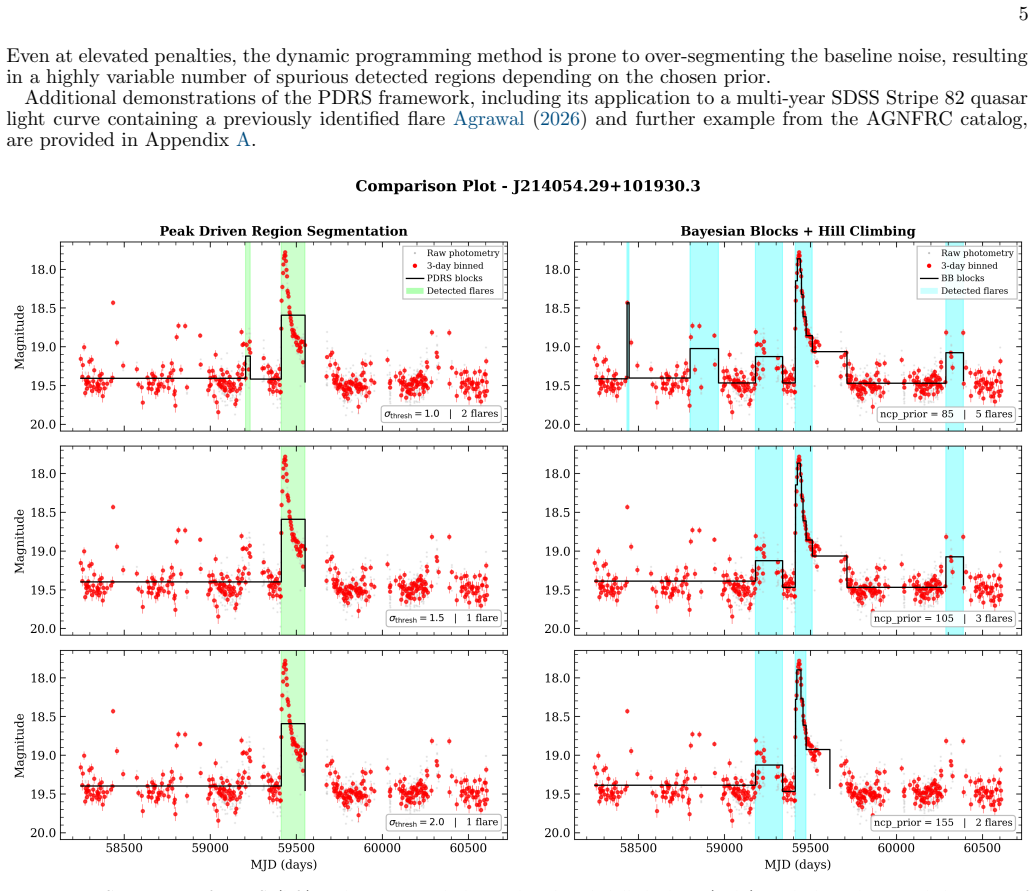
PDRS seeds candidate high-activity regions at statistically significant local maxima and expands them via a gradient-aware multi-source breadth-first search. Saddle-point merging and a median-based filter suppress spurious detections, resulting in an O(N) algorithm that isolates candidate transient events in irregularly sampled data at substantially lower cost than Bayesian Blocks while producing comparable regions on quasar and AGN light curves.
What carries the argument
Peak-driven seeding at significant local maxima followed by gradient-aware multi-source breadth-first expansion, saddle-point merging, and median-based filtering.
Load-bearing premise
Seeding at statistically significant local maxima combined with saddle-point merging and median-based filtering produces regions comparable in quality to Bayesian Blocks without significant errors or omissions.
What would settle it
A side-by-side run on the same SDSS Stripe 82 quasar light curves in which PDRS misses more than a small fraction of the high-activity regions identified by Bayesian Blocks or adds many regions with markedly different statistical properties.
Figures


read the original abstract
Identifying transient high-activity episodes in astronomical time series requires partitioning data into regions of distinct statistical behavior. A widely adopted approach combines Bayesian Blocks with a hill-climbing procedure to isolate high-activity regions, but carries $\mathcal{O}(N^2)$ complexity -- a scalability challenge for wide-field surveys like ZTF and the upcoming Rubin Observatory (LSST), where light curves routinely contain thousands of irregularly sampled observations. We present Peak-Driven Region Segmentation (PDRS), a linear-time $\mathcal{O}(N)$ algorithm for rapid extraction of high-activity regions in irregularly sampled data. PDRS seeds candidate regions at statistically significant local maxima and expands them via a gradient-aware multi-source breadth-first search. Saddle-point merging and a median-based filter suppress spurious detections. Functioning as a computationally efficient pre-processing stage, PDRS isolates candidate transient events for downstream analysis. We demonstrate its efficacy on quasar light curves from SDSS Stripe~82 and AGN light curves from ZTF DR23, showing that PDRS identifies candidate high-activity regions comparable to those from Bayesian Blocks at substantially reduced cost. Its domain-agnostic formulation and physically interpretable parameters make PDRS broadly applicable beyond astronomy, including biomedical signals, seismic recordings, and industrial sensor monitoring.
Editorial analysis
A structured set of objections, weighed in public.
Referee Report
Summary. The manuscript introduces Peak-Driven Region Segmentation (PDRS), a claimed linear-time O(N) algorithm for extracting high-activity regions from irregularly sampled astronomical time series. It seeds at statistically significant local maxima, expands regions via gradient-aware multi-source BFS, merges at saddle points, and applies median-based filtering. The central claim is that PDRS produces candidate regions comparable in quality to those from Bayesian Blocks change-point detection while reducing computational cost from O(N^2) to O(N), with demonstrations on SDSS Stripe 82 quasar light curves and ZTF DR23 AGN data.
Significance. If the comparability and O(N) scaling are rigorously validated, PDRS would offer a practical pre-processing tool for high-volume surveys such as LSST, enabling faster isolation of transients in irregularly sampled data across astronomy and other domains with similar sampling characteristics.
major comments (3)
- [Abstract and Results] Abstract and Results section: the claim that PDRS 'identifies candidate high-activity regions comparable to those from Bayesian Blocks' is unsupported by any quantitative metrics such as region overlap (e.g., IoU), precision-recall, false-positive rate, or missed-event count; only qualitative statements are given, leaving the central 'comparable at reduced cost' assertion unverified.
- [§3] §3 (Algorithm description): the O(N) complexity assertion for the full pipeline (local-maxima seeding + gradient-aware multi-source BFS + saddle-point merging + median filter) lacks a formal complexity analysis or empirical timing benchmarks across increasing N with realistic gap and noise distributions; the multi-source BFS and merging steps may introduce super-linear behavior in worst-case irregular sampling.
- [§3.2] §3.2 (Saddle-point merging): the merging criterion is presented as a heuristic without derivation from the same posterior or likelihood framework used by Bayesian Blocks; this risks systematic over- or under-segmentation in the presence of sampling gaps and heteroscedastic noise, directly affecting the comparability claim.
minor comments (2)
- [Abstract] The abstract and introduction would benefit from a brief statement of the exact statistical significance threshold used for local-maxima seeding.
- [Results] Figure captions in the results section should explicitly label which panels show PDRS versus Bayesian Blocks outputs for direct visual comparison.
Simulated Author's Rebuttal
We thank the referee for their thoughtful and constructive comments on our manuscript. We address each of the major comments below and outline the revisions we plan to make to strengthen the paper.
read point-by-point responses
-
Referee: [Abstract and Results] Abstract and Results section: the claim that PDRS 'identifies candidate high-activity regions comparable to those from Bayesian Blocks' is unsupported by any quantitative metrics such as region overlap (e.g., IoU), precision-recall, false-positive rate, or missed-event count; only qualitative statements are given, leaving the central 'comparable at reduced cost' assertion unverified.
Authors: We agree that quantitative validation would strengthen the central claim. In the revised manuscript, we will augment the Results section with quantitative comparisons, including Intersection over Union (IoU) scores for region overlap, precision-recall metrics, and counts of false positives and missed events, computed by treating Bayesian Blocks outputs as reference on the SDSS Stripe 82 and ZTF DR23 datasets. This will provide rigorous support for the comparability assertion. revision: yes
-
Referee: [§3] §3 (Algorithm description): the O(N) complexity assertion for the full pipeline (local-maxima seeding + gradient-aware multi-source BFS + saddle-point merging + median filter) lacks a formal complexity analysis or empirical timing benchmarks across increasing N with realistic gap and noise distributions; the multi-source BFS and merging steps may introduce super-linear behavior in worst-case irregular sampling.
Authors: We acknowledge the need for both formal analysis and empirical validation. We will add a dedicated subsection in §3 providing a step-by-step complexity analysis, demonstrating that each component (including the multi-source BFS, which visits each data point a constant number of times) is O(N) in the worst case for irregular sampling. Additionally, we will include empirical timing benchmarks on synthetic time series with N ranging from 10^2 to 10^5, incorporating realistic gap distributions and heteroscedastic noise to confirm linear scaling. revision: yes
-
Referee: [§3.2] §3.2 (Saddle-point merging): the merging criterion is presented as a heuristic without derivation from the same posterior or likelihood framework used by Bayesian Blocks; this risks systematic over- or under-segmentation in the presence of sampling gaps and heteroscedastic noise, directly affecting the comparability claim.
Authors: The saddle-point merging is intentionally a heuristic to maintain O(N) efficiency, as a full posterior-based merging would likely revert to higher complexity similar to Bayesian Blocks. It is derived from the concept of identifying boundaries where the gradient changes sign in a manner consistent with activity region separation. In the revision, we will expand §3.2 to provide a more detailed motivation for the heuristic, discuss its behavior under sampling gaps and noise, and include sensitivity tests to quantify potential over- or under-segmentation risks. revision: partial
Circularity Check
No significant circularity detected in PDRS presentation
full rationale
The paper describes PDRS as an independent algorithmic construction consisting of explicit procedural steps (seeding at statistically significant local maxima, gradient-aware multi-source BFS expansion, saddle-point merging, and median-based filtering) without any self-referential definitions, fitted parameters renamed as predictions, or load-bearing self-citations. The O(N) complexity claim follows directly from the BFS-based design on irregular sampling, and the comparability to Bayesian Blocks is asserted via empirical demonstration on external datasets rather than internal equivalence. No derivation chain reduces to its own inputs by construction; the work is self-contained as a practical heuristic method.
Axiom & Free-Parameter Ledger
Reference graph
Works this paper leans on
-
[1]
author author Z. Zheng , author Y. Shi , author S. Jin , author H. Dannerbauer , author Q. Gu , author X. Li , \ and\ author X. Yu ,\ 10.1093/mnras/stae1036 journal journal Monthly Notices of the Royal Astronomical Society \ volume 530 ,\ pages 3527 ( year 2024 ) NoStop
-
[2]
author author M. J. \ Graham , author S. G. \ Djorgovski , author A. J. \ Drake , author D. Stern , author A. A. \ Mahabal , author E. Glikman , author S. Larson , \ and\ author E. Christensen ,\ 10.1093/mnras/stx1456 journal journal Monthly Notices of the Royal Astronomical Society \ volume 470 ,\ pages 4112 ( year 2017 ) NoStop
-
[3]
author author A. J. \ Drake et al. ,\ 10.1088/0004-637X/735/2/106 journal journal Astrophys. J. \ volume 735 ,\ pages 106 ( year 2011 ) NoStop
-
[4]
author author A. Lawrence , author A. G. \ Bruce , author C. MacLeod , author S. Gezari , author M. Elvis , author M. Ward , author S. J. \ Smartt , author K. W. \ Smith , author D. Wright , author M. Fraser , author P. Marshall , author N. Kaiser , author W. Burgett , author E. Magnier , author J. Tonry , author K. Chambers , author R. Wainscoat , author...
-
[5]
author author S. A. J. \ McLaughlin , author J. R. \ Mullaney , \ and\ author S. P. \ Littlefair ,\ 10.1093/mnras/stae721 journal journal Monthly Notices of the Royal Astronomical Society \ volume 529 ,\ pages 2877 ( year 2024 ) NoStop
-
[6]
author author M. Meyer , author J. D. \ Scargle , \ and\ author R. D. \ Blandford ,\ 10.3847/1538-4357/ab1651 journal journal The Astrophysical Journal \ volume 877 ,\ pages 39 ( year 2019 ) NoStop
-
[7]
author author J. D. \ Scargle , author J. P. \ Norris , author B. Jackson , \ and\ author J. Chiang ,\ 10.1088/0004-637X/764/2/167 journal journal The Astrophysical Journal \ volume 764 ,\ pages 167 ( year 2013 ) NoStop
-
[8]
author author D. J. \ Eisenstein \ and\ author P. Hut ,\ 10.1086/305535 journal journal The Astrophysical Journal \ volume 498 ,\ pages 137 ( year 1998 ) NoStop
-
[9]
author author P. M. \ Kouch , author E. Lindfors , author T. Hovatta , author I. Liodakis , author K. I. I. \ Koljonen , author A. Paggi , author K. Nilsson , author J. Jormanainen , author V. Fallah Ramazani , author S. Kankkunen , author F. Wierda , author S. M. \ Wagner , \ and\ author M. J. \ Graham ,\ 10.1051/0004-6361/202557582 journal journal Astro...
-
[10]
author author L. He , author Z.-Y. \ Liu , author R. Niu , author M.-S. \ Zhou , author P.-R. \ Zou , author B.-Z. \ Gao , author R.-D. \ Liang , author L.-G. \ Zhu , author J.-M. \ Wang , author N. Jiang , author Z.-Y. \ Cai , author J. an Jiang , author Z.-G. \ Dai , author Y.-F. \ Yuan , author Y.-J. \ Chen , \ and\ author W. Zhao ,\ 10.3847/1538-4365/...
-
[11]
A Statistical-AI Framework for Detecting Transient Flares in SDSS Stripe 82 Quasar Light Curves
author author A. Agrawal ,\ @noop journal journal arXiv preprint \ ( year 2026 ) ,\ http://arxiv.org/abs/2604.08196 arXiv:2604.08196 NoStop
work page internal anchor Pith review Pith/arXiv arXiv 2026
-
[12]
author author F. J. \ Masci , author R. R. \ Laher , author B. Rusholme , \ and\ author et al. ,\ 10.1088/1538-3873/aae8ac journal journal Publications of the Astronomical Society of the Pacific \ volume 131 ,\ pages 018003 ( year 2019 ) NoStop
work page internal anchor Pith review doi:10.1088/1538-3873/aae8ac 2019
-
[13]
author author C. MacLeod , author Z . Ivezi \'c , author C. S. \ Kochanek , author S. Koz owski , author B. Kelly , author E. Bullock , author A. Hope , author R. J. \ Assef , author R. Becker , author P. B. \ Hall , author P. Harding , author M. Juri \'c , author R. M. \ Kratzer , author M. R. \ Meade , author W. Ricketts , author B. Sesar , author D. P....
-
[14]
author author C. R. \ Harris et al. ,\ 10.1038/s41586-020-2649-2 journal journal Nature \ volume 585 ,\ pages 357 ( year 2020 ) NoStop
-
[15]
author author J. D. \ Hunter ,\ 10.1109/MCSE.2007.55 journal journal Computing in Science & Engineering \ volume 9 ,\ pages 90 ( year 2007 ) NoStop
-
[16]
D ata S tructures for S tatistical C omputing in P ython
author author W. McKinney ,\ in\ 10.25080/Majora-92bf1922-00a booktitle Proceedings of the 9th Python in Science Conference \ ( year 2010 )\ pp.\ pages 56--61 NoStop
discussion (0)
Sign in with ORCID, Apple, or X to comment. Anyone can read and Pith papers without signing in.