Recognition: unknown
A Statistical-AI Framework for Detecting Transient Flares in SDSS Stripe 82 Quasar Light Curves
Pith reviewed 2026-05-10 17:30 UTC · model grok-4.3
The pith
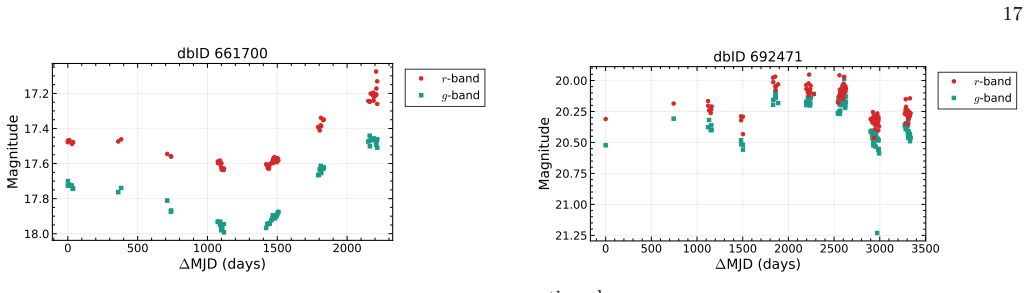
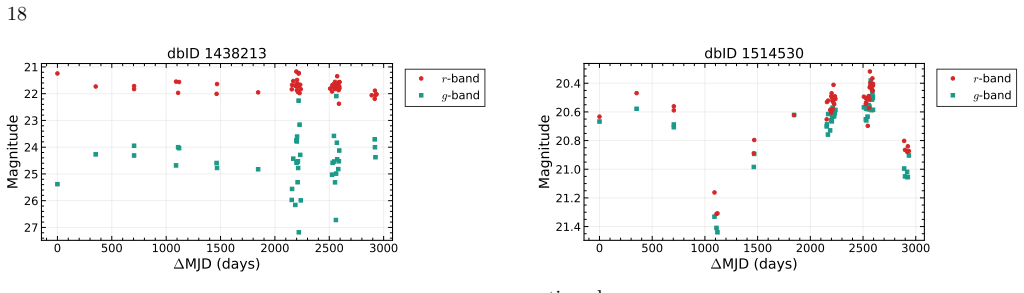
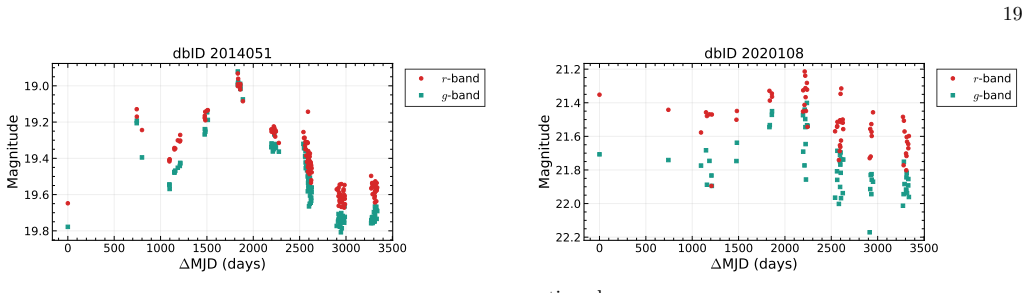
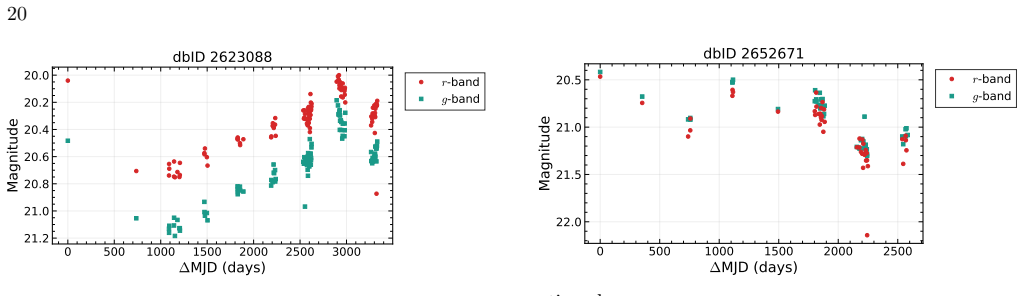
The FLARE framework identifies 51 quasars with distinct flaring activity in SDSS Stripe 82 by modeling baseline variability and scoring anomalies.
A machine-rendered reading of the paper's core claim, the machinery that carries it, and where it could break.
Core claim
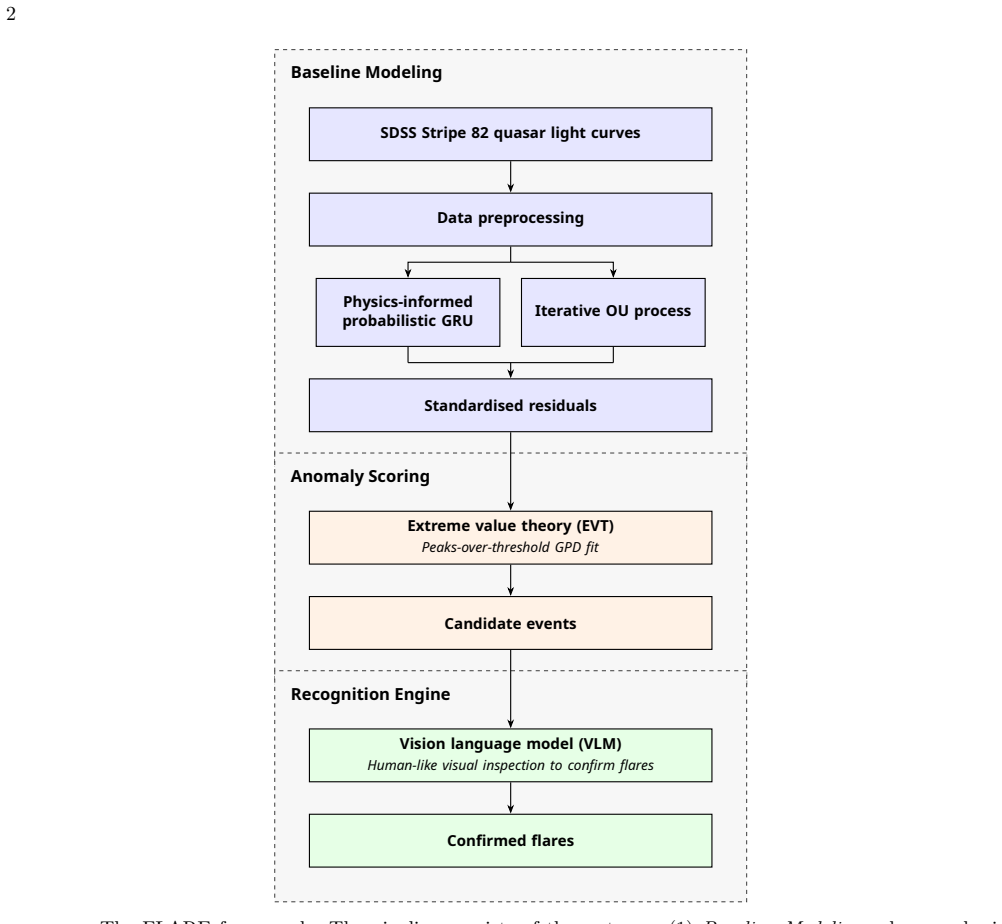
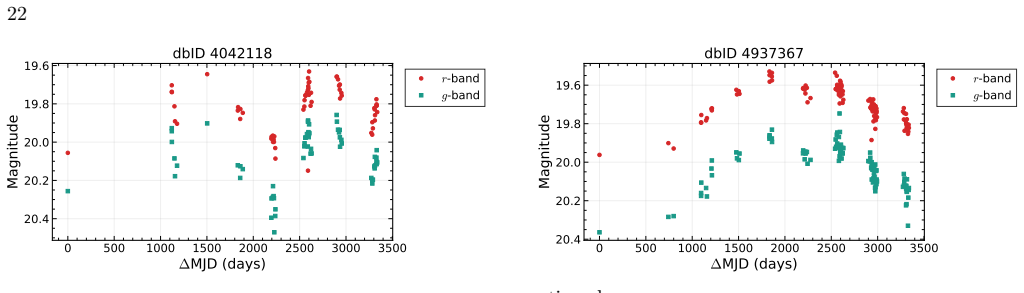
The paper presents FLARE as a modular pipeline that models baseline quasar variability with either a physics-informed gated recurrent unit trained on simulated damped random walk light curves or an iterative Ornstein-Uhlenbeck process fitted to the data with outlier masking, applies extreme value theory to score anomalies, and uses vision language models to verify candidate events. Applied to the r-band light curves of 9,258 spectroscopically confirmed quasars in the SDSS Stripe 82 dataset with g-band cross-checks, the framework detects 51 quasars that exhibit distinct flaring activity as significant departures from the modeled baseline.
What carries the argument
FLARE, a three-stage pipeline that models baseline stochastic variability with damped random walk or Ornstein-Uhlenbeck processes, applies extreme value theory for anomaly scoring, and employs vision language models for final verification.
Load-bearing premise
The damped random walk model together with outlier-masked Ornstein-Uhlenbeck fitting fully describes normal quasar variability, so that the remaining anomalies are genuine physical flares rather than unmodeled changes or data artifacts.
What would settle it
Reprocessing the 51 candidate light curves with a more flexible variability model that includes additional parameters for non-stationary behavior and finding that most or all of the flagged events fall within the revised baseline distribution.
Figures








read the original abstract
Quasars exhibit stochastic variability across wavelengths, typically well described by a Damped Random Walk (DRW). Occasionally, however, they undergo extreme luminosity changes--known as flares--that represent significant departures from this baseline behavior and provide valuable probes of accretion disc dynamics and the physics of supermassive black hole fueling. Although modern transient surveys have spurred growing interest in flare detection, no systematic search has yet been conducted within the legacy SDSS Stripe 82 dataset, which contains 9,258 spectroscopically confirmed quasars observed over a ~10-year baseline. The principal statistical challenge is distinguishing these rare events from the ever-present stochastic variability. To address this, we present FLARE (Flare detection via physics-informed Learning, Anomaly scoring, and Recognition Engine), a modular three-stage framework for detecting transient flares in quasar light curves. FLARE models baseline DRW behavior, applies statistical anomaly scoring to flag candidate events, and employs a recognition engine to verify detections. For the Stripe 82 implementation, we deploy two complementary baselines--a physics-informed probabilistic Gated Recurrent Unit (GRU) trained on simulated DRW light curves, and an iterative Ornstein-Uhlenbeck (OU) process fitted directly to observed data with outlier masking--followed by Extreme Value Theory (EVT) for anomaly scoring. We benchmark twelve open-weight and proprietary Vision Language Models (VLMs) as recognition engines for final candidate verification. Detection is performed on r-band light curves, with candidates cross-checked against g-band data to rule out instrumental artifacts. Applying this framework, we identify 51 quasars exhibiting distinct flaring activity.
Editorial analysis
A structured set of objections, weighed in public.
Referee Report
Summary. The manuscript introduces the FLARE framework, a three-stage pipeline for detecting transient flares in SDSS Stripe 82 quasar light curves. It models baseline variability using a physics-informed GRU trained on simulated DRW light curves and an iterative Ornstein-Uhlenbeck process fitted to observed data with outlier masking, applies Extreme Value Theory for anomaly scoring, and uses Vision Language Models for final verification, ultimately claiming the detection of 51 quasars with distinct flaring activity in r-band (cross-checked in g-band).
Significance. If the pipeline's ability to separate genuine flares from stochastic variability is demonstrated with quantitative metrics, the work would provide a systematic, reproducible approach to identifying rare accretion events in legacy photometric datasets, offering new probes of supermassive black hole fueling and disk physics. The modular combination of physics-informed simulation, statistical anomaly detection, and AI verification is a constructive direction, but the absence of performance benchmarks currently limits its assessed impact.
major comments (3)
- [Abstract] Abstract: The central claim of 51 detections is presented without any reported false-positive rates, precision/recall on simulated DRW-only light curves, recovery efficiency for injected flares, or comparison against a control sample of known non-flaring quasars. This validation is load-bearing for the claim that the two-stage baseline plus EVT scoring cleanly isolates physical flares.
- [Methodology (OU fitting)] Methodology section on the iterative OU process: Fitting the Ornstein-Uhlenbeck parameters directly to the observed light curves while iteratively masking outliers creates circularity, as the baseline model is partly defined by the same data used to score anomalies. This risks either excising real flares during masking or retaining unmodeled red-noise components that EVT then flags as candidates.
- [Results] Results section: No quantitative comparison is provided between the 51 candidates and either previously reported flaring quasars in the literature or the output of simpler DRW-residual methods, leaving the added value of the GRU+EVT+VLM stages unquantified.
minor comments (2)
- [Abstract] Abstract: The acronym FLARE is expanded only after first use; define it on first appearance for clarity.
- [Methodology (VLM stage)] The description of the twelve VLMs benchmarked lacks details on prompt engineering or decision thresholds used for verification; this should be expanded in the methods for reproducibility.
Simulated Author's Rebuttal
We thank the referee for their constructive and detailed review of our manuscript on the FLARE framework. We have addressed each major comment point by point below, providing clarifications and committing to revisions that strengthen the validation and methodological transparency without misrepresenting our results.
read point-by-point responses
-
Referee: [Abstract] Abstract: The central claim of 51 detections is presented without any reported false-positive rates, precision/recall on simulated DRW-only light curves, recovery efficiency for injected flares, or comparison against a control sample of known non-flaring quasars. This validation is load-bearing for the claim that the two-stage baseline plus EVT scoring cleanly isolates physical flares.
Authors: We acknowledge that the abstract and main text do not explicitly report quantitative performance metrics such as false-positive rates, precision/recall on DRW-only simulations, or recovery efficiency for injected flares. The manuscript describes training the GRU on simulated DRW light curves and VLM-based verification of the 51 candidates (with g-band cross-checks), but these do not constitute the full suite of benchmarks requested. We will revise the manuscript by adding a dedicated validation subsection that includes these metrics, derived from our existing simulations and a control sample of non-flaring quasars, to be placed before the results section. revision: yes
-
Referee: [Methodology (OU fitting)] Methodology section on the iterative OU process: Fitting the Ornstein-Uhlenbeck parameters directly to the observed light curves while iteratively masking outliers creates circularity, as the baseline model is partly defined by the same data used to score anomalies. This risks either excising real flares during masking or retaining unmodeled red-noise components that EVT then flags as candidates.
Authors: The iterative OU fitting with outlier masking is a deliberate design choice to estimate the underlying DRW baseline while mitigating the influence of transients, following established practices in time-series modeling. We recognize the potential circularity concern and will expand the methodology section with a detailed algorithmic description, including the specific masking threshold, iteration limits, and convergence criteria. We will also add simulation experiments demonstrating that injected flares are preserved and that residual red-noise components are not systematically passed to the EVT stage. revision: partial
-
Referee: [Results] Results section: No quantitative comparison is provided between the 51 candidates and either previously reported flaring quasars in the literature or the output of simpler DRW-residual methods, leaving the added value of the GRU+EVT+VLM stages unquantified.
Authors: The SDSS Stripe 82 quasar sample has not previously undergone a systematic flare search, which limits direct literature comparisons. We agree that explicit benchmarking against simpler DRW-residual methods would better quantify the incremental value of the full pipeline. In the revised manuscript, we will add a comparison subsection in the results that applies a basic DRW residual outlier detection to the same light curves, reports overlap with our 51 candidates, and discusses any matches to known flaring events from the literature. revision: yes
Circularity Check
No significant circularity in derivation or claims
full rationale
The paper presents an applied statistical-AI pipeline (FLARE) for flare detection rather than a mathematical derivation chain. Baseline modeling uses a GRU trained on external simulated DRW light curves plus iterative OU fitting with outlier masking on the target data, followed by EVT scoring and VLM verification. No equations, self-citations, or steps are described that reduce any claimed result (such as the count of 51 flaring quasars) to its inputs by construction; the anomaly detection operates on deviations from a fitted model, which is a standard non-circular statistical procedure. The framework remains self-contained against external benchmarks like simulations and cross-band checks.
Axiom & Free-Parameter Ledger
free parameters (2)
- DRW parameters
- OU process parameters
axioms (1)
- domain assumption Quasar light curves are typically well described by a Damped Random Walk (DRW).
invented entities (1)
-
FLARE framework
no independent evidence
Forward citations
Cited by 1 Pith paper
-
PDRS : A Linear $\mathcal{O}(N)$ Algorithm for Segmentation of High-Activity Regions in Irregularly Sampled Time Series
PDRS is an O(N) algorithm for identifying high-activity regions in time series by seeding at local maxima and using gradient-aware search, achieving performance comparable to Bayesian Blocks.
Reference graph
Works this paper leans on
-
[1]
author author M. J. \ Graham , author S. G. \ Djorgovski , author A. J. \ Drake , author D. Stern , author A. A. \ Mahabal , author E. Glikman , author S. Larson , \ and\ author E. Christensen ,\ 10.1093/mnras/stx1456 journal journal Monthly Notices of the Royal Astronomical Society \ volume 470 ,\ pages 4112 ( year 2017 ) NoStop
-
[2]
author author C. MacLeod , author Z . Ivezi \'c , author C. S. \ Kochanek , author S. Koz owski , author B. Kelly , author E. Bullock , author A. Hope , author R. J. \ Assef , author R. Becker , author P. B. \ Hall , author P. Harding , author M. Juri \'c , author R. M. \ Kratzer , author M. R. \ Meade , author W. Ricketts , author B. Sesar , author D. P....
-
[3]
author author C.-H. \ Chan , author T. Piran , author J. H. \ Krolik , \ and\ author D. Saban ,\ 10.3847/1538-4357/ab2b40 journal journal The Astrophysical Journal \ volume 881 ,\ pages 113 ( year 2019 ) NoStop
-
[4]
author author A. J. \ Drake et al. ,\ 10.1088/0004-637X/735/2/106 journal journal Astrophys. J. \ volume 735 ,\ pages 106 ( year 2011 ) ,\ http://arxiv.org/abs/1103.5514 arXiv:1103.5514 [astro-ph.CO] NoStop
-
[5]
author author Z. Zheng , author Y. Shi , author S. Jin , author H. Dannerbauer , author Q. Gu , author X. Li , \ and\ author X. Yu ,\ 10.1093/mnras/stae1036 journal journal Monthly Notices of the Royal Astronomical Society \ volume 530 ,\ pages 3527 ( year 2024 ) NoStop
-
[6]
author author L. He , author Z.-Y. \ Liu , author R. Niu , author M.-S. \ Zhou , author P.-R. \ Zou , author B.-Z. \ Gao , author R.-D. \ Liang , author L.-G. \ Zhu , author J.-M. \ Wang , author N. Jiang , author Z.-Y. \ Cai , author J. an Jiang , author Z.-G. \ Dai , author Y.-F. \ Yuan , author Y.-J. \ Chen , \ and\ author W. Zhao ,\ 10.3847/1538-4365/...
-
[7]
author author S. A. J. \ McLaughlin , author J. R. \ Mullaney , \ and\ author S. P. \ Littlefair ,\ 10.1093/mnras/stae721 journal journal Monthly Notices of the Royal Astronomical Society \ volume 529 ,\ pages 2877 ( year 2024 ) NoStop
-
[8]
author author K. L. \ Suberlak , author Z . Ivezi \'c , \ and\ author C. L. \ MacLeod ,\ 10.3847/1538-4357/abc698 journal journal The Astrophysical Journal \ volume 907 ,\ pages 96 ( year 2021 ) NoStop
-
[9]
author author B. C. \ Kelly , author J. Bechtold , \ and\ author A. Siemiginowska ,\ 10.1088/0004-637X/698/1/895 journal journal The Astrophysical Journal \ volume 698 ,\ pages 895 ( year 2009 ) NoStop
-
[10]
author author B. C. \ Kelly , author A. C. \ Becker , author M. Sobolewska , author A. Siemiginowska , \ and\ author P. Uttley ,\ 10.1088/0004-637X/788/1/33 journal journal The Astrophysical Journal \ volume 788 ,\ pages 33 ( year 2014 ) NoStop
-
[11]
author author W. Yu , author G. T. \ Richards , author M. S. \ Vogeley , author J. Moreno , \ and\ author M. J. \ Graham ,\ 10.3847/1538-4357/ac8351 journal journal The Astrophysical Journal \ volume 936 ,\ pages 132 ( year 2022 ) NoStop
-
[12]
author author J. Fagin , author J. H.-H. \ Chan , author H. Best , author M. O'Dowd , author K. E. S. \ Ford , author M. J. \ Graham , author J. W. \ Park , \ and\ author V. A. \ Villar ,\ 10.3847/1538-4357/addabc journal journal The Astrophysical Journal \ ( year 2025 ),\ 10.3847/1538-4357/addabc NoStop
-
[13]
author author Y. Tachibana , author M. J. \ Graham , author N. Kawai , author S. G. \ Djorgovski , author A. J. \ Drake , author A. A. \ Mahabal , \ and\ author D. Stern ,\ 10.3847/1538-4357/abb9a9 journal journal The Astrophysical Journal \ volume 903 ,\ eid 54 ( year 2020 ) NoStop
-
[14]
author author D. Foreman-Mackey , author E. Agol , author S. Ambikasaran , \ and\ author R. Angus ,\ 10.3847/1538-3881/aa9332 journal journal The Astronomical Journal \ volume 154 ,\ pages 220 ( year 2017 ) NoStop
-
[15]
author author M. Raissi , author P. Perdikaris , \ and\ author G. E. \ Karniadakis ,\ 10.1016/j.jcp.2018.10.045 journal journal Journal of Computational Physics \ volume 378 ,\ pages 686 ( year 2019 ) NoStop
-
[16]
author author Y. Bengio , author J. Louradour , author R. Collobert , \ and\ author J. Weston ,\ in\ 10.1145/1553374.1553380 booktitle Proceedings of the 26th International Conference on Machine Learning \ ( year 2009 )\ pp.\ pages 41--48 NoStop
-
[17]
author author S. Koz owski ,\ 10.1051/0004-6361/201629890 journal journal Astronomy & Astrophysics \ volume 597 ,\ pages A128 ( year 2017 ) NoStop
-
[18]
author author S. Coles ,\ 10.1007/978-1-4471-3675-0 title An Introduction to Statistical Modeling of Extreme Values \ ( publisher Springer ,\ year 2001 ) NoStop
-
[19]
Dettmers , author A
author author T. Dettmers , author A. Pagnoni , author A. Holtzman , \ and\ author L. Zettlemoyer ,\ in\ c booktitle Advances in Neural Information Processing Systems ,\ Vol. volume 36 \ ( year 2023 )\ pp.\ pages 10088--10115 NoStop
2023
-
[20]
author author C. R. \ Harris et al. ,\ 10.1038/s41586-020-2649-2 journal journal Nature \ volume 585 ,\ pages 357 ( year 2020 ) NoStop
-
[21]
author author P. Virtanen et al. ,\ 10.1038/s41592-019-0686-2 journal journal Nature Methods \ volume 17 ,\ pages 261 ( year 2020 ) NoStop
-
[22]
Paszke , author S
author author A. Paszke , author S. Gross , author F. Massa , author A. Lerer , author J. Bradbury , author G. Chanan , author T. Killeen , author Z. Lin , author N. Gimelshein , author L. Antiga , et al. ,\ in\ https://proceedings.neurips.cc/paper/2019/file/bdbca288fee7f92f2bfa9f7012727740-Paper.pdf booktitle Advances in Neural Information Processing Sys...
2019
-
[23]
Yu \ and\ author G
author author W. Yu \ and\ author G. T. \ Richards ,\ https://ascl.net/2201.001 title EzTao: Easier CARMA Modeling , \ howpublished Astrophysics Source Code Library, record ascl:2201.001 ( year 2022 ) NoStop
2022
-
[24]
Transformers: State-of-the-Art Natural Language Processing , url =
author author T. Wolf et al. ,\ in\ 10.18653/v1/2020.emnlp-demos.6 booktitle Proceedings of the 2020 Conference on Empirical Methods in Natural Language Processing: System Demonstrations \ ( year 2020 )\ pp.\ pages 38--45 NoStop
-
[25]
author author J. D. \ Hunter ,\ 10.1109/MCSE.2007.55 journal journal Computing in Science & Engineering \ volume 9 ,\ pages 90 ( year 2007 ) NoStop
-
[26]
author author W. McKinney ,\ in\ 10.25080/Majora-92bf1922-00a booktitle Proceedings of the 9th Python in Science Conference \ ( year 2010 )\ pp.\ pages 56--61 NoStop
discussion (0)
Sign in with ORCID, Apple, or X to comment. Anyone can read and Pith papers without signing in.