Recognition: unknown
Gluing diagrams part 1: A constructive solution for the Higman-Thompson group isomorphism problem
Pith reviewed 2026-05-08 02:04 UTC · model grok-4.3
The pith
Gluing diagrams provide an explicit construction of isomorphisms between Higman-Thompson groups.
A machine-rendered reading of the paper's core claim, the machinery that carries it, and where it could break.
Core claim
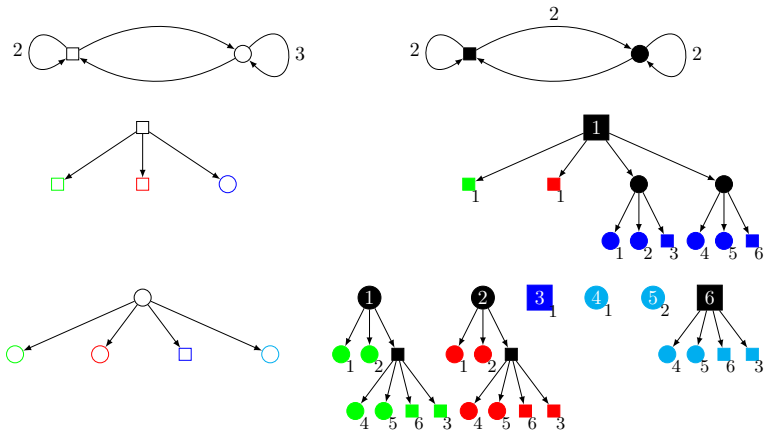
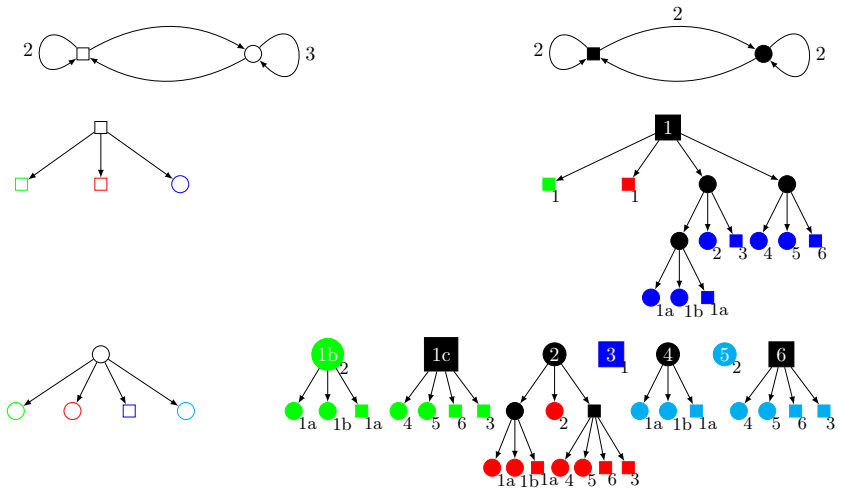
We introduce gluing diagrams as a combinatorial tool to construct homomorphisms between the shift pseudogroups of directed graphs and thus also their full groups of shifts. We establish which of these diagrams produce isomorphisms. As an application, using the interpretation of Higman-Thompson groups as full groups of shifts of specific graphs, we describe a procedure that constructs gluing diagrams that explicitly describe the isomorphisms between Higman-Thompson groups, conjectured by Higman and whose existence was proven by Pardo.
What carries the argument
Gluing diagrams on directed graphs, which specify compatible edge identifications that induce a shift-equivariant map between the two graphs' shift spaces and thereby a homomorphism of their full groups.
If this is right
- Isomorphisms between any two Higman-Thompson groups can be written down explicitly via a finite gluing diagram.
- The isomorphism problem for Higman-Thompson groups now admits a constructive algorithmic solution.
- Homomorphisms between shift pseudogroups on directed graphs become systematically constructible from the same diagrams.
- The same criteria decide when a diagram produces an isomorphism rather than a proper homomorphism.
Where Pith is reading between the lines
- The diagrams may yield practical algorithms for computing the action of these isomorphisms on finite words or paths.
- The technique could be tested on other classes of groups that arise as full groups of graph shifts.
- Explicit diagrams might make it possible to compare presentations or find new generators for the groups.
Load-bearing premise
The combinatorial conditions that guarantee an isomorphism for gluing diagrams on arbitrary graphs continue to hold without extra obstructions when the graphs are the specific ones that realize Higman-Thompson groups.
What would settle it
Apply the procedure to produce a gluing diagram for any known isomorphic pair of Higman-Thompson groups and check whether the resulting map fails to be a bijective homomorphism of the groups.
Figures


read the original abstract
This paper introduces gluing diagrams a combinatorial tool to construct homomorphisms between the shift pseudogroups of directed graphs and thus also their full groups of shifts. We will establish which of these diagrams produce isomorphisms. As an application, using the interpretation of Higman-Thompson groups as full groups of shifts of specific graphs, we will describe a procedure that constructs gluing diagrams that explicitly describe the isomorphisms between Higman-Thompson groups, conjectured by Higman and whose existence was proven by Pardo arXiv:1006.1759.
Editorial analysis
A structured set of objections, weighed in public.
Referee Report
Summary. The manuscript introduces gluing diagrams as a combinatorial tool to construct homomorphisms between the shift pseudogroups of directed graphs and thus their full groups of shifts. It establishes which diagrams produce isomorphisms. As an application, using the interpretation of Higman-Thompson groups as full groups of shifts of specific graphs, it describes a procedure that constructs gluing diagrams explicitly realizing the isomorphisms between Higman-Thompson groups V_{n,r} conjectured by Higman and proven to exist by Pardo.
Significance. If the construction is shown to satisfy the general isomorphism criteria, the work would supply the first explicit, combinatorial realizations of these isomorphisms, advancing beyond Pardo's existence proof and potentially enabling computational or structural investigations of the groups. The general framework for gluing diagrams on arbitrary directed graphs may also prove useful for other full groups of shifts.
major comments (2)
- [Application to Higman-Thompson groups] Application section (following the general theory): the procedure is shown to produce well-defined gluing diagrams on the (usually infinite, regular) graphs for V_{n,r}, but the manuscript does not explicitly verify that the output diagrams satisfy the bijectivity-on-edges and shift-compatibility conditions established in the general characterization theorem for inducing isomorphisms of full groups. This verification is load-bearing for the central claim of a constructive solution.
- [General theory of gluing diagrams] General theory section: the statement of the main theorem characterizing isomorphism-inducing gluing diagrams should clarify whether the listed combinatorial conditions are sufficient for arbitrary directed graphs or require additional hypotheses (e.g., regularity or out-degree bounds) that are automatically met by the Higman-Thompson realizations but not stated as such.
minor comments (2)
- [Abstract] The abstract refers to 'a procedure' without indicating the section or theorem number where the explicit construction is given; adding this would improve readability.
- [Introduction] Notation for the shift pseudogroup and full group should be introduced with a brief reminder of the standard definitions from the literature on graph shifts, even if the paper assumes familiarity.
Simulated Author's Rebuttal
We thank the referee for their careful reading of the manuscript and for the constructive comments. We are pleased that the referee recognizes the potential significance of the gluing diagrams framework. Below we respond to each major comment, indicating the revisions we will make.
read point-by-point responses
-
Referee: [Application to Higman-Thompson groups] Application section (following the general theory): the procedure is shown to produce well-defined gluing diagrams on the (usually infinite, regular) graphs for V_{n,r}, but the manuscript does not explicitly verify that the output diagrams satisfy the bijectivity-on-edges and shift-compatibility conditions established in the general characterization theorem for inducing isomorphisms of full groups. This verification is load-bearing for the central claim of a constructive solution.
Authors: We agree that an explicit verification would make the argument more transparent. Although the construction is designed so that the diagrams satisfy the conditions of the main theorem (as the procedure is derived from the known isomorphisms), the manuscript would benefit from a direct check. In the revised version, we will include a verification that the gluing diagrams produced by the procedure for the Higman-Thompson groups satisfy bijectivity on edges and shift-compatibility, thereby confirming they induce isomorphisms of the full groups. revision: yes
-
Referee: [General theory of gluing diagrams] General theory section: the statement of the main theorem characterizing isomorphism-inducing gluing diagrams should clarify whether the listed combinatorial conditions are sufficient for arbitrary directed graphs or require additional hypotheses (e.g., regularity or out-degree bounds) that are automatically met by the Higman-Thompson realizations but not stated as such.
Authors: The main theorem is stated and proved for arbitrary directed graphs, with no additional hypotheses required beyond the listed combinatorial conditions. The proof does not rely on regularity or bounded out-degrees. We will revise the statement of the theorem to explicitly affirm that the conditions are sufficient for any directed graph to ensure the induced map is an isomorphism of full groups of shifts. revision: yes
Circularity Check
No significant circularity; new general tool applied to specific graphs with external existence result cited.
full rationale
The paper first defines gluing diagrams as a combinatorial tool for arbitrary directed graphs and independently establishes the conditions under which they induce isomorphisms of the associated full groups of shifts. It then specializes this framework to the (typically infinite regular) graphs whose full groups realize the Higman-Thompson groups V_{n,r}, describing an explicit procedure that outputs diagrams on those graphs. The existence of the target isomorphisms is attributed to Pardo's prior result (arXiv:1006.1759), but the paper supplies a constructive method rather than deriving the isomorphisms from that citation or from any fitted parameters. No self-definitional loops, no renaming of known results, and no load-bearing self-citations appear in the derivation chain; the central construction rests on the newly proven general criteria applied to the specific realizations.
Axiom & Free-Parameter Ledger
axioms (1)
- domain assumption Higman-Thompson groups can be realized as the full groups of shifts on specific directed graphs
invented entities (1)
-
gluing diagrams
no independent evidence
Reference graph
Works this paper leans on
-
[1]
Leavitt path algebras: the first decade.Bulletin of Mathematical Sciences, 5:59–120, 2015
Gene Abrams. Leavitt path algebras: the first decade.Bulletin of Mathematical Sciences, 5:59–120, 2015
2015
-
[2]
Moreno, and Enrique Pardo
Pere Ara, Maria A. Moreno, and Enrique Pardo. Nonstable k-theory for graph algebras. Algebras and representation theory, 10(2):157–178, 2007
2007
-
[3]
Arklint, Søren Eilers, and Efren Ruiz
Sara E. Arklint, Søren Eilers, and Efren Ruiz. A dynamical characterization of diagonal- preserving ˚-isomorphisms of graphc ˚-algebras.Ergodic Theory and Dynamical Systems, 38(7):2401–2421, 2018
2018
-
[4]
Gauthier-Villars, 1874
Claude-Gaspard Bachet and A Labosne.Problemes plaisants & delectables qui se font par les nombres. Gauthier-Villars, 1874
-
[5]
J. C. Birget. New embeddings between the higman-thompson groups.Communications in Algebra, 48(8):3429–3438, 2020
2020
-
[6]
Cannon, William J
James W. Cannon, William J. Floyd, and Walter R. Parry. Introductory notes on richard thompson’s groups.Enseign. Math.(2), 42(3-4):215, 1996
1996
-
[7]
Notes in pure math
Graham Higman.Finitely Presented Infinite Simple Groups. Notes in pure math. Department of Pure Mathematics, Department of Mathematics, I.A.S., Australian National University, 1974
1974
-
[8]
Continuous orbit equivalence of topological markov shifts and cuntz–krieger algebras.Kyoto Journal of Mathematics, 54(4), January 2014
Kengo Matsumoto and Hiroki Matui. Continuous orbit equivalence of topological markov shifts and cuntz–krieger algebras.Kyoto Journal of Mathematics, 54(4), January 2014. 29
2014
-
[9]
Rigidity properties of full groups of pseudogroups over the Cantor set
Nicol´ as Matte Bon. Rigidity properties of full groups of pseudogroups over the Cantor set. arXiv e-prints, page arXiv:1801.10133, January 2018
-
[10]
Topological full groups of one-sided shifts of finite type.Journal f¨ ur die reine und angewandte Mathematik (Crelles Journal), 2015(705):35–84, 2015
Hiroki Matui. Topological full groups of one-sided shifts of finite type.Journal f¨ ur die reine und angewandte Mathematik (Crelles Journal), 2015(705):35–84, 2015
2015
-
[11]
The isomorphism problem for Higman–Thompson groups.Journal of Algebra, 344(1):172–183, 2011
Enrique Pardo. The isomorphism problem for Higman–Thompson groups.Journal of Algebra, 344(1):172–183, 2011
2011
-
[12]
Elizabeth A. Scott. A construction which can be used to produce finitely presented infinite simple groups.Journal of Algebra, 90(2):294–322, 1984. 30
1984
discussion (0)
Sign in with ORCID, Apple, or X to comment. Anyone can read and Pith papers without signing in.