Recognition: 3 theorem links
· Lean TheoremThe SRG/eROSITA diffuse soft X-ray background II. spectra and morphology of the eROSITA bubbles in the western Galactic hemisphere
Pith reviewed 2026-05-08 17:41 UTC · model grok-4.3
The pith
The western eROSITA bubble interior consists of two uniform-temperature gas components, with the cooler one dominating the emission measure.
A machine-rendered reading of the paper's core claim, the machinery that carries it, and where it could break.
Core claim
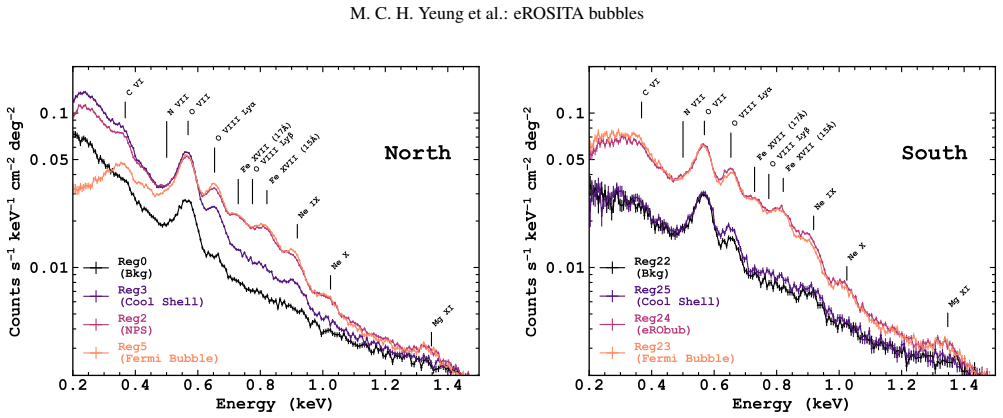
The interior of the western eRObub is best characterised by two emission components with relatively uniform temperatures: a hotter component at kT=0.60±0.02 keV, and a colder one at kT=0.21+0.03-0.01 keV, where the latter's emission measure is about five times higher on average. Spectra suggest sub-solar abundances (Z=0.2±0.1 Z⊙), consistent with expectations for the Galactic halo, while no conclusive evidence for α-element enhancement is found. The North Polar Spur shows higher abundances (Z>0.5 Z⊙), disfavoring a common origin. A cool shell at kT∼0.18-0.2 keV surrounds the northern eRObub, and no noticeable difference appears in regions overlapping the Fermi Bubbles. The geometrical model,
What carries the argument
Two-component thermal plasma model assuming collisional ionization equilibrium combined with a parametrized geometrical blast-wave model describing expansion into an idealized Galactic halo.
Load-bearing premise
The analysis assumes the emitting gas is in collisional ionization equilibrium and that the bubble can be modeled as a simple blast wave expanding into a smooth halo.
What would settle it
Detection of strong temperature gradients inside the bubble or alpha-element abundances significantly above solar would contradict the two-component uniform-temperature and sub-solar abundance description.
Figures




read the original abstract
The eROSITA bubbles (eRObub) were discovered in 2020 in the first SRG/eROSITA All-Sky Survey, and are among the most extended structures in the X-ray sky. Using eROSITA all-sky maps and spatially resolved spectra, we aim to infer the three-dimensional structure and measure the hot gas properties of the eRObub. We fit spectra binned to a constant S/N and high-S/N spectra from custom regions to examine gas properties in more detail. We fit the morphology of eRObub with a parametrised geometrical model that describes a blast wave propagating into an idealised Galactic halo from the centre. We found the interior of the western eRObub is best characterised by two emission components with relatively uniform temperatures: a hotter component at $kT=0.60\pm0.02$ keV, and a colder one at $kT=0.21^{+0.03}_{-0.01}$ keV, where the latter's emission measure is about five times higher on average. Our spectra suggest sub-solar abundances ($Z=0.2\pm0.1 Z_\odot$), consistent with expectations for the Galactic halo, while we find no conclusive evidence for $\alpha$-element enhancement. In contrast, the North Polar Spur exhibits higher abundances ($Z>0.5 Z_\odot$), which, at face value, disfavours a common origin. We spectrally confirm an apparent cool shell at $kT\sim0.18$-$0.2$ keV surrounding the northern eRObub, assuming collisional ionisation equilibrium. We found no noticeable difference in X-ray emission in regions overlapping with the Fermi Bubbles. Our geometrical model suggests that the horizontal size of both eRObub is well-constrained (semi-minor axis $\sim 6$ kpc), but their vertical extent is uncertain, as the observed X-ray emission is almost insensitive to the existence and location of a bubble cap. Additionally, a tilt ($\sim 30^{\circ}$) towards $l\sim 220^{\circ}$ is needed to reproduce the projected image of the northern eRObub, whereas the southern bubble requires little tilt.
Editorial analysis
A structured set of objections, weighed in public.
Referee Report
Summary. The paper analyzes SRG/eROSITA all-sky survey data to characterize the eROSITA bubbles in the western Galactic hemisphere. It reports that the western bubble interior is best described by two relatively uniform CIE plasma components (kT=0.60±0.02 keV hotter and kT=0.21^{+0.03}_{-0.01} keV colder, with the latter having ~5× higher emission measure on average), sub-solar metallicity (Z=0.2±0.1 Z_⊙), and a cool shell (kT~0.18-0.2 keV) around the northern bubble. A parametrized blast-wave geometrical model in an idealized halo yields a well-constrained semi-minor axis of ~6 kpc but uncertain vertical extent, with a ~30° tilt needed for the northern bubble; no X-ray differences are found in regions overlapping the Fermi Bubbles, and the North Polar Spur shows higher abundances.
Significance. If the two-component characterization and morphological constraints hold, the work supplies important observational benchmarks for the energetics, origin, and 3D structure of these large-scale Galactic X-ray features and their possible connection to other structures. The combination of constant-S/N spectral binning, custom high-S/N region fits, and parametric geometry modeling provides a concrete data product for future comparisons with simulations of Galactic feedback.
major comments (2)
- [Spectral fitting section] Spectral analysis of the bubble interior (as described in the abstract and the fits to constant-S/N and custom regions): the two-component model and derived parameters (kT values and ~5× emission-measure ratio) assume collisional ionization equilibrium without any reported tests of non-equilibrium ionization (NEI) models or ionization timescales. Because the strongest claim rests on these temperatures and the component ratio, and because NEI alters continuum shape and line ratios, this assumption is load-bearing and requires explicit verification or justification.
- [Morphological modeling section] Geometrical modeling section: the blast-wave model assumes an idealized smooth Galactic halo with propagation from the Galactic center. While the paper correctly notes the X-ray data's insensitivity to a bubble cap, the effect of plausible deviations from this idealization on the reported semi-minor axis (~6 kpc) and the 30° tilt should be quantified to confirm that the horizontal-size constraint is robust.
minor comments (3)
- [Abstract] Abstract: omits any mention of background-subtraction procedure, exact binning criteria beyond constant S/N, or goodness-of-fit statistics, which would allow readers to assess the robustness of the reported spectral parameters.
- [Throughout] Notation: the asymmetric uncertainties on the colder-component temperature are reported clearly, but the text should consistently state whether the quoted errors are 1σ statistical only or include systematics.
- [Discussion section] The comparison to the North Polar Spur abundances would benefit from a brief statement on whether the same plasma model and abundance table were used for both the bubbles and the Spur.
Simulated Author's Rebuttal
We thank the referee for their positive assessment of our manuscript and for the constructive major comments. We address each point below and have revised the paper to incorporate the requested verifications and quantifications.
read point-by-point responses
-
Referee: [Spectral fitting section] Spectral analysis of the bubble interior (as described in the abstract and the fits to constant-S/N and custom regions): the two-component model and derived parameters (kT values and ~5× emission-measure ratio) assume collisional ionization equilibrium without any reported tests of non-equilibrium ionization (NEI) models or ionization timescales. Because the strongest claim rests on these temperatures and the component ratio, and because NEI alters continuum shape and line ratios, this assumption is load-bearing and requires explicit verification or justification.
Authors: We thank the referee for highlighting this important point. Although the submitted manuscript did not include explicit NEI tests, we have now performed additional fits using NEI models (nei in XSPEC) on the high-S/N custom-region spectra. The resulting ionization timescales exceed 10^12 s cm^{-3}, consistent with CIE conditions at the derived temperatures. The two-component kT values and emission-measure ratio remain unchanged within uncertainties. We have added a new paragraph in the spectral analysis section describing these tests and justifying the CIE assumption on physical grounds (large scales and estimated ages of several Myr). revision: yes
-
Referee: [Morphological modeling section] Geometrical modeling section: the blast-wave model assumes an idealized smooth Galactic halo with propagation from the Galactic center. While the paper correctly notes the X-ray data's insensitivity to a bubble cap, the effect of plausible deviations from this idealization on the reported semi-minor axis (~6 kpc) and the 30° tilt should be quantified to confirm that the horizontal-size constraint is robust.
Authors: We agree that quantifying robustness against deviations from the idealized halo is valuable. We have carried out sensitivity tests by varying the halo density scale height (2–10 kpc) and introducing mild radial asymmetries. Across these variations the semi-minor axis remains constrained to 5.5–6.5 kpc, while the ~30° tilt required for the northern bubble is stable. The vertical extent continues to show larger uncertainty, as expected from the data’s limited sensitivity to bubble caps. We have added a quantitative discussion of these tests and the associated caveats to the morphological modeling section. revision: yes
Circularity Check
No significant circularity in derivation chain
full rationale
The paper's central claims consist of direct spectral fitting of eROSITA data to extract temperatures (kT = 0.60 ± 0.02 keV and 0.21 keV) and emission measures for two plasma components, plus a parametrized geometrical model fitted to the observed bubble morphology. These are independent parameter estimations from external observations using standard CIE plasma models and a blast-wave geometry; no paper equation or self-citation reduces the reported values back to the inputs by construction. The CIE assumption for the cool shell is stated explicitly but does not create a definitional loop or force the interior results. The analysis is self-contained against telescope data with no load-bearing self-citation chains or renamed predictions.
Axiom & Free-Parameter Ledger
free parameters (4)
- hotter component temperature =
0.60 keV
- colder component temperature =
0.21 keV
- metallicity Z =
0.2 Z_sun
- semi-minor axis =
~6 kpc
axioms (2)
- domain assumption Collisional ionisation equilibrium holds for the emitting plasma
- domain assumption The Galactic halo can be treated as an idealised smooth medium for blast-wave propagation
Lean theorems connected to this paper
-
Cost.FunctionalEquation / Constants - RS expresses physical scales via J-cost zeros and phi-powers; the paper's four parameters are free fits to plasma codes with no ratio-symmetric structure.washburn_uniqueness_aczel unclear?
unclearRelation between the paper passage and the cited Recognition theorem.
kT=0.60+/-0.02 keV ... kT=0.21+0.03-0.01 keV ... emission measure is about five times higher on average ... Z=0.2+/-0.1 Z_sun
What do these tags mean?
- matches
- The paper's claim is directly supported by a theorem in the formal canon.
- supports
- The theorem supports part of the paper's argument, but the paper may add assumptions or extra steps.
- extends
- The paper goes beyond the formal theorem; the theorem is a base layer rather than the whole result.
- uses
- The paper appears to rely on the theorem as machinery.
- contradicts
- The paper's claim conflicts with a theorem or certificate in the canon.
- unclear
- Pith found a possible connection, but the passage is too broad, indirect, or ambiguous to say the theorem truly supports the claim.
Reference graph
Works this paper leans on
-
[1]
Detection of large-scale X-ray bubbles in the Milky Way halo. , keywords =. doi:10.1038/s41586-020-2979-0 , archivePrefix =. 2012.05840 , primaryClass =
-
[2]
X-Ray and Gamma-Ray Observations of the Fermi Bubbles and NPS/Loop I Structures. Galaxies , keywords =. doi:10.3390/galaxies6010027 , archivePrefix =. 1802.07463 , primaryClass =
-
[3]
Interaction of the Loop I supershell with the Local Hot Bubble. , keywords =. doi:10.48550/arXiv.astro-ph/9412086 , archivePrefix =. astro-ph/9412086 , primaryClass =
work page internal anchor Pith review doi:10.48550/arxiv.astro-ph/9412086
-
[4]
On the distance to the North Polar Spur and the local CO-H _ 2 factor. , keywords =. doi:10.1051/0004-6361/201629453 , archivePrefix =. 1609.03813 , primaryClass =
-
[5]
Revisiting the Distance to Radio Loops I and IV Using Gaia and Radio/Optical Polarization Data. , keywords =. doi:10.3847/1538-4357/ac273f , archivePrefix =. 2106.14267 , primaryClass =
-
[6]
Suzaku Observations of the Diffuse X-Ray Emission across the Fermi Bubbles' Edges. , keywords =. doi:10.1088/0004-637X/779/1/57 , archivePrefix =. 1310.3553 , primaryClass =
-
[7]
Studying the Interstellar Medium and the Inner Region of NPS/LOOP 1 with Shadow Observations toward MBM36. , keywords =. doi:10.3847/0004-637X/816/1/33 , archivePrefix =. 1512.00024 , primaryClass =
-
[8]
Thermal and chemical properties of the eROSITA bubbles from Suzaku observations. , keywords =. doi:10.1038/s41550-023-01963-5 , archivePrefix =. 2201.09915 , primaryClass =
-
[9]
The Spectrum and Morphology of the Fermi Bubbles. , keywords =. doi:10.1088/0004-637X/793/1/64 , archivePrefix =. 1407.7905 , primaryClass =
-
[10]
Giant Gamma-ray Bubbles from Fermi-LAT: Active Galactic Nucleus Activity or Bipolar Galactic Wind?. , keywords =. doi:10.1088/0004-637X/724/2/1044 , archivePrefix =. 1005.5480 , primaryClass =
-
[11]
Fermi and eROSITA bubbles as relics of the past activity of the Galaxy's central black hole. , keywords =. doi:10.1038/s41550-022-01618-x , archivePrefix =. 2203.02526 , primaryClass =
-
[12]
Galactic Winds and Bubbles from Nuclear Starburst Rings. , keywords =. doi:10.3847/2041-8213/ac86c3 , archivePrefix =. 2205.13465 , primaryClass =
-
[13]
Discovery of non-equilibrium ionization plasma associated with the North Polar Spur and Loop I. , keywords =. doi:10.1093/mnras/stac577 , archivePrefix =. 2203.00468 , primaryClass =
-
[14]
Radioactive ^ 26 Al from massive stars in the Galaxy. , keywords =. doi:10.1038/nature04364 , archivePrefix =. astro-ph/0601015 , primaryClass =
-
[15]
2021, A&A, 647, A1, doi: 10.1051/0004-6361/202039313
The eROSITA X-ray telescope on SRG. , keywords =. doi:10.1051/0004-6361/202039313 , archivePrefix =. 2010.03477 , primaryClass =
-
[16]
arXiv e-prints , keywords =
eROSITA Science Book: Mapping the Structure of the Energetic Universe. arXiv e-prints , keywords =
-
[17]
A Unified Model of the Fermi Bubbles, Microwave Haze, and Polarized Radio Lobes: Reverse Shocks in the Galactic Center s Giant Outflows. , keywords =. doi:10.1088/0004-637X/808/2/107 , archivePrefix =. 1412.7510 , primaryClass =
-
[18]
The SRG/eROSITA view of the soft X-ray background in the eFEDS field
Abundance and temperature of the outer hot circumgalactic medium. The SRG/eROSITA view of the soft X-ray background in the eFEDS field. , keywords =. doi:10.1051/0004-6361/202243992 , archivePrefix =. 2210.03133 , primaryClass =
-
[19]
eROSITA narrowband maps at the energies of soft X-ray emission lines. , keywords =. doi:10.1051/0004-6361/202449398 , archivePrefix =. 2401.17310 , primaryClass =
-
[20]
2003, MNRAS, 340, 1214, doi: 10.1046/j.1365-8711.2003.06380.x
The X-ray spectrum of the North Polar Spur. , keywords =. doi:10.1046/j.1365-8711.2003.06741.x , adsurl =
-
[21]
Suzaku Observations of the North Polar Spur: Evidence for Nitrogen Enhancement. , keywords =. doi:10.1093/pasj/60.sp1.S95 , archivePrefix =. 0708.4227 , primaryClass =
-
[22]
The invisible black widow PSR J1720-0534: implications for the electron density towards the North Polar Spur. , keywords =. doi:10.1093/mnras/stae498 , archivePrefix =. 2402.09010 , primaryClass =
-
[23]
Zheng,et al., Broadband maps of eROSITA and their comparison with the ROSAT survey
Broadband maps of eROSITA and their comparison with the ROSAT survey. , keywords =. doi:10.1051/0004-6361/202346576 , archivePrefix =. 2312.06745 , primaryClass =
-
[24]
The local hot bubble in the western Galactic hemisphere
The SRG/eROSITA diffuse soft X-ray background: I. The local hot bubble in the western Galactic hemisphere. , keywords =. doi:10.1051/0004-6361/202451045 , archivePrefix =. 2410.23345 , primaryClass =
-
[25]
, year = 2024, note =
2024
-
[26]
The Interaction of the Fermi Bubbles with the Milky Way s Hot Gas Halo. , keywords =. doi:10.3847/0004-637X/829/1/9 , archivePrefix =. 1607.04906 , primaryClass =
-
[27]
The warm-hot circumgalactic medium of the Milky Way as seen by eROSITA. , keywords =. doi:10.1051/0004-6361/202347061 , archivePrefix =. 2310.10715 , primaryClass =
-
[28]
Shock waves in the interstellar medium. , keywords =. doi:10.1086/190562 , adsurl =
-
[29]
Supernova Remnants in the Sedov Expansion Phase: Thermal X-Ray Emission. , keywords =. doi:10.1086/319011 , archivePrefix =. astro-ph/0008066 , primaryClass =
-
[30]
Evidence for Rapid Adiabatic Cooling as an Origin of the Recombining Plasma in the Supernova Remnant W49B Revealed by NuSTAR Observations. , keywords =. doi:10.3847/2041-8213/aaf055 , archivePrefix =. 1811.04426 , primaryClass =
-
[31]
Core-collapse Supernovae from 9 to 120 Solar Masses Based on Neutrino-powered Explosions. , keywords =. doi:10.3847/0004-637X/821/1/38 , archivePrefix =. 1510.04643 , primaryClass =
-
[32]
Barnes, A. T. and Longmore, S. N. and Battersby, C. and Bally, J. and Kruijssen, J. M. D. and Henshaw, J. D. and Walker, D. L. , title = ". , volume =. 2017 , month =. doi:10.1093/mnras/stx941 , url =
-
[33]
On the variation of the initial mass function. , keywords =. doi:10.1046/j.1365-8711.2001.04022.x , archivePrefix =. astro-ph/0009005 , primaryClass =
-
[34]
Misaligned Jets from Sgr A* and the Origin of Fermi/eROSITA Bubbles. , keywords =. doi:10.3847/1538-4357/acd75d , archivePrefix =. 2211.12967 , primaryClass =
-
[35]
Clues to the origin of Fermi bubbles from O viii/O vii line ratio. , keywords =. doi:10.1093/mnras/stx314 , archivePrefix =. 1610.00719 , primaryClass =
-
[36]
Multiwavelength features of Fermi bubbles as signatures of a Galactic wind. , keywords =. doi:10.1093/mnras/stv1806 , archivePrefix =. 1505.03634 , primaryClass =
-
[37]
Multicomponent imaging of the Fermi gamma-ray sky in the spatio-spectral domain. , keywords =. doi:10.1051/0004-6361/202243819 , archivePrefix =. 2204.09360 , primaryClass =
-
[38]
The SRG/eROSITA all-sky survey. First X-ray catalogues and data release of the western Galactic hemisphere. , keywords =. doi:10.1051/0004-6361/202347165 , archivePrefix =. 2401.17274 , primaryClass =
work page internal anchor Pith review doi:10.1051/0004-6361/202347165
-
[39]
ROSAT Survey Diffuse X-Ray Background Maps. II. , keywords =. doi:10.1086/304399 , adsurl =
-
[40]
Supernova remnants: the X-ray perspective. , keywords =. doi:10.1007/s00159-011-0049-1 , archivePrefix =. 1112.0576 , primaryClass =
-
[41]
The Formation of a Blast Wave by a Very Intense Explosion. I. Theoretical Discussion. Proc. R. Soc. Lond. Ser. A. , year = 1950, month = mar, volume =. doi:10.1098/rspa.1950.0049 , adsurl =
-
[42]
ZAMM , year = 1946, month = jan, volume =
Propagation of strong shock waves. ZAMM , year = 1946, month = jan, volume =
1946
-
[43]
Extended adiabatic blast waves and a model of the soft X-ray background. , keywords =. doi:10.1086/159632 , adsurl =
-
[44]
HI4PI: A full-sky H I survey based on EBHIS and GASS. , keywords =. doi:10.1051/0004-6361/201629178 , archivePrefix =. 1610.06175 , primaryClass =
-
[45]
On the Absorption of X-rays in the Interstellar Medium
On the Absorption of X-Rays in the Interstellar Medium. , keywords =. doi:10.1086/317016 , archivePrefix =. astro-ph/0008425 , primaryClass =
-
[46]
2021, MNRAS, 508, 4667, doi: 10.1093/mnras/stab2779
X-ray bubbles in the circumgalactic medium of TNG50 Milky Way- and M31-like galaxies: signposts of supermassive black hole activity. , keywords =. doi:10.1093/mnras/stab2779 , archivePrefix =. 2105.08062 , primaryClass =
-
[47]
, year = 2025, volume =
Low mass stars dominate the hot (0.7\,keV) Galactic X-ray emission. , year = 2025, volume =
2025
-
[48]
Low-mass stars dominate the hot (0.7 keV) Galactic X-ray emission. , keywords =. doi:10.1051/0004-6361/202556925 , archivePrefix =. 2602.03941 , primaryClass =
-
[49]
North Polar Spur: Gaseous plume(s) from star-forming regions 3 5 kpc from the Galactic Center?. , keywords =. doi:10.1051/0004-6361/202451762 , archivePrefix =. 2408.00752 , primaryClass =
-
[50]
2003, The Astrophysical Journal, 591, 1220, doi: 10.1086/375492
Solar System Abundances and Condensation Temperatures of the Elements. , keywords =. doi:10.1086/375492 , adsurl =
-
[51]
Global Structure of Isothermal Diffuse X-Ray Emission along the Fermi Bubbles. , keywords =. doi:10.1088/0004-637X/807/1/77 , archivePrefix =. 1505.05936 , primaryClass =
-
[52]
UV and X-ray Spectroscopy of Astrophysical and Laboratory Plasmas , year = 1996, editor =
SPEX: a new code for spectral analysis of X & UV spectra. UV and X-ray Spectroscopy of Astrophysical and Laboratory Plasmas , year = 1996, editor =
1996
-
[53]
Astronomical Data Analysis Software and Systems XXIX , year = 2020, editor =
SPEX: High-Resolution Spectral Modeling and Fitting for X-ray Astronomy. Astronomical Data Analysis Software and Systems XXIX , year = 2020, editor =. doi:10.48550/arXiv.1912.07897 , archivePrefix =. 1912.07897 , primaryClass =
-
[54]
SRG/eROSITA in-flight background at L2. , volume =. doi:10.1117/12.2562709 , adsurl =
-
[55]
SRG/eROSITA X-ray shadowing study of giant molecular clouds. , keywords =. doi:10.1051/0004-6361/202345867 , archivePrefix =. 2306.05858 , primaryClass =
-
[56]
2026, arXiv e-prints, arXiv:2603.28751 Article number, page 11 A&A proofs:manuscript no
The average X-ray spectrum of the volume-complete M-, F-, G-, and K-type star sample within 10 pc of the Sun. , keywords =. doi:10.48550/arXiv.2603.28751 , archivePrefix =. 2603.28751 , primaryClass =
-
[57]
Testing kinematic distances under a realistic Galactic potential: Investigating systematic errors in the kinematic distance method arising from a non-axisymmetric potential. , keywords =. doi:10.1051/0004-6361/202450000 , archivePrefix =. 2403.18000 , primaryClass =
-
[58]
The Initial Mass Function Based on the Full-sky 20 pc Census of 3600 Stars and Brown Dwarfs. , keywords =. doi:10.3847/1538-4365/ad24e2 , archivePrefix =. 2312.03639 , primaryClass =
-
[59]
Identifying the coronal content with HamStar
The SRG/eROSITA all-sky survey. Identifying the coronal content with HamStar. , keywords =. doi:10.1051/0004-6361/202348278 , archivePrefix =. 2401.17282 , primaryClass =
-
[60]
, year = 1955, month = jan, volume =
The Luminosity Function and Stellar Evolution. , year = 1955, month = jan, volume =. doi:10.1086/145971 , adsurl =
-
[61]
X-ray spectroscopy of stars. , keywords =. doi:10.1007/s00159-009-0022-4 , archivePrefix =. 0904.3078 , primaryClass =
-
[62]
, year = 1994, month = oct, volume =
Delayed recombination as a major source of the soft X-ray background. , year = 1994, month = oct, volume =. doi:10.1038/371774a0 , adsurl =
-
[63]
A parsec-scale Galactic 3D dust map out to 1.25 kpc from the Sun. , keywords =. doi:10.1051/0004-6361/202347628 , archivePrefix =. 2308.01295 , primaryClass =
-
[64]
Collision of Cosmological Shock Waves Produced by Explosions and Formation of Large-Scale Structures. , keywords =. doi:10.1086/169127 , adsurl =
-
[65]
H I in the galaxy. , keywords =. doi:10.1146/annurev.aa.28.090190.001243 , adsurl =
-
[66]
2009, MNRAS, 396, 1383, doi:10.1111/j.1365-2966.2009.14843.x
The relation between optical extinction and hydrogen column density in the Galaxy. , keywords =. doi:10.1111/j.1365-2966.2009.15598.x , archivePrefix =. 0903.2057 , primaryClass =
-
[67]
CHIANTI - an atomic database for emission lines. , keywords =. doi:10.1051/aas:1997368 , adsurl =
-
[68]
CHIANTI An Atomic Database for Emission Lines. XVI. Version 10, Further Extensions. , keywords =. doi:10.3847/1538-4357/abd8ce , archivePrefix =. 2011.05211 , primaryClass =
-
[69]
Collisional Plasma Models with APEC/APED: Emission-Line Diagnostics of Hydrogen-like and Helium-like Ions. , keywords =. doi:10.1086/322992 , archivePrefix =. astro-ph/0106478 , primaryClass =
-
[70]
arXiv , author =:1207.0576 , journal =
Updated Atomic Data and Calculations for X-Ray Spectroscopy. , keywords =. doi:10.1088/0004-637X/756/2/128 , archivePrefix =. 1207.0576 , primaryClass =
-
[71]
Abundances of the Elements in the Solar System. Landolt B. doi:10.1007/978-3-540-88055-4_34 , archivePrefix =. 0901.1149 , primaryClass =
-
[72]
Atoms , year = 2020, month = aug, volume =
PyAtomDB: Extending the AtomDB Atomic Database to Model New Plasma Processes and Uncertainties. Atoms , year = 2020, month = aug, volume =. doi:10.3390/atoms8030049 , adsurl =
-
[73]
NIST Atomic Spectra Database (version 5.12) , year = 2024, url =
2024
-
[74]
Estimating turbulent velocities in the elliptical galaxies NGC 5044 and NGC 5813. , keywords =. doi:10.1051/0004-6361/201118404 , archivePrefix =. 1201.1910 , primaryClass =
-
[75]
Radial Brightness Profiles of Resonance X-Ray Lines in Galaxy Clusters. Astron. Zh. , year = 1987, month = jan, volume =
1987
-
[76]
Resonance scattering, absorption and off-centre abundance peaks in clusters of galaxies. , keywords =. doi:10.1111/j.1365-2966.2006.10497.x , archivePrefix =. astro-ph/0604575 , primaryClass =
-
[77]
2009, MNRAS, 396, 1383, doi:10.1111/j.1365-2966.2009.14843.x
Constraints on turbulent pressure in the X-ray haloes of giant elliptical galaxies from resonant scattering. , keywords =. doi:10.1111/j.1365-2966.2009.14860.x , archivePrefix =. 0904.0254 , primaryClass =
-
[78]
Resonant Scattering of X-ray Emission Lines in the Hot Intergalactic Medium. , keywords =. doi:10.1007/s11214-010-9685-4 , archivePrefix =. 1007.3263 , primaryClass =
-
[79]
High-Resolution Observations of the Elliptical Galaxy NGC 4636 with the Reflection Grating Spectrometer on Board XMM-Newton. , keywords =. doi:10.1086/342828 , archivePrefix =. astro-ph/0110013 , primaryClass =
-
[80]
Evidence for Resonance Scattering in the X-Ray Grating Spectrum of the Supernova Remnant N49. , keywords =. doi:10.3847/1538-4357/ab90fc , archivePrefix =. 2005.04626 , primaryClass =
discussion (0)
Sign in with ORCID, Apple, or X to comment. Anyone can read and Pith papers without signing in.