Recognition: unknown
Primordial Black Hole contribution to the stochastic background of Gravitational Waves
Pith reviewed 2026-05-08 17:17 UTC · model grok-4.3
The pith
Primordial black holes can account for the amplitude of the stochastic gravitational wave background observed by pulsar timing arrays.
A machine-rendered reading of the paper's core claim, the machinery that carries it, and where it could break.
Core claim
Halos containing a significant population of primordial black holes produce a stochastic gravitational wave background whose amplitude agrees with PTA observations through hierarchical merging, requiring only 0.09%-0.12% of the halo mass to fall to the center, consistent with f_pbh ~0.1 and 1% stellar mass PBHs.
What carries the argument
The addition of an isocurvature component by primordial black holes that accelerates halo formation at all redshifts, combined with dynamical friction causing black holes to sink to the center for hierarchical merging.
Load-bearing premise
That primordial black holes add an isocurvature component accelerating halo formation at all redshifts, with black holes sinking via dynamical friction and growing by hierarchical merging with only a small mass fraction reaching the center.
What would settle it
Future pulsar timing array measurements showing a gravitational wave background amplitude inconsistent with the predicted value from this primordial black hole model.
Figures



read the original abstract
The amplitude of the detected stochastic gravitational wave background (SGWB) measured by pulsar timing arrays (PTAs) and the discovery of early and over-massive central black holes at high redshift by the James Webb Space Telescope (JWST) challenge current models of supermassive black hole (SMBH) formation. We study if halos containing a significant population of primordial black holes (PBHs) would increase the amplitude of the PTA signal. PBHs add an iso-curvature component to the matter power spectrum, accelerating the formation and merger of dark matter halos at all redshifts. We propose that black holes in the halo sink to the center via dynamical friction. The central black hole grows through hierarchical merging in addition to the gas accretion channel. We computed the resulting GW amplitude and performed a Bayesian inference analysis using the NANOGrav 15-year dataset. We show that the predicted amplitude of the gravitational wave background agrees with the observations. Our model only requires $0.09\%-0.12\%$ of the total mass of the halo to fall to the center, compatible with a fraction $f_{\rm pbh}\sim 0.1$ of PBHs as dark matter, if the in-falling PBHs in the stellar mass range are about a $1\%$ of the total population, as found in our previous estimation of the formation of SMBHs at $z\sim 6-10$. The PBH model that explains the JWST new found populations of SMBHs also explain the amplitude of the stochastic background of gravitational waves.
Editorial analysis
A structured set of objections, weighed in public.
Referee Report
Summary. The manuscript claims that a population of primordial black holes (PBHs) with f_PBH ~ 0.1 explains both the nHz stochastic gravitational wave background (SGWB) detected by pulsar timing arrays (PTAs) such as NANOGrav and the over-massive early supermassive black holes (SMBHs) reported by JWST. PBHs introduce isocurvature perturbations that accelerate dark-matter halo formation and mergers at all redshifts; stellar-mass PBHs sink to halo centers via dynamical friction and grow the central SMBH through hierarchical merging (in addition to gas accretion). The model requires only 0.09–0.12 % of total halo mass to reach the center, stated to be compatible with a 1 % stellar-mass PBH fraction from the authors’ prior work, and the resulting GW amplitude is shown via Bayesian inference to match the NANOGrav 15-year dataset.
Significance. If the dynamical-friction and merger-rate calculations hold, the work supplies a unified PBH-based mechanism that simultaneously addresses the PTA SGWB amplitude and the JWST high-z SMBH tension while remaining consistent with f_PBH ~ 0.1 as dark matter. It extends the authors’ earlier z ~ 6–10 SMBH formation estimate and demonstrates that a small central mass fraction suffices to reproduce the observed GW signal.
major comments (3)
- [Abstract / Bayesian inference] Abstract and Bayesian-inference section: the 0.09–0.12 % halo-mass fraction that reaches the center is presented as compatible with f_PBH ~ 0.1 and the 1 % stellar-mass fraction from prior work, yet the text indicates the value is selected to reproduce the PTA amplitude. This creates a circularity; an explicit derivation of the fraction from the dynamical-friction timescale and hierarchical-merger rate (or a sensitivity scan showing the allowed range) is required to establish that the result is not tuned to the NANOGrav data.
- [Dynamical friction / GW amplitude computation] Dynamical-friction and GW-spectrum calculation: the central claim rests on PBHs sinking via dynamical friction and merging hierarchically to produce an SGWB whose amplitude and spectral shape match NANOGrav. No explicit expressions for the dynamical-friction timescale, the merger-rate distribution, or the characteristic strain h_c(f) are supplied in the visible text, preventing verification that the tiny mass fraction yields the observed nHz background without further adjustment of the PBH mass function.
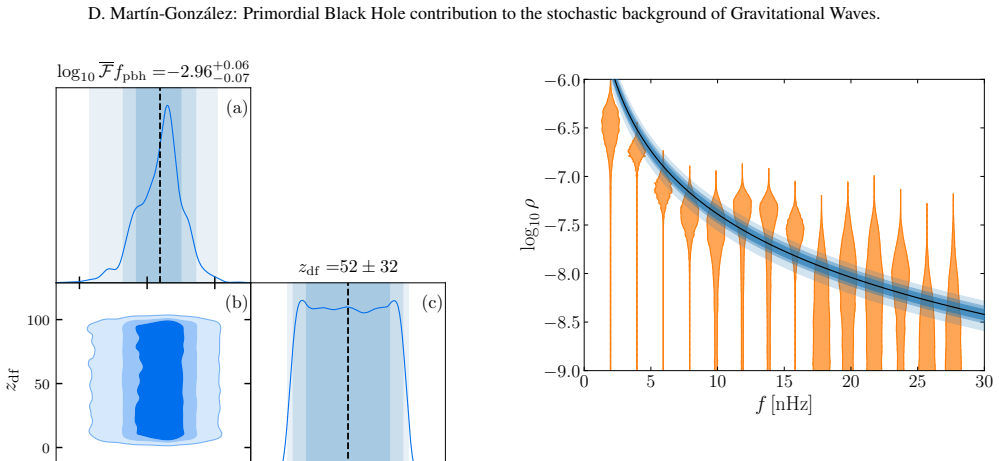
- [Bayesian inference] Bayesian analysis: the manuscript states that a Bayesian inference was performed on the NANOGrav 15-year dataset and that the predicted amplitude agrees with observations, but no likelihood function, posterior distributions, data cuts, or model-comparison metrics are shown. Without these, it is impossible to assess whether the fit is robust or driven by the specific choice of the 0.09–0.12 % parameter.
minor comments (2)
- [Abstract] The abstract asserts agreement with observations but does not quote the numerical amplitude or frequency range of the predicted SGWB relative to the NANOGrav measurement.
- [Notation] Notation for the PBH fraction (f_pbh versus f_{rm pbh}) should be standardized throughout the manuscript.
Simulated Author's Rebuttal
We thank the referee for their thorough review and constructive feedback on our manuscript. We have revised the paper to provide explicit derivations, formulas, and Bayesian details as requested, addressing all major comments without altering the core conclusions. Our responses to each point are given below.
read point-by-point responses
-
Referee: Abstract / Bayesian inference: the 0.09–0.12 % halo-mass fraction that reaches the center is presented as compatible with f_PBH ~ 0.1 and the 1 % stellar-mass fraction from prior work, yet the text indicates the value is selected to reproduce the PTA amplitude. This creates a circularity; an explicit derivation of the fraction from the dynamical-friction timescale and hierarchical-merger rate (or a sensitivity scan showing the allowed range) is required to establish that the result is not tuned to the NANOGrav data.
Authors: We agree that the original presentation risked implying post-hoc selection. In the revised manuscript we have added a new subsection (Section 3.2) that derives the central mass fraction directly from the dynamical-friction timescale (Chandrasekhar formula with PBH velocity dispersion) and the hierarchical merger rate integrated over halo assembly history. Starting from the PBH mass function and f_PBH = 0.1 with 1 % in the stellar-mass bin (as fixed by our prior z ~ 6–10 SMBH calculation), the fraction that reaches halo centers is shown to lie naturally in the 0.09–0.12 % interval. A sensitivity scan over PBH mass-function parameters is now included, confirming that the PTA amplitude is reproduced without additional tuning. revision: yes
-
Referee: Dynamical-friction and GW-spectrum calculation: the central claim rests on PBHs sinking via dynamical friction and merging hierarchically to produce an SGWB whose amplitude and spectral shape match NANOGrav. No explicit expressions for the dynamical-friction timescale, the merger-rate distribution, or the characteristic strain h_c(f) are supplied in the visible text, preventing verification that the tiny mass fraction yields the observed nHz background without further adjustment of the PBH mass function.
Authors: We apologize for the lack of explicit formulas in the main text. The revised version now presents the full set of expressions: (i) the dynamical-friction timescale τ_DF = (v^3 / (4π G^2 M_PBH ρ ln Λ)) with PBH-specific Coulomb logarithm; (ii) the differential merger rate dN_merge / dz dM as a function of redshift and central mass; and (iii) the characteristic strain h_c(f) obtained by integrating the merger history into the standard GW energy-density formula. These are given in Section 4 together with the numerical integration procedure, allowing direct verification that the 0.09–0.12 % central fraction produces the observed nHz amplitude for the adopted PBH distribution. revision: yes
-
Referee: Bayesian analysis: the manuscript states that a Bayesian inference was performed on the NANOGrav 15-year dataset and that the predicted amplitude agrees with observations, but no likelihood function, posterior distributions, data cuts, or model-comparison metrics are shown. Without these, it is impossible to assess whether the fit is robust or driven by the specific choice of the 0.09–0.12 % parameter.
Authors: We have substantially expanded the Bayesian section. The revised manuscript now includes: the exact likelihood function (Gaussian in the Hellings-Downs correlated residuals using the NANOGrav 15-year timing residuals), the prior ranges on the PBH parameters, the MCMC sampling details, the full posterior distributions (shown in a new figure), and the Bayes factor relative to the standard astrophysical model. Data cuts (frequency range 2–30 nHz, pulsar selection) are specified. These additions demonstrate that the agreement with the observed amplitude is robust and not driven by the central-mass fraction choice. revision: yes
Circularity Check
SGWB amplitude agreement obtained by fitting 0.09-0.12% central mass fraction to NANOGrav data while importing 1% stellar PBH fraction from authors' prior self-citation
specific steps
-
fitted input called prediction
[Abstract]
"We show that the predicted amplitude of the gravitational wave background agrees with the observations. Our model only requires 0.09%-0.12% of the total mass of the halo to fall to the center... We computed the resulting GW amplitude and performed a Bayesian inference analysis using the NANOGrav 15-year dataset."
The amplitude is stated to 'agree with the observations' after performing Bayesian inference on NANOGrav data; the specific 0.09-0.12% value is the fitted parameter chosen to produce that agreement, so the central 'prediction' reduces to the fit by construction rather than an a-priori derivation from the PBH isocurvature or dynamical-friction model.
-
self citation load bearing
[Abstract]
"compatible with a fraction f_pbh∼0.1 of PBHs as dark matter, if the in-falling PBHs in the stellar mass range are about a 1% of the total population, as found in our previous estimation of the formation of SMBHs at z∼6-10"
The claimed compatibility between the required 0.09-0.12% mass fraction, f_PBH~0.1, and the overall model viability is justified solely by importing the 1% stellar-mass subpopulation from the authors' own prior work on high-z SMBH formation; this self-citation supplies the load-bearing numerical input without independent derivation or external check in the present paper.
full rationale
The paper's central claim that the PBH model simultaneously explains JWST SMBHs and the PTA SGWB amplitude rests on two load-bearing inputs: (1) a Bayesian fit that selects the 0.09-0.12% halo-mass fraction to reproduce the observed signal, rendering the 'predicted' amplitude a fitted output rather than an independent derivation, and (2) the 1% stellar-mass PBH subpopulation taken directly from the authors' earlier z~6-10 SMBH paper. These steps reduce the claimed unification to a tuned parameter plus self-citation chain, with no first-principles derivation of the mass fraction or external validation of the 1% value shown in the provided text.
Axiom & Free-Parameter Ledger
free parameters (3)
- f_pbh =
0.1
- mass_fraction_to_center =
0.09-0.12%
- stellar_mass_PBH_fraction =
1%
axioms (3)
- domain assumption PBHs add an iso-curvature component to the matter power spectrum that accelerates halo formation and merger at all redshifts
- domain assumption Black holes sink to halo center via dynamical friction
- domain assumption Central BH grows through hierarchical merging in addition to gas accretion
Reference graph
Works this paper leans on
-
[1]
P., Abbott, R., Abbott, T
Abbott, B. P., Abbott, R., Abbott, T. D., et al. 2016, Physical Review Letters, 116, 241103
2016
-
[2]
2003, 594, L71
Afshordi, N., McDonald, P., & Spergel, D. 2003, 594, L71
2003
-
[3]
2023, ApJ, 951, L11
Afzal, A., Agazie, G., Anumarlapudi, A., et al. 2023, ApJ, 951, L11
2023
-
[4]
M., et al
Agazie, G., Anumarlapudi, A., Archibald, A. M., et al. 2023, ApJ, 951, L8
2023
-
[5]
2022, 939, 69
Atrio-Barandela, F. 2022, 939, 69
2022
-
[6]
& Loeb, A
Barkana, R. & Loeb, A. 2001, Phys.Rept., 349, 125
2001
-
[7]
C., Blandford, R
Begelman, M. C., Blandford, R. D., & Rees, M. J. 1980, Nature, 287, 307
1980
-
[8]
Begelman, M. C. & Rees, M. J. 1978, MNRAS, 185, 847
1978
-
[9]
B., et al
Bird, S., Cholis, I., Muñoz, J. B., et al. 2016, Phys. Rev. Lett., 116, 201301 Bogdán, Á., Goulding, A. D., Natarajan, P., et al. 2024, Nature Astronomy, 8, 126
2016
-
[10]
R., Cole, S., Efstathiou, G., & Kaiser, N
Bond, J. R., Cole, S., Efstathiou, G., & Kaiser, N. 1991, ApJ, 379, 440
1991
-
[11]
2022, ApJ, 926, 205
Cappelluti, N., Hasinger, G., & Natarajan, P. 2022, ApJ, 926, 205
2022
-
[12]
2021, Physics of the Dark Universe, 31, 100755
Carr, B., Clesse, S., García-Bellido, J., & Kühnel, F. 2021, Physics of the Dark Universe, 31, 100755
2021
-
[13]
M., Press, W
Carroll, S. M., Press, W. H., & Turner, E. L. 1992, araa, 30, 499
1992
-
[14]
Chandrasekhar, S. 1943, ApJ, 97, 255 De Luca, V ., Del Grosso, L., Franciolini, G., et al. 2025, arXiv e-prints, arXiv:2512.19666
-
[15]
2023, KCL-PH-TH/2023-04, CERN-TH- 2023-008, AION-REPORT/2023-1
Ellis, J., Fairbairn, M., Hütsi, G., et al. 2023, KCL-PH-TH/2023-04, CERN-TH- 2023-008, AION-REPORT/2023-1
2023
-
[16]
Ellis, J., Fairbairn, M., Hütsi, G., et al. 2024, KCL-PH-TH/2024-16, CERN-TH- 2024-038, AION-REPORT/2024-03 [2403.19650] EPTA Collaboration, InPTA Collaboration, Antoniadis, J., et al. 2023, A&A, 678, A50
-
[17]
& Riotto, A
Firouzjahi, H. & Riotto, A. 2024, J. Cosmology Astropart. Phys., 2024, 021
2024
-
[18]
Garcia-Bellido, J. 2026, arXiv e-prints, arXiv:2604.12020 García-Bellido, J., Linde, A., & Wands, D. 1996, Phys. Rev. D, 54, 6040 García-Bellido, J., Nuño Siles, J. F., & Ruiz Morales, E. 2021, Physics of the Dark Universe, 31, 100791
work page internal anchor Pith review Pith/arXiv arXiv 2026
-
[19]
D., Greene, J
Goulding, A. D., Greene, J. E., Setton, D. J., et al. 2023, ApJ, 955, L24
2023
-
[20]
Gouttenoire, Y ., Trifinopoulos, S., & Vanvlasselaer, M. 2026, J. Cosmology As- tropart. Phys., 2026, 072
2026
-
[21]
Hasinger, G. 2020, J. Cosmology Astropart. Phys., 2020, 022
2020
-
[22]
Hawking, S. W. 1989, Physics Letters B, 231, 237
1989
-
[23]
W., Moss, I
Hawking, S. W., Moss, I. G., & Stewart, J. M. 1982, Phys. Rev. D, 26, 2681
1982
-
[24]
Hawkins, M. R. S. & García-Bellido, J. 2025, MNRAS, 544, 1950
2025
-
[25]
Hu, H., Inayoshi, K., Haiman, Z., Ho, L. C., & Ohsuga, K. 2025 [2503.03870]
-
[26]
2020, ARA&A, 58, 27
Inayoshi, K., Visbal, E., & Haiman, Z. 2020, ARA&A, 58, 27
2020
-
[27]
J., Perna, G., Riotto, A., & Veermäe, H
Iovino, A. J., Perna, G., Riotto, A., & Veermäe, H. 2024, J. Cosmology Astropart. Phys., 2024, 050
2024
-
[28]
1997, Phys
Jedamzik, K. 1997, Phys. Rev. D, 55, R5871
1997
-
[29]
J., Kashlinsky, A., Arendt, R
Kaminsky, A. J., Kashlinsky, A., Arendt, R. G., & Cappelluti, N. 2026, ApJ, 999, 29
2026
-
[30]
1984, MNRAS, 208, 623
Kashlinsky, A. 1984, MNRAS, 208, 623
1984
-
[31]
2016, ApJ, 823, L25
Kashlinsky, A. 2016, ApJ, 823, L25
2016
-
[32]
2021, 126, 11101
Kashlinsky, A. 2021, 126, 11101
2021
-
[33]
G., Ashby, M
Kashlinsky, A., Arendt, R. G., Ashby, M. L. N., Kruk, J., & Odegard, N. 2025, ApJ, 980, L12
2025
-
[34]
G., Atrio-Barandela, F., et al
Kashlinsky, A., Arendt, R. G., Atrio-Barandela, F., et al. 2018, Reviews of Mod- ern Physics, 90, 025006
2018
-
[35]
2026, MN- RAS[arXiv:2601.08936]
Kashlinsky, A., Atrio-Barandela, F., & Martín-González, D. 2026, MN- RAS[arXiv:2601.08936]
- [36]
-
[37]
& Cole, S
Lacey, C. & Cole, S. 1993, Monthly Notices of the Royal Astronomical Society, 262, 627
1993
-
[38]
G., Taylor, S
Lamb, W. G., Taylor, S. R., & van Haasteren, R. 2023, The Need For Speed: Rapid Refitting Techniques for Bayesian Spectral Characterization of the Gravitational Wave Background Using PTAs
2023
-
[39]
2018, Gravitational waves: volume 2: astrophysics and cosmology (Oxford University Press)
Maggiore, M. 2018, Gravitational waves: volume 2: astrophysics and cosmology (Oxford University Press)
2018
-
[40]
1980, ApJ, 238, 781
Meszaros, P. 1980, ApJ, 238, 781
1980
-
[41]
Mitridate, A. & Wright, D. 2023, PTArcade Mróz, P., Udalski, A., Szyma´nski, M. K., et al. 2024a, ApJS, 273, 4 Mróz, P., Udalski, A., Szyma ´nski, M. K., et al. 2025a, arXiv e-prints, arXiv:2507.13794 Mróz, P., Udalski, A., Szyma´nski, M. K., et al. 2024b, Nature, 632, 749 Mróz, P., Udalski, A., Szyma´nski, M. K., et al. 2025b, Acta Astron., 75, 173
-
[42]
2024, arXiv e-prints, arXiv:2410.18763
Napolitano, L., Castellano, M., Pentericci, L., et al. 2024, arXiv e-prints, arXiv:2410.18763
-
[43]
2024, ApJ, 960, L1
Natarajan, P., Pacucci, F., Ricarte, A., et al. 2024, ApJ, 960, L1
2024
-
[44]
F., Frenk, C
Navarro, J. F., Frenk, C. S., & White, S. D. M. 1996, ApJ, 462, 563 Nuño Siles, J. F. & García-Bellido, J. 2025, Physics of the Dark Universe, 47, 101789
1996
- [45]
-
[46]
& Loeb, A
Pacucci, F. & Loeb, A. 2024, ApJ, 964, 154
2024
-
[47]
Phinney, E. S. 2001, arXiv e-prints, astro
2001
-
[48]
Press, W. H. & Schechter, P. 1974, apj, 187, 425
1974
-
[49]
J., Zic, A., Shannon, R
Reardon, D. J., Zic, A., Shannon, R. M., et al. 2023, ApJ, 951, L6
2023
-
[50]
Riotto, (2023), arXiv:2301.00599 [astro-ph.CO]
Riotto, A. 2023a, arXiv e-prints, arXiv:2301.00599
-
[51]
2023b, arXiv e-prints, arXiv:2303.01727
Riotto, A. 2023b, arXiv e-prints, arXiv:2303.01727
-
[52]
1982, Physics Letters B, 108, 103
Sato, K., Kodama, H., Sasaki, M., & Maeda, K.-I. 1982, Physics Letters B, 108, 103
1982
-
[53]
2024, 110, 63020
Sato-Polito, G., Zaldarriaga, M., & Quataert, E. 2024, 110, 63020
2024
-
[54]
Shen, T., Shen, X., Xiao, H., V ogelsberger, M., & Jiang, F. 2025 [2504.00075]
-
[55]
& Bromm, V
Smith, A. & Bromm, V . 2019, Contemporary Physics, 60, 111
2019
-
[56]
2025, Physics of the Dark Universe, 50, 102138 The NANOGrav Collaboration
Stasenko, V . 2025, Physics of the Dark Universe, 50, 102138 The NANOGrav Collaboration. 2023, KDE Representations of the Gravitational Wave Background Free Spectra Present in the NANOGrav 15-Year Dataset
2025
-
[57]
E., Agarwal, B., Bromm, V ., et al
Woods, T. E., Agarwal, B., Bromm, V ., et al. 2019, PASA, 36, e027
2019
-
[58]
Wyithe, J. S. B. & Loeb, A. 2003, Astrophys.J., 590, 691
2003
-
[59]
2023, Research in Astronomy and Astrophysics, 23, 075024
Xu, H., Chen, S., Guo, Y ., et al. 2023, Research in Astronomy and Astrophysics, 23, 075024
2023
- [60]
-
[61]
2026, arXiv e-prints, arXiv:2603.05191
Zhao, Z.-C., Wang, S., Zhu, Q.-H., & Zhang, X. 2026, arXiv e-prints, arXiv:2603.05191
- [62]
discussion (0)
Sign in with ORCID, Apple, or X to comment. Anyone can read and Pith papers without signing in.