Recognition: unknown
Ultrafast acoustic modulation of second-harmonic generation in monolayer transition metal dichalcogenides
Pith reviewed 2026-05-07 13:02 UTC · model grok-4.3
The pith
Surface acoustic waves dynamically modulate second-harmonic generation in monolayer materials at 226 MHz.
A machine-rendered reading of the paper's core claim, the machinery that carries it, and where it could break.
Core claim
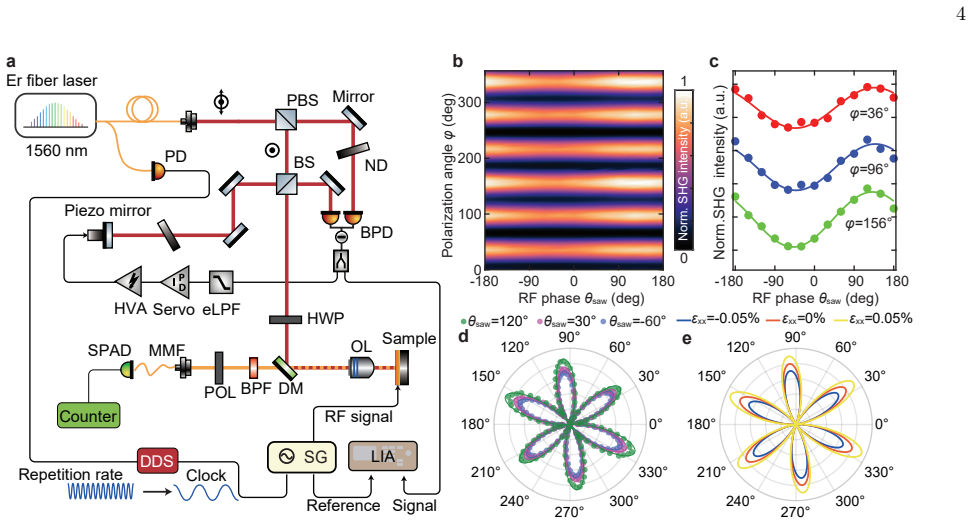
By employing a fully phase-synchronized second-harmonic measurement combined with stroboscopic surface displacement detection, the authors directly visualize dynamic modulation of second-harmonic generation at 226 MHz in monolayer transition metal dichalcogenides driven by surface acoustic waves, and use theoretical modeling to quantitatively extract the SAW-induced dynamic strain.
What carries the argument
Phase-synchronized SHG measurement with stroboscopic detection of surface displacement, which establishes the link between acoustic strain fields and optical nonlinearities through the photoelastic effect.
Load-bearing premise
The observed changes in second-harmonic generation result purely from mechanical strain induced by the surface acoustic waves, and the photoelastic model converts the optical signal to strain without interference from heating or carrier dynamics.
What would settle it
Measuring the second-harmonic modulation while blocking the acoustic wave generation but maintaining similar optical excitation conditions, and finding no modulation would support the claim; persistent modulation would indicate other effects at play.
Figures



read the original abstract
High-speed modulation and deterministic control of optical nonlinear processes in nanomaterials are essential for realizing future nanoscale optoelectronic devices. Applying strain is a ubiquitous and versatile approach to deform atomically thin materials, allowing direct modification of their electronic and optical properties. Yet, strain engineering of nonlinear processes has so far relied predominantly on static approaches, which inherently limit modulation speed, reproducibility, and device scalability. Here, we demonstrate ultrafast acoustic modulation of second-harmonic (SH) generation in monolayer transition metal dichalcogenides using surface acoustic waves (SAWs). By employing a fully phase-synchronized SH measurement combined with stroboscopic surface displacement detection, we directly visualize dynamic SH modulation at a frequency of 226 MHz. Moreover, theoretical modeling and determination of photoelastic coefficients enable quantitative extraction of the SAW-induced dynamic strain. Our results establish a direct link between acoustic fields and optical nonlinearities, providing a robust platform for dynamic strain engineering in two-dimensional nanophotonic devices.
Editorial analysis
A structured set of objections, weighed in public.
Referee Report
Summary. The manuscript demonstrates ultrafast acoustic modulation of second-harmonic generation (SHG) in monolayer transition metal dichalcogenides (TMDs) using surface acoustic waves (SAWs) at 226 MHz. By combining fully phase-synchronized SH measurements with stroboscopic surface displacement detection, the authors claim to directly visualize the dynamic SH modulation and, through theoretical modeling and determination of photoelastic coefficients, quantitatively extract the SAW-induced dynamic strain.
Significance. If the central claims hold after addressing controls and data presentation, the work would establish a direct experimental link between high-frequency acoustic strain and optical nonlinearities in 2D materials. This could provide a scalable platform for dynamic strain engineering in nanophotonic devices, moving beyond static strain approaches. The phase-synchronized stroboscopic method is a technical strength that enables the high-frequency visualization.
major comments (3)
- [Results] Results section (around the description of the 226 MHz modulation): the claim of direct visualization and quantitative extraction lacks accompanying raw time traces, error bars on modulation amplitude, or statistical measures of reproducibility; without these, the signal-to-noise and robustness against noise or drift cannot be evaluated.
- [Theoretical Modeling] Modeling and photoelastic coefficient determination (likely in the theoretical analysis section): it is unclear whether the photoelastic coefficients are obtained from independent measurements or fitted to the same SH modulation data used for the strain extraction; if the latter, the quantitative link between acoustic displacement and SH signal becomes circular and the strain values are not independently validated.
- [Discussion] Experimental controls and discussion of mechanisms: the assumption that the observed SH modulation arises solely from SAW-induced strain (via the photoelastic effect) is load-bearing for the central claim, yet no explicit checks or control experiments are described to rule out contributions from heating, carrier dynamics, or other photo-induced effects at the 226 MHz frequency.
minor comments (2)
- [Figures] Figure captions and axis labels should explicitly state the modulation frequency, phase synchronization details, and any averaging performed to aid reproducibility.
- [Abstract and Introduction] The abstract and introduction could more precisely define the SAW wavelength and device geometry to contextualize the 226 MHz frequency.
Simulated Author's Rebuttal
We thank the referee for their positive evaluation of the significance of our work and for the constructive comments that help strengthen the manuscript. We have revised the paper to address concerns about data presentation, modeling details, and experimental controls, as detailed in our point-by-point responses below.
read point-by-point responses
-
Referee: [Results] Results section (around the description of the 226 MHz modulation): the claim of direct visualization and quantitative extraction lacks accompanying raw time traces, error bars on modulation amplitude, or statistical measures of reproducibility; without these, the signal-to-noise and robustness against noise or drift cannot be evaluated.
Authors: We agree that raw data and statistical measures are necessary to fully substantiate the claims. In the revised manuscript we have added raw time traces of the phase-synchronized SHG signal over multiple SAW cycles as Supplementary Figure S1. Error bars (standard error from five independent runs) are now shown on the modulation-amplitude data in Figure 3, and a new paragraph in the Results section reports the signal-to-noise ratio (SNR > 10) together with reproducibility statistics across devices and samples. revision: yes
-
Referee: [Theoretical Modeling] Modeling and photoelastic coefficient determination (likely in the theoretical analysis section): it is unclear whether the photoelastic coefficients are obtained from independent measurements or fitted to the same SH modulation data used for the strain extraction; if the latter, the quantitative link between acoustic displacement and SH signal becomes circular and the strain values are not independently validated.
Authors: The photoelastic coefficients were obtained from independent static-strain calibration measurements on monolayer TMDs (detailed in the Methods section and cross-referenced to prior literature). These fixed values were then inserted into the dynamic model, while the SAW displacement amplitude was taken directly from the stroboscopic interferometry data. To eliminate any residual concern, the revised supplementary information now includes a sensitivity analysis of the extracted strain with respect to the photoelastic coefficients and a direct comparison with finite-element simulations of the SAW strain field. revision: partial
-
Referee: [Discussion] Experimental controls and discussion of mechanisms: the assumption that the observed SH modulation arises solely from SAW-induced strain (via the photoelastic effect) is load-bearing for the central claim, yet no explicit checks or control experiments are described to rule out contributions from heating, carrier dynamics, or other photo-induced effects at the 226 MHz frequency.
Authors: We have expanded the Discussion section with a dedicated subsection on mechanism validation. New control data (Supplementary Figure S3) include: (i) power-dependent measurements showing negligible change in modulation depth, (ii) SHG traces recorded with and without SAW excitation, and (iii) time-resolved photoluminescence measurements confirming that carrier-dynamics contributions are negligible at 226 MHz. These controls support that the observed modulation is dominated by the photoelastic response to SAW strain. revision: yes
Circularity Check
No significant circularity
full rationale
The paper's derivation chain centers on an experimental visualization of 226 MHz SH modulation via fully phase-synchronized SH measurement combined with stroboscopic surface displacement detection. This is a direct observational method that does not reduce to fitted parameters or self-referential definitions. Quantitative strain extraction is enabled by separate theoretical modeling and determination of photoelastic coefficients, presented as an independent step that converts the observed optical signal into strain values. No self-definitional equations, fitted inputs renamed as predictions, load-bearing self-citations, or ansatz smuggling appear in the provided abstract or description. The central claim remains self-contained and externally falsifiable through the timing synchronization and displacement detection, yielding an independent link between acoustic fields and nonlinear optics.
Axiom & Free-Parameter Ledger
free parameters (1)
- photoelastic coefficient
axioms (1)
- domain assumption SAW-induced lattice deformation is the sole cause of the observed SH modulation
Reference graph
Works this paper leans on
-
[1]
S.; Geim, A
Novoselov, K. S.; Geim, A. K.; Morozov, S. V.; Jiang, D.; Zhang, Y.; Dubonos, S. V.; Grigorieva, I. V.; Firsov, A. A. Electric Field Effect in Atomically Thin Carbon Films.Science2004,306, 666–669
-
[2]
Nonlinear Optics with 2D Layered Materials
Autere, A.; Jussila, H.; Dai, Y.; Wang, Y.; Lipsanen, H.; Sun, Z. Nonlinear Optics with 2D Layered Materials. Adv. Mater.2018,30, 1705963
2018
-
[3]
Nonlinear optical properties and applications of 2D materials: theoretical and experimental aspects.Proc
You, J.; Bongu, S.; Bao, Q.; Panoiu, N. Nonlinear optical properties and applications of 2D materials: theoretical and experimental aspects.Proc. Spie.2019,8, 63–97
2019
-
[4]
M.; Lou, J.; Zhao, H
Kumar, N.; Najmaei, S.; Cui, Q.; Ceballos, F.; Ajayan, P. M.; Lou, J.; Zhao, H. Second harmonic mi- croscopy of monolayer MoS 2.Phys. Rev. B2013,87, 161403
-
[5]
F.; You, Y.; Wang, S.; Dean, C
Li, Y.; Rao, Y.; Mak, K. F.; You, Y.; Wang, S.; Dean, C. R.; Heinz, T. F. Probing Symmetry Proper- ties of Few-Layer MoS 2 and h-BN by Optical Second- Harmonic Generation.Nano Lett.2013,13, 3329–3333
2013
-
[6]
M.; Alencar, T
Malard, L. M.; Alencar, T. V.; Barboza, A. P. M.; Mak, K. F.; de Paula, A. M. Observation of intense second harmonic generation from MoS 2 atomic crystals. Phys. Rev. B2013,87, 201401
-
[7]
Fang, N.; Yamashita, D.; Fujii, S.; Otsuka, K.; Taniguchi, T.; Watanabe, K.; Nagashio, K.; Kato, Y. K. Quantization of Mode Shifts in Nanocavities Integrated with Atomically Thin Sheets.Adv. Opt. Mater.2022,10, 2200538
2022
-
[8]
F.; Kato, Y
Fujii, S.; Fang, N.; Yamashita, D.; Kozawa, D.; Fong, C. F.; Kato, Y. K. van der Waals Decoration of Ultra-High-Q Silica Microcavities forχ (2)-χ(3) Hybrid Nonlinear Photonics.Nano Lett.2024,24, 4209–4216
2024
-
[9]
Zuo, Y. et al. Optical fibres with embedded two- dimensional materials for ultrahigh nonlinearity.Nat. Nanotechnol.2020,15, 987–991
2020
-
[10]
Q.; Najafidehaghani, E.; Gan, Z.; Khaz- aee, S.; Siems, M
Ngo, G. Q.; Najafidehaghani, E.; Gan, Z.; Khaz- aee, S.; Siems, M. P.; George, A.; Schartner, E. P.; Nolte, S.; Ebendorff-Heidepriem, H.; Pertsch, T.; Tu- niz, A.; Schmidt, M. A.; Peschel, U.; Turchanin, A.; Eilenberger, F. In-fibre second-harmonic generation with embedded two-dimensional materials.Nat. Photonics 2022,16, 769–776
2022
-
[11]
S.; Choi, D.-Y.; Vincenti, M
Chen, H.; Corboliou, V.; Solntsev, A. S.; Choi, D.-Y.; Vincenti, M. A.; de Ceglia, D.; de Angelis, C.; Lu, Y.; Ne- shev, D. N. Enhanced second-harmonic generation from two-dimensional MoSe2 on a silicon waveguide.Light Sci. Appl.2017,6, e17060–e17060
2017
-
[12]
H.; Yang, B.; Amontree, J.; Zhang, S.; Hone, J.; Dean, C
Mooshammer, F.; Xu, X.; Trovatello, C.; Peng, Z. H.; Yang, B.; Amontree, J.; Zhang, S.; Hone, J.; Dean, C. R.; Schuck, P. J.; Basov, D. N. Enabling Waveguide Optics in Rhombohedral-Stacked Transition Metal Dichalco- genides with Laser-Patterned Grating Couplers.ACS Nano2024,18, 4118–4130
-
[13]
A.; Wee, A
Wang, Z.; Dong, Z.; Zhu, H.; Jin, L.; Chiu, M.-H.; Li, L.-J.; Xu, Q.-H.; Eda, G.; Maier, S. A.; Wee, A. T. S.; Qiu, C.-W.; Yang, J. K. W. Selectively Plasmon- Enhanced Second-Harmonic Generation from Monolayer 8 Tungsten Diselenide on Flexible Substrates.ACS Nano 2018,12, 1859–1867
2018
-
[14]
All-optical polarization and amplitude modulation of second-harmonic genera- tion in atomically thin semiconductors.Nat
Klimmer, S.; Ghaebi, O.; Gan, Z.; George, A.; Tur- chanin, A.; Cerullo, G.; Soavi, G. All-optical polarization and amplitude modulation of second-harmonic genera- tion in atomically thin semiconductors.Nat. Photonics 2021,15, 837–842
2021
-
[15]
Quan- tum sensing with optically accessible spin defects in van der Waals layered materials.Light Sci
Fang, H.-H.; Wang, X.-J.; Marie, X.; Sun, H.-B. Quan- tum sensing with optically accessible spin defects in van der Waals layered materials.Light Sci. Appl.2024,13, 303
2024
-
[16]
Nonlinear valley se- lection rules and all-optical probe of broken time-reversal symmetry in monolayerW Se 2.Nat
Herrmann, P.; Klimmer, S.; Lettau, T.; Weickhardt, T.; Papavasileiou, A.; Mosina, K.; Sofer, Z.; Paradisanos, I.; Kartashov, D.; Wilhelm, J.; Soavi, G. Nonlinear valley se- lection rules and all-optical probe of broken time-reversal symmetry in monolayerW Se 2.Nat. Photonics2025,19, 300–306
-
[17]
V.; Kartashov, D.; Peschel, U.; Wilhelm, J.; Neshev, D.; Soavi, G
Klimmer, S.; Lettau, T.; Molina, L. V.; Kartashov, D.; Peschel, U.; Wilhelm, J.; Neshev, D.; Soavi, G. Probing Ultrafast Coherent Bandgap Modulation in Monolayer W Se2 by Nonlinear Optics.Adv. Opt. Mater.2026,14, e03236
2026
-
[18]
Second Harmonic Generation from Artificially Stacked Transition Metal Dichalcogenide Twisted Bilayers.ACS Nano2014,8, 2951–2958
Hsu, W.-T.; Zhao, Z.-A.; Li, L.-J.; Chen, C.-H.; Chiu, M.-H.; Chang, P.-S.; Chou, Y.-C.; Chang, W.-H. Second Harmonic Generation from Artificially Stacked Transition Metal Dichalcogenide Twisted Bilayers.ACS Nano2014,8, 2951–2958
-
[19]
L.; Schaibley, J
Seyler, K. L.; Schaibley, J. R.; Gong, P.; Rivera, P.; Jones, A. M.; Wu, S.; Yan, J.; Mandrus, D. G.; Yao, W.; Xu, X. Electrical control of second-harmonic generation in a WSe2 monolayer transistor.Nat. Nanotechnol.2015, 10, 407–411
2015
-
[20]
C.; Glazov, M
Shree, S.; Lagarde, D.; Lombez, L.; Robert, C.; Baloc- chi, A.; Watanabe, K.; Taniguchi, T.; Marie, X.; Ger- ber, I. C.; Glazov, M. M.; Golub, L. E.; Urbaszek, B.; Paradisanos, I. Interlayer exciton mediated second har- monic generation in bilayer MoS 2.Nat. Commun.2021, 12, 6894
2021
-
[21]
Wang, Y. et al. Giant All-Optical Modulation of Second- Harmonic Generation Mediated by Dark Excitons.ACS Photonics2021,8, 2320–2328
-
[22]
J.; Lei, D
Peng, Z.; Chen, X.; Fan, Y.; Srolovitz, D. J.; Lei, D. Strain engineering of 2D semiconductors and graphene: from strain fields to band-structure tuning and photonic applications.Light Sci. Appl.2020,9, 190
2020
-
[23]
Second harmonic gen- eration in strained transition metal dichalcogenide mono- layers: MoS 2, MoSe 2, WS 2, and WSe 2.APL Photonics 2018,4, 034404
Mennel, L.; Paur, M.; Mueller, T. Second harmonic gen- eration in strained transition metal dichalcogenide mono- layers: MoS 2, MoSe 2, WS 2, and WSe 2.APL Photonics 2018,4, 034404
2018
-
[24]
M.; Mouchliadis, L.; Michail, A.; Christodoulides, J
Kourmoulakis, G.; Psilodimitrakopoulos, S.; Maragkakis, G. M.; Mouchliadis, L.; Michail, A.; Christodoulides, J. A.; Tripathi, M.; Dalton, A. B.; Parthenios, J.; Papagelis, K.; Stratakis, E.; Kioseoglou, G. Strain distribution in WS 2 mono- layers detected through polarization-resolved second harmonic generation.Sci. Rep.2024,14, 15159
2024
-
[25]
Quantifying the in-plane strain influence on second harmonic genera- tion of molybdenum disulfide.Commun
Xing, H.; Liu, J.; Zhao, Z.; He, X.; Qiu, W. Quantifying the in-plane strain influence on second harmonic genera- tion of molybdenum disulfide.Commun. Phys.2024,7, 382
2024
-
[26]
Atomically phase- matched second-harmonic generation in a 2D crystal
Zhao, M.; Ye, Z.; Suzuki, R.; Ye, Y.; Zhu, H.; Xiao, J.; Wang, Y.; Iwasa, Y.; Zhang, X. Atomically phase- matched second-harmonic generation in a 2D crystal. Light Sci. Appl.2016,5, e16131–e16131
2016
-
[27]
Tunable-Diameter Nanoscrolls from Janus WSSe/WSe 2 Heterostructures.ACS Nano2025,19, 34918–34927
Kaneda, M.; Zhang, W.; Bi, D.; Sun, T.; Ogura, H.; Endo, T.; Takahashi, Y.; Fujii, S.; Kato, T.; Miyata, Y. Tunable-Diameter Nanoscrolls from Janus WSSe/WSe 2 Heterostructures.ACS Nano2025,19, 34918–34927
-
[28]
T.; Gon¸ calves, P
Reserbat-Plantey, A.; Epstein, I.; Torre, I.; Costa, A. T.; Gon¸ calves, P. A. D.; Mortensen, N. A.; Polini, M.; Song, J. C. W.; Peres, N. M. R.; Koppens, F. H. L. Quan- tum Nanophotonics in Two-Dimensional Materials.ACS Photonics2021,8, 85–101
-
[29]
Datta, K.; Li, Z.; Lyu, Z.; Deotare, P. B. Piezoelectric Modulation of Excitonic Properties in Monolayer WSe 2 under Strong Dielectric Screening.ACS Nano2021,15, 12334–12341
-
[30]
Datta, K.; Lyu, Z.; Li, Z.; Taniguchi, T.; Watan- abe, K.; Deotare, P. B. Spatiotemporally controlled room-temperature exciton transport under dynamic strain.Nat. Photonics2022,16, 242–247
-
[31]
Nysten, E. D. S.; Weiß, M.; Mayer, B.; Pet- zak, T. M.; Wurstbauer, U.; Krenner, H. J. Scan- ning Acousto-Optoelectric Spectroscopy on a Transition Metal Dichalcogenide Monolayer.Adv. Mater.2024,36, 2402799
2024
-
[32]
Liang, J. et al. Monitoring Local Strain Vector in Atomic- Layered MoS 2 by Second-Harmonic Generation.Nano Lett.2017,17, 7539–7543
2017
-
[33]
J.; Peng, B.; Song, P.; Cheng, J.; Kuo, J.; Lal, A.; Zhang, W.-M.; Gorman, J
Shao, L.; Gokhale, V. J.; Peng, B.; Song, P.; Cheng, J.; Kuo, J.; Lal, A.; Zhang, W.-M.; Gorman, J. J. Femtometer-amplitude imaging of coherent super high frequency vibrations in micromechanical resonators.Nat. Commun.2022,13, 694
2022
-
[34]
Spatiotemporal visualization of a surface acous- tic wave coupled to magnons across a submillimeter-long sample by pulsed laser interferometry.Phys
Maezawa, K.; Fujii, S.; Yamanoi, K.; Nozaki, Y.; Watan- abe, S. Spatiotemporal visualization of a surface acous- tic wave coupled to magnons across a submillimeter-long sample by pulsed laser interferometry.Phys. Rev. Appl. 2024,21, 044047
2024
-
[35]
L.; Dadoenkova, N
Lyubchanskii, I. L.; Dadoenkova, N. N.; Lyubchan- skii, M. I.; Rasing, T.; Jeong, J.-W.; Shin, S.-C. Second- harmonic generation from realistic film–substrate inter- faces: The effects of strain.Appl. Phys. Lett.2000,76, 1848–1850
2000
-
[36]
M.; Wachter, S.; Paur, M.; Polyushkin, D
Mennel, L.; Furchi, M. M.; Wachter, S.; Paur, M.; Polyushkin, D. K.; Mueller, T. Optical imaging of strain in two-dimensional crystals.Nat. Commun.2018,9, 516
2018
-
[37]
Wei, P.Theory of elastic waves; Springer, 2022
2022
-
[38]
Room-Temperature Chiral Light-Emitting Diode Based on Strained Monolayer Semiconductors
Pu, J.; Zhang, W.; Matsuoka, H.; Kobayashi, Y.; Tak- aguchi, Y.; Miyata, Y.; Matsuda, K.; Miyauchi, Y.; Takenobu, T. Room-Temperature Chiral Light-Emitting Diode Based on Strained Monolayer Semiconductors. Adv. Mater.2021,33, 2100601
2021
-
[39]
Guan, Z.; Xu, Y.; Li, J.; Peng, Z.; Lei, D.; Srolovitz, D. J. Strain-induced giant second-order susceptibility in mono- layer WSe2.Phys. Rev. B2025,111, 245423
-
[40]
S.; Bur- gos, J
Lazi´ c, S.; Espinha, A.; Pinilla Yanguas, S.; Gibaja, C.; Zamora, F.; Ares, P.; Chhowalla, M.; Paz, W. S.; Bur- gos, J. J. P.; Hern´ andez-M´ ınguez, A.; Santos, P. V.; van der Meulen, H. P. Dynamically tuned non-classical light emission from atomic defects in hexagonal boron nitride.Commun. Phys.2019,2, 113
2019
-
[41]
A.; Liu, Q.; Li, M
Li, H.; Tadesse, S. A.; Liu, Q.; Li, M. Nanophotonic cavity optomechanics with propagating acoustic waves at frequencies up to 12 GHz.Optica2015,2, 826–831
-
[42]
I.; Banerjee, K.; Moody, G
Parto, K.; Azzam, S. I.; Banerjee, K.; Moody, G. De- fect and strain engineering of monolayer WSe 2 enables site-controlled single-photon emission up to 150 K.Nat. 9 Commun.2021,12, 3585. [43] Weissflog, M. A. et al. A tunable transition metal dichalcogenide entangled photon-pair source.Nat. Com- mun.2024,15, 7600
2021
discussion (0)
Sign in with ORCID, Apple, or X to comment. Anyone can read and Pith papers without signing in.