Recognition: unknown
A Fast Model Counting Algorithm for Two-Variable Logic with Counting and Modulo Counting Quantifiers
Pith reviewed 2026-05-07 13:42 UTC · model grok-4.3
The pith
Direct operation on Scott normal form reduces WFOMC data complexity in C² from quadratic to linear in counting parameters and proves domain-liftability for modulo counting.
A machine-rendered reading of the paper's core claim, the machinery that carries it, and where it could break.
Core claim
IncrementalWFOMC3 computes the weighted sum of models for C² sentences by processing their Scott normal form directly and retaining counting quantifiers throughout inference; this yields data complexity linear in the counting parameters. The approach further proves that C²_mod, the extension that includes modulo counting quantifiers, is domain-liftable.
What carries the argument
IncrementalWFOMC3 operating directly on Scott normal form while retaining counting quantifiers throughout inference.
If this is right
- WFOMC for C² has data complexity linear rather than quadratic in the counting parameters.
- C²_mod is domain-liftable, so WFOMC remains polynomial in domain size for the modulo extension.
- The algorithm avoids the overhead of prior reduction steps and therefore runs faster in practice.
- It scales better than both earlier WFOMC procedures and state-of-the-art propositional counters.
Where Pith is reading between the lines
- Implementations of other lifted-inference tasks may similarly benefit from keeping quantifiers native instead of compiling them away.
- The linear dependence on counting parameters could allow the method to handle larger parameter values arising in statistical relational models.
- Similar direct-treatment strategies might extend tractability results to additional fragments containing other kinds of numeric quantifiers.
Load-bearing premise
That direct processing of Scott normal form while retaining counting quantifiers preserves correctness and produces the claimed polynomial bound without introducing hidden exponential costs.
What would settle it
An exhaustive enumeration on a small domain for a C² sentence with counting parameter k greater than 5 that yields a weighted count different from the output of IncrementalWFOMC3.
Figures




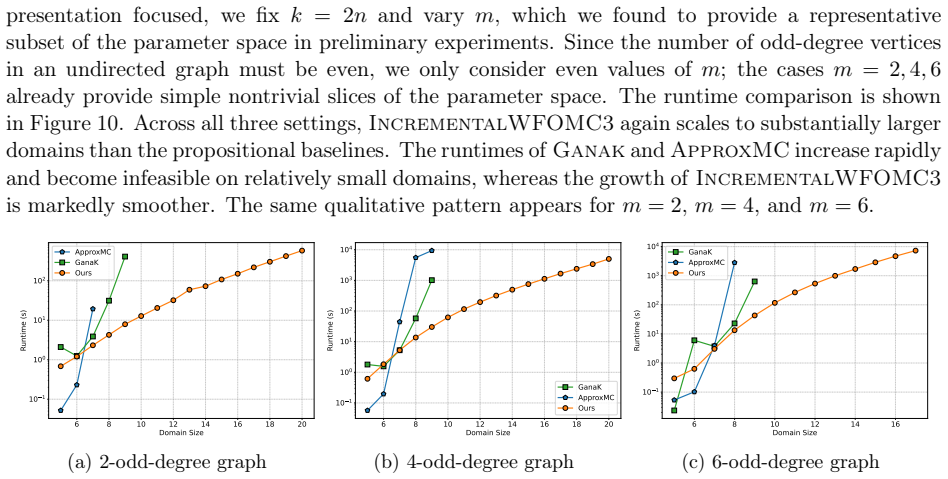


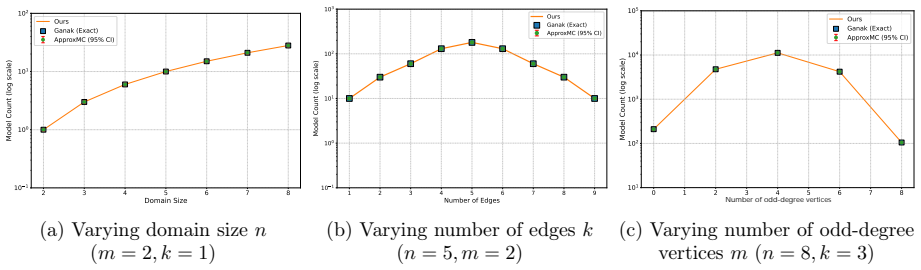
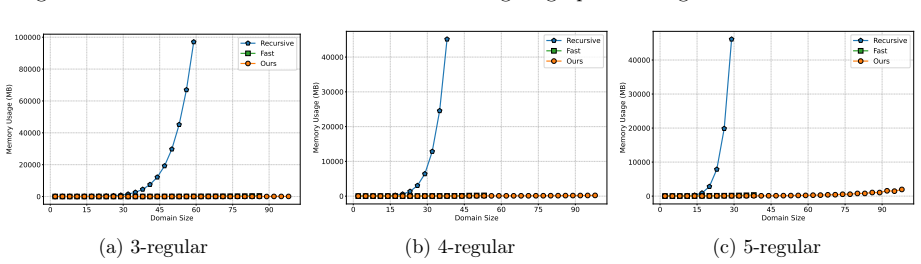
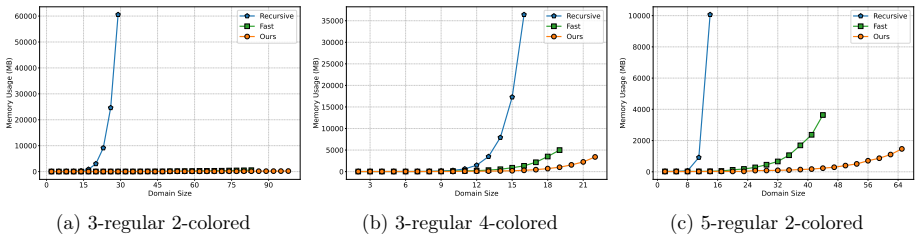

read the original abstract
Weighted first-order model counting (WFOMC) is a central task in lifted probabilistic inference: It asks for the weighted sum of all models of a first-order sentence over a finite domain. A long line of work has identified domain-liftable fragments of first-order logic, that is, syntactic classes for which WFOMC can be solved in time polynomial in the domain size. Among them, the two-variable fragment with counting quantifiers, $\mathbf{C}^2$, is one of the most expressive known liftable fragments. Existing algorithms for $\mathbf{C}^2$, however, establish tractability through multi-stage reductions that eliminate counting quantifiers via cardinality constraints, which introduces substantial practical overhead as the domain size grows. In this paper, we introduce IncrementalWFOMC3, a lifted algorithm for WFOMC on $\mathbf{C}^2$ and its modulo counting extension, $\mathbf{C}^2_{\text{mod}}$. Instead of relying on reduction techniques, IncrementalWFOMC3 operates directly on a Scott normal form that retains counting quantifiers throughout inference. This direct treatment yields two main results. First, we derive a tighter data-complexity bound for WFOMC in $\mathbf{C}^2$, reducing the degree of the polynomial from quadratic to linear in the counting parameters. Second, we prove that $\mathbf{C}^2_{\text{mod}}$ is domain-liftable, extending tractability from $\mathbf{C}^2$ to a richer fragment with native modulo counting support. Finally, our empirical evaluation shows that IncrementalWFOMC3 delivers orders-of-magnitude runtime improvements and better scalability than both existing WFOMC algorithms and state-of-the-art propositional model counters.
Editorial analysis
A structured set of objections, weighed in public.
Referee Report
Summary. The paper introduces IncrementalWFOMC3, a lifted algorithm for weighted first-order model counting (WFOMC) on the two-variable fragment with counting quantifiers (C²) and its modulo extension (C²_mod). It operates directly on Scott normal form retaining counting quantifiers, deriving a tighter data-complexity bound reducing the polynomial degree from quadratic to linear in counting parameters for C², proving domain-liftability for C²_mod, and showing empirical runtime improvements over existing methods.
Significance. If the central claims hold, this work would advance lifted probabilistic inference by providing a more efficient algorithm for an expressive fragment, with a strictly improved complexity bound and an extension to native modulo counting. The direct treatment of quantifiers avoids reduction overhead, and the empirical gains suggest practical impact for applications in AI reasoning.
major comments (2)
- [§4] §4 (Complexity Analysis): The claim of a linear (rather than quadratic) data-complexity bound for WFOMC in C² rests on the incremental DP maintaining state space and transition costs that scale linearly with individual counting bounds; the manuscript must explicitly show that no pairwise cardinality convolutions or products arise when combining multiple retained ∃^{=k} atoms in the Scott normal form representation.
- [§5] §5 (Liftability Proof): The proof that C²_mod is domain-liftable is described as existing but only outlined; because this is one of the two main results and extends tractability to a richer fragment, the full derivation is required to confirm absence of hidden exponential factors in the handling of modulo counting quantifiers.
minor comments (2)
- [Empirical Evaluation] The empirical evaluation should include implementation details (e.g., data structures for the incremental DP and exact counting-parameter ranges tested) to support reproducibility of the reported runtime improvements.
- [Preliminaries] Notation for the modulo counting quantifiers in the definition of C²_mod should be clarified with an explicit example sentence to avoid ambiguity with standard counting quantifiers.
Simulated Author's Rebuttal
We thank the referee for the constructive comments, which help strengthen the presentation of our results on IncrementalWFOMC3. We address each major comment below and will revise the manuscript accordingly.
read point-by-point responses
-
Referee: [§4] §4 (Complexity Analysis): The claim of a linear (rather than quadratic) data-complexity bound for WFOMC in C² rests on the incremental DP maintaining state space and transition costs that scale linearly with individual counting bounds; the manuscript must explicitly show that no pairwise cardinality convolutions or products arise when combining multiple retained ∃^{=k} atoms in the Scott normal form representation.
Authors: We agree that an explicit argument is needed to confirm the absence of pairwise convolutions. In the incremental DP of Section 4, each retained ∃^{=k} atom is processed sequentially: the state vector tracks the cumulative count for the current quantifier independently of prior ones, and transitions update a single dimension at a time via additive increments. Because the Scott normal form atoms are independent in their cardinality constraints, no convolution or product between pairs of counting bounds is performed; the overall cost remains linear in the sum of the individual bounds. We will add a dedicated lemma (with a short inductive argument) in the revised Section 4 to make this separation explicit and thereby rigorously establish the linear data-complexity bound. revision: yes
-
Referee: [§5] §5 (Liftability Proof): The proof that C²_mod is domain-liftable is described as existing but only outlined; because this is one of the two main results and extends tractability to a richer fragment, the full derivation is required to confirm absence of hidden exponential factors in the handling of modulo counting quantifiers.
Authors: We concur that the domain-liftability proof for C²_mod merits a complete, self-contained derivation. The outline in Section 5 indicates that modulo constraints are incorporated by extending the DP state with a constant-size residue tracker per quantifier, preserving polynomial dependence on domain size. In the revised manuscript we will expand this into a full proof: we first reduce C²_mod sentences to an equivalent Scott normal form, then show by induction on formula structure that the incremental DP computes the weighted count in time polynomial in the domain size, with the modulo operations contributing only a linear factor in the state space and no exponential blow-up. All intermediate lemmas and the final complexity statement will be included. revision: yes
Circularity Check
No circularity: linear bound and liftability follow from direct analysis of IncrementalWFOMC3 on Scott normal form
full rationale
The paper presents IncrementalWFOMC3 as a new algorithm that retains counting quantifiers in Scott normal form and analyzes its data complexity directly. The reduction from quadratic to linear degree in counting parameters and the domain-liftability of C²_mod are obtained by bounding the state space and transitions of this incremental procedure. No equation or claim reduces by construction to a fitted parameter, a self-defined quantity, or a load-bearing self-citation; the arguments rely on standard dynamic-programming size analysis applied to the retained quantifiers. The derivation is therefore self-contained against external complexity benchmarks.
Axiom & Free-Parameter Ledger
axioms (2)
- domain assumption Every C² sentence can be converted to an equivalent Scott normal form that retains counting quantifiers.
- standard math Weighted model counting over finite domains is well-defined for the given weight functions.
Reference graph
Works this paper leans on
-
[1]
Statistical mechanics of complex networks
Réka Albert and Albert-László Barabási. Statistical mechanics of complex networks.Rev. Mod. Phys., 74:47–97, Jan 2002. doi: 10.1103/RevModPhys.74.47
-
[2]
Kostylev, Mikaël Monet, Jorge Pérez, Juan L
Pablo Barceló, Egor V. Kostylev, Mikaël Monet, Jorge Pérez, Juan L. Reutter, and Juan Pablo Silva. The logical expressiveness of graph neural networks. In8th International Conference on Learning Representations, ICLR 2020, Addis Ababa, Ethiopia, April 26-30, 2020. OpenRe- view.net, 2020. URLhttps://openreview.net/forum?id=r1lZ7AEKvB
2020
-
[3]
Symmetric weighted first- order model counting
Paul Beame, Guy Van den Broeck, Eric Gribkoff, and Dan Suciu. Symmetric weighted first- order model counting. InProceedings of the 34th ACM SIGMOD-SIGACT-SIGAI Symposium on Principles of Database Systems, volume 31 ofSIGMOD/PODS’15, pages 313–328, Mel- bourne Victoria Australia, May 2015. ACM. ISBN 9781450327572. doi: 10.1145/2745754. 2745760. URLhttp://d...
-
[4]
Modulo counting on words and trees
Bartosz Bednarczyk and Witold Charatonik. Modulo counting on words and trees. In Satya V. Lokam and R. Ramanujam, editors,37th IARCS Annual Conference on Foundations of Soft- ware Technology and Theoretical Computer Science, FSTTCS 2017, Kanpur, India, December 11-15, 2017, LIPIcs, pages 12:1–12:16. Schloss Dagstuhl - Leibniz-Zentrum für Informatik,
2017
-
[5]
URLhttps://drops.dagstuhl.de/entities/ document/10.4230/LIPIcs.FSTTCS.2017.12
doi: 10.4230/LIPICS.FSTTCS.2017.12. URLhttps://drops.dagstuhl.de/entities/ document/10.4230/LIPIcs.FSTTCS.2017.12
-
[6]
Two variable logic with ultimately periodic counting.SIAM Journal on Computing, 53(4):884–968, 2024
Michael Benedikt, Egor V Kostylev, and Tony Tan. Two variable logic with ultimately periodic counting.SIAM Journal on Computing, 53(4):884–968, 2024. doi: 10.1137/22M1504792. URL https://doi.org/10.1137/22m1504792
-
[7]
Open-world probabilistic databases: Semantics, algorithms, complexity.Artif
İsmail İlkan Ceylan, Adnan Darwiche, and Guy Van den Broeck. Open-world probabilistic databases: Semantics, algorithms, complexity.Artif. Intell., 295:103474, June 2021. doi: 10.1016/j.artint.2021.103474
-
[8]
Meel, and Moshe Y
Supratik Chakraborty, Kuldeep S. Meel, and Moshe Y. Vardi. A scalable approximate model counter. In Christian Schulte, editor,Principles and Practice of Constraint Pro- gramming - 19th International Conference, CP 2013, Uppsala, Sweden, September 16-20,
2013
-
[9]
Proceedings, Lecture Notes in Computer Science, pages 200–216. Springer, 2013. doi: 10.1007/978-3-642-40627-0\_18. URLhttps://doi.org/10.1007/978-3-642-40627-0_18
-
[10]
Sampling regular graphs and a peer-to- peer network.Comb
Colin Cooper, Martin Dyer, and Catherine Greenhill. Sampling regular graphs and a peer-to- peer network.Comb. Probab. Comput., 16(4):557–593, 2007. doi: 10.1017/S0963548306007978. URLhttps://doi.org/10.1017/S0963548306007978
-
[11]
Amsterdam University Press
Jörg Flum, Erich Grädel, and Thomas Wilke, editors.Logic and Automata: History and Perspectives [in Honor of Wolfgang Thomas], volume 2 ofTexts in Logic and Games, 2008. Amsterdam University Press. ISBN 978-90-5356-576-6. 27
2008
-
[12]
Pu Gao and Nicholas C. Wormald. Uniform generation of random regular graphs.SIAM J. Comput., 46(4):1395–1427, 2017. doi: 10.1137/15M1052779. URLhttps://doi.org/10.1137/ 15M1052779
-
[13]
Lise Getoor and Ben Taskar.Introduction to statistical relational learning. MIT press, 2007. doi: 10.7551/mitpress/7432.001.0001
-
[14]
On the decision problem for two-variable first-order logic , journal =
Erich Grädel, Phokion G Kolaitis, and Moshe Y Vardi. On the decision problem for two-variable first-order logic.Bulletin of Symbolic Logic, 3(1):53–69, 1997. doi: 10.2307/421196
-
[15]
Two-variable logic with counting is decidable
Erich Grädel, Martin Otto, and Eric Rosen. Two-variable logic with counting is decidable. In Proceedings of Twelfth Annual IEEE Symposium on Logic in Computer Science, pages 306–317. IEEE Computer Society, 1997. doi: 10.1109/LICS.1997.614957. URLhttps://doi.org/10. 1109/LICS.1997.614957
-
[16]
Lifted probabilistic inference: A guide for the database researcher.IEEE Data Eng
Eric Gribkoff, Dan Suciu, and Guy Van den Broeck. Lifted probabilistic inference: A guide for the database researcher.IEEE Data Eng. Bull., 37(3):6–17, 2014. URLhttp://sites. computer.org/debull/A14sept/p6.pdf
2014
-
[17]
Stan P Hauke and Przemysław Andrzej Wałęga. Aggregate-combine-readout GNNs can ex- press logical classifiers beyond the logic C2.Proceedings of the AAAI Conference on Ar- tificial Intelligence, 40(26):21594–21601, Mar. 2026. doi: 10.1609/aaai.v40i26.39308. URL https://ojs.aaai.org/index.php/AAAI/article/view/39308
-
[18]
Hanf normal form for first-order logic with unary counting quantifiers
Lucas Heimberg, Dietrich Kuske, and Nicole Schweikardt. Hanf normal form for first-order logic with unary counting quantifiers. InProceedings of the 31st Annual ACM/IEEE Symposium on Logic in Computer Science, LICS ’16, page 277–286, New York, NY, USA, 2016. Association for Computing Machinery. ISBN 9781450343916. doi: 10.1145/2933575.2934571. URLhttps: /...
-
[19]
New liftable classes for first-order probabilistic inference
Seyed Mehran Kazemi, Angelika Kimmig, Guy Van den Broeck, and David Poole. New liftable classes for first-order probabilistic inference. In Daniel D. Lee, Masashi Sugiyama, Ulrike von Luxburg, Isabelle Guyon, and Roman Garnett, editors,Advances in Neural Information Processing Systems 29: Annual Conference on Neural Information Processing Systems 2016, De...
2016
-
[20]
arXiv preprint arXiv:1707.07763 , year=
Seyed Mehran Kazemi, Angelika Kimmig, Guy Van den Broeck, and David Poole. Domain recursion for lifted inference with existential quantifiers.CoRR, abs/1707.07763, 2017. URL http://arxiv.org/abs/1707.07763
-
[21]
Regular graphs and the spectra of two-variable logic with counting.SIAM J
Eryk Kopczynski and Tony Tan. Regular graphs and the spectra of two-variable logic with counting.SIAM J. Comput., 44(3):786–818, 2015. doi: 10.1137/130943625. URLhttps: //doi.org/10.1137/130943625
-
[22]
Bridging weighted first order model counting and graph polynomials
Qipeng Kuang, Ondřej Kuželka, Yuanhong Wang, and Yuyi Wang. Bridging weighted first order model counting and graph polynomials. In Stefano Guerrini and Barbara König, ed- itors,34th EACSL Annual Conference on Computer Science Logic (CSL 2026), volume 363 ofLeibniz International Proceedings in Informatics (LIPIcs), pages 7:1–7:23, Dagstuhl, Ger- many, 2026...
-
[23]
Weighted first-order model counting in the two-variable fragment with count- ing quantifiers.J
Ondřej Kuželka. Weighted first-order model counting in the two-variable fragment with count- ing quantifiers.J. Artif. Intell. Res., 70:1281–1307, 2021. doi: 10.1613/JAIR.1.12320. URL https://doi.org/10.1613/jair.1.12320
-
[24]
Towards a more efficient approach for the satisfiability of two-variable logic
Ting-Wei Lin, Chia-Hsuan Lu, and Tony Tan. Towards a more efficient approach for the satisfiability of two-variable logic. In2021 36th Annual ACM/IEEE Symposium on Logic in Computer Science (LICS), pages 1–13, 2021. doi: 10.1109/LICS52264.2021.9470502
-
[25]
Kamal Lodaya and A. V. Sreejith. Two-variable first order logic with counting quantifiers: complexity results. InDevelopments in Language Theory - 21st International Conference, DLT 2017, Liège, Belgium, August 7-11, 2017, Proceedings, Lecture Notes in Computer Science, pages 260–271. Springer, 2017. doi: 10.1007/978-3-319-62809-7\_19
-
[26]
Lifted inference beyond first-order logic
Sagar Malhotra, Davide Bizzaro, and Luciano Serafini. Lifted inference beyond first-order logic. Artif. Intell., 342:104310, May 2025. ISSN 0004-3702. doi: 10.1016/j.artint.2025.104310
-
[27]
A more practical algorithm for weighted first-order model counting with linear order axiom
Qiaolan Meng, Jan Tóth, Yuanhong Wang, Yuyi Wang, and Ondřej Kuželka. A more practical algorithm for weighted first-order model counting with linear order axiom. In Ulle Endriss, Francisco S. Melo, Kerstin Bach, Alberto José Bugarín Diz, Jose Maria Alonso-Moral, Senén Barro, and Fredrik Heintz, editors,ECAI 2024 - 27th European Conference on Artificial In...
-
[28]
Model enumeration of two-variable logic with quadratic delay complexity
Qiaolan Meng, Juhua Pu, Hongting Niu, Yuyi Wang, Yuanhong Wang, and Ondřej Kuželka. Model enumeration of two-variable logic with quadratic delay complexity. In40th Annual ACM/IEEE Symposium on Logic in Computer Science, LICS 2025, Singapore, June 23-26, 2025, pages 301–313. IEEE, 2025. doi: 10.1109/LICS65433.2025.00030
-
[29]
Zettlemoyer, Kristian Kersting, Michael Haimes, and Leslie Pack Kael- bling
Brian Milch, Luke S. Zettlemoyer, Kristian Kersting, Michael Haimes, and Leslie Pack Kael- bling. Lifted probabilistic inference with counting formulas. In Dieter Fox and Carla P. Gomes, editors,Proceedings of the Twenty-Third AAAI Conference on Artificial Intelligence, AAAI 2008, Chicago, Illinois, USA, July 13-17, 2008, pages 1062–1068. AAAI Press, 2008...
2008
-
[30]
Yash Pote, Kuldeep S. Meel, and Jiong Yang. Towards real-time approximate counting. In Toby Walsh, Julie Shah, and Zico Kolter, editors,Thirty-Ninth AAAI Conference on Artificial Intelligence, Thirty-Seventh Conference on Innovative Applications of Artificial Intelligence, Fifteenth Symposium on Educational Advances in Artificial Intelligence, AAAI 2025, ...
-
[31]
Matthew Richardson and Pedro Domingos. Markov logic networks.Mach. Learn., 62:107–136, 2006. doi: 10.1007/S10994-006-5833-1. URLhttps://doi.org/10.1007/ s10994-006-5833-1
-
[32]
Shubham Sharma, Subhajit Roy, Mate Soos, and Kuldeep S. Meel. GANAK: A scalable probabilistic exact model counter. InProceedings of the Twenty-Eighth International Joint Conference on Artificial Intelligence (IJCAI 2019), pages 1169–1176. ijcai.org, 2019. doi: 10. 24963/ijcai.2019/163. 29
2019
-
[33]
Lifted inference with linear order axiom
Jan Tóth and Ondřej Kuželka. Lifted inference with linear order axiom. InThirty-Seventh AAAI Conference on Artificial Intelligence, AAAI 2023, Thirty-Fifth Conference on Inno- vative Applications of Artificial Intelligence, IAAI 2023, Thirteenth Symposium on Educa- tional Advances in Artificial Intelligence, EAAI 2023, Washington, DC, USA, February 7- 14,...
-
[34]
Jan Tóth and Ondřej Kuželka. Complexity of weighted first-order model counting in the two- variable fragment with counting quantifiers: A bound to beat. InProceedings of the 21st International Conference on Principles of Knowledge Representation and Reasoning, pages 676–686, 8 2024. doi: 10.24963/kr.2024/64. URLhttps://doi.org/10.24963/kr.2024/64
-
[35]
Leslie G. Valiant. The complexity of computing the permanent.Theor. Comput. Sci., 8: 189–201, 1979. doi: 10.1016/0304-3975(79)90044-6
-
[36]
Faster lifting for two-variable logic using cell graphs
Timothy Van Bremen and Ondřej Kuželka. Faster lifting for two-variable logic using cell graphs. InUncertainty in Artificial Intelligence, pages 1393–1402. PMLR, 2021. URLhttps: //proceedings.mlr.press/v161/bremen21a.html
2021
-
[37]
On the completeness of first-order knowledge compilation for lifted probabilistic inference
Guy Van den Broeck. On the completeness of first-order knowledge compilation for lifted probabilistic inference. InAdvances in Neural Information Processing Systems 24: 25th Annual Conference on Neural Information Processing Systems 2011. Proceedings of a meeting held 12- 14 December 2011, Granada, Spain, pages 1386–1394, 2011. URLhttps://proceedings. neu...
2011
-
[38]
Lifted probabilistic inference by first-order knowledge compilation
Guy Van den Broeck, Nima Taghipour, Wannes Meert, Jesse Davis, and Luc De Raedt. Lifted probabilistic inference by first-order knowledge compilation. InProceedings of the Twenty- Second International Joint Conference on Artificial Intelligence, pages 2178–2185, 2011. doi: 10.5591/978-1-57735-516-8/IJCAI11-363
-
[39]
Skolemization for weighted first-order model counting
Guy Van den Broeck, Wannes Meert, and Adnan Darwiche. Skolemization for weighted first-order model counting. In Chitta Baral, Giuseppe De Giacomo, and Thomas Eiter, editors,Principles of Knowledge Representation and Reason- ing: Proceedings of the Fourteenth International Conference, KR 2014, Vienna, Austria, July 20-24, 2014. AAAI Press, 2014. URLhttps:/...
2014
-
[40]
Guy Van den Broeck, Kristian Kersting, Sriraam Natarajan, and David Poole.An introduction to lifted probabilistic inference. The MIT Press, August 2021. ISBN 978-0-262-36559-8. doi: 10. 7551/mitpress/10548.001.0001. URLhttps://doi.org/10.7551/mitpress/10548.001.0001
-
[41]
Lifted algorithms for sym- metric weighted first-order model sampling.Artif
Yuanhong Wang, Juhua Pu, Yuyi Wang, and Ondřej Kuželka. Lifted algorithms for sym- metric weighted first-order model sampling.Artif. Intell., 331:104114, 2024. ISSN 0004-3702. doi: https://doi.org/10.1016/j.artint.2024.104114. URLhttps://www.sciencedirect.com/ science/article/pii/S000437022400050X
-
[42]
Faster lifting for ordered domains with predecessor relations
Kuncheng Zou, Jiahao Mai, Yonggang Zhang, Yuyi Wang, Ondřej Kuželka, Yuanhong Wang, and Yi Chang. Faster lifting for ordered domains with predecessor relations. InECAI 2025 - 28th European Conference on Artificial Intelligence, volume 413 ofFrontiers in Artificial Intelligence and Applications, pages 1784–1791. IOS Press, 2025. doi: 10.3233/FAIA251008. UR...
discussion (0)
Sign in with ORCID, Apple, or X to comment. Anyone can read and Pith papers without signing in.