Recognition: unknown
Search for Long-Lived Dark Photons from Dark Radiation at the LHC
Pith reviewed 2026-05-07 15:58 UTC · model grok-4.3
The pith
A dark radiation channel from Z decays to dark matter produces more long-lived dark photons than standard sources at the LHC.
A machine-rendered reading of the paper's core claim, the machinery that carries it, and where it could break.
Core claim
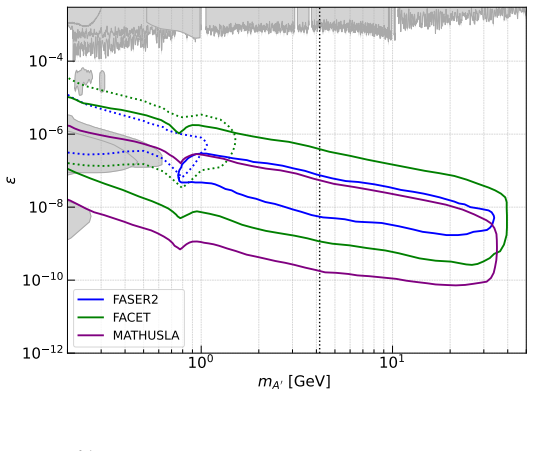
We investigate a novel production mechanism for long-lived dark photons at the LHC, arising from dark radiation emitted from χ in Z→χ̄χ decays, where χ is a fermionic dark matter candidate. The effective Zχχ coupling is generated radiatively through one-loop diagrams involving the top quark and a new colored scalar. We show that dark photons produced via this dark radiation channel can dominate over the conventional sources—meson decays and proton bremsstrahlung—across wide regions of parameter space, particularly for small kinetic mixing and dark photon masses well above the GeV scale. Using this enhanced production mechanism, we analyze the sensitivity of dedicated long-lived particle det
What carries the argument
The radiatively generated effective Zχχ coupling through one-loop diagrams with the top quark and a new colored scalar, which permits dark photon emission as radiation in Z decays to dark matter.
If this is right
- Dark photon production from the dark radiation channel exceeds meson decays and proton bremsstrahlung for small kinetic mixing and masses well above the GeV scale.
- FASER2, FACET, and MATHUSLA can reach previously inaccessible regions of dark photon parameter space that remain consistent with the observed dark matter relic abundance.
- These detectors gain sensitivity beyond what conventional production mechanisms alone would allow.
- The new channel opens parameter space that standard dark photon scenarios cannot probe at the LHC.
Where Pith is reading between the lines
- Similar loop-induced couplings could enhance production rates for other hidden-sector particles in Z or Higgs decays at colliders.
- Non-observation at the projected sensitivities would constrain the mass and couplings of the new colored scalar needed for the dark matter relic density.
- The mechanism might generalize to other mediator bosons that couple to both the Standard Model and a dark sector.
- Combined analyses of long-lived particle searches and direct dark matter detection could test the same loop diagrams from complementary angles.
Load-bearing premise
The effective Z χ χ coupling is generated radiatively through one-loop diagrams involving the top quark and a new colored scalar, with parameter choices that simultaneously satisfy the observed dark matter relic abundance.
What would settle it
A measured dark photon signal rate in FASER2 or MATHUSLA that falls below the prediction for the loop-induced Zχχ coupling at dark photon masses above 1 GeV and kinetic mixing below 10^-4 would indicate that this dark radiation channel does not dominate.
Figures




read the original abstract
We investigate a novel production mechanism for long-lived dark photons at the LHC, arising from dark radiation emitted from $\chi$ in $Z\to\bar{\chi}\chi$ decays, where $\chi$ is a fermionic dark matter candidate. The effective $Z\chi\chi$ coupling is generated radiatively through one-loop diagrams involving the top quark and a new colored scalar. We show that dark photons produced via this dark radiation channel can dominate over the conventional sources-meson decays and proton bremsstrahlung-across wide regions of parameter space, particularly for small kinetic mixing and dark photon masses well above the GeV scale. Using this enhanced production mechanism, we analyze the sensitivity of dedicated long-lived particle detectors, including FASER2, FACET, and MATHUSLA. We find that these experiments can significantly surpass existing bounds, probing regions of dark photon parameter space consistent with the observed dark matter relic abundance and inaccessible in conventional dark photon scenarios.
Editorial analysis
A structured set of objections, weighed in public.
Referee Report
Summary. The manuscript proposes a new production channel for long-lived dark photons (A') at the LHC via dark radiation emitted from fermionic dark matter χ produced in Z → χχ decays. The effective Zχχ coupling arises radiatively from one-loop diagrams involving the top quark and a new colored scalar. The authors claim this mechanism dominates over conventional sources (meson decays, proton bremsstrahlung) for small kinetic mixing ε and m_A' ≫ GeV, enabling dedicated LLP detectors (FASER2, FACET, MATHUSLA) to probe relic-density-consistent parameter space inaccessible via standard dark photon scenarios.
Significance. If the quantitative results on dominance and sensitivity hold, the work would usefully connect dark matter relic density constraints to long-lived particle searches, expanding the testable dark photon parameter space at the LHC. The explicit incorporation of relic abundance consistency is a strength, as it anchors the target region in observation rather than arbitrary choices. The approach relies on standard effective field theory and Monte Carlo tools for projections.
major comments (2)
- [§2] §2 (Model and loop-induced coupling): The central claim of dominance requires that the radiatively generated Zχχ coupling (suppressed by 1/(16π²) and Yukawa/mass factors) produces sufficient χ yield for the subsequent A' radiation to exceed meson and bremsstrahlung rates at small ε. Provide the explicit one-loop expression for the effective coupling and benchmark points (colored scalar mass, Yukawas) demonstrating simultaneous satisfaction of Ωh² ≈ 0.12 and BR(Z → χχ) large enough for dominance; without this, the overlap of regimes remains unverified.
- [§4–5] §4–5 (Production rates and sensitivity projections): The assertion that the dark radiation channel dominates and allows these experiments to surpass existing bounds in relic-consistent regions must be supported by explicit rate comparisons and exclusion contours. Include a table or figure quantifying event yields from the new channel versus conventional sources across ε and m_A' (with error bands or parameter scans), and overlay the projected reaches on current limits.
minor comments (2)
- [§2] Clarify the definition and range of the new colored scalar parameters in the text and any tables to avoid ambiguity with direct search constraints.
- [§5] Ensure all figures showing sensitivity have consistent axis labels (ε vs m_A') and explicitly mark the relic-density-consistent bands.
Simulated Author's Rebuttal
We thank the referee for the thorough review and constructive feedback on our manuscript. We appreciate the emphasis on providing explicit derivations and quantitative comparisons to strengthen the central claims. Below we address each major comment in detail, and we will incorporate the requested additions into a revised version of the manuscript.
read point-by-point responses
-
Referee: [§2] §2 (Model and loop-induced coupling): The central claim of dominance requires that the radiatively generated Zχχ coupling (suppressed by 1/(16π²) and Yukawa/mass factors) produces sufficient χ yield for the subsequent A' radiation to exceed meson and bremsstrahlung rates at small ε. Provide the explicit one-loop expression for the effective coupling and benchmark points (colored scalar mass, Yukawas) demonstrating simultaneous satisfaction of Ωh² ≈ 0.12 and BR(Z → χχ) large enough for dominance; without this, the overlap of regimes remains unverified.
Authors: We agree that an explicit derivation of the loop-induced Zχχ coupling is essential for verifying the dominance claim. In the revised manuscript we will include the complete one-loop expression for the effective coupling, obtained from the diagrams involving the top quark and the new colored scalar, with all suppression factors (1/(16π²), Yukawa couplings, and mass ratios) shown explicitly. We will also add a dedicated subsection with benchmark points specifying the colored scalar mass, Yukawa values, and resulting BR(Z → χχ) that simultaneously satisfy Ωh² ≈ 0.12 and ensure the dark radiation channel exceeds conventional rates for small ε and m_A' ≫ GeV. These benchmarks will be chosen from the viable parameter space already explored in our Monte Carlo simulations. revision: yes
-
Referee: [§4–5] §4–5 (Production rates and sensitivity projections): The assertion that the dark radiation channel dominates and allows these experiments to surpass existing bounds in relic-consistent regions must be supported by explicit rate comparisons and exclusion contours. Include a table or figure quantifying event yields from the new channel versus conventional sources across ε and m_A' (with error bands or parameter scans), and overlay the projected reaches on current limits.
Authors: We concur that explicit rate comparisons are required to substantiate the dominance and enhanced sensitivity. In the revised manuscript we will add a new figure (or table) that directly compares the expected event yields from the dark radiation channel against meson decays and proton bremsstrahlung as functions of ε and m_A', including scans over the relevant model parameters with uncertainty bands derived from the Monte Carlo statistics. The projected exclusion contours for FASER2, FACET, and MATHUSLA will be overlaid on existing limits, restricted to the relic-density-consistent regions, thereby demonstrating the newly accessible parameter space. revision: yes
Circularity Check
No significant circularity detected
full rationale
The paper defines a model with a radiatively generated effective Zχχ coupling via one-loop diagrams and computes the resulting dark photon production rate from Z decays. It then compares this rate to conventional sources (meson decays, bremsstrahlung) across parameter space and projects detector sensitivities. The observed relic abundance is invoked only as an external benchmark to identify interesting regions of parameter space, not as a fitted input that defines the production mechanism or sensitivity by construction. No self-definitional equations, fitted quantities renamed as predictions, or load-bearing self-citations appear in the provided text. The derivation chain remains independent of its own outputs.
Axiom & Free-Parameter Ledger
free parameters (2)
- kinetic mixing parameter
- dark photon mass
axioms (2)
- domain assumption Existence of fermionic dark matter candidate chi with radiatively generated effective Z chi chi coupling via top quark and new colored scalar loops.
- domain assumption Dark photons produced this way are long-lived and detectable by FASER2, FACET, and MATHUSLA.
invented entities (1)
-
New colored scalar
no independent evidence
Reference graph
Works this paper leans on
-
[1]
M. Pospelov, A. Ritz, and M. B. Voloshin, Phys. Lett. B662, 53 (2008), arXiv:0711.4866 [hep-ph]
work page Pith review arXiv 2008
- [2]
- [3]
- [4]
- [5]
-
[6]
A. Hayrapetyanet al. (CMS), JHEP12, 070 (2023), arXiv:2309.16003 [hep-ex]
-
[7]
H. Abreuet al. (FASER), Phys. Lett. B848, 138378 (2024), arXiv:2308.05587 [hep- ex]
-
[8]
M. Buschmann, J. Kopp, J. Liu, and P. A. N. Machado, JHEP07, 045 (2015), arXiv:1505.07459 [hep-ph]
- [9]
- [10]
- [11]
- [12]
-
[13]
V. Chekhovskyet al. (CMS), JHEP01, 047 (2026), arXiv:2503.09742 [hep-ex]
- [14]
- [15]
- [16]
-
[17]
W. Beenakker, C. Borschensky, M. Krämer, A. Kulesza, E. Laenen, J. Mamužić, and L. M. Valero, SciPost Phys. Core7, 072 (2024), arXiv:2404.18837 [hep-ph]
- [18]
- [19]
- [20]
- [21]
- [22]
-
[23]
H.-C. Cheng, X.-H. Jiang, L. Li, and E. Salvioni, JHEP04, 081 (2024), arXiv:2401.08785 [hep-ph]
-
[24]
Schaelet al.(ALEPH and DELPHI and L3 and OPAL and SLD), Phys
S. Schael et al. (ALEPH, DELPHI, L3, OPAL, SLD, LEP Electroweak Working Group, SLD Electroweak Group, SLD Heavy Flavour Group), Phys. Rept.427, 257 (2006), arXiv:hep-ex/0509008
-
[25]
Navaset al
S. Navaset al. (Particle Data Group), Phys. Rev. D110, 030001 (2024)
2024
-
[26]
J. Abdallahet al., Phys. Dark Univ.9-10, 8 (2015), arXiv:1506.03116 [hep-ph]
-
[27]
K. A. Oliveet al. (Particle Data Group), Chin. Phys. C38, 090001 (2014)
2014
- [28]
-
[29]
Dark Matter Search Results from 4.2 Tonne-Years of Exposure of the LUX-ZEPLIN (LZ) Experiment,
J. Aalberset al. (LZ), Phys. Rev. Lett.135, 011802 (2025), arXiv:2410.17036 [hep- ex]
-
[30]
E. Aprile et al. (XENON), Phys. Rev. Lett.123, 251801 (2019), arXiv:1907.11485 [hep-ex]
-
[31]
P. Agneset al. (DarkSide-50), Phys. Rev. D107, 063001 (2023), arXiv:2207.11966 [hep-ex]
-
[32]
F. Acerbiet al. (DarkSide-50, DarkSide-20k), (2025), arXiv:2511.13629 [hep-ex]
work page internal anchor Pith review arXiv 2025
-
[33]
C. Amoleet al. (PICO), Phys. Rev. D100, 022001 (2019), arXiv:1902.04031 [astro- ph.CO]
-
[34]
A. Tumasyanet al. (CMS), JHEP11, 153 (2021), arXiv:2107.13021 [hep-ex]
-
[35]
G. Aad et al. (ATLAS), Phys. Rev. D103, 112006 (2021), arXiv:2102.10874 [hep- ex]
-
[36]
Planck 2018 results. VI. Cosmological parameters
N. Aghanim et al. (Planck), Astron. Astrophys.641, A6 (2020), [Erratum: As- tron.Astrophys. 652, C4 (2021)], arXiv:1807.06209 [astro-ph.CO]
work page internal anchor Pith review arXiv 2020
-
[37]
G. Alguero, G. Belanger, F. Boudjema, S. Chakraborti, A. Goudelis, S. Kraml, A. Mjallal, and A. Pukhov, Comput. Phys. Commun.299, 109133 (2024), arXiv:2312.14894 [hep-ph]. 25
-
[38]
J. L. Feng, I. Galon, F. Kling, and S. Trojanowski, Phys. Rev. D97, 035001 (2018), arXiv:1708.09389 [hep-ph]
work page Pith review arXiv 2018
-
[39]
FASER's Physics Reach for Long-Lived Particles
A. Ariga et al. (FASER), Phys. Rev. D99, 095011 (2019), arXiv:1811.12522 [hep- ph]
work page Pith review arXiv 2019
-
[40]
Cerciet al., JHEP06, 110 (2022), arXiv:2201.00019 [hep-ex]
S. Cerciet al., JHEP06, 110 (2022), arXiv:2201.00019 [hep-ex]
-
[41]
B. Aitkenet al. (MATHUSLA), (2025), arXiv:2503.20893 [physics.ins-det]
-
[42]
J. Alwall, R. Frederix, S. Frixione, V. Hirschi, F. Maltoni, O. Mattelaer, H. S. Shao, T. Stelzer, P. Torrielli, and M. Zaro, JHEP07, 079 (2014), arXiv:1405.0301 [hep-ph]
work page internal anchor Pith review arXiv 2014
-
[43]
T. Sjöstrand, S. Ask, J. R. Christiansen, R. Corke, N. Desai, P. Ilten, S. Mrenna, S. Prestel, C. O. Rasmussen, and P. Z. Skands, Comput. Phys. Commun.191, 159 (2015), arXiv:1410.3012 [hep-ph]
work page internal anchor Pith review arXiv 2015
-
[44]
F. Kling and S. Trojanowski, Phys. Rev. D104, 035012 (2021), arXiv:2105.07077 [hep-ph]
- [45]
- [46]
-
[47]
Passarino and M
G. Passarino and M. J. G. Veltman, Nucl. Phys. B160, 151 (1979). 26
1979
discussion (0)
Sign in with ORCID, Apple, or X to comment. Anyone can read and Pith papers without signing in.