Recognition: unknown
Higher categories of bordisms with geometric structures
Pith reviewed 2026-05-09 16:25 UTC · model grok-4.3
The pith
A system of axioms uniquely defines the (∞,d)-category of bordisms equipped with geometric data on manifolds of various types.
A machine-rendered reading of the paper's core claim, the machinery that carries it, and where it could break.
Core claim
We introduce a system of axioms that uniquely defines an (infinity,d)-category of bordisms equipped with geometric data. The underlying manifolds of these bordisms may be smooth, complex, super, or formal smooth manifolds, as well as any class of manifolds satisfying conditions specified in this paper. We develop a general notion of a field on a manifold, encompassing structures such as Riemannian metrics, principal bundles with connection, conformal structures, and traditional tangential structures. Using this framework, we construct a symmetric monoidal (infinity,d)-category of bordisms with prescribed underlying manifolds and fields, and prove that it satisfies our axioms.
What carries the argument
The system of axioms that is asserted to uniquely characterize the symmetric monoidal (∞,d)-category of bordisms with fields, together with the general definition of a field on a manifold that accommodates metrics, bundles, and tangential data.
If this is right
- The same axioms and construction yield a well-defined (∞,d)-category for Riemannian bordisms.
- The category is the unique one (up to equivalence) satisfying the axioms for any allowable manifold class and field type.
- Extended topological field theories with geometric data can be defined by functors out of this single reference category.
- The framework applies uniformly to super manifolds and formal smooth manifolds without separate case analysis.
Where Pith is reading between the lines
- Varying the choice of field inside the same axiomatic setup may produce new bordism invariants that refine classical ones.
- Known constructions of bordism categories with spin or string structures can be checked directly against the axioms to see whether they coincide with the universal object.
- The uniqueness statement supplies a criterion for deciding when two different geometric inputs give rise to equivalent higher categories.
Load-bearing premise
The axioms are sufficient to determine the (∞,d)-category uniquely up to equivalence, and the general definitions of fields and allowable manifold classes apply without extra restrictions that would break uniqueness or the construction.
What would settle it
Exhibit two non-equivalent symmetric monoidal (∞,d)-categories of bordisms with the same class of manifolds and the same notion of fields that both satisfy the full list of axioms, or show that the construction fails to produce a category satisfying the axioms for one of the listed manifold classes such as complex manifolds.
Figures
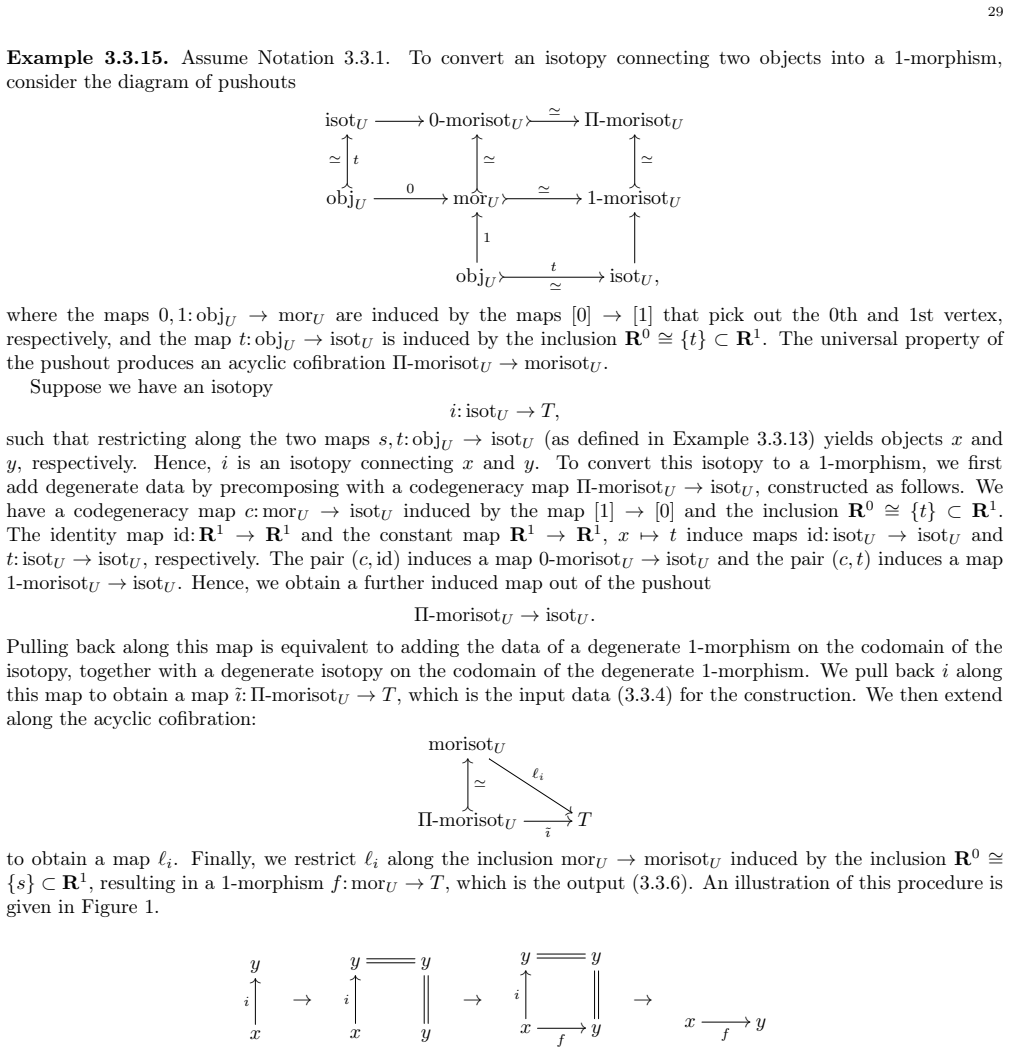


read the original abstract
We introduce a system of axioms that uniquely defines an (infinity,d)-category of bordisms equipped with geometric data. The underlying manifolds of these bordisms may be smooth, complex, super, or formal smooth manifolds, as well as any class of manifolds satisfying conditions specified in this paper. We develop a general notion of a field on a manifold, encompassing structures such as Riemannian metrics, principal bundles with connection, conformal structures, and traditional tangential structures. Using this framework, we construct a symmetric monoidal (infinity,d)-category of bordisms with prescribed underlying manifolds and fields, and prove that it satisfies our axioms.
Editorial analysis
A structured set of objections, weighed in public.
Referee Report
Summary. The paper introduces a system of axioms claimed to uniquely characterize the symmetric monoidal (∞,d)-category of bordisms equipped with geometric structures ('fields') whose underlying manifolds belong to broad classes including smooth, complex, super, and formal manifolds. It defines a general notion of fields encompassing metrics, connections, conformal structures, and tangential data, constructs the corresponding (∞,d)-category, and proves that the construction satisfies the axioms.
Significance. If the uniqueness theorem holds with the stated generality, the work would supply a unified axiomatic foundation for higher bordism categories incorporating geometric data, extending classical constructions to non-classical manifold types. This could streamline comparisons across geometric TQFTs and provide a template for incorporating additional structures without ad-hoc choices.
major comments (2)
- [§4, Theorem 5.1] §4 (Axioms) and Theorem 5.1 (Uniqueness): the claim that the axioms uniquely determine the (∞,d)-category up to equivalence rests on the general field definition supplying exactly the data needed for composition and gluing; however, the proof sketch does not explicitly verify that the required tangent-bundle or partition-of-unity properties hold for super and formal manifolds, where these may fail or require extra restrictions. This is load-bearing for the central uniqueness assertion across all listed manifold classes.
- [§3] §3 (Definition of fields): the general notion of a field is stated in a way that appears permissive enough to include structures on super manifolds, yet the subsequent gluing axioms in §4 assume existence of certain pushouts or colimits that are not shown to exist without additional conditions on the field data for non-smooth cases. A counterexample or explicit check for at least one super manifold example would be needed to confirm the construction works as stated.
minor comments (2)
- The notation for the symmetric monoidal (∞,d)-category is introduced without a direct comparison table to standard references such as Lurie's Higher Algebra or bordism-category literature; adding such a table would improve readability.
- Several diagrams illustrating bordism composition with fields (e.g., in §2) lack explicit labels for the field data on the boundaries, making it harder to track how the general field definition interacts with gluing.
Simulated Author's Rebuttal
We thank the referee for their careful reading of our manuscript and for providing detailed comments. We address the major comments point by point below, and we will revise the paper to incorporate additional clarifications and examples as suggested.
read point-by-point responses
-
Referee: [§4, Theorem 5.1] §4 (Axioms) and Theorem 5.1 (Uniqueness): the claim that the axioms uniquely determine the (∞,d)-category up to equivalence rests on the general field definition supplying exactly the data needed for composition and gluing; however, the proof sketch does not explicitly verify that the required tangent-bundle or partition-of-unity properties hold for super and formal manifolds, where these may fail or require extra restrictions. This is load-bearing for the central uniqueness assertion across all listed manifold classes.
Authors: The axioms and the uniqueness theorem in Theorem 5.1 are formulated in a manner that applies uniformly to all manifold classes satisfying the conditions outlined in Section 2, which explicitly include super and formal manifolds. The field definition ensures that the necessary tangent bundle and partition-of-unity properties hold by construction for these classes, as the geometric structures are required to be compatible with the manifold's differential structure. While the proof sketch is concise, it relies on these general properties rather than case-by-case verification. To strengthen the exposition and address the referee's concern, we will expand the proof in the revised manuscript to include explicit checks for super and formal manifolds. revision: yes
-
Referee: [§3] §3 (Definition of fields): the general notion of a field is stated in a way that appears permissive enough to include structures on super manifolds, yet the subsequent gluing axioms in §4 assume existence of certain pushouts or colimits that are not shown to exist without additional conditions on the field data for non-smooth cases. A counterexample or explicit check for at least one super manifold example would be needed to confirm the construction works as stated.
Authors: The general definition of fields in Section 3 is designed to be broad yet compatible with the gluing and composition operations required in the (∞,d)-category. For non-smooth cases such as super manifolds, the existence of the relevant pushouts and colimits follows from the categorical properties of the underlying manifold category and the field data being functorial. We agree that an explicit example would enhance clarity. In the revised version, we will include a concrete example involving a super manifold equipped with a geometric field, such as a superconformal structure, to demonstrate the gluing axioms in action. revision: yes
Circularity Check
Axiomatic definition followed by independent construction with no reduction to inputs
full rationale
The paper introduces a system of axioms for an (∞,d)-category of bordisms with geometric structures, develops a general notion of fields applicable to smooth, complex, super, and formal manifolds, constructs the symmetric monoidal (∞,d)-category explicitly from this data, and proves that the construction satisfies the axioms. The uniqueness statement is framed as a consequence of the axioms themselves rather than derived from the construction or prior self-citations in a load-bearing way. No equation or step equates the final category to a fitted parameter, renamed input, or self-referential definition; the derivation chain consists of independent definitions, constructions, and verifications that remain self-contained against external mathematical benchmarks.
Axiom & Free-Parameter Ledger
Reference graph
Works this paper leans on
-
[1]
Théorie des points proches sur les variétés différentiables.Géométrie différentielle.Colloques Internationaux du Centre National de la Recherche Scientifique 52 (1953), 111–117
André Weil. Théorie des points proches sur les variétés différentiables.Géométrie différentielle.Colloques Internationaux du Centre National de la Recherche Scientifique 52 (1953), 111–117. Centre National de la Recherche Scientifique, 1953. https://dmitripavlov.org/scans/weil-theorie-des-points-proches-sur-les-varietes-differentiables.pdf. 4.1.20
1953
-
[2]
Geometric aspects of formal differential operations on tensor fields
Albert Nijenhuis. Geometric aspects of formal differential operations on tensor fields. Proceedings of the International Congress of Mathematicians 1958, 463–469. https://www.mathunion.org/fileadmin/ICM/Proceedings/ICM1958/ICM1958.ocr.pdf. 5.1.2
1958
-
[3]
Lectures on theh-Cobordism Theorem
John Milnor. Lectures on theh-Cobordism Theorem. Princeton University Press, 1965. JSTOR:j.ctt183psc9. 1
1965
-
[4]
Brian J. Day. Construction of biclosed categories. Dissertation, School of Mathematics, University of New South Wales (1970). doi:10.26190/unsworks/8048. 2.2.1
-
[5]
Aldridge K. Bousfield, Daniel M. Kan. Homotopy limits, completions and localizations. Lecture Notes in Mathematics 304 (1972). doi:10.1007/978-3-540-38117-4. 1.2 [1974.a] Graeme Segal. Categories and cohomology theories. Topology 13:3 (1974), 293–312. doi:10.1016/0040-9383(74)90022-6. 1.2, 2, 2.1, 2.1.4 [1974.b] Christopher L. Reedy. Homotopy theory of mo...
-
[6]
Aldridge K. Bousfield, Eric M. Friedlander. Homotopy theory ofΓ-spaces, spectra, and bisimplicial sets. Lecture Notes in Mathematics 658 (1978), 80–130. doi:10.1007/bfb0068711. 1.2, 2.1, 2.3, 2.3.21
-
[7]
Eduardo J. Dubuc. Sur les modèles de la géométrie différentielle synthétique. Cahiers de topologie et géométrie différentielle catégoriques 20:3 (1979), 231–279. numdam:CTGDC_1979__20_3_231_0. 4.1.20
1979
-
[8]
Topological quantum field theories
Michael Atiyah. Topological quantum field theories. Publications Mathématiques de l’IHÉS 68 (1988), 175–186. doi:10.1007/bf02698547. 1 [1989.b] William G. Dwyer, Daniel M. Kan, Jeffrey H. Smith. Homotopy commutative diagrams and their realizations. Journal of Pure and Applied Algebra 57:1 (1989), 5-24. doi:10.1016/0022-4049(89)90023-6. 2
-
[9]
Ieke Moerdijk, Gonzalo E. Reyes. Models for Smooth Infinitesimal Analysis. Springer, 1991. doi:10.1007/978-1-4757-4143-8. 4.1.20
-
[10]
Daniel S. Freed. Higher algebraic structures and quantization. Communications in Mathematical Physics 159:2 (1994), 343–398. arXiv:hep-th/9212115v2, doi:10.1007/bf02102643. 1 [1993.a] Ivan Kolář, Peter W. Michor, Jan Slovák. Natural Operations in Differential Geometry. Springer, 1993. doi:10.1007/978-3-662-02950-3. 4.1.20 [1993.b] Daniel S. Freed. Extende...
-
[11]
John C. Baez, James Dolan. Higher-dimensional algebra and topological quantum field theory. Journal of Mathematical Physics 36:11 (1995), 6073–6105. arXiv:q-alg/9503002v2, doi:10.1063/1.531236. 1
-
[12]
Sur des notions den-catégorie etn-groupoïde non strictes via des ensembles multi-simpliciaux
Zouhair Tamsamani. Sur des notions den-catégorie etn-groupoïde non strictes via des ensembles multi-simpliciaux. K-Theory 16:1 (1999), 51–99. arXiv:alg-geom/9512006, doi:10.1023/a:1007747915317. 2
-
[13]
Disks, duality andΘ-categories
André Joyal. Disks, duality andΘ-categories. September 1997. https://ncatlab.org/nlab/files/JoyalThetaCategories.pdf. 3.2, 3.2.2 [1998.a] André Hirschowitz, Carlos Simpson. Descente pour lesn-champs. arXiv:math/9807049v3. 2 [1998.b] Charles Rezk. A model for the homotopy theory of homotopy theory. Transactions of the American Mathematical Society 353:3 (2...
-
[14]
Régis Pellissier. Catégories enrichies faibles. arXiv:math/0308246. 2 [2004.a] Graeme Segal. The definition of conformal field theory. London Mathematical Society Lecture Notes Series 308 (2004), 421–577. doi:10.1017/cbo9780511526398.019. 1 [2004.b] Stephan Stolz, Peter Teichner. What is an elliptic object? London Mathematical Society Lecture Note Series ...
-
[15]
Clark Barwick. On left and right model categories and left and right Bousfield localizations. Homology, Homotopy and Applications 12:2 (2010), 245–320. doi:10.4310/hha.2010.v12.n2.a9. 1.2, 2.2, 2.3.1, 2.3.7, 2.3.8, 2.3.9, 2.3.10 [2008.b] Clemens Berger, Ieke Moerdijk. On an extension of the notion of Reedy category. Mathematische Zeitschrift 269:3–4 (2011...
-
[16]
Čech cocycles for differential characteristic classes: an∞-Lie theoretic construction
Domenico Fiorenza, Urs Schreiber, Jim Stasheff. Čech cocycles for differential characteristic classes: an∞-Lie theoretic construction. Advances in Theoretical and Mathematical Physics 16:1 (2012), 149–250. arXiv:1011.4735v2, doi:10.4310/atmp.2012.v16.n1.a5. 1, 2, 2.1, 2.1.5 [2011.a] Stephan Stolz, Peter Teichner. Supersymmetric field theories and generali...
-
[17]
Daniel S. Freed, Constantin Teleman. Relative quantum field theory. Communications in Mathematical Physics 326:2 (2014), 459–476. arXiv:1212.1692v3, doi:10.1007/s00220-013-1880-1. 5.1.2 [2013.a] André Henriques. Three-tier CFTs from Frobenius algebras. Topology and Field Theories. Contemporary Mathematics 613 (2014), 1–40. arXiv:1304.7328v2, doi:10.1090/c...
-
[18]
Classifying spaces of infinity-sheaves
Daniel Berwick-Evans, Pedro Boavida de Brito, Dmitri Pavlov. Classifying spaces of infinity-sheaves. Algebraic & Geometric Topology 24:9 (2024), 4891–4937. arXiv:1912.10544v3, doi:10.2140/agt.2024.24.4891. 1.2
-
[19]
Higher Categories and Homotopical Algebra
Denis-Charles Cisinski. Higher Categories and Homotopical Algebra. Cambridge Studies in Advanced Mathematics 180 (2019). Cambridge University Press. https://cisinski.app.uni-regensburg.de/CatLR.pdf, doi:10.1017/9781108588737. 1.2 [2020.a] Matthias Ludewig, Augusto Stoffel. A framework for geometric field theories and their classification in dimension one....
-
[20]
Differentiable sheaves I: Fractured∞-toposes and compactness
Adrian Clough. Differentiable sheaves I: Fractured∞-toposes and compactness. Proceedings of the American Mathematical Society 153 (2025), 4487–4500. arXiv:2309.01757v1, doi:10.1090/proc/17260. 4.1 [2025.a] Emilio Minichiello. Coverages and Grothendieck toposes. arXiv:2503.20664v2. 2.1.6 [2025.b] Stacks Project. https://stacks.math.columbia.edu/. 4.1.17, 5...
discussion (0)
Sign in with ORCID, Apple, or X to comment. Anyone can read and Pith papers without signing in.