Recognition: unknown
Understanding Task Performance of Time-Multiplexed Optical Reservoir Computing via Polynomial Expansion
Pith reviewed 2026-05-07 04:00 UTC · model grok-4.3
The pith
A linear optical reservoir achieves enhanced task performance by using transient coupling and delayed feedback to compensate for missing higher-order nonlinearities.
A machine-rendered reading of the paper's core claim, the machinery that carries it, and where it could break.
Core claim
In contrast to conventional nonlinear reservoirs, the proposed linear architecture isolates the contributions of nonlinear transformations, transient dynamics, and time-delay effects. By explicitly identifying the contributing monomials for different tasks, we establish the relationship between task requirements and the nonlinearity provided by the system. Incorporating transient coupling and delayed feedback significantly enhances performance and attractor reconstruction capabilities by compensating for missing higher-order nonlinearities through access to multi-step integration schemes. This improvement, however, comes at the cost of requiring a larger number of virtual nodes.
What carries the argument
Polynomial expansion of the reservoir output to identify contributing monomials, within a linear architecture that separates transient coupling and delayed feedback from nonlinear spreading.
If this is right
- Tasks needing higher-order nonlinearities show improved performance when transient coupling and delayed feedback are added.
- Attractor reconstruction becomes more accurate with the inclusion of transient coupling and delayed feedback.
- A larger number of virtual nodes is required to realize the performance gains from multi-step integration.
- The roles of nonlinear transformations, transient dynamics, and time-delay effects can be analyzed independently for different tasks.
Where Pith is reading between the lines
- Designers could tune delay length and coupling strength to match the polynomial degree needed for a target task without adding physical nonlinear elements.
- Similar delay-based compensation for nonlinearity might appear in other linear physical computing platforms such as electronic or mechanical systems.
- The monomial-tracking approach could be used to benchmark reservoir performance against explicit polynomial feature maps in classical machine learning.
- Varying the integration step count in simulation might predict how many virtual nodes are minimally needed for a given task complexity.
Load-bearing premise
The proposed linear architecture isolates the contributions of nonlinear transformations, transient dynamics, and time-delay effects because intrinsic nonlinear spreading is absent.
What would settle it
Run the reservoir on a task requiring a specific higher-order monomial such as a cubic term, first without transient coupling and then with it; the claim holds if the monomial appears in the output only when coupling and delay enable multi-step integration.
Figures


read the original abstract
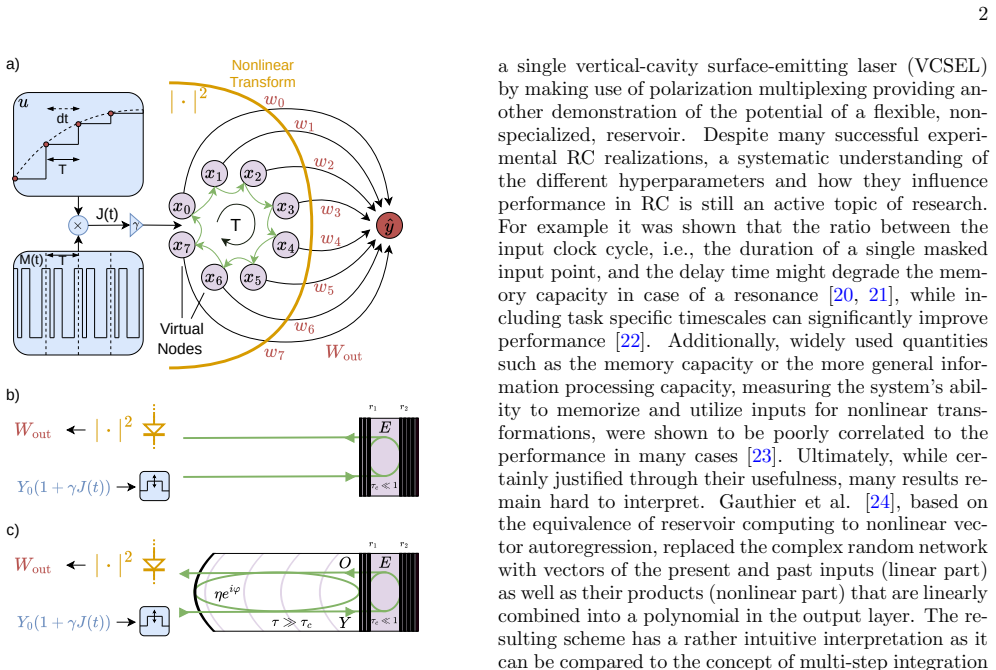
We investigate the computational potential and limitations of a passive linear optical reservoir with a photodetector at the optical-to-electrical interface as the sole source of nonlinearity. In contrast to conventional nonlinear reservoirs, where transient dynamics and delay jointly enhance complexity and distribute nonlinear responses, the proposed linear architecture isolates these contributions, as intrinsic nonlinear spreading is absent. We thus provide a framework that enables the independent and systematic analysis of key factors, including nonlinear transformations, transient dynamics, and time-delay effects, as well as their interactions. By explicitly identifying the contributing monomials for different tasks, we establish the relationship between task requirements and the nonlinearity provided by the system. Incorporating transient coupling and delayed feedback is shown to significantly enhance performance and attractor reconstruction capabilities by compensating for missing higher-order nonlinearities through access to multi-step integration schemes. This improvement, however, comes at the cost of requiring a larger number of virtual nodes.
Editorial analysis
A structured set of objections, weighed in public.
Referee Report
Summary. The manuscript examines a passive linear optical reservoir computing architecture in which nonlinearity arises solely from the photodetector at the optical-to-electrical interface. By applying polynomial expansion to identify the monomials that contribute to task performance, the authors separate the roles of nonlinear transformations, transient dynamics, and time-delay effects. They report that adding transient coupling and delayed feedback improves performance and attractor reconstruction by supplying higher-order terms via multi-step integration schemes, at the expense of requiring a larger number of virtual nodes.
Significance. If the central claims are substantiated, the work supplies a useful interpretive framework for dissecting component contributions in optical reservoir computing, where intrinsic nonlinearity is often weak. The explicit monomial-identification approach offers interpretability that is uncommon in RC literature and could guide designs that leverage memory and transients to offset limited nonlinearity. The isolation of linear optics from nonlinear spreading is a methodological strength that enables cleaner analysis than in conventional nonlinear reservoirs.
major comments (2)
- [Abstract] Abstract and main text: The claim that transient coupling and delayed feedback compensate for missing higher-order nonlinearities 'through access to multi-step integration schemes' is load-bearing for the reported performance gains and attractor-reconstruction results, yet no derivation is supplied that starts from the linear-optical + photodetector dynamics, constructs the iterated map, and shows that the newly accessible monomials match the truncation or stability properties of any concrete multi-step integrator (Euler, Heun, etc.). Without this mapping, the improvement could equally be explained by the delay line simply enlarging the effective state dimension or memory capacity.
- [Abstract] Abstract: The polynomial-expansion analysis identifies contributing monomials for different tasks, but the manuscript provides no quantitative error analysis, uniqueness check, or comparison of the fitted monomials against the actual system output (e.g., via residual norms or cross-validation on held-out data). This leaves open the possibility that the monomial identification is post-hoc and does not uniquely support the compensation interpretation.
minor comments (2)
- The abstract states that the linear architecture 'isolates' the contributions of nonlinear transformations, transients, and delays, but the manuscript should explicitly state the quantitative criterion (e.g., spectral flatness or cross-term suppression) used to verify that intrinsic nonlinear spreading is absent.
- The cost of requiring a larger number of virtual nodes is mentioned but not quantified (e.g., scaling of node count versus performance gain); a brief table or plot relating node number to task error would strengthen the practical assessment.
Simulated Author's Rebuttal
We thank the referee for the detailed and constructive review of our manuscript. We address the major comments point by point below and outline the revisions we will make to strengthen the paper.
read point-by-point responses
-
Referee: [Abstract] Abstract and main text: The claim that transient coupling and delayed feedback compensate for missing higher-order nonlinearities 'through access to multi-step integration schemes' is load-bearing for the reported performance gains and attractor-reconstruction results, yet no derivation is supplied that starts from the linear-optical + photodetector dynamics, constructs the iterated map, and shows that the newly accessible monomials match the truncation or stability properties of any concrete multi-step integrator (Euler, Heun, etc.). Without this mapping, the improvement could equally be explained by the delay line simply enlarging the effective state dimension or memory capacity.
Authors: We agree that an explicit derivation would provide stronger support for the interpretation. In the revised version, we will add a dedicated subsection deriving the effective iterated map from the underlying linear optical dynamics combined with the photodetector nonlinearity and transient coupling. This will demonstrate how the multi-step integration arises and which specific monomials become accessible, matching properties of schemes like the Heun method. To address the alternative explanation involving enlarged state dimension, we will include additional analysis comparing the performance and monomial contributions against equivalent-dimensional reservoirs without transient coupling or delayed feedback. Our polynomial expansion results already indicate that the specific higher-order terms introduced are not merely a consequence of increased dimensionality but arise from the temporal integration enabled by the transients. revision: yes
-
Referee: [Abstract] Abstract: The polynomial-expansion analysis identifies contributing monomials for different tasks, but the manuscript provides no quantitative error analysis, uniqueness check, or comparison of the fitted monomials against the actual system output (e.g., via residual norms or cross-validation on held-out data). This leaves open the possibility that the monomial identification is post-hoc and does not uniquely support the compensation interpretation.
Authors: We acknowledge the need for quantitative validation of the monomial identification procedure. In the revised manuscript, we will incorporate residual norm calculations between the polynomial expansion predictions and the actual reservoir outputs, perform cross-validation on held-out datasets, and conduct uniqueness checks by assessing the stability of the identified monomials under perturbations. These additions will confirm that the monomials are not post-hoc but accurately capture the system's nonlinear contributions, thereby reinforcing the compensation interpretation. revision: yes
Circularity Check
Polynomial monomial identification is self-contained; no reduction of claims to fitted inputs or self-citations
full rationale
The paper's core method explicitly identifies contributing monomials from the linear-optical reservoir dynamics plus photodetector nonlinearity, enabling separate analysis of nonlinear transformations, transients, and delays. Performance and attractor-reconstruction improvements are presented as consequences of this monomial framework rather than as predictions fitted to metrics or derived tautologically from the inputs. No load-bearing step reduces by construction to a self-citation, ansatz smuggled via citation, or renaming of a known result; the derivation chain remains independent of the target performance claims.
Axiom & Free-Parameter Ledger
axioms (2)
- domain assumption The optical reservoir is passive and linear, with nonlinearity solely from the photodetector at the optical-to-electrical interface.
- domain assumption Polynomial expansion accurately captures the system's response and identifies the monomials relevant to each task.
Reference graph
Works this paper leans on
-
[1]
echo state
Herbert Jaeger. The “echo state” approach to analysing and training recurrent neural networks-with an erratum note.GMD: German national research center for Com- puter Science, 2001
2001
-
[2]
Re- cent advances in physical reservoir computing: A review
Gouhei Tanaka, Toshiyuki Yamane, Jean Benoit H´ eroux, Ryosho Nakane, Naoki Kanazawa, Seiji Takeda, Hidetoshi Numata, Daiju Nakano, and Akira Hirose. Re- cent advances in physical reservoir computing: A review. Neural Networks, 115:100–123, 2019
2019
-
[3]
An organized view of reservoir computing: a perspective on theory and technology development.Japanese Journal of Applied Physics, 63(5):050803, 2024
Gisya Abdi, Tomasz Mazur, and Konrad Szaci lowski. An organized view of reservoir computing: a perspective on theory and technology development.Japanese Journal of Applied Physics, 63(5):050803, 2024
2024
-
[4]
Reservoir com- puting approaches to recurrent neural network training
Mantas Lukoˇ seviˇ cius and Herbert Jaeger. Reservoir com- puting approaches to recurrent neural network training. Computer Science Review, 3(3):127–149, 2009
2009
-
[5]
Information processing using a single dy- namical node as complex system.Nature communica- tions, 2(1):468, 2011
Lennert Appeltant, Miguel Cornelles Soriano, Guy Van der Sande, Jan Danckaert, Serge Massar, Joni Dambre, Benjamin Schrauwen, Claudio R Mirasso, and Ingo Fischer. Information processing using a single dy- namical node as complex system.Nature communica- tions, 2(1):468, 2011
2011
-
[6]
Parallel photonic information process- ing at gigabyte per second data rates using transient states.Nature communications, 4(1):1364, 2013
Daniel Brunner, Miguel C Soriano, Claudio R Mirasso, and Ingo Fischer. Parallel photonic information process- ing at gigabyte per second data rates using transient states.Nature communications, 4(1):1364, 2013
2013
-
[7]
Experimental demonstration of reservoir computing on a silicon photonics chip.Nature communications, 5(1):3541, 2014
Kristof Vandoorne, Pauline Mechet, Thomas Van Vaerenbergh, Martin Fiers, Geert Morthier, David Verstraeten, Benjamin Schrauwen, Joni Dambre, and Peter Bienstman. Experimental demonstration of reservoir computing on a silicon photonics chip.Nature communications, 5(1):3541, 2014
2014
-
[8]
Optoelectronic reservoir computing.Sci- entific reports, 2(1):287, 2012
Yvan Paquot, Francois Duport, Antoneo Smerieri, Joni Dambre, Benjamin Schrauwen, Marc Haelterman, and Serge Massar. Optoelectronic reservoir computing.Sci- entific reports, 2(1):287, 2012
2012
-
[9]
Larger, M
L. Larger, M. C. Soriano, D. Brunner, L. Appeltant, J. M. Gutierrez, L. Pesquera, C. R. Mirasso, and I. Fischer. Photonic information processing beyond turing: an op- toelectronic implementation of reservoir computing.Opt. Express, 20(3):3241–3249, 2012
2012
-
[10]
Udaltsov, Yanne K
Laurent Larger, Antonio Bayl´ on-Fuentes, Romain Mar- tinenghi, Vladimir S. Udaltsov, Yanne K. Chembo, and Maxime Jacquot. High-speed photonic reservoir comput- ing using a time-delay-based architecture: Million words per second classification.Phys. Rev. X, 7:011015, 2017
2017
-
[11]
Reservoir computing system with double optoelec- tronic feedback loops.Optics Express, 27(20):27431– 27440, 2019
Yaping Chen, Lilin Yi, Junxiang Ke, Zhao Yang, Yun- peng Yang, Luyao Huang, Qunbi Zhuge, and Weisheng Hu. Reservoir computing system with double optoelec- tronic feedback loops.Optics Express, 27(20):27431– 27440, 2019
2019
-
[12]
Galletero, Ernesto Pereda, Claudio R
Apostolos Argyris, Javier Cantero, M. Galletero, Ernesto Pereda, Claudio R. Mirasso, Ingo Fischer, and Miguel C. Soriano. Comparison of photonic reservoir computing systems for fiber transmission equalization.IEEE Jour- nal of Selected Topics in Quantum Electronics, 26(1):1–9, 2020
2020
-
[13]
Impact of input mask signals on delay- based photonic reservoir computing with semiconductor lasers.Opt
Yoma Kuriki, Joma Nakayama, Kosuke Takano, and At- sushi Uchida. Impact of input mask signals on delay- based photonic reservoir computing with semiconductor lasers.Opt. Express, 26(5):5777–5788, 2018
2018
-
[14]
Advances in photonic reservoir computing
Guy Van der Sande, Daniel Brunner, and Miguel C Soriano. Advances in photonic reservoir computing. Nanophotonics, 6(3):561–576, 2017
2017
-
[15]
Machine learning based on reservoir computing with time-delayed optoelectronic and pho- tonic systems.Chaos: An Interdisciplinary Journal of Nonlinear Science, 30(1), 2020
Yanne K Chembo. Machine learning based on reservoir computing with time-delayed optoelectronic and pho- tonic systems.Chaos: An Interdisciplinary Journal of Nonlinear Science, 30(1), 2020
2020
-
[16]
Task- independent computational abilities of semiconductor lasers with delayed optical feedback for reservoir com- puting.Photonics, 6(4):124, 2019
Krishan Harkhoe and Guy Van der Sande. Task- independent computational abilities of semiconductor lasers with delayed optical feedback for reservoir com- puting.Photonics, 6(4):124, 2019
2019
-
[17]
High-performance photonic reservoir computer based on a coherently driven passive cavity
Quentin Vinckier, Fran¸ cois Duport, Anteo Smerieri, Kristof Vandoorne, Peter Bienstman, Marc Haelterman, and Serge Massar. High-performance photonic reservoir computer based on a coherently driven passive cavity. Optica, 2(5):438–446, 2015
2015
-
[18]
Mirasso, Mattia Mancinelli, Lorenzo Pavesi, and Apostolos Argyris
Giovanni Donati, Claudio R. Mirasso, Mattia Mancinelli, Lorenzo Pavesi, and Apostolos Argyris. Microring res- onators with external optical feedback for time delay reservoir computing.Opt. Express, 30(1):522–537, 2022
2022
-
[19]
Polarization multiplex- ing reservoir computing based on a vcsel with polarized optical feedback.IEEE Journal of Selected Topics in Quantum Electronics, 26(1):1–9, 2020
Xing Xing Guo, Shui Ying Xiang, Ya Hui Zhang, Lin Lin, Ai Jun Wen, and Yue Hao. Polarization multiplex- ing reservoir computing based on a vcsel with polarized optical feedback.IEEE Journal of Selected Topics in Quantum Electronics, 26(1):1–9, 2020
2020
-
[20]
Deep time-delay reservoir computing: Dynam- ics and memory capacity.Chaos: An Interdisciplinary Journal of Nonlinear Science, 30(9), 2020
Mirko Goldmann, Felix K¨ oster, Kathy L¨ udge, and Serhiy Yanchuk. Deep time-delay reservoir computing: Dynam- ics and memory capacity.Chaos: An Interdisciplinary Journal of Nonlinear Science, 30(9), 2020
2020
-
[21]
Role of delay-times in delay-based photonic reser- voir computing.Opt
Tobias H¨ ulser, Felix K¨ oster, Lina Jaurigue, and Kathy L¨ udge. Role of delay-times in delay-based photonic reser- voir computing.Opt. Mater. Express, 12(3):1214–1231, 2022
2022
-
[22]
Reducing reservoir com- puter hyperparameter dependence by external timescale tailoring.Neuromorphic Computing and Engineering, 4(1):014001, 2024
Lina Jaurigue and Kathy L¨ udge. Reducing reservoir com- puter hyperparameter dependence by external timescale tailoring.Neuromorphic Computing and Engineering, 4(1):014001, 2024
2024
-
[23]
Deriving task specific performance from the in- formation processing capacity of a reservoir computer
Tobias H¨ ulser, Felix K¨ oster, Kathy L¨ udge, and Lina Jau- rigue. Deriving task specific performance from the in- formation processing capacity of a reservoir computer. Nanophotonics, 12(5):937–947, 2023
2023
-
[24]
Next generation reservoir computing
Daniel J Gauthier, Erik Bollt, Aaron Griffith, and Wend- son AS Barbosa. Next generation reservoir computing. Nature communications, 12(1):5564, 2021
2021
-
[25]
Gires and P
F. Gires and P. Tournois. Interferometre utilisable pour la compression d’impulsions lumineuses modulees en fre- quence.C. R. Acad. Sci. Paris, (258):6112–6115, 1964
1964
-
[26]
Schelte, A
C. Schelte, A. Pimenov, A. G. Vladimirov, J. Javaloyes, and S. V. Gurevich. Tunable Kerr frequency combs and temporal localized states in time-delayed Gires-Tournois interferometers.Opt. Lett., 44(20):4925–4928, Oct 2019
2019
-
[27]
Seidel, Julien Javaloyes, and Svetlana V
Thomas G. Seidel, Julien Javaloyes, and Svetlana V. Gurevich. A normal form for frequency combs and local- ized states in kerr–gires–tournois interferometers.Opt. Lett., 47(12):2979–2982, Jun 2022
2022
-
[28]
T. G. Seidel, S. V. Gurevich, and J. Javaloyes. Conser- vative solitons and reversibility in time delayed systems. Phys. Rev. Lett., 128:083901, Feb 2022
2022
-
[29]
Koch, T.G
E.R. Koch, T.G. Seidel, S.V. Gurevich, and J. Javal- oyes. Square-wave generation in vertical external-cavity Kerr-Gires-Tournois interferometers.Optics Letters, 13 47(17):4343–4346, 2022
2022
-
[30]
Square waves and Bykov T-points in a delay algebraic model for the Kerr– Gires–Tournois interferometer.Chaos, 33(11), 2023
Mina St¨ ohr, Elias R Koch, Julien Javaloyes, Svetlana V Gurevich, and Matthias Wolfrum. Square waves and Bykov T-points in a delay algebraic model for the Kerr– Gires–Tournois interferometer.Chaos, 33(11), 2023
2023
-
[31]
Edward N. Lorenz. Deterministic nonperiodic flow.Jour- nal of Atmospheric Sciences, 20(2), 1963
1963
-
[32]
Albuquerque, and Paulo C
Cristiane Stegemann, Holokx A. Albuquerque, and Paulo C. Rech. Some two-dimensional parameter spaces of a Chua system with cubic nonlinearity. Chaos: An Interdisciplinary Journal of Nonlinear Sci- ence, 20(2):023103, 04 2010
2010
-
[33]
Data-informed reservoir computing for efficient time-series prediction.Chaos: An Interdisciplinary Journal of Nonlinear Science, 33(7), 2023
Felix K¨ oster, Dhruvit Patel, Alexander Wikner, Lina Jaurigue, and Kathy L¨ udge. Data-informed reservoir computing for efficient time-series prediction.Chaos: An Interdisciplinary Journal of Nonlinear Science, 33(7), 2023
2023
-
[34]
Number 44
Arieh Iserles.A first course in the numerical analysis of differential equations. Number 44. Cambridge university press, 2009
2009
-
[35]
Insight into delay based reservoir computing via eigenvalue anal- ysis.Journal of Physics: Photonics, 3(2):024011, 2021
Felix K¨ oster, Serhiy Yanchuk, and Kathy L¨ udge. Insight into delay based reservoir computing via eigenvalue anal- ysis.Journal of Physics: Photonics, 3(2):024011, 2021
2021
-
[36]
Data-driven performance measures using global properties of attractors for black- box surrogate models of chaotic systems.arXiv preprint, 2025
Luci Fumagalli, Kathy L¨ udge, Jana de Wiljes, Heikki Haario, and Lina Jaurigue. Data-driven performance measures using global properties of attractors for black- box surrogate models of chaotic systems.arXiv preprint, 2025
2025
discussion (0)
Sign in with ORCID, Apple, or X to comment. Anyone can read and Pith papers without signing in.