Recognition: unknown
Local interaction of two systems with saddle-node bifurcations: mutualistic and mixed cases
Pith reviewed 2026-05-07 13:06 UTC · model grok-4.3
The pith
Two systems with simultaneous saddle-node bifurcations require four parameters to unfold their coupled dynamics.
A machine-rendered reading of the paper's core claim, the machinery that carries it, and where it could break.
Core claim
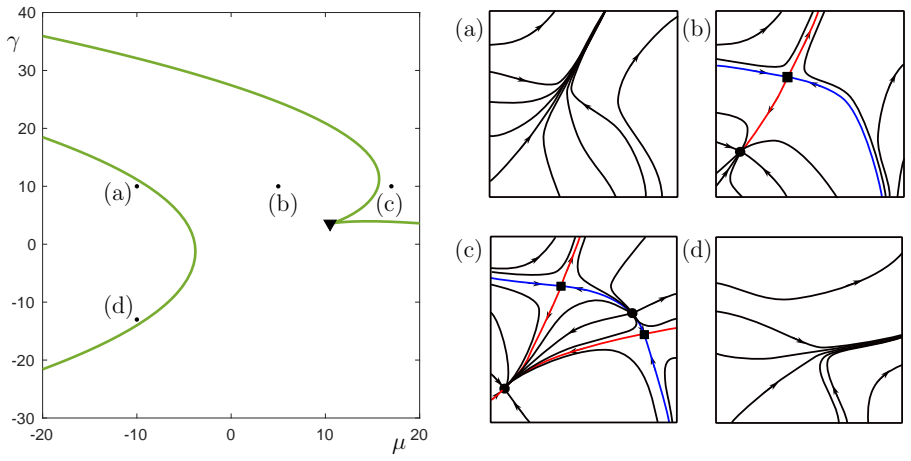
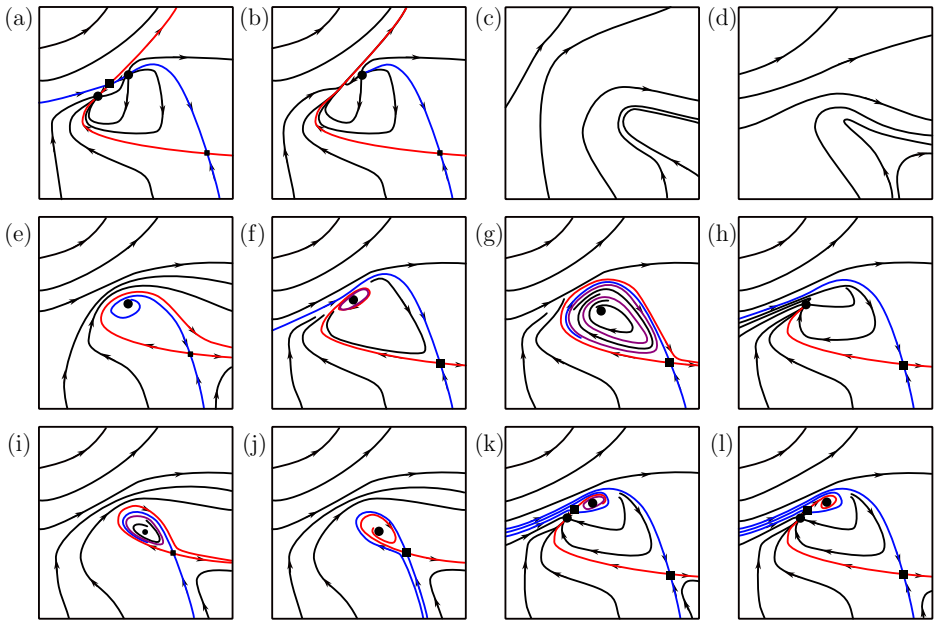
The interaction of two generically coupled systems with simultaneous saddle-node bifurcations requires a four-parameter unfolding. In addition to saddle-node, Hopf and codimension-two local bifurcations, the unfolding contains global bifurcations including homoclinic, SNIC, SNICeroclinic and non-central SNIC bifurcations. Numerical continuation methods are developed for tracking these codimension-two bifurcations through parameter space.
What carries the argument
The four-parameter unfolding of the codimension-two simultaneous saddle-node bifurcations in two coupled ODE systems.
If this is right
- The dynamics include various global bifurcations in addition to local ones.
- SNICeroclinic and non-central SNIC bifurcations occur at the termination of SNIC bifurcation curves.
- Numerical continuation techniques can track codimension-two bifurcations in parameter space.
- Mutualistic and mixed coupling cases are analyzed separately in the unfolding.
Where Pith is reading between the lines
- This framework could extend to understanding interactions in networks of multiple systems with saddle-node bifurcations.
- Similar complexity might appear in other types of codimension-two bifurcations in coupled oscillators or population models.
- The numerical methods could be applied to study tipping point cascades in real-world coupled systems like climate or ecological models.
Load-bearing premise
The two systems are smooth ordinary differential equations with generic coupling terms and undergo saddle-node bifurcations at the same parameter value without additional degeneracies.
What would settle it
An explicit example of two coupled systems with simultaneous saddle-node bifurcations where the interaction cannot be captured by a four-parameter family, or where no global bifurcations appear, would contradict the generic unfolding.
Figures





read the original abstract
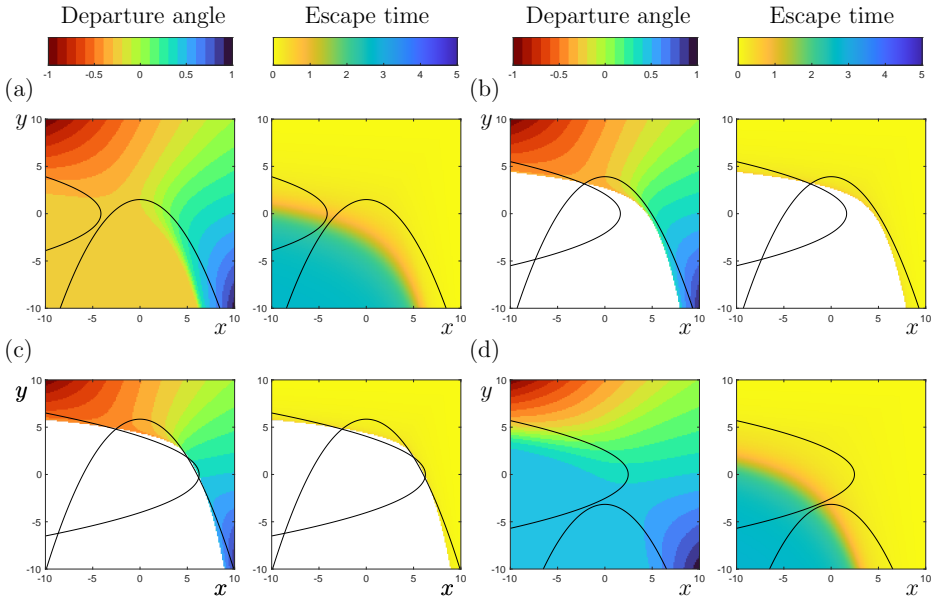
The saddle-node bifurcation is the simplest example of a generic bifurcation in smooth ordinary differential equations, and is associated with the creation or destruction of a pair of equilibria. In this paper we examine the unfolding of the dynamics that occur when two generically coupled systems have simultaneous saddle-node bifurcations. We note that four parameters are required to generically unfold the interactions, and the dynamics are surprisingly complicated relative to the simplicity of a single saddle-node bifurcation. In the unfolding, in addition to saddle-node, Hopf and codimension-two local bifurcations, we also find a variety of global bifurcations, including homoclinic, SNIC, SNICeroclinic and non-central SNIC bifurcations. The latter two are codimension-two bifurcations that occur at the termination of a curve of SNIC bifurcations. A further contribution of this work is the development of numerical continuation techniques for the tracking of these codimension-two bifurcations through parameter space.
Editorial analysis
A structured set of objections, weighed in public.
Referee Report
Summary. The manuscript studies the unfolding of interactions between two generically coupled smooth ODE systems that undergo simultaneous saddle-node bifurcations. It asserts that four parameters are required for a generic unfolding, producing a rich bifurcation structure that includes local bifurcations (saddle-node, Hopf, and codimension-two) as well as global ones (homoclinic, SNIC, SNICeroclinic, and non-central SNIC). The work also develops numerical continuation techniques for tracking the codimension-two loci through parameter space, with attention to mutualistic and mixed coupling cases.
Significance. If the results hold, the paper makes a useful contribution to the study of codimension-two bifurcations in coupled dynamical systems by providing an explicit four-parameter family and classifying an unexpectedly complex set of local and global bifurcations. The development of numerical continuation methods for SNICeroclinic and non-central SNIC bifurcations is a concrete practical strength that could aid future analyses of systems with simultaneous saddle-node points.
minor comments (2)
- [Abstract] Abstract: the terms 'SNICeroclinic' and 'non-central SNIC' are introduced without definition or reference; a parenthetical gloss or citation to the relevant section would improve readability.
- [Introduction] The manuscript would benefit from an explicit statement, early in the introduction or in a dedicated subsection, of the main result establishing that four parameters suffice for the generic unfolding (e.g., a theorem number or proposition).
Simulated Author's Rebuttal
We thank the referee for their positive summary of the manuscript, recognition of its significance in classifying local and global bifurcations in coupled saddle-node systems, and recommendation for minor revision. No specific major comments were raised in the report.
Circularity Check
No significant circularity; derivation self-contained via standard normal-form unfolding
full rationale
The manuscript constructs a four-parameter unfolding for the interaction of two generically coupled smooth ODEs undergoing simultaneous saddle-node bifurcations. This follows directly from the generic normal-form theory for codimension-one saddle-node bifurcations extended to the coupled case, without any reduction to self-definitions, fitted inputs renamed as predictions, or load-bearing self-citations. The classification of local bifurcations (SN, Hopf, codim-2) and global ones (homoclinic, SNIC and variants) is obtained by analyzing the resulting vector field, and the numerical continuation techniques for codim-2 loci are developed as independent algorithmic contributions. No step equates an output to its input by construction, and the work remains externally verifiable against established bifurcation results.
Axiom & Free-Parameter Ledger
free parameters (1)
- four unfolding parameters
axioms (1)
- domain assumption The vector fields are smooth and the coupling is generic.
Reference graph
Works this paper leans on
-
[1]
G. Ansmann, K. Lehnertz, and U. Feudel. Self-induced switchings between multiple space-time patterns on complex networks of excitable units.Phys. Rev. X, 6:011030, Mar 2016. doi: https://doi.org/10.1103/PhysRevX.6.011030
-
[2]
Ashwin and C
P. Ashwin and C. Postlethwaite. Excitable networks for finite state computation with continuous time recurrent neural networks.Biological cybernetics, 115(5):519–538, 2021
2021
-
[3]
Ashwin, C
P. Ashwin, C. Postlethwaite, , and J. Sieber. Pages for supporting repository with interactive figures. URLhttps://peterashwin.github.io/SNinteraction-2025/
2025
-
[4]
Ashwin, M
P. Ashwin, M. Fadera, and C. Postlethwaite. Network attractors and nonlinear dynamics of neural computation.Current Opinion in Neurobiology, 84:102818, 2024. ISSN 0959-
2024
-
[5]
doi: https://doi.org/10.1016/j.conb.2023.102818. 18
-
[6]
Co-evolutionary dynamics for two adaptively coupled Theta neurons
F. Augustsson and E.A. Martens. Co-evolutionary dynamics for two adaptively cou- pled theta neurons.Chaos: An Interdisciplinary Journal of Nonlinear Science, 34(11): 113126, 11 2024. ISSN 1054-1500. doi: https://doi.org/10.1063/5.0226338
-
[7]
C. Baesens and R.S. MacKay. Interaction of two systems with saddle-node bifurcations on invariant circles: I. foundations and the mutualistic case.Nonlinearity, 26(12):3043, nov 2013. doi: https://doi.org/10.1088/0951-7715/26/12/3043
-
[8]
W.-J. Beyn. The numerical computation of connecting orbits in dynamical systems. IMA Journal of Numerical Analysis, 10(3):379–405, 1990. doi: https://doi.org/10. 1093/imanum/10.3.379
1990
-
[9]
Dankowicz and F
H. Dankowicz and F. Schilder.Recipes for continuation. SIAM, 2013
2013
-
[10]
Deco and V.K
G. Deco and V.K. Jirsa. Ongoing cortical activity at rest: criticality, multistability, and ghost attractors.Journal of Neuroscience, 32(10):3366–3375, 2012
2012
-
[11]
E. J. Doedel. Lecture notes on numerical analysis of nonlinear equations. In B Krauskopf, H M Osinga, and J Gal´ an-Vioque, editors,Numerical Continuation Meth- ods for Dynamical Systems: Path following and boundary value problems, pages 1–49. Springer-Verlag, Dordrecht, 2007
2007
-
[12]
E. J. Doedel, A. R. Champneys, T. F. Fairgrieve, Y. A. Kuznetsov, B. Sandstede, and X. Wang.AUTO97: Continuation and bifurcation software for ordinary differential equations; available by FTP from ftp.cs.concordia.ca in directory pub/doedel/auto., 1999
1999
-
[13]
F. Dumortier, R. Roussarie, and C. Rousseau. Hilbert’s 16th problem for quadratic vector fields.Journal of Differential Equations, 110(1):86–133, 1994. ISSN 0022-0396. doi: https://doi.org/10.1006/jdeq.1994.1061
-
[14]
G. B. Ermentrout and N. Kopell. Parabolic bursting in an excitable system coupled with a slow oscillation.SIAM Journal on Applied Mathematics, 46(2):233–253, 1986. doi: https://doi.org/10.1137/0146017
-
[15]
Glendinning and D.J.W
P.A. Glendinning and D.J.W. Simpson. Normal forms for saddle-node bifurcations: Takens’ coefficient and applications in climate models.Proc. R. Soc. A., 478:0548,
-
[16]
doi: http://doi.org/10.1098/rspa.2022.0548
-
[17]
Golubitsky and D
M. Golubitsky and D. Schaeffer. A theory for imperfect bifurcation via singularity theory.Communications on Pure and Applied Mathematics, 32(1):21–98, 1979
1979
-
[18]
Golubitsky and D.G
M. Golubitsky and D.G. Schaeffer.Singularities and Groups in Bifurcation Theory: Volume I. Springer, 1985
1985
-
[19]
Ilyashenko
Yu. Ilyashenko. Centennial history of Hilbert’s 16th problem.Bull. AMS, 39:301–354, 2002. 19
2002
-
[20]
A.C. Rezende J.C. Art´ es, R.D.S. Oliveira. Structurally unstable quadratic vector fields of codimension two: Families possessing either a cusp point or two finite saddle-nodes.J Dyn Diff Equat, 33:1779–1821, 2021. doi: https://doi.org/10.1007/s10884-020-09871-2
-
[21]
D. Koch, A. Nandan, G. Ramesan, I. Tyukin, A. Gorban, and A. Koseska. Ghost channels and ghost cycles guiding long transients in dynamical systems.Physical Review Letters, 133(4):047202, 2024
2024
-
[22]
Yu. A. Kuznetsov.Elements of applied bifurcation theory, volume 112. Springer, 2004
2004
-
[23]
C.R. Laing. The dynamics of networks of identical theta neurons.J. Math. Neurosc., 8, 2018. doi: https://doi.org/10.1186/s13408-018-0059-7
-
[24]
Morozov, U
A. Morozov, U. Feudel, A. Hastings, K.C. Abbott, K. Cuddington, C.M. Heggerud, and S. Petrovskii. Long-living transients in ecological models: Recent progress, new challenges, and open questions.Physics of Life Reviews, 2024
2024
-
[25]
K. Nechyporenko, P. Ashwin, and K. Tsaneva-Atanasova. A novel route to oscilla- tions via non-central SNICeroclinic bifurcation: unfolding the separatrix loop between a saddle-node and a saddle.SIAM J. Applied Dynamical Systems, (to appear), 2026. doi: https://doi.org/10.48550/arXiv.2412.12298
-
[26]
P´ erez-Cervera, P
A. P´ erez-Cervera, P. Ashwin, G. Huguet, T. M. Seara, and J. Rankin. The uncoupling limit of identical hopf bifurcations with an application to perceptual bistability.The Journal of Mathematical Neuroscience, 9(1):7, 2019
2019
-
[27]
Strogatz.Nonlinear dynamics and chaos: with applications to physics, biology, chemistry, and engineering
S.H. Strogatz.Nonlinear dynamics and chaos: with applications to physics, biology, chemistry, and engineering. Chapman and Hall/CRC, 2024
2024
-
[28]
F. Takens. Normal forms for certain singularities of vectorfields.Annales de l’institut Fourier, 23(2):163–195, 1973
1973
-
[29]
Thompson and G.W
J.M.T. Thompson and G.W. Hunt.A General Theory of Elastic Stability. Wiley- interscience publication. J. Wiley, 1973. ISBN 9780471859918. 20 A Defining systems for continuation of SNICeroclinic and Non-central SNIC bifurcations The defining systems for non-central SNIC and SNICeroclinic, used to determine the curves in (µ, β, γ)-space in Figure 5, follow ...
1973
-
[29]
Thompson and G.W
J.M.T. Thompson and G.W. Hunt.A General Theory of Elastic Stability. Wiley- interscience publication. J. Wiley, 1973. ISBN 9780471859918. 20 A Defining systems for continuation of SNICeroclinic and Non-central SNIC bifurcations The defining systems for non-central SNIC and SNICeroclinic, used to determine the curves in (µ, β, γ)-space in Figure 5, follow ...
1973
discussion (0)
Sign in with ORCID, Apple, or X to comment. Anyone can read and Pith papers without signing in.