Recognition: unknown
Interplay of Nonstabilizerness and Ergotropy in Quantum Batteries
Pith reviewed 2026-05-07 04:06 UTC · model grok-4.3
The pith
U(1)-symmetric interactions create a one-to-one match between ergotropy in a quantum battery and the total nonstabilizerness of the charger-battery system.
A machine-rendered reading of the paper's core claim, the machinery that carries it, and where it could break.
Core claim
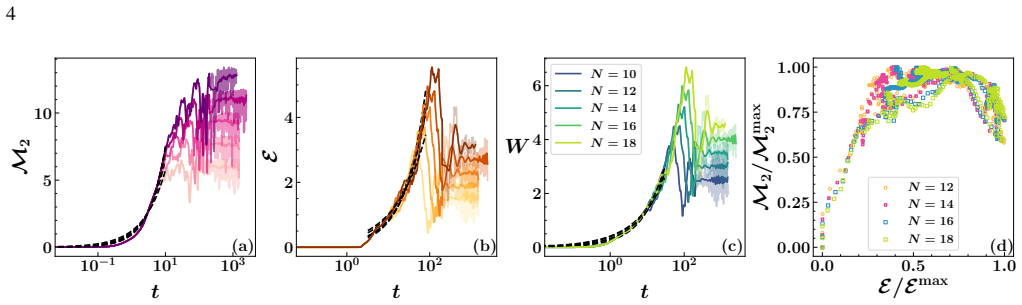
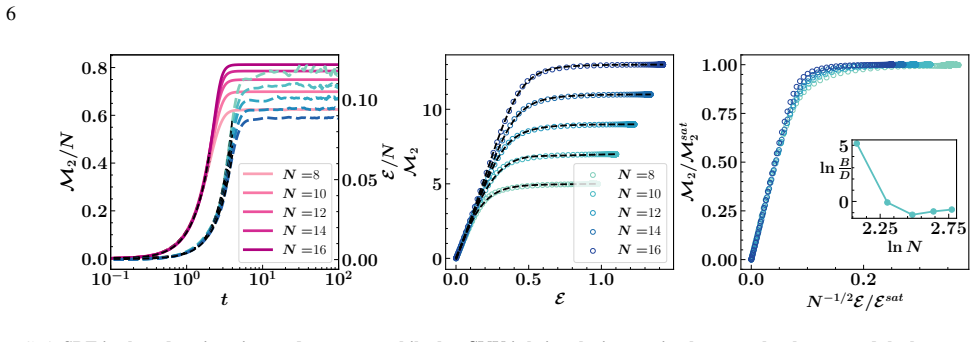
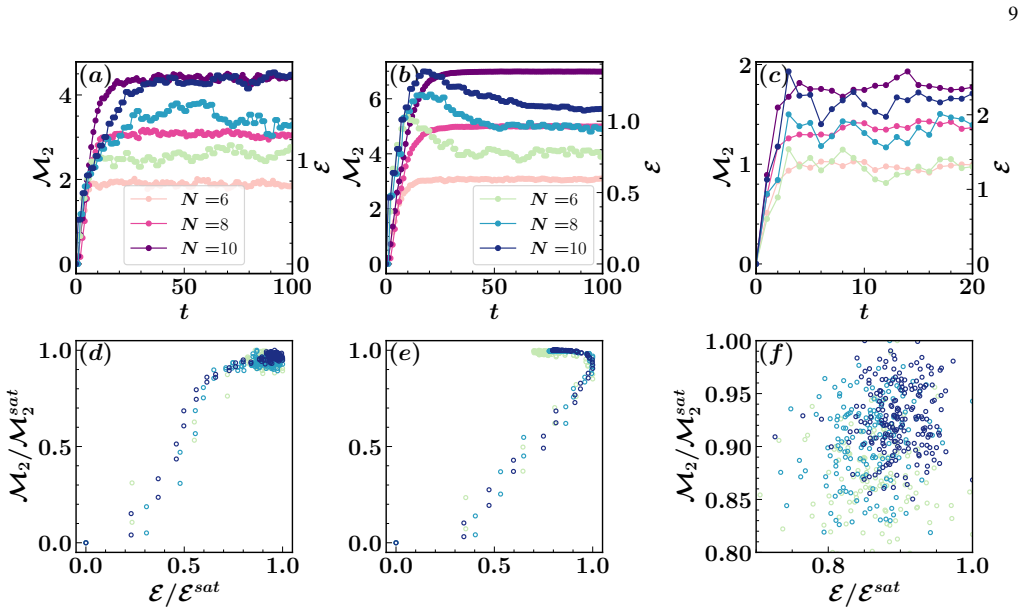
In an N-spin chain with a fixed left-right bipartition, U(1)-symmetric charger-battery interactions produce an exact equality between the ergotropy stored in the battery and the total nonstabilizerness of the full composite state. Interactions lacking U(1) symmetry destroy this equality. In the complementary protocol where the battery begins in a nonstabilizer state and evolves under Clifford gates, the maximum average charging power depends non-monotonically on the initial nonstabilizerness and attains its highest value for certain states with zero magic.
What carries the argument
U(1)-symmetry-preserving interaction Hamiltonians between the charger and battery halves, which enforce a conserved charge that directly equates battery ergotropy to the composite system's total magic.
Load-bearing premise
The physical system must consist of a fixed bipartition into charger and battery halves whose interactions fall cleanly into symmetry-preserving or symmetry-breaking classes.
What would settle it
A numerical or physical realization with U(1)-preserving interactions in which the computed ergotropy fails to equal the independently calculated total nonstabilizerness would disprove the claimed correspondence.
Figures





read the original abstract
Nonstabilizerness plays an essential role in an efficient simulation of quantum systems on quantum computers. In this work, we investigate its role in the context of quantum batteries (QBs). To this end, we consider a system of N spin-1/2 particles, where the left half serves as the charger and the right half acts as the battery. By studying different classes of interactions between the charger and the battery, we quantify the amount of nonstabilizerness required to store work in the QB. Our results reveal that a one-to-one correspondence between the ergotropy stored in the battery and the total nonstabilizerness of the composite system emerges whenever the interaction Hamiltonian preserves a U(1) symmetry. In contrast, this correspondence is generally lost for more generic interactions that do not respect this symmetry. Finally, we examine the complementary scenario in which the battery is initialized in a nonstabilizer state and subsequently charged through Clifford evolution. In this case, we find that the maximum average charging power exhibits a non-monotonic dependence on the initial nonstabilizerness. Remarkably, the highest average power can be achieved even when the initial state carries no magic (nonstabilizerness), demonstrating that the initial magic is not a necessary resource for generating an optimal charging power in this protocol.
Editorial analysis
A structured set of objections, weighed in public.
Referee Report
Summary. The manuscript studies an N-spin-1/2 chain with a fixed left-half charger and right-half battery bipartition. It classifies interaction Hamiltonians and reports that a one-to-one correspondence between battery ergotropy and total composite nonstabilizerness appears precisely when the interaction preserves U(1) symmetry, while the correspondence is lost for generic interactions lacking this symmetry. In the complementary protocol where the battery begins in a nonstabilizer state and is charged by Clifford evolution, the maximum average charging power is found to depend non-monotonically on the initial nonstabilizerness, with the global maximum achievable even for stabilizer initial states.
Significance. If the reported bijection can be shown to hold for arbitrary U(1)-invariant interactions and bipartitions, the result would furnish a concrete link between two operationally distinct quantum resources (ergotropy and nonstabilizerness), with potential implications for resource-efficient quantum battery design. The finding that optimal charging power does not require initial magic is a useful counter-example to the intuition that magic is always a necessary resource for quantum advantage in thermodynamic protocols. The work is technically sound within the models examined and supplies concrete numerical evidence for the interplay, but its broader claims rest on the scope of the symmetry classification.
major comments (2)
- [Abstract / main results] Abstract and main results section: the statement that the one-to-one correspondence 'emerges whenever the interaction Hamiltonian preserves a U(1) symmetry' is not accompanied by a general analytic derivation. The evidence is confined to specific families of U(1)-preserving interactions on the fixed half-half bipartition; it remains unclear whether the bijection survives for other U(1)-invariant Hamiltonians (e.g., longer-range or differently structured) or for unequal bipartitions such as 1-vs-(N-1). A counter-example or a proof that the symmetry alone is sufficient would be required to support the 'whenever' claim.
- [Clifford charging section] Clifford-charging protocol: the claim that the highest average charging power can be achieved with zero initial nonstabilizerness is interesting, but the manuscript does not specify the precise figure of merit (instantaneous power, time-averaged power, or integrated work), the ensemble over which the average is taken, or the optimization procedure used to identify the maximum. Without these details it is difficult to assess whether the non-monotonic dependence is robust or an artifact of the chosen initial-state parametrization.
minor comments (2)
- [Abstract] The abstract mentions 'different classes of interactions' but does not list the explicit Hamiltonians or the symmetry classification criteria; a short table or appendix summarizing the interaction families would improve readability.
- [Methods / definitions] Notation for the nonstabilizerness measure (e.g., whether it is the stabilizer Rényi entropy, mana, or another monotone) should be defined at first use and kept consistent throughout.
Simulated Author's Rebuttal
We thank the referee for the thorough review and valuable feedback, which has prompted us to clarify the scope of our claims and improve the presentation of our results. We address each major comment below and have revised the manuscript to enhance precision and completeness.
read point-by-point responses
-
Referee: [Abstract / main results] Abstract and main results section: the statement that the one-to-one correspondence 'emerges whenever the interaction Hamiltonian preserves a U(1) symmetry' is not accompanied by a general analytic derivation. The evidence is confined to specific families of U(1)-preserving interactions on the fixed half-half bipartition; it remains unclear whether the bijection survives for other U(1)-invariant Hamiltonians (e.g., longer-range or differently structured) or for unequal bipartitions such as 1-vs-(N-1). A counter-example or a proof that the symmetry alone is sufficient would be required to support the 'whenever' claim.
Authors: We appreciate this observation. Our results, including the numerical evidence and analytic arguments, are derived for specific families of U(1)-preserving Hamiltonians (nearest-neighbor and certain long-range variants) on the balanced N/2 vs. N/2 bipartition. The U(1) symmetry enforces conservation of total magnetization, which in turn links the battery ergotropy directly to the total nonstabilizerness through the structure of the eigenstates and the resource theory of magic. In the revised manuscript we have updated the abstract and introduction to read 'for the U(1)-symmetric interactions examined in this work' rather than the broader 'whenever' phrasing. We have also added a new discussion paragraph explaining why the symmetry is expected to be the essential ingredient and why we anticipate the correspondence to hold more generally, while explicitly noting that a rigorous proof for arbitrary U(1)-invariant Hamiltonians and unbalanced bipartitions lies beyond the present scope. No counter-examples were found within the models we tested. revision: partial
-
Referee: [Clifford charging section] Clifford-charging protocol: the claim that the highest average charging power can be achieved with zero initial nonstabilizerness is interesting, but the manuscript does not specify the precise figure of merit (instantaneous power, time-averaged power, or integrated work), the ensemble over which the average is taken, or the optimization procedure used to identify the maximum. Without these details it is difficult to assess whether the non-monotonic dependence is robust or an artifact of the chosen initial-state parametrization.
Authors: We regret the omission of these technical details. The figure of merit is the time-averaged charging power, defined as the total ergotropy extracted from the battery divided by the total charging time, and then averaged over an ensemble of Clifford circuits. The ensemble consists of random Clifford unitaries drawn uniformly from the Clifford group (implemented via random Clifford gates up to a fixed depth sufficient for convergence). The optimization is performed by parametrizing the initial battery state as a convex combination of a stabilizer state and a non-stabilizer state controlled by a single magic parameter, then numerically maximizing the averaged power over both this parameter and the circuit realizations. In the revised manuscript we have inserted a new subsection that explicitly defines the power measure, describes the ensemble and sampling procedure, details the numerical optimization algorithm, and includes additional figures demonstrating that the non-monotonic dependence and the zero-magic optimum persist across different system sizes and circuit depths, confirming robustness beyond the original parametrization. revision: yes
Circularity Check
No significant circularity: correspondence is an observed outcome of explicit computations across interaction classes
full rationale
The paper defines ergotropy (maximum extractable work) and nonstabilizerness (magic) as independent quantities and evaluates both for concrete families of charger-battery interactions in a fixed left-right bipartition of the N-spin chain. The reported one-to-one link appears only for the U(1)-preserving classes and is absent for generic interactions; this is presented as a comparative numerical/analytic result rather than a definitional identity or a fitted parameter relabeled as a prediction. No load-bearing self-citation, ansatz smuggling, or uniqueness theorem imported from prior author work is required for the central claim. The derivation chain therefore remains self-contained within the model calculations and does not reduce to its own inputs by construction.
Axiom & Free-Parameter Ledger
axioms (1)
- domain assumption The composite system is modeled as N spin-1/2 particles bipartitioned into charger and battery halves with well-defined interaction Hamiltonians that either preserve or break U(1) symmetry.
Forward citations
Cited by 1 Pith paper
-
Clifford Ergotropy
Clifford ergotropy is upper-bounded by a magic measure, exhibits a control transition in two qubits, and implies a second law under Clifford operations for typical many-body states.
Reference graph
Works this paper leans on
-
[1]
Horodecki, P
R. Horodecki, P. Horodecki, M. Horodecki, and K. Horodecki, Quantum entanglement, Rev. Mod. Phys.81, 865 (2009)
2009
-
[2]
Aaronson and D
S. Aaronson and D. Gottesman, Improved simulation of stabi- lizer circuits, Phys. Rev. A70, 052328 (2004)
2004
-
[3]
M. A. Nielsen and I. L. Chuang,Quantum computation and quantum information(Cambridge university press, 2010)
2010
-
[4]
Bravyi and A
S. Bravyi and A. Kitaev, Universal quantum computation with ideal clifford gates and noisy ancillas, Phys. Rev. A71, 022316 (2005)
2005
-
[5]
The Heisenberg Representation of Quantum Computers
D. Gottesman, The heisenberg representation of quantum com- puters (1998), arXiv:quant-ph/9807006 [quant-ph]
work page internal anchor Pith review arXiv 1998
-
[6]
Stabilizer Codes and Quantum Error Correction
D. Gottesman, Stabilizer codes and quantum error correction (1997), arXiv:quant-ph/9705052 [quant-ph]
work page internal anchor Pith review arXiv 1997
-
[7]
Gottesman, Theory of fault-tolerant quantum computation, Phys
D. Gottesman, Theory of fault-tolerant quantum computation, Phys. Rev. A57, 127 (1998)
1998
-
[8]
Howard and E
M. Howard and E. Campbell, Application of a resource the- ory for magic states to fault-tolerant quantum computing, Phys. Rev. Lett.118, 090501 (2017)
2017
-
[9]
Leone, S
L. Leone, S. F. E. Oliviero, and A. Hamma, Stabilizer r ´enyi entropy, Phys. Rev. Lett.128, 050402 (2022)
2022
-
[10]
C. D. White, C. Cao, and B. Swingle, Conformal field theories are magical, Phys. Rev. B103, 075145 (2021)
2021
-
[11]
Sarkar, C
S. Sarkar, C. Mukhopadhyay, and A. Bayat, Characterization of an operational quantum resource in a critical many-body sys- tem, New Journal of Physics22, 083077 (2020)
2020
-
[12]
S. F. E. Oliviero, L. Leone, and A. Hamma, Magic-state re- source theory for the ground state of the transverse-field ising model, Phys. Rev. A106, 042426 (2022)
2022
-
[13]
Haug and L
T. Haug and L. Piroli, Quantifying nonstabilizerness of matrix product states, Phys. Rev. B107, 035148 (2023)
2023
-
[14]
P. S. Tarabunga, E. Tirrito, T. Chanda, and M. Dalmonte, Many- body magic via pauli-markov chains—from criticality to gauge theories, PRX Quantum4, 040317 (2023)
2023
-
[15]
P. S. Tarabunga, Critical behaviors of non-stabilizerness in quantum spin chains, Quantum8, 1413 (2024)
2024
-
[16]
E. T. Campbell, B. M. Terhal, and C. Vuillot, Roads to- wards fault-tolerant universal quantum computation, Nature 549, 172179 (2017)
2017
-
[17]
Bravyi, D
S. Bravyi, D. Browne, P. Calpin, E. Campbell, D. Gosset, and M. Howard, Simulation of quantum circuits by low-rank stabi- lizer decompositions, Quantum3, 181 (2019)
2019
-
[18]
S. F. E. Oliviero, L. Leone, A. Hamma, and S. Lloyd, Measur- ing magic on a quantum processor, npj Quantum Information8, 10.1038/s41534-022-00666-5 (2022)
-
[19]
C. Capecci, G. C. Santra, A. Bottarelli, E. Tirrito, and P. Hauke, Role of nonstabilizerness in quantum optimization (2025), arXiv:2505.17185 [quant-ph]
-
[20]
Hern ´andez-Yanes, P
T. Hern ´andez-Yanes, P. Sierant, J. Zakrzewski, and M. Płodzie´n, Nonstabilizerness in quantum-enhanced metro- logical protocols, Phys. Rev. A113, 012416 (2026)
2026
-
[21]
Alicki and M
R. Alicki and M. Fannes, Entanglement boost for extractable work from ensembles of quantum batteries, Phys. Rev. E87, 042123 (2013)
2013
-
[22]
Campaioli, S
F. Campaioli, S. Gherardini, J. Q. Quach, M. Polini, and G. M. Andolina, Colloquium: Quantum batteries, Rev. Mod. Phys.96, 031001 (2024)
2024
-
[23]
F. C. Binder, S. Vinjanampathy, K. Modi, and J. Goold, Quan- tacell: powerful charging of quantum batteries, New Journal of Physics17, 075015 (2015)
2015
-
[24]
Campaioli, F
F. Campaioli, F. A. Pollock, F. C. Binder, L. C ´eleri, J. Goold, S. Vinjanampathy, and K. Modi, Enhancing the charging power of quantum batteries, Phys. Rev. Lett.118, 150601 (2017)
2017
-
[25]
Ferraro, M
D. Ferraro, M. Campisi, G. M. Andolina, V . Pellegrini, and M. Polini, High-power collective charging of a solid-state quan- tum battery, Phys. Rev. Lett.120, 117702 (2018)
2018
-
[26]
G. M. Andolina, M. Keck, A. Mari, M. Campisi, V . Giovannetti, and M. Polini, Extractable work, the role of correlations, and asymptotic freedom in quantum batteries, Phys. Rev. Lett.122, 047702 (2019)
2019
-
[27]
Caravelli, G
F. Caravelli, G. Coulter-De Wit, L. P. Garc ´ıa-Pintos, and A. Hamma, Random quantum batteries, Phys. Rev. Res.2, 023095 (2020)
2020
-
[28]
H.-L. Shi, S. Ding, Q.-K. Wan, X.-H. Wang, and W.-L. Yang, Entanglement, coherence, and extractable work in quantum bat- teries, Phys. Rev. Lett.129, 130602 (2022)
2022
-
[29]
T. K. Konar, L. G. C. Lakkaraju, S. Ghosh, and A. Sen(De), Quantum battery with ultracold atoms: Bosons versus fermions, Phys. Rev. A106, 022618 (2022)
2022
-
[30]
Juli `a-Farr´e, T
S. Juli `a-Farr´e, T. Salamon, A. Riera, M. N. Bera, and M. Lewenstein, Bounds on the capacity and power of quantum batteries, Phys. Rev. Res.2, 023113 (2020)
2020
-
[31]
Yang, Y .-H
X. Yang, Y .-H. Yang, M. Alimuddin, R. Salvia, S.-M. Fei, L.- M. Zhao, S. Nimmrichter, and M.-X. Luo, Battery capacity of energy-storing quantum systems, Phys. Rev. Lett.131, 030402 (2023)
2023
-
[32]
S. Imai, O. G ¨uhne, and S. Nimmrichter, Work fluctuations and entanglement in quantum batteries, Phys. Rev. A107, 022215 (2023)
2023
-
[33]
Bhanja, D
G. Bhanja, D. Tiwari, and S. Banerjee, Impact of non- markovian quantum brownian motion on quantum batteries, Phys. Rev. A109, 012224 (2024)
2024
-
[34]
B. Vigneshwar and R. Sankaranarayanan, Nonlocal contri- butions to ergotropy: A thermodynamic perspective (2025), arXiv:2512.14497 [quant-ph]
-
[35]
T. P. Le, J. Levinsen, K. Modi, M. M. Parish, and F. A. Pollock, Spin-chain model of a many-body quantum battery, Phys. Rev. A97, 022106 (2018)
2018
-
[36]
Rossini, G
D. Rossini, G. M. Andolina, and M. Polini, Many-body local- ized quantum batteries, Phys. Rev. B100, 115142 (2019)
2019
-
[37]
Ghosh, T
S. Ghosh, T. Chanda, and A. Sen(De), Enhancement in the per- formance of a quantum battery by ordered and disordered inter- actions, Phys. Rev. A101, 032115 (2020)
2020
-
[38]
Mondal and S
S. Mondal and S. Bhattacharjee, Periodically driven many-body quantum battery, Phys. Rev. E105, 044125 (2022)
2022
-
[39]
Guo, F.-M
W.-X. Guo, F.-M. Yang, and F.-Q. Dou, Analytically solvable many-body rosen-zener quantum battery, Phys. Rev. A109, 032201 (2024)
2024
-
[40]
X. Zhang, X. Song, and D. Wang, Quantum battery in the heisenberg spin chain models with dzyaloshinski- imoriya interaction, Advanced Quantum Technologies7, 10.1002/qute.202400114 (2024)
- [41]
-
[42]
A. Sahoo and D. Rakshit, Power-law interactions stabilize time crystals realizing quantum energy storage and sensing (2025), arXiv:2508.14847 [quant-ph]
work page internal anchor Pith review Pith/arXiv arXiv 2025
-
[43]
Bhattacharya, V
S. Bhattacharya, V . B. Sabale, and A. Kumar, Heisenberg spin networks for realizing quantum battery with the aid of dzyaloshinskiimoriya interaction, New Journal of Physics28, 014508 (2026)
2026
-
[44]
W. Lu, J. Chen, L.-M. Kuang, and X. Wang, Optimal state for a 15 tavis-cummings quantum battery via the bethe ansatz method, Phys. Rev. A104, 043706 (2021)
2021
-
[45]
F.-Q. Dou, H. Zhou, and J.-A. Sun, Cavity heisenberg-spin- chain quantum battery, Phys. Rev. A106, 032212 (2022)
2022
-
[46]
Zhao, Z.-R
S.-C. Zhao, Z.-R. Zhao, and N.-Y . Zhuang, Non-markoviann- spin chain quantum battery in thermal charging process, Phys. Rev. E112, 024129 (2025)
2025
- [47]
-
[48]
Ghosh, T
S. Ghosh, T. Chanda, S. Mal, and A. Sen(De), Fast charging of a quantum battery assisted by noise, Phys. Rev. A104, 032207 (2021)
2021
-
[49]
Zakavati, F
S. Zakavati, F. T. Tabesh, and S. Salimi, Bounds on charging power of open quantum batteries, Phys. Rev. E104, 054117 (2021)
2021
-
[50]
M. B. Arjmandi, H. Mohammadi, and A. C. Santos, Enhanc- ing self-discharging process with disordered quantum batteries, Phys. Rev. E105, 054115 (2022)
2022
-
[51]
S.-Q. Liu, L. Wang, H. Fan, F.-L. Wu, and S.-Y . Liu, Better per- formance of quantum batteries in different environments com- pared to closed batteries, Phys. Rev. A109, 042411 (2024)
2024
-
[52]
Tirone, R
S. Tirone, R. Salvia, S. Chessa, and V . Giovannetti, Work ex- traction processes from noisy quantum batteries: The role of nonlocal resources, Phys. Rev. Lett.131, 060402 (2023)
2023
- [53]
-
[54]
F. H. Kamin, F. T. Tabesh, S. Salimi, F. Kheirandish, and A. C. Santos, Non-markovian effects on charging and self- discharging process of quantum batteries, New Journal of Physics22, 083007 (2020)
2020
-
[55]
A. C. Santos, Quantum advantage of two-level batteries in the self-discharging process, Phys. Rev. E103, 042118 (2021)
2021
-
[56]
Xu, H.-G
K. Xu, H.-G. Li, H.-J. Zhu, and W.-M. Liu, Inhibiting the self-discharging process of quantum batteries in non-markovian noises, Phys. Rev. E109, 054132 (2024)
2024
-
[57]
Chaki, A
P. Chaki, A. Bhattacharyya, K. Sen, and U. Sen, Auxiliary- assisted energy distillation from quantum batteries, Phys. Rev. A112, 052446 (2025)
2025
-
[58]
Morrone, M
D. Morrone, M. A. Rossi, and M. G. Genoni, Daemonic er- gotropy in continuously monitored open quantum batteries, Phys. Rev. Appl.20, 044073 (2023)
2023
-
[59]
Ahmadi, P
B. Ahmadi, P. Mazurek, P. Horodecki, and S. Barzanjeh, Non- reciprocal quantum batteries, Phys. Rev. Lett.132, 210402 (2024)
2024
-
[60]
Medina, O
I. Medina, O. Culhane, F. C. Binder, G. T. Landi, and J. Goold, Anomalous discharging of quantum batteries: The ergotropic mpemba effect, Phys. Rev. Lett.134, 220402 (2025)
2025
-
[61]
M. Hadipour and S. Haseli, Nonequilibrium quantum batter- ies: Amplified work extraction through thermal bath modula- tion (2025), arXiv:2502.05508 [quant-ph]
-
[62]
Z.-G. Lu, G. Tian, X.-Y . L ¨u, and C. Shang, Topological quan- tum batteries (2025)
2025
-
[63]
Vigneshwar and R
B. Vigneshwar and R. Sankaranarayanan, Noise resilience of spin quantum battery in the presence of dm interactions, Journal of Physics A: Mathematical and Theoretical59, 015302 (2026)
2026
-
[64]
Joshi and T
J. Joshi and T. S. Mahesh, Experimental investigation of a quan- tum battery using star-topology nmr spin systems, Phys. Rev. A 106, 042601 (2022)
2022
-
[65]
I. M. de Buy Wenniger, S. E. Thomas, M. Maffei, S. C. Wein, M. Pont, N. Belabas, S. Prasad, A. Harouri, A. Lematre, I. Sagnes, N. Somaschi, A. Auffves, and P. Senellart, Experi- mental analysis of energy transfers between a quantum emitter and light fields (2023), arXiv:2202.01109 [quant-ph]
-
[66]
J. Q. Quach, K. E. McGhee, L. Ganzer, D. M. Rouse, B. W. Lovett, E. M. Gauger, J. Keeling, G. Cerullo, D. G. Lidzey, and T. Virgili, Superabsorption in an organic microcavity: To- ward a quantum battery, Science Advances8, 3160 (2022), https://www.science.org/doi/pdf/10.1126/sciadv.abk3160
-
[67]
Dou and F.-M
F.-Q. Dou and F.-M. Yang, Superconducting transmon qubit- resonator quantum battery, Phys. Rev. A107, 023725 (2023)
2023
-
[68]
C.-K. Hu, J. Qiu, P. J. P. Souza, J. Yuan, Y . Zhou, L. Zhang, J. Chu, X. Pan, L. Hu, J. Li, Y . Xu, Y . Zhong, S. Liu, F. Yan, D. Tan, R. Bachelard, C. J. Villas-Boas, A. C. Santos, and D. Yu, Optimal charging of a superconducting quantum battery, Quantum Science and Technology7, 045018 (2022)
2022
-
[69]
G. Gemme, M. Grossi, D. Ferraro, S. Vallecorsa, and M. Sas- setti, Ibm quantum platforms: A quantum battery perspective, Batteries8, 10.3390/batteries8050043 (2022)
-
[70]
Kurman, K
Y . Kurman, K. Hymas, A. Fedorov, W. J. Munro, and J. Quach, Powering quantum computation with quantum batteries, Phys. Rev. X16, 011016 (2026)
2026
-
[71]
J.-Y . Gyhm, D. ˇSafr´anek, and D. Rosa, Quantum charging ad- vantage cannot be extensive without global operations, Phys. Rev. Lett.128, 140501 (2022)
2022
-
[72]
Veitch, S
V . Veitch, S. A. Hamed Mousavian, D. Gottesman, and J. Emer- son, The resource theory of stabilizer quantum computation, New Journal of Physics16, 013009 (2014)
2014
-
[73]
Sierant, J
P. Sierant, J. Vall `es-Muns, and A. Garcia-Saez, Computing quantum magic of state vectors, Quantum10, 2059 (2026)
2059
-
[74]
A. E. Allahverdyan, R. Balian, and T. M. Nieuwenhuizen, Max- imal work extraction from finite quantum systems, Europhysics Letters (EPL)67, 565571 (2004)
2004
-
[75]
Sachdev and J
S. Sachdev and J. Ye, Gapless spin-fluid ground state in a ran- dom quantum heisenberg magnet, Phys. Rev. Lett.70, 3339 (1993)
1993
-
[76]
Bera and M
S. Bera and M. Schiro, Non-stabilizerness of Sachdev-Ye- Kitaev model, SciPost Phys.19, 159 (2025)
2025
-
[77]
Russomanno, G
A. Russomanno, G. Passarelli, D. Rossini, and P. Lucignano, Nonstabilizerness in the unitary and monitored quantum dy- namics of xxz-staggered and sachdev-ye-kitaev models, Phys. Rev. B112, 064312 (2025)
2025
-
[78]
Jasser, J
B. Jasser, J. Odavi ´c, and A. Hamma, Stabilizer entropy and en- tanglement complexity in the sachdev-ye-kitaev model, Phys. Rev. B112, 174204 (2025)
2025
-
[79]
Rossini, G
D. Rossini, G. M. Andolina, D. Rosa, M. Carrega, and M. Polini, Quantum advantage in the charging process of sachdev-ye-kitaev batteries, Phys. Rev. Lett.125, 236402 (2020)
2020
-
[80]
D. Rosa, D. Rossini, G. M. Andolina, M. Polini, and M. Carrega, Ultra-stable charging of fast-scrambling syk quantum batteries, Journal of High Energy Physics2020, 10.1007/jhep11(2020)067 (2020)
discussion (0)
Sign in with ORCID, Apple, or X to comment. Anyone can read and Pith papers without signing in.