Recognition: unknown
Reducing Postselection Overhead in Magic-State Cultivation by In-Patch Multiplexing
Pith reviewed 2026-05-07 17:07 UTC · model grok-4.3
The pith
In-patch multiplexing reduces expected attempts in magic-state cultivation by creating multiple early opportunities inside one logical patch.
A machine-rendered reading of the paper's core claim, the machinery that carries it, and where it could break.
Core claim
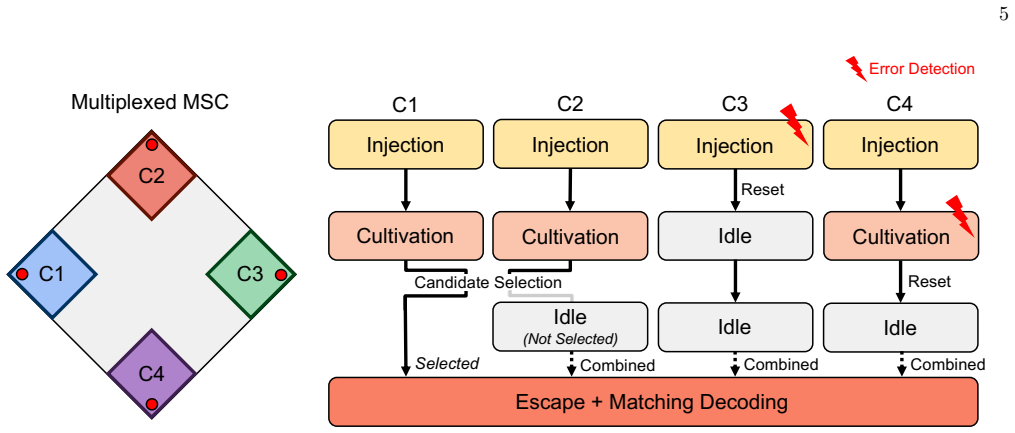
The central claim is that in-patch multiplexing creates multiple local cultivation opportunities from early-stage idle resources inside one logical patch, forwards passing candidates to the standard escape pathway, and thereby reduces the injection-and-cultivation discard rate and expected attempts without altering the escape stage or decoder-based acceptance procedure.
What carries the argument
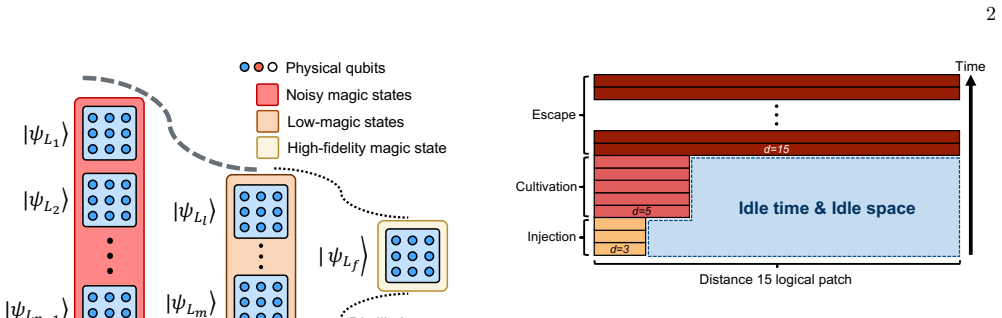
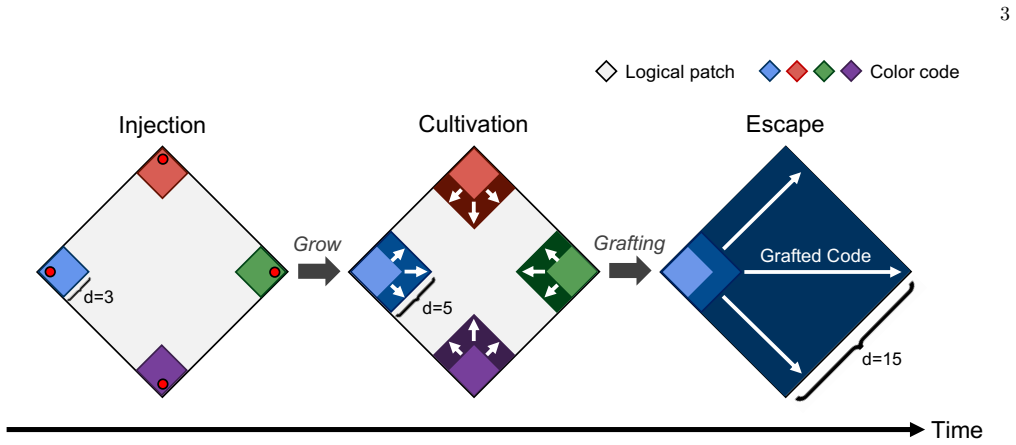
In-patch multiplexing scheme that repurposes idle resources inside a single logical patch to generate parallel early-stage cultivation trials before forwarding successes to the escape stage.
If this is right
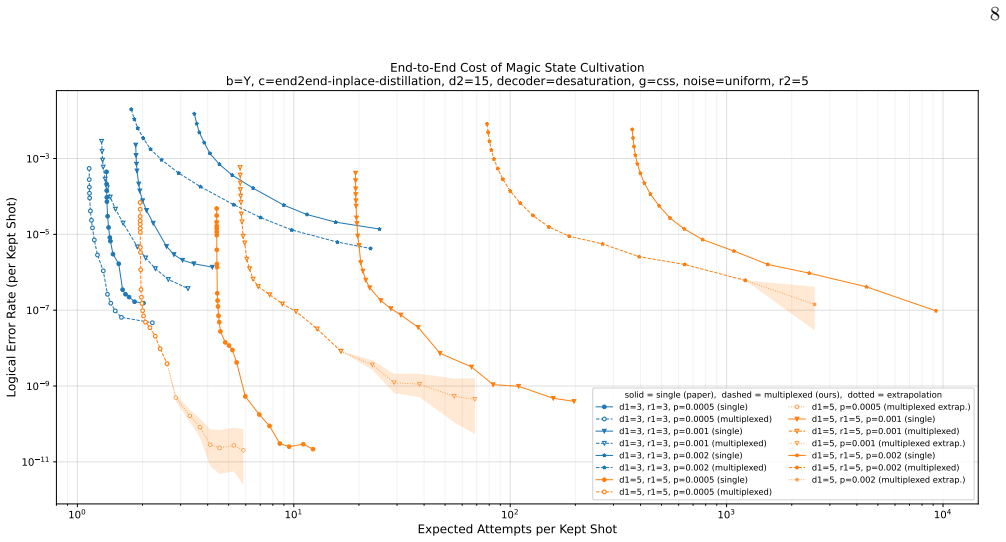
- Injection-and-cultivation expected attempts fall by 45.46% for d1=3 and 72.91% for d1=5 at p=2×10^{-3}.
- Full-cycle expected attempts per kept logical output fall by 49.04% for d1=3 and 78.69% for d1=5 at the same rate.
- Full-cycle cost curves shift toward smaller expected attempts.
- Final logical-error rates stay governed solely by the escape-stage gap threshold.
Where Pith is reading between the lines
- The same idle-resource reuse could be applied to other postselection-heavy stages in surface-code protocols.
- Hardware tests with realistic idle noise could check whether the depolarizing model over- or under-estimates the multiplexing gain.
- Combining in-patch multiplexing with distance-adaptive cultivation might further compress the overall cost curve.
Load-bearing premise
The escape stage and decoder acceptance can stay identical to the single-site baseline without adding new error sources, and the uniform depolarizing noise model with idle noise accurately represents hardware behavior during multiplexing.
What would settle it
A measurement showing that the logical error rate after multiplexing differs from the single-site baseline at the same escape gap threshold, or that the predicted reduction in attempts fails to appear under the assumed noise model, would falsify the preservation of baseline behavior.
Figures





read the original abstract
Fault-tolerant quantum computing requires high-fidelity logical magic states for implementing non-Clifford operations. Magic-state cultivation provides a lower-overhead route to logical magic-state preparation, but its efficiency is limited by postselection loss during the early injection-and-cultivation stages. In this work, we propose an in-patch multiplexing scheme that uses early-stage idle resources within a single logical patch to create multiple local cultivation opportunities. A candidate that passes the early stages is forwarded to the standard escape pathway, while the escape stage and the decoder-based acceptance procedure are kept identical to those of the single-site baseline. Under a uniform depolarizing noise model with idle noise, the proposed protocol substantially reduces the injection-and-cultivation discard rate and the expected number of attempts required to obtain an accepted early-stage candidate. At a physical error rate of \(p=2\times10^{-3}\), the injection-and-cultivation expected attempts are reduced by \(45.46\%\) for \(d_1=3\) and by \(72.91\%\) for \(d_1=5\), relative to the single-site MSC baseline. In the direct full-cycle evaluation including escape, the expected attempts per kept logical output are further reduced by \(49.04\%\) for \(d_1=3\) and by \(78.69\%\) for \(d_1=5\) at the same physical error rate. The full-cycle cost curves are shifted toward smaller expected attempts, while the final logical-error behavior remains governed by the escape-stage gap threshold. These results show that in-patch multiplexing can reduce postselection overhead while preserving the standard magic-state cultivation framework.
Editorial analysis
A structured set of objections, weighed in public.
Referee Report
Summary. The manuscript introduces an in-patch multiplexing scheme for magic-state cultivation (MSC) that exploits idle resources inside a single logical patch to generate multiple early-stage cultivation candidates. Successful candidates are forwarded to an otherwise unchanged escape stage whose decoder-based acceptance criterion is identical to the single-site baseline. Under a uniform depolarizing noise model that includes idle noise, the authors report concrete reductions in expected attempts: 45.46% (d1=3) and 72.91% (d1=5) for the injection-and-cultivation stage, and 49.04% / 78.69% in the full-cycle metric that includes escape, all at physical error rate p=2×10^{-3}. The final logical-error rate remains governed by the escape-stage gap threshold.
Significance. If the multiplexing operations do not alter the error distribution reaching the escape stage, the scheme offers a practical route to lowering post-selection overhead in an already low-overhead MSC framework. The work supplies explicit numerical improvements obtained from circuit-level simulations under a stated noise model; this concrete, reproducible-style evidence is a positive feature. The approach preserves the existing MSC pipeline, which facilitates direct comparison with prior single-site results.
major comments (3)
- [Abstract and §4] Abstract and §4 (Numerical Results): The reported percentage reductions (45.46%, 72.91%, 49.04%, 78.69%) are given as point values with no accompanying error bars, confidence intervals, or description of Monte Carlo sample sizes and convergence criteria. Because the central claim is quantitative improvement under a specific noise model, the absence of statistical characterization makes it impossible to judge whether the observed gains exceed sampling fluctuations.
- [§3 and §4.1] §3 (Protocol Description) and §4.1 (Simulation Setup): The manuscript asserts that the escape stage and decoder remain identical, yet provides no direct comparison of the logical-error rate or the distribution of error weights entering the escape decoder between the multiplexed and single-site cases. Under circuit-level depolarizing noise, the additional idles and operations required for in-patch multiplexing can introduce spatial or temporal correlations that change the effective input to the gap-threshold test, even if the syntactic acceptance procedure is unchanged.
- [§4.2] §4.2 (Full-Cycle Evaluation): The claim that “the final logical-error behavior remains governed by the escape-stage gap threshold” is stated without a supporting plot or table that overlays the logical-error rate versus gap threshold for both the multiplexed and baseline protocols. Such a comparison is required to confirm that the multiplexing does not shift the operating point of the escape stage.
minor comments (2)
- [§4.1] The noise model is described as “uniform depolarizing with idle noise,” but the precise idle-error rate relative to the gate error rate p is not stated in the main text; it should be given explicitly (perhaps as a multiple of p) so that the simulations can be reproduced.
- [Figures 3–5] Figure captions for the cost curves should include the exact values of d1, d2, and the gap threshold used, rather than referring only to “the parameters of the main text.”
Simulated Author's Rebuttal
We thank the referee for their careful reading of our manuscript and for the constructive comments. We address each of the major comments below, indicating where revisions will be made to strengthen the presentation of our results.
read point-by-point responses
-
Referee: [Abstract and §4] Abstract and §4 (Numerical Results): The reported percentage reductions (45.46%, 72.91%, 49.04%, 78.69%) are given as point values with no accompanying error bars, confidence intervals, or description of Monte Carlo sample sizes and convergence criteria. Because the central claim is quantitative improvement under a specific noise model, the absence of statistical characterization makes it impossible to judge whether the observed gains exceed sampling fluctuations.
Authors: We agree that including statistical details is important for assessing the reliability of the quantitative claims. In the revised manuscript, we will specify the Monte Carlo sample sizes employed in the simulations and provide error bars or confidence intervals for the reported percentage reductions in expected attempts. This will enable readers to evaluate whether the improvements are statistically significant. revision: yes
-
Referee: [§3 and §4.1] §3 (Protocol Description) and §4.1 (Simulation Setup): The manuscript asserts that the escape stage and decoder remain identical, yet provides no direct comparison of the logical-error rate or the distribution of error weights entering the escape decoder between the multiplexed and single-site cases. Under circuit-level depolarizing noise, the additional idles and operations required for in-patch multiplexing can introduce spatial or temporal correlations that change the effective input to the gap-threshold test, even if the syntactic acceptance procedure is unchanged.
Authors: While the escape stage circuit and decoder are unchanged by design, we acknowledge the possibility that additional operations in the early stage could affect error correlations. To rigorously address this concern, we will include in the revised manuscript a comparison of the logical error rates and error weight distributions entering the escape stage for both the multiplexed and baseline protocols. This will confirm that the input to the gap-threshold test remains effectively the same. revision: yes
-
Referee: [§4.2] §4.2 (Full-Cycle Evaluation): The claim that “the final logical-error behavior remains governed by the escape-stage gap threshold” is stated without a supporting plot or table that overlays the logical-error rate versus gap threshold for both the multiplexed and baseline protocols. Such a comparison is required to confirm that the multiplexing does not shift the operating point of the escape stage.
Authors: We concur that an explicit visual or tabular comparison would better substantiate the claim. Accordingly, we will add to the revised manuscript a plot or table that overlays the logical error rate versus gap threshold for the in-patch multiplexed protocol and the single-site baseline, demonstrating that the final logical-error behavior is indeed governed by the escape-stage gap threshold in both cases. revision: yes
Circularity Check
No circularity; results are direct simulation outputs
full rationale
The paper reports numerical reductions in expected attempts (45.46% for d1=3, 72.91% for d1=5 at p=2e-3) obtained from Monte Carlo simulations of the in-patch multiplexing protocol versus the single-site baseline under an explicitly stated uniform depolarizing noise model with idle noise. The escape stage and decoder acceptance are described as syntactically identical to the baseline, with logical error behavior governed by the gap threshold; these are simulation setup choices, not fitted parameters or self-referential definitions that would render the reported percentages tautological by construction. No equations, ansatzes, or self-citations are invoked in the provided text to force the outcomes. The derivation chain consists of independent circuit-level simulations and is therefore self-contained.
Axiom & Free-Parameter Ledger
axioms (2)
- domain assumption Uniform depolarizing noise model with idle noise governs the physical errors during cultivation and multiplexing
- domain assumption Escape stage and decoder acceptance criteria remain valid and unchanged when early-stage multiplexing is added
Reference graph
Works this paper leans on
-
[1]
Within this broader landscape, magic-state cultivation has been proposed as a lower-cost alternative for preparing logical|T⟩states in the interme- diate logical-error regime
Magic state cultivation Magic-state preparation is a standard route to fault- tolerant non-Clifford computation, with magic-state dis- tillation serving as the dominant framework for produc- ing high-fidelity logical resource states from noisier en- coded inputs [15, 51–53]. Within this broader landscape, magic-state cultivation has been proposed as a low...
-
[2]
These code regions are not structurally identi- cal
Patch structures and the need for grafting The standard MSC protocol combines local growth on color-code regions with final escape into a larger logical patch. These code regions are not structurally identi- cal. Surface-code patches and color-code patches differ in stabilizer geometry and in the corresponding syndrome- extraction circuits [57–61]. Figure...
-
[2]
These code regions are not structurally identi- cal
Patch structures and the need for grafting The standard MSC protocol combines local growth on color-code regions with final escape into a larger logical patch. These code regions are not structurally identi- cal. Surface-code patches and color-code patches differ in stabilizer geometry and in the corresponding syndrome- extraction circuits [57–61]. Figure...
-
[3]
For each sitei, define two binary survival indicators: χ(inj) i , χ (cult) i ∈ {0,1}
Detector-based success criterion and candidate formation Let the four local cultivation sites be indexed byi∈ {1,2,3,4}. For each sitei, define two binary survival indicators: χ(inj) i , χ (cult) i ∈ {0,1}. Here,χ (inj) i = 1 means that siteisurvives injection with- out triggering an error-detection event, andχ (cult) i = 1 means that siteisurvives cultiv...
-
[4]
If C=∅, then no local trajectory has survived the early stages, and the shot is discarded
Selection rule and idle treatment Once the candidate setChas been formed, the protocol distinguishes two cases. If C=∅, then no local trajectory has survived the early stages, and the shot is discarded. A new shot must then be started from the beginning. If instead |C| ≥1, then one candidate is selected for continuation into the escape stage. We denote th...
-
[5]
The selected local trajectory is forwarded to the same grafted transition and subsequent escape path described for the single-site protocol in the main text
Connection to the standard MSC escape framework Once the selected sitec ⋆ has been determined, the pro- tocol returns to the standard MSC escape framework. The selected local trajectory is forwarded to the same grafted transition and subsequent escape path described for the single-site protocol in the main text. Thus, multi- plexing is confined to the ear...
-
[6]
A. R. Calderbank and P. W. Shor, Good quantum error- correcting codes exist, Phys. Rev. A54, 1098 (1996)
1996
-
[7]
P. W. Shor, Scheme for reducing decoherence in quantum computer memory, Phys. Rev. A52, R2493 (1995)
1995
-
[8]
Gottesman, Theory of fault-tolerant quantum compu- tation, Physical Review A57, 127 (1998)
D. Gottesman, Theory of fault-tolerant quantum compu- tation, Physical Review A57, 127 (1998)
1998
- [9]
-
[10]
B. M. Terhal, Quantum error correction for quantum memories, Reviews of Modern Physics87, 307 (2015)
2015
-
[11]
Knill, R
E. Knill, R. Laflamme, and W. H. Zurek, Resilient Quan- tum Computation, Science279, 342 (1998)
1998
-
[12]
D. Aharonov and M. Ben-Or, Fault-Tolerant Quan- tum Computation with Constant Error Rate, SIAM Journal on Computing38, 1207 (2008), eprint: https://doi.org/10.1137/S0097539799359385
-
[13]
Aliferis, D
P. Aliferis, D. Gottesman, and J. Preskill, Quantum accu- racy threshold for concatenated distance-3 codes, Quan- tum Info. Comput.6, 97–165 (2006)
2006
-
[14]
Raussendorf and J
R. Raussendorf and J. Harrington, Fault-tolerant quan- tum computation with high threshold in two dimensions, Phys. Rev. Lett.98, 190504 (2007)
2007
-
[15]
Bravyi and A
S. Bravyi and A. Kitaev, Universal quantum computa- tion with ideal Clifford gates and noisy ancillas, Physical Review A71, 022316 (2005)
2005
-
[16]
Eastin and E
B. Eastin and E. Knill, Restrictions on Transversal En- coded Quantum Gate Sets, Physical Review Letters102, 110502 (2009)
2009
-
[17]
B. Zeng, A. Cross, and I. L. Chuang, Transversality Versus Universality for Additive Quantum Codes, IEEE Transactions on Information Theory57, 6272 (2011)
2011
-
[18]
Gottesman and I
D. Gottesman and I. L. Chuang, Demonstrating the via- bility of universal quantum computation using teleporta- tion and single-qubit operations, Nature402, 390 (1999)
1999
-
[19]
Knill, Quantum computing with realistically noisy de- vices, Nature434, 39 (2005)
E. Knill, Quantum computing with realistically noisy de- vices, Nature434, 39 (2005)
2005
-
[20]
B. W. Reichardt, Quantum universality by state distilla- tion, Quantum Info. Comput.9, 1030–1052 (2009)
2009
-
[21]
B. W. Reichardt, Quantum universality from magic states distillation applied to css codes, Quantum Infor- mation Processing4, 251–264 (2005)
2005
-
[22]
X. Zhou, D. W. Leung, and I. L. Chuang, Methodology for quantum logic gate construction, Physical Review A 62, 052316 (2000)
2000
-
[23]
O’Gorman and E
J. O’Gorman and E. T. Campbell, Quantum computa- tion with realistic magic-state factories, Physical Review A95, 032338 (2017)
2017
-
[24]
E. T. Campbell, B. M. Terhal, and C. Vuillot, Roads towards fault-tolerant universal quantum computation, Nature549, 172 (2017)
2017
-
[25]
Bravyi and J
S. Bravyi and J. Haah, Magic-state distillation with low overhead, Physical Review A86, 052329 (2012)
2012
-
[26]
Chamberland and K
C. Chamberland and K. Noh, Very low overhead fault- tolerant magic state preparation using redundant ancilla encoding and flag qubits, npj Quantum Information6, 91 (2020)
2020
-
[27]
E. T. Campbell and D. E. Browne, Bound States for Magic State Distillation in Fault-Tolerant Quan- tum Computation, Physical Review Letters104, 030503 (2010)
2010
-
[28]
E. T. Campbell, H. Anwar, and D. E. Browne, Magic- State Distillation in All Prime Dimensions Using Quan- tum Reed-Muller Codes, Physical Review X2, 041021 (2012)
2012
-
[29]
Jones, Multilevel distillation of magic states for quan- tum computing, Physical Review A87, 042305 (2013)
C. Jones, Multilevel distillation of magic states for quan- tum computing, Physical Review A87, 042305 (2013)
2013
-
[30]
Magic state cultivation: growing T states as cheap as CNOT gates
C. Gidney, N. Shutty, and C. Jones, Magic state cultiva- tion: growing T states as cheap as CNOT gates (2024), arXiv:2409.17595 [quant-ph]
work page internal anchor Pith review arXiv 2024
-
[31]
E. Rosenfeld, C. Gidney, G. Roberts, A. Morvan, N. Lacroix, D. Kafri, J. Marshall, M. Li, V. Sivak, D. Abanin, A. Abbas, R. Acharya, L. A. Beni, G. Aigeldinger, R. Alcaraz, S. Alcaraz, T. I. Andersen, M. Ansmann, F. Arute, K. Arya, W. Askew, N. As- trakhantsev, J. Atalaya, R. Babbush, B. Ballard, J. C. Bardin, H. Bates, A. Bengtsson, M. B. Karimi, A. Bilm...
-
[32]
Chen, M.-C
Z.-H. Chen, M.-C. Chen, C.-Y. Lu, and J.-W. Pan, Ef- ficient magic state cultivation on∖p 2, PRX Quantum7, 010315 (2026)
2026
-
[33]
Vaknin, S
Y. Vaknin, S. Jacoby, A. Grimsmo, and A. Retzker, High rate magic state cultivation on the surface code, PRX Quantum7, 010353 (2026)
2026
- [34]
-
[35]
Gidney, C
C. Gidney, C. Jones, and N. Shutty, Data for ”Magic state cultivation: growing T states as cheap as CNOT gates” (2024)
2024
-
[36]
D. S. Wang, A. G. Fowler, and L. C. L. Hollenberg, Sur- face code quantum computing with error rates over 1%, Phys. Rev. A83, 020302(R) (2011)
2011
-
[37]
Tomita and K
Y. Tomita and K. M. Svore, Low-distance surface codes under realistic quantum noise, Phys. Rev. A90, 062320 (2014)
2014
-
[38]
T. Hao, J. Sullivan, S. Omanakuttan, M. A. Perlin, and R. Shaydulin, Compilation Pipeline for Predicting Algo- rithmic Break-Even in an Early-Fault-Tolerant Surface Code Architecture (2025)
2025
-
[39]
B. A. Chase and F. Labib, Clifft: Fast Exact Sim- ulation of Near-Clifford Quantum Circuits (2026), arXiv:2604.27058 [quant-ph]
work page internal anchor Pith review Pith/arXiv arXiv 2026
-
[40]
Higgott, T
O. Higgott, T. C. Bohdanowicz, A. Kubica, S. T. Flam- mia, and E. T. Campbell, Improved decoding of circuit noise and fragile boundaries of tailored surface codes, Phys. Rev. X13, 031007 (2023)
2023
-
[41]
Bombin, R
H. Bombin, R. S. Andrist, M. Ohzeki, H. G. Katzgraber, and M. A. Martin-Delgado, Strong resilience of topo- logical codes to depolarization, Phys. Rev. X2, 021004 (2012)
2012
-
[42]
D. S. Wang, A. G. Fowler, A. M. Stephens, and L. C. L. Hollenberg, Threshold error rates for the toric and planar codes, Quantum Info. Comput.10, 456–469 (2010)
2010
-
[43]
Jones, Low-overhead constructions for the fault- tolerant Toffoli gate, Physical Review A87, 022328 (2013)
C. Jones, Low-overhead constructions for the fault- tolerant Toffoli gate, Physical Review A87, 022328 (2013)
2013
-
[44]
Tiurev, P.-J
K. Tiurev, P.-J. H. S. Derks, J. Roffe, J. Eisert, and J.-M. Reiner, Correcting non-independent and non-identically distributed errors with surface codes, Quantum7, 1123 (2023)
2023
-
[45]
D. Cruz, F. A. Monteiro, and B. C. Coutinho, Quantum Error Correction Via Noise Guessing Decoding, IEEE Ac- cess11, 119446 (2023)
2023
-
[46]
Harper, S
R. Harper, S. T. Flammia, and J. J. Wallman, Effi- cient learning of quantum noise, Nature Physics16, 1184 (2020)
2020
-
[47]
Sarovar, T
M. Sarovar, T. Proctor, K. Rudinger, K. Young, E. Nielsen, and R. Blume-Kohout, Detecting crosstalk errors in quantum information processors, Quantum4, 321 (2020)
2020
-
[48]
Rudinger, C
K. Rudinger, C. W. Hogle, R. K. Naik, A. Hashim, D. Lobser, D. I. Santiago, M. D. Grace, E. Nielsen, T. Proctor, S. Seritan, S. M. Clark, R. Blume-Kohout, I. Siddiqi, and K. C. Young, Experimental Characteri- zation of Crosstalk Errors with Simultaneous Gate Set Tomography, PRX Quantum2, 040338 (2021)
2021
-
[49]
J. M. Gambetta, A. D. C´ orcoles, S. T. Merkel, B. R. Johnson, J. A. Smolin, J. M. Chow, C. A. Ryan, C. Rigetti, S. Poletto, T. A. Ohki, M. B. Ketchen, and M. Steffen, Characterization of Addressability by Si- multaneous Randomized Benchmarking, Physical Review Letters109, 240504 (2012)
2012
-
[50]
Krinner, S
S. Krinner, S. Lazar, A. Remm, C. Andersen, N. Lacroix, G. Norris, C. Hellings, M. Gabureac, C. Eichler, and A. Wallraff, Benchmarking coherent errors in controlled- phase gates due to spectator qubits, Phys. Rev. Appl. 14, 024042 (2020)
2020
-
[51]
Duan, Z.-F
P. Duan, Z.-F. Chen, Q. Zhou, W.-C. Kong, H.-F. Zhang, and G.-P. Guo, Mitigating crosstalk-induced qubit read- out error with shallow-neural-network discrimination, Phys. Rev. Appl.16, 024063 (2021)
2021
-
[52]
X. Dai, D. Tennant, R. Trappen, A. Martinez, D. Melan- son, M. Yurtalan, Y. Tang, S. Novikov, J. Grover, S. Disseler, J. Basham, R. Das, D. Kim, A. Melville, B. Niedzielski, S. Weber, J. Yoder, D. Lidar, and A. Lu- pascu, Calibration of flux crosstalk in large-scale flux- tunable superconducting quantum circuits, PRX Quan- tum2, 040313 (2021)
2021
-
[53]
Acharya, I
R. Acharya, I. Aleiner, R. Allen, T. I. Andersen, M. Ans- mann, F. Arute, K. Arya, A. Asfaw, J. Atalaya, R. Bab- bush, D. Bacon, J. C. Bardin, J. Basso, A. Bengtsson, S. Boixo, G. Bortoli, A. Bourassa, J. Bovaird, L. Brill, M. Broughton, B. B. Buckley, D. A. Buell, T. Burger, B. Burkett, N. Bushnell, Y. Chen, Z. Chen, B. Chiaro, J. Cogan, R. Collins, P. C...
2023
-
[54]
Acharya, D
R. Acharya, D. A. Abanin, L. Aghababaie-Beni, I. Aleiner, T. I. Andersen, M. Ansmann, F. Arute, K. Arya, A. Asfaw, N. Astrakhantsev, J. Atalaya, R. Babbush, D. Bacon, B. Ballard, J. C. Bardin, J. Bausch, A. Bengtsson, A. Bilmes, S. Blackwell, S. Boixo, G. Bortoli, A. Bourassa, J. Bovaird, L. Brill, M. Broughton, D. A. Browne, B. Buchea, B. B. Buck- ley, D...
2025
-
[55]
Litinski, A Game of Surface Codes: Large-Scale Quan- tum Computing with Lattice Surgery, Quantum3, 128 (2019)
D. Litinski, A Game of Surface Codes: Large-Scale Quan- tum Computing with Lattice Surgery, Quantum3, 128 (2019)
2019
-
[56]
Haah and M
J. Haah and M. B. Hastings, Codes and Protocols for Dis- tilling$T$, controlled-$S$, and Toffoli Gates, Quantum 2, 71 (2018)
2018
-
[57]
Litinski, Magic State Distillation: Not as Costly as You Think, Quantum3, 205 (2019)
D. Litinski, Magic State Distillation: Not as Costly as You Think, Quantum3, 205 (2019)
2019
- [58]
-
[59]
Sahay, P.-K
K. Sahay, P.-K. Tsai, K. K. Chang, Q. Su, T. B. Smith, S. Singh, and S. Puri, Fold-transversal surface code cul- tivation, PRX Quantum (2026)
2026
-
[60]
Constant depth magic state cultivation with Clifford measurements by gauging
B. Het´ enyi, B. J. Brown, and D. J. Williamson, Constant depth magic state cultivation with Clifford measurements by gauging (2026), arXiv:2603.05429 [quant-ph]
work page internal anchor Pith review arXiv 2026
- [61]
-
[62]
A. G. Fowler, M. Mariantoni, J. M. Martinis, and A. N. Cleland, Surface codes: Towards practical large-scale quantum computation, Phys. Rev. A86, 032324 (2012)
2012
-
[63]
Y. Zhao, Y. Ye, H.-L. Huang, Y. Zhang, D. Wu, H. Guan, Q. Zhu, Z. Wei, T. He, S. Cao, F. Chen, T.-H. Chung, H. Deng, D. Fan, M. Gong, C. Guo, S. Guo, L. Han, N. Li, S. Li, Y. Li, F. Liang, J. Lin, H. Qian, H. Rong, H. Su, L. Sun, S. Wang, Y. Wu, Y. Xu, C. Ying, J. Yu, C. Zha, K. Zhang, Y.-H. Huo, C.-Y. Lu, C.-Z. Peng, X. Zhu, and J.-W. Pan, Realization of...
2022
-
[64]
Krinner, N
S. Krinner, N. Lacroix, A. Remm, A. Di Paolo, E. Genois, C. Leroux, C. Hellings, S. Lazar, F. Swiadek, J. Her- rmann, G. J. Norris, C. K. Andersen, M. M¨ uller, A. Blais, C. Eichler, and A. Wallraff, Realizing repeated quantum error correction in a distance-three surface code, Nature 605, 669 (2022)
2022
-
[65]
Lacroix, A
N. Lacroix, A. Bourassa, F. J. H. Heras, L. M. Zhang, J. Bausch, A. W. Senior, T. Edlich, N. Shutty, V. Sivak, A. Bengtsson, M. McEwen, O. Higgott, D. Kafri, J. Claes, A. Morvan, Z. Chen, A. Zalcman, S. Madhuk, R. Acharya, L. Aghababaie Beni, G. Aigeldinger, R. Al- caraz, T. I. Andersen, M. Ansmann, F. Arute, K. Arya, A. Asfaw, J. Atalaya, R. Babbush, B. ...
2025
-
[66]
Takada and K
Y. Takada and K. Fujii, Improving threshold for fault-tolerant color-code quantum computing by flagged weight optimization, PRX Quantum5, 030352 (2024)
2024
-
[67]
Jones, P
C. Jones, P. Brooks, and J. Harrington, Gauge color codes in two dimensions, Phys. Rev. A93, 052332 (2016)
2016
discussion (0)
Sign in with ORCID, Apple, or X to comment. Anyone can read and Pith papers without signing in.