Recognition: no theorem link
Constant depth magic state cultivation with Clifford measurements by gauging
Pith reviewed 2026-05-15 16:01 UTC · model grok-4.3
The pith
Gauging a transversal Clifford gate performs constant-depth logical XS dagger measurements on the color code, enabling practical magic state cultivation for larger distances.
A machine-rendered reading of the paper's core claim, the machinery that carries it, and where it could break.
Core claim
Logical XS dagger measurements on the color code are realized in constant depth by gauging a transversal Clifford gate; repeated gauging measurements followed by post-selection then prepare magic states whose logical error rates match those of prior cultivation protocols without incurring circuit-depth overhead that grows with code distance.
What carries the argument
Gauging a transversal Clifford gate to obtain a constant-depth logical measurement circuit, followed by repeated post-selected gauging rounds.
If this is right
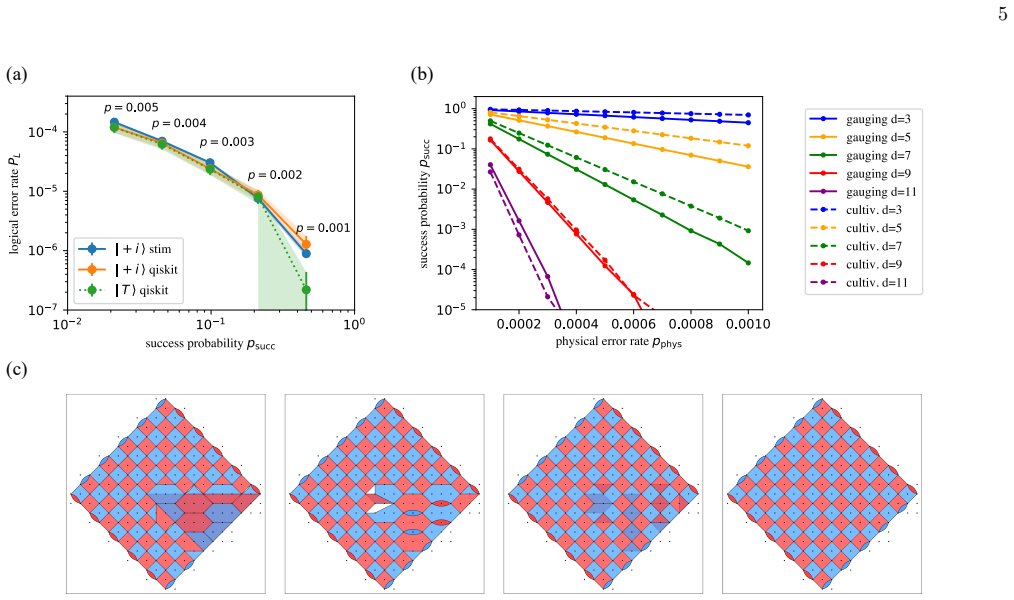
- The protocol works on a regular square grid and reaches 10 to the minus 12 logical error at 0.05 percent physical error for d=7 while retaining over 1 percent of shots.
- Circuit depth stays constant with code distance, removing the main obstacle that limited prior cultivation to d=5.
- Magic states become available for distances where transversal Clifford measurements were previously too deep to be practical.
- The method trades full error correction of the gauged code for simplicity and post-selection overhead.
- Only square-lattice connectivity is required, matching many existing hardware layouts.
Where Pith is reading between the lines
- The same gauging idea could be applied to other codes that admit transversal Clifford gates, potentially broadening the set of cultivable magic states.
- Because post-selection discards most shots at higher distances, the approach may need to be paired with more efficient rejection sampling or hybrid distillation to remain useful beyond d=7.
- If the noise model used in simulation underestimates correlated errors during gauging, the retained-shot fraction could drop sharply on real hardware.
- Combining constant-depth gauging with existing lattice-surgery techniques might further reduce the total space-time cost of magic-state factories.
Load-bearing premise
Repeated gauging measurements with post-selection alone suffice to suppress errors to the claimed logical rates without performing error correction on the emergent Clifford stabilizer code.
What would settle it
An experiment or simulation on the d=7 color code at 0.05 percent physical error rate that measures the final logical error rate after the full protocol and finds it stays above 10 to the minus 10 while the fraction of retained shots falls below 1 percent.
Figures



read the original abstract
Magic states are a scarce resource for two-dimensional qubit stabilizer codes. Magic state cultivation was recently proposed to reduce the cost of magic state preparation by measuring the transversal Clifford operator of the color code. Cultivation achieves $\sim 10^{-9}$ logical error rates for the $d=5$ color code, with substantially lower space-time overhead than magic state distillation. However, due to the $\mathcal{O}(d)$ depth of the Clifford measurement circuit, magic state cultivation becomes impractical for $d>5$. Here, we perform logical $XS^\dagger$ measurements on the color code by gauging a transversal Clifford gate, resulting in a constant-depth logical measurement circuit. We employ repeated gauging measurements with post-selection rather than performing error correction on the Clifford stabilizer code that emerges during the gauging protocol, thus gaining simplicity at the cost of scalability. Our protocol requires a regular square grid connectivity and yields logical error rates comparable to magic state cultivation. The $d=7$ version of our protocol gives access to the $10^{-12}$ logical error rate regime at $0.05\%$ physical error rate while retaining more than $1\%$ of the shots after the equivalent of the cultivation stage.
Editorial analysis
A structured set of objections, weighed in public.
Referee Report
Summary. The manuscript proposes a constant-depth magic state cultivation protocol for color codes that implements logical XS† measurements via gauging of a transversal Clifford gate. It relies on repeated gauging measurements combined with post-selection rather than error correction on the emergent Clifford stabilizer code, achieving logical error rates comparable to prior cultivation methods while requiring only square-grid connectivity. Simulations are reported to show that the d=7 version reaches the 10^{-12} logical error regime at 0.05% physical error rate while retaining more than 1% of shots after the cultivation stage.
Significance. If the simulation results hold under the stated assumptions, the protocol would offer a practical constant-depth route to high-fidelity magic states with lower space-time overhead than distillation, extending the reach of 2D color-code architectures toward universal fault-tolerant computation.
major comments (2)
- [Simulation results] Simulation results (abstract and main text): the reported d=5 and d=7 logical error rates and yields lack full circuit-level descriptions, explicit data-exclusion rules, and statistical error-bar analysis, preventing independent verification of the central performance claim that d=7 reaches 10^{-12} at 0.05% physical error with >1% retention.
- [Protocol description] Protocol description (abstract): the choice to rely exclusively on repeated gauging plus post-selection without error correction on the emergent Clifford code is load-bearing for the claimed suppression; no quantitative analysis is given of how residual gauge errors propagate to logical errors when the noise model deviates from ideal depolarizing circuit noise (e.g., leakage or correlated errors).
minor comments (1)
- [Abstract] The abstract could explicitly state the precise noise model and connectivity assumptions used in the simulations.
Simulated Author's Rebuttal
We thank the referee for their careful reading and constructive comments. We respond to each major comment below and indicate the changes we will make in the revised manuscript.
read point-by-point responses
-
Referee: [Simulation results] Simulation results (abstract and main text): the reported d=5 and d=7 logical error rates and yields lack full circuit-level descriptions, explicit data-exclusion rules, and statistical error-bar analysis, preventing independent verification of the central performance claim that d=7 reaches 10^{-12} at 0.05% physical error with >1% retention.
Authors: We agree that the simulation details must be expanded for independent verification. In the revised manuscript we will add a dedicated methods subsection that specifies the full circuit-level depolarizing noise model, the precise post-selection rules used to discard shots, and the statistical error bars obtained from the Monte Carlo sampling. These additions will make the reported d=5 and d=7 performance figures, including the 10^{-12} regime at 0.05% physical error with >1% retention, fully reproducible from the stated parameters. revision: yes
-
Referee: [Protocol description] Protocol description (abstract): the choice to rely exclusively on repeated gauging plus post-selection without error correction on the emergent Clifford code is load-bearing for the claimed suppression; no quantitative analysis is given of how residual gauge errors propagate to logical errors when the noise model deviates from ideal depolarizing circuit noise (e.g., leakage or correlated errors).
Authors: The exclusive use of repeated gauging measurements followed by post-selection, without error correction on the emergent Clifford stabilizer code, is indeed central to achieving constant depth and architectural simplicity. Our quantitative claims are derived under the standard circuit-level depolarizing noise model. We acknowledge that a detailed propagation analysis of residual gauge errors under non-ideal models (leakage, correlated errors) is absent and would be valuable; such an extension lies beyond the scope of the present work. In the revision we will add a concise paragraph noting this limitation and identifying it as a topic for future study. revision: partial
Circularity Check
Minor self-citation to prior cultivation work but no load-bearing circularity in derivations or predictions
full rationale
The paper introduces a gauging-based constant-depth protocol for logical XS† measurements on the color code and reports d=7 simulation results (10^{-12} logical error at 0.05% physical error with >1% yield) under repeated gauging plus post-selection. No equations reduce a claimed prediction to a fitted input by construction, nor does any derivation rely on self-definition or ansatz smuggling. The abstract's reference to 'magic state cultivation was recently proposed' constitutes a minor self-citation (likely overlapping authors), but this is not load-bearing: the new constant-depth circuit and post-selection performance claims rest on explicit circuit-level simulation outputs rather than on any unverified prior result. The derivation chain for the gauging protocol is self-contained against the stated square-grid connectivity and depolarizing noise model.
Axiom & Free-Parameter Ledger
axioms (1)
- domain assumption Physical errors follow a standard depolarizing or Pauli noise model amenable to simulation.
Forward citations
Cited by 1 Pith paper
-
Reducing Postselection Overhead in Magic-State Cultivation by In-Patch Multiplexing
In-patch multiplexing reduces expected attempts for early-stage magic-state cultivation by 45.46% (d1=3) to 72.91% (d1=5) and full-cycle attempts by 49-79% at p=2e-3, while final logical error rates stay governed by t...
Reference graph
Works this paper leans on
-
[1]
S. Bravyi and R. K¨ onig, Classification of Topologically Pro- tected Gates for Local Stabilizer Codes, Physical Review Letters110, 170503 (2013)
work page 2013
-
[2]
M. Davydova, A. Bauer, J. C. M. de la Fuente, M. Webster, D. J. Williamson, and B. J. Brown, Universal fault tolerant quantum computation in 2d without getting tied in knots, arXiv: 2503.15751 (2025)
-
[3]
A. Bauer and J. C. M. de la Fuente, Planar fault-tolerant circuits for non-Clifford gates on the 2D color code (2025), version Number: 1
work page 2025
-
[4]
S.-J. Huang and Y. Chen, Generating logical magic states with the aid of non-abelian topological order (2025), arXiv:2502.00998 [quant-ph]
-
[5]
R. Kobayashi, G. Zhu, and P.-S. Hsin, Clifford hierarchy stabilizer codes: Transversal non-clifford gates and magic (2025), arXiv:2511.02900 [quant-ph]
- [6]
-
[7]
A. Warman and S. Schafer-Nameki, Transversal clifford- hierarchy gates via non-abelian surface codes (2026), arXiv:2512.13777 [quant-ph]
-
[8]
T. J. Yoder, E. Schoute, P. Rall, E. Pritchett, J. M. Gam- betta, A. W. Cross, M. Carroll, and M. E. Beverland, Tour de gross: A modular quantum computer based on bivariate bicycle codes (2025), arXiv:2506.03094 [quant-ph]
work page internal anchor Pith review Pith/arXiv arXiv 2025
-
[9]
P. Webster, L. Berent, O. Chandra, E. T. Hockings, N. Baspin, F. Thomsen, S. C. Smith, and L. Z. Cohen, The pinnacle architecture: Reducing the cost of breaking rsa-2048 to 100 000 physical qubits using quantum ldpc codes (2026), arXiv:2602.11457 [quant-ph]
work page internal anchor Pith review Pith/arXiv arXiv 2048
-
[10]
S. Bravyi and A. Kitaev, Universal quantum computation with ideal Clifford gates and noisy ancillas, Physical Review A71, 022316 (2005)
work page 2005
-
[11]
A. G. Fowler, M. Mariantoni, J. M. Martinis, and A. N. Cle- land, Surface codes: Towards practical large-scale quantum computation, Physical Review A86, 032324 (2012)
work page 2012
-
[12]
Litinski, Magic State Distillation: Not as Costly as You Think, Quantum3, 205 (2019)
D. Litinski, Magic State Distillation: Not as Costly as You Think, Quantum3, 205 (2019)
work page 2019
-
[13]
H. Goto, Minimizing resource overheads for fault-tolerant preparation of encoded states of the steane code, Scientific Reports 2016 6:16, 19578 (2016)
work page 2016
-
[14]
C. Chamberland and A. W. Cross, Fault-tolerant magic state preparation with flag qubits, Quantum3, 143 (2019)
work page 2019
-
[15]
C. Chamberland and K. Noh, Very low overhead fault- tolerant magic state preparation using redundant ancilla encoding and flag qubits, npj Quantum Information6, 10.1038/s41534-020-00319-5 (2020)
-
[16]
R. S. Gupta, N. Sundaresan, T. Alexander, C. J. Wood, S. T. Merkel, M. B. Healy, M. Hillenbrand, T. Jochym- O’Connor, J. R. Wootton, T. J. Yoder, A. W. Cross, M. Takita, and B. J. Brown, Encoding a magic state with beyond break-even fidelity, Nature625, 259 (2024)
work page 2024
-
[17]
T. Itogawa, Y. Takada, Y. Hirano, and K. Fujii, Effi- cient magic state distillation by zero-level distillation, PRX Quantum6, 10.1103/thxx-njr6 (2025)
-
[18]
Magic state cultivation: growing T states as cheap as CNOT gates
C. Gidney, N. Shutty, and C. Jones, Magic state cultiva- tion: Growing T states as cheap as CNOT gates (2024), arXiv:2409.17595 [quant-ph]
work page internal anchor Pith review Pith/arXiv arXiv 2024
-
[19]
Y. Vaknin, S. Jacoby, A. Grimsmo, and A. Retzker, Effi- cient magic state cultivation on the surface code (2026), arXiv:2502.01743 [quant-ph]
-
[20]
Z.-H. Chen, M.-C. Chen, C.-Y. Lu, and J.-W. Pan, Efficient magic state cultivation onRP 2 (2025), arXiv:2503.18657 [quant-ph]
-
[21]
K. Sahay, P.-K. Tsai, K. Chang, Q. Su, T. B. Smith, S. Singh, and S. Puri, Fold-transversal surface code cul- tivation (2025), arXiv:2509.05212 [quant-ph]
-
[22]
D. J. Williamson and T. J. Yoder, Low-overhead fault- tolerant quantum computation by gauging logical opera- tors (2024), arXiv:2410.02213 [quant-ph]
work page internal anchor Pith review Pith/arXiv arXiv 2024
-
[23]
H. Bombin and M. A. Martin-Delgado, Topolog- ical quantum distillation, Physical Review Letters 97, 10.1103/PhysRevLett.97.180501 (2006), arXiv:0605138 [quant-ph]
-
[24]
At the boundary of the lattice one needs to extend the 4- body plaquettes with 2 data qubits in a known state to complete the cycles while preserving the connectivity
-
[25]
C. Gidney and C. Jones, New circuits and an open source decoder for the color code (2023), arXiv:2312.08813 [quant- ph]
-
[26]
G. Aleksandrowicz, T. Alexander, P. Barkoutsos, L. Bello, Y. Ben-Haim, D. Bucher, F. J. Cabrera-Hern´ andez, J. Carballo-Franquis, A. Chen, C.-F. Chen, J. M. Chow, A. D. Corcoles-Gonzales, A. J. Cross, A. Cross, J. Cruz-Benito, C. Culver, S. De La Puente Gonz´ alez, E. De La Torre, D. Ding, E. Dumitrescu, I. Duran, P. Eendebak, M. Everitt, I. Faro Sertage...
-
[27]
C. Gidney, Stim: a fast stabilizer circuit simulator, Quan- tum5, 497 (2021), arXiv:2103.02202 [quant-ph]
-
[28]
Further, we take tCX =t M/R which describes well the uniform noise model
For this rough estimate, we assume that the success rate depends the same way on the number of fault locations in both cases, and the number of fault locations is the total number of qubits times the total time. Further, we take tCX =t M/R which describes well the uniform noise model
-
[29]
N. Lacroix, A. Bourassa, F. J. H. Heras, L. M. Zhang, J. Bausch, A. W. Senior, T. Edlich, N. Shutty, V. Sivak, A. Bengtsson, M. McEwen, O. Higgott, D. Kafri, J. Claes, A. Morvan, Z. Chen, A. Zalcman, S. Madhuk, R. Acharya, L. A. Beni, G. Aigeldinger, R. Alcaraz, T. I. Andersen, M. Ansmann, F. Arute, K. Arya, A. Asfaw, J. Atalaya, R. Babbush, B. Ballard, J...
- [30]
-
[31]
M. H. Shaw and B. M. Terhal, Lowering Connectivity Re- quirements for Bivariate Bicycle Codes Using Morphing Circuits, Physical Review Letters134, 090602 (2025)
work page 2025
- [32]
-
[33]
A. Prem and D. Williamson, Gauging permutation symme- tries as a route to non-Abelian fractons, SciPost Physics7, 068 (2019), arXiv:1905.06309
-
[34]
Topological phases with generalized global symmetries
B. Yoshida, Topological phases with generalized global symmetries, Physical Review B93, 155131 (2016), arXiv:1508.03468
work page internal anchor Pith review Pith/arXiv arXiv 2016
-
[35]
M. Iqbal, N. Tantivasadakarn, R. Verresen, S. L. Camp- bell, J. M. Dreiling, C. Figgatt, J. P. Gaebler, J. Jo- hansen, M. Mills, S. A. Moses, J. M. Pino, A. Ransford, M. Rowe, P. Siegfried, R. P. Stutz, M. Foss-Feig, A. Vish- wanath, and H. Dreyer, Non-Abelian Topological Order and Anyons on a Trapped-Ion Processor, Nature626, 505 (2023), arXiv:2305.03766v2
-
[36]
M. Barkeshli, P. Bonderson, M. Cheng, and Z. Wang, Symmetry fractionalization, defects, and gauging of topo- logical phases, Physical Review B100, 10.1103/Phys- RevB.100.115147 (2019), arXiv:1410.4540
-
[37]
B. Het´ enyi and J. R. Wootton, Creating entangled logical qubits in the heavy-hex lattice with topological codes, PRX Quantum5, 040334 (2024)
work page 2024
-
[38]
2D quantum computation with 3D topological codes
H. Bombin, 2d quantum computation with 3d topological codes (2018), arXiv:1810.09571 [quant-ph]
work page internal anchor Pith review Pith/arXiv arXiv 2018
-
[39]
Transversal gates and error propagation in 3D topological codes
H. Bombin, Transversal gates and error propaga- tion in 3D topological codes, arXiv preprint (2018), arXiv:1810.09575
work page internal anchor Pith review Pith/arXiv arXiv 2018
-
[40]
B. J. Brown, A fault-tolerant non-clifford gate for the surface code in two dimensions, Science Advances6, 10.1126/SCIADV.AAY4929 (2020), arXiv:1903.11634. 9 Appendix A: Color Code on the heavy-hex lattice In this appendix, we review the Color Code and the heavy-hex lattice. Below we depict a patch of the heavy-hex lattice. (A1) The vertex-edge lattice st...
-
[41]
Square patch We first discuss a square patch of the Color Code with green vertical, and red or blue horizontal, boundary conditions. With these boundary conditions, the Color Code encodes a pair of logical qubits that support a transversal Hadamard gate that implements a logical Hadamard+SWAP transformation. This Color Code also supports a logicalCZgate t...
-
[42]
Triangle patch We now consider a triangular patch of the Color Code with a red, green, and blue, boundary. This configuration of the Color Code encodes a single logical qubit that supports transversalSandHgates which generate the full logical Clifford group. This includes the logicalXSgate, which has a transversal implementation as described above. (A5) A...
-
[43]
Perform single qubit rotations on all vertex qubits to bring the transversal logical operator on each site into the form of anXoperator
-
[44]
Initialize all edge qubits in the|0⟩state
-
[45]
In each CNOT the vertex is the control qubit and the edge is the target qubit
Perform CNOTs from each vertex to all surrounding edges. In each CNOT the vertex is the control qubit and the edge is the target qubit
-
[46]
MeasureXon each vertex qubit, and reset to|±⟩conditioned on the measurement outcome
-
[47]
Perform the CNOT circuit from step 3 again
-
[48]
MeasureZon each edge qubit
-
[49]
Apply aZ-type byproduct operator to vertex qubits
-
[50]
Undo the single qubit rotations from step 1. The above procedure measures the global transversal logical operator, but does not measure any other operator that is supported solely on the vertex qubits. The outcome of the logical measurement is recovered by taking the product of all vertex qubitXmeasurement results. To implement the above procedure scalabl...
-
[51]
In this case the transversalXlogical operator is measured directly on the Color Code
LogicalXmeasurement First, we consider a simple example where no rotation is performed at step 1. In this case the transversalXlogical operator is measured directly on the Color Code. Steps 2-4 essentially initializes a new copy of surface code. The resulting deformed code at step 4 is equivalent to three copies of the surface code supported on the red, g...
-
[52]
LogicalXS † measurement We now discuss applying the gauging measurement procedure to the transversal √−iXS, √ iXS †, operator on Color Code. For the remainder of this section we do not explicitly write the phase factors that make theXS, XS †, operators Hermitian. For a square patch of Color Code, see Eq. (A4), this measures a logicalCZgate. Similarly, for...
discussion (0)
Sign in with ORCID, Apple, or X to comment. Anyone can read and Pith papers without signing in.