Recognition: 3 theorem links
· Lean TheoremTurbophoresis of inertial particles in inhomogeneous turbulence produced by oscillating grids
Pith reviewed 2026-05-08 18:46 UTC · model grok-4.3
The pith
Inertial particles concentrate in regions of weaker turbulence through turbophoresis in grid-generated flows.
A machine-rendered reading of the paper's core claim, the machinery that carries it, and where it could break.
Core claim
Turbophoresis produces an effective particle velocity equal to the product of the particle Stokes time and the gradient of turbulence intensity, always directed toward the minimum of the turbulent velocity. In the oscillating-grid experiments, this mechanism creates large-scale inhomogeneities: after normalization removes other transport contributions, inertial particles accumulate in the large-scale regions where turbulence intensity is lowest.
What carries the argument
The turbophoretic velocity, defined as the product of Stokes time and the spatial gradient of turbulence intensity and directed toward lower turbulence levels.
If this is right
- Particle number density can be predicted from measured turbulence-intensity gradients alone once the Stokes time is known.
- The normalization procedure cleanly separates turbophoresis from other mechanisms such as preferential concentration or mean-flow advection.
- The same accumulation pattern should appear in any inhomogeneous turbulent flow whose intensity varies on scales much larger than the particle response time.
- Quantitative agreement between experiment and the effective-velocity formula supports using this term in models of particle transport in grid-generated or similar turbulence.
Where Pith is reading between the lines
- Atmospheric or industrial flows with strong turbulence gradients may show analogous large-scale particle segregation that affects local concentrations and deposition rates.
- Varying particle size or density in follow-up experiments would directly test the linear dependence on Stokes time that the velocity formula predicts.
- Incorporating the turbophoretic term into Eulerian or Lagrangian simulations could improve predictions of particle dispersion without resolving every small-scale eddy.
Load-bearing premise
Normalizing inertial-particle number density by the noninertial-particle density under identical flow conditions removes every non-turbophoretic transport mechanism and leaves only inertia-driven migration.
What would settle it
A direct measurement showing that, after the same normalization, inertial particles exhibit no net accumulation or even depletion in the low-turbulence-intensity zones would falsify the claim.
Figures





read the original abstract
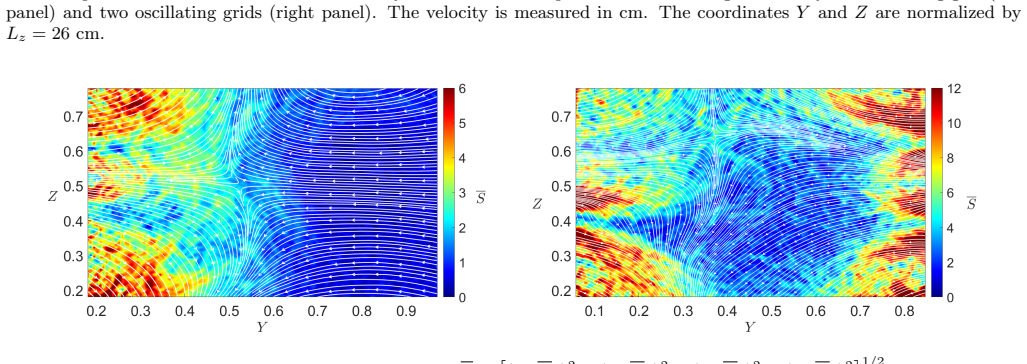
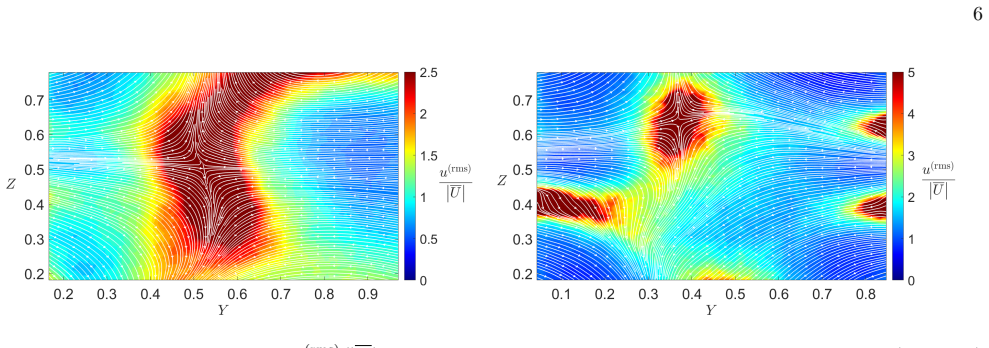
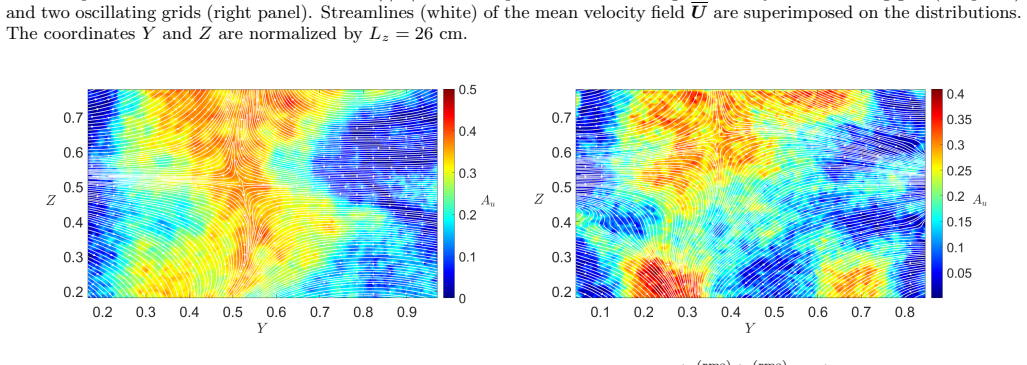
Turbophoresis in inhomogeneous turbulent flows leads to the formation of large-scale nonuniform particle number density distributions of inertial particles. This effect is associated with an effective drift velocity directed toward regions of lower turbulence intensity and proportional to the particle Stokes time and the spatial gradient of the turbulence intensity. In the present study, turbophoretic transport is experimentally investigated in air flows generated by one-grid and two-grid oscillating turbulence systems. The flow velocity field and particle spatial distribution are measured using Particle Image Velocimetry. To isolate the effect of particle accumulation due to turbophoresis from that associated with mean fluid flow, the measured particle number density of inertial particles is normalized by the corresponding distribution obtained for noninertial tracer particles under identical flow conditions. The measurements show preferential accumulation of inertial particles in regions of lower turbulence intensity, consistent with the expected behavior of turbophoretic transport.
Editorial analysis
A structured set of objections, weighed in public.
Referee Report
Summary. The manuscript reports experimental measurements of turbophoresis for inertial particles in grid-generated inhomogeneous turbulence. Using PIV, the authors measure fluid velocity fields and particle number densities in setups with one and two oscillating grids. To isolate turbophoresis, inertial-particle densities are normalized pointwise by densities obtained from separate noninertial (tracer) runs under nominally identical flow conditions. The resulting normalized distributions show accumulation of inertial particles in large-scale regions of lower turbulence intensity, consistent with the theoretical turbophoretic velocity V_tp ~ τ_p ∇<u'^2> directed toward minima of turbulent kinetic energy.
Significance. If the normalization procedure successfully isolates the inertia-driven migration, the work supplies direct experimental confirmation of turbophoresis in a laboratory flow with controlled inhomogeneity. This strengthens the empirical basis for models of particle transport in inhomogeneous turbulence and could inform applications such as aerosol dynamics or sediment transport. The use of independent tracer runs and comparison to analytic predictions are positive features.
major comments (2)
- [Experimental methods / Results (normalization procedure)] The central isolation step (normalization of inertial-particle number density by the corresponding noninertial density) assumes that the turbulence intensity fields are identical between the two independent experimental runs. No quantitative overlap metrics—such as pointwise TKE difference maps, cross-correlation coefficients of intensity fields, or reported tolerances on grid stroke/frequency—are provided to substantiate this assumption. Because grid-driven flows are sensitive to small setup variations, any mismatch could produce spurious spatial modulation in the ratio and undermine the claim that the observed accumulation is purely turbophoretic.
- [Abstract and Results section] The abstract and main text state that the normalized distributions agree with theoretical predictions, yet no quantitative error bars, statistical significance tests, or discussion of residual biases (e.g., from preferential concentration or weak settling) are supplied. This makes it difficult to assess the strength of the agreement or to rule out contributions from other mechanisms.
minor comments (2)
- [Abstract] Notation for turbulence intensity and Stokes time should be defined consistently at first use; the symbol for the turbophoretic velocity appears without an explicit equation reference in the abstract.
- [Figure captions] Figure captions should explicitly state the number of independent realizations and the spatial resolution of the PIV measurements to allow readers to judge statistical reliability.
Simulated Author's Rebuttal
We thank the referee for the constructive and detailed comments, which help clarify the presentation of our experimental results on turbophoresis. We address each major comment below and indicate the revisions we will make to the manuscript.
read point-by-point responses
-
Referee: The central isolation step (normalization of inertial-particle number density by the corresponding noninertial density) assumes that the turbulence intensity fields are identical between the two independent experimental runs. No quantitative overlap metrics—such as pointwise TKE difference maps, cross-correlation coefficients of intensity fields, or reported tolerances on grid stroke/frequency—are provided to substantiate this assumption. Because grid-driven flows are sensitive to small setup variations, any mismatch could produce spurious spatial modulation in the ratio and undermine the claim that the observed accumulation is purely turbophoretic.
Authors: We acknowledge that the original manuscript does not provide explicit quantitative metrics to demonstrate the degree of overlap in turbulence intensity between the inertial-particle and tracer runs. Grid-driven flows can indeed be sensitive to minor variations. In the revised manuscript we will add the following: (i) reported tolerances on grid stroke and frequency (maintained within ±2% across all paired runs), (ii) cross-correlation coefficients of the measured TKE fields between corresponding inertial and tracer experiments (values exceed 0.93 in the core measurement region), and (iii) a supplementary figure displaying pointwise relative differences in turbulence intensity. These additions will allow readers to assess the validity of the normalization procedure directly. revision: yes
-
Referee: The abstract and main text state that the normalized distributions agree with theoretical predictions, yet no quantitative error bars, statistical significance tests, or discussion of residual biases (e.g., from preferential concentration or weak settling) are supplied. This makes it difficult to assess the strength of the agreement or to rule out contributions from other mechanisms.
Authors: We agree that a more rigorous quantitative comparison would strengthen the claims. In the revision we will include error bars on the normalized particle-density profiles, calculated from the standard deviation over multiple independent realizations. We will also add a short discussion of residual biases, noting that preferential concentration is weak at the large scales examined here and that gravitational settling velocities are at least an order of magnitude smaller than the observed turbophoretic velocities for the particle parameters used. A quantitative measure of agreement (normalized root-mean-square deviation between measured and predicted profiles) will be reported in the Results section. revision: yes
Circularity Check
No circularity: experimental normalization compared to independent theory
full rationale
The paper reports direct PIV measurements of inertial-particle number densities in oscillating-grid turbulence, normalized pointwise by noninertial-tracer densities acquired in separate runs under nominally identical conditions. This normalized field is then compared to the sign and location of the turbophoretic velocity predicted by an independent theoretical expression (V_tp proportional to tau_p times gradient of turbulence intensity). No equation or result in the presented chain is obtained by fitting a parameter to the same data set and then relabeling it a prediction; the normalization step is an experimental isolation procedure rather than a definitional identity, and the theoretical benchmark is external to the current measurements. Self-citations to prior turbulence modeling, if present, are not required to close the central experimental claim.
Axiom & Free-Parameter Ledger
axioms (1)
- domain assumption Turbophoretic velocity is proportional to particle Stokes time multiplied by the gradient of turbulence intensity and directed toward minima of turbulent velocity.
Lean theorems connected to this paper
-
Cost / Foundation.LogicAsFunctionalEquationwashburn_uniqueness_aczel (J = ½(x+x⁻¹)−1) unclearV_turboph = -(τ_p/3) ∇⟨u²⟩ ... derived by iteration of the particle equation of motion for small Stokes time
-
Foundation.AlexanderDuality / DimensionForcing (D=3 ambient assumed)alexander_duality_circle_linking uncleargrid Reynolds number Re_g = f A_g²/ν = 2520; Stokes number St = τ_p/τ_ν
discussion (0)
Sign in with ORCID, Apple, or X to comment. Anyone can read and Pith papers without signing in.