Recognition: unknown
Sorry for the late reply: Response times and reciprocity in WhatsApp and Instagram chats
Pith reviewed 2026-05-07 12:37 UTC · model grok-4.3
The pith
Chat partners match each other's response speeds in WhatsApp and Instagram, and this balance holds steady over months.
A machine-rendered reading of the paper's core claim, the machinery that carries it, and where it could break.
Core claim
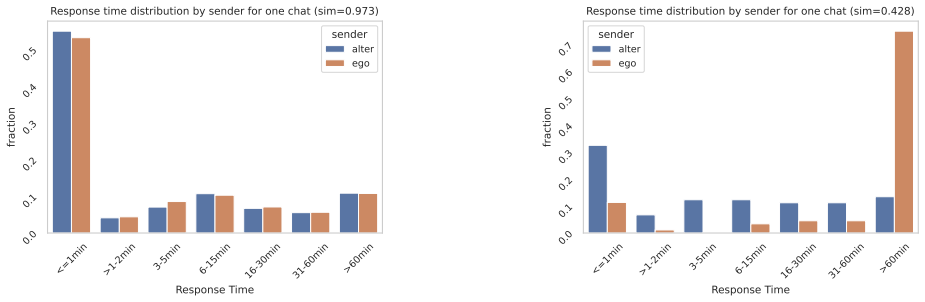
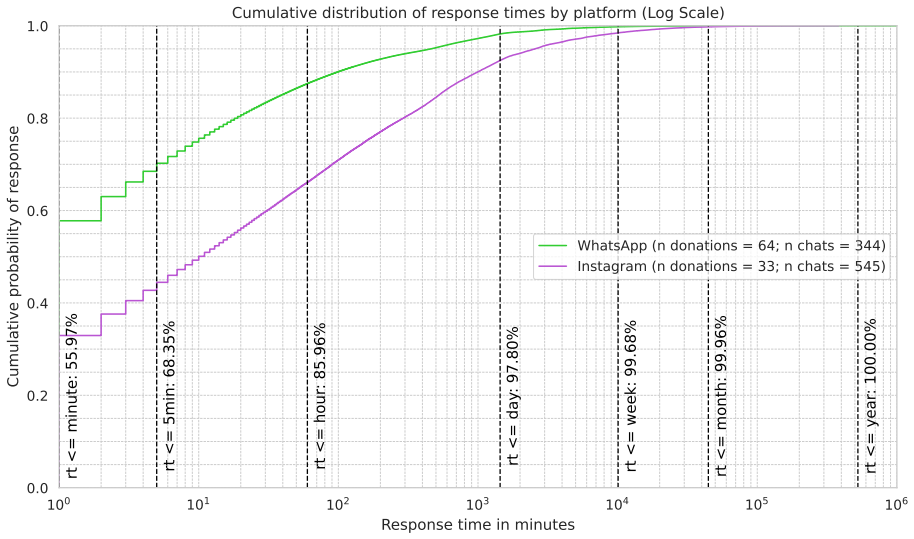
Around 70 percent of WhatsApp messages and 44 percent of Instagram messages were answered within five minutes. The response-speed distributions of the two partners in each chat were closely aligned, and the probability that one person would reply within five minutes rose steeply with the same probability for the partner (slopes 0.786 on WhatsApp, 0.796 on Instagram). This similarity remained stable when measured month by month, leading the authors to position response-time balance as a quantitative marker of reciprocity in computer-mediated communication.
What carries the argument
Response-time similarity between chat partners, quantified by Jensen-Shannon distance on their full reply-time distributions and by linear regression slopes on each partner's probability of replying within five minutes.
If this is right
- Response-time balance can be tracked as a running indicator of reciprocity in ongoing digital relationships.
- The same metric can be applied to study how social ties strengthen or weaken over longer periods.
- It supplies a concrete, automatically measurable complement to existing ways of analyzing closeness and enjoyment in chats.
- The approach opens a route to quantify reciprocity in any large archive of timestamped message data.
Where Pith is reading between the lines
- If the balance tracks tie strength, apps could one day flag fading connections by watching whether reply speeds drift apart.
- The same logic could be tested in group chats or across different cultures to see whether reciprocity norms differ.
- Future work could separate true mirroring from shared routines by collecting data on when each person is actually online.
Load-bearing premise
The similarity in response times mainly reflects one person adjusting to the other's pace rather than both simply facing the same external schedule, topics, or phone habits.
What would settle it
If the similarity in reply speeds disappears or drops sharply once overlapping availability windows or shared conversation topics are statistically removed, the claim that the pattern indexes reciprocity would be falsified.
Figures



read the original abstract
Chat communication is often fast-paced, creating the expectation of quick replies. While the timing of exchanges is known to foster closeness and enjoyment, it remains largely unexplored whether chat partners with strong ties reciprocate each other's response times. Using 3.4 million messages from 889 chats across 97 donations of anonymous WhatsApp and Instagram chats, we analyzed response times, their balance between chat partners, and its stability over time. To our knowledge, this is the first study to examine response speed as an expression of reciprocity, bridging a key aspect of online communication with a fundamental principle of social interactions. We found that around 70% of WhatsApp and 44% of Instagram messages were answered within five minutes, confirming the fast pace of instant messaging. Overall, the response speed between chat partners was similar. The response speed similarity was evident both in the overall response-time distributions of chat partners assessed with Jensen-Shannon distance and in the steep regression slopes (0.786 for WhatsApp and 0.796 for Instagram) linking one person's probability of responding within five minutes to the partner's corresponding probability. Importantly, the dispersion of response time similarity over months showed that this balance persists over time. Our results position response time balance as a marker of reciprocity in computer-mediated communication, offering a new way to quantitatively study this fundamental principle of social interaction. We suggest using response speed balance as a complementary metric in the analysis of relationship dynamics, such as the strengthening or weakening of social ties.
Editorial analysis
A structured set of objections, weighed in public.
Referee Report
Summary. The paper analyzes response times in 3.4 million messages from 889 WhatsApp and Instagram chats donated by 97 users. It reports that ~70% of WhatsApp and ~44% of Instagram messages receive replies within five minutes, documents similarity in partners' response-time distributions via Jensen-Shannon distance, and finds steep regression slopes (0.786 WhatsApp, 0.796 Instagram) relating one partner's probability of a sub-five-minute reply to the other's. The similarity metric is shown to remain stable across months, and the authors interpret response-time balance as a quantitative marker of reciprocity in computer-mediated communication.
Significance. The large sample and cross-platform consistency provide a useful empirical observation of response-time similarity in instant messaging. If the reciprocity interpretation can be strengthened by addressing alternative explanations, the work supplies a new, easily computed metric that could complement existing measures of tie strength and relationship dynamics in online settings.
major comments (3)
- [Results] Results section (regression analysis): the reported slopes of 0.786 (WhatsApp) and 0.796 (Instagram) linking partners' five-minute response probabilities are presented as evidence of reciprocity, yet the analysis contains no time-of-day stratification, dyad fixed effects, or topic covariates. These omissions leave the result equally consistent with stable external confounds such as overlapping availability windows or synchronized notification habits.
- [Methods] Methods section: no details are provided on data cleaning, message filtering, outlier removal, or how the 889 chats were selected from the 97 donations. Without these steps the reported distributions and regression coefficients cannot be fully evaluated for robustness.
- [Discussion] Discussion: the claim that month-to-month dispersion of the similarity metric demonstrates persistent reciprocity does not adjudicate between intentional response matching and persistent external factors; both accounts predict temporal stability.
minor comments (3)
- The five-minute response threshold is introduced without sensitivity checks or justification relative to other cutoffs.
- [Abstract] The abstract describes Jensen-Shannon distances only qualitatively; numerical values or confidence intervals for the distances between partner distributions would strengthen the presentation.
- A small number of typographical inconsistencies appear in the reporting of percentages (70 % vs. 44 %) and slope values across the abstract and main text.
Simulated Author's Rebuttal
We thank the referee for the detailed and constructive report. The comments highlight important areas for strengthening the manuscript, particularly regarding controls, methodological transparency, and interpretive caution. We address each major comment below and indicate planned revisions.
read point-by-point responses
-
Referee: [Results] Results section (regression analysis): the reported slopes of 0.786 (WhatsApp) and 0.796 (Instagram) linking partners' five-minute response probabilities are presented as evidence of reciprocity, yet the analysis contains no time-of-day stratification, dyad fixed effects, or topic covariates. These omissions leave the result equally consistent with stable external confounds such as overlapping availability windows or synchronized notification habits.
Authors: We agree that time-of-day stratification and additional controls would help address potential confounds. Our dataset includes message timestamps, so we will add a time-of-day stratified analysis in the revision to verify whether the regression slopes remain consistent across morning, afternoon, evening, and night periods. Dyad-level fixed effects are not straightforward in this design but we will report results from mixed-effects models with dyad random effects. Topic covariates cannot be included because the donated chats were anonymized without message content; we will explicitly state this limitation. While external factors remain possible, the replication of steep slopes across 889 independent dyads and two distinct platforms provides evidence that the similarity is not reducible to a small set of stable confounds. We will revise the results and discussion to present these points more balanced. revision: partial
-
Referee: [Methods] Methods section: no details are provided on data cleaning, message filtering, outlier removal, or how the 889 chats were selected from the 97 donations. Without these steps the reported distributions and regression coefficients cannot be fully evaluated for robustness.
Authors: We acknowledge that these procedural details were omitted. In the revised Methods section we will fully document the data-cleaning pipeline, including criteria for excluding system-generated messages, filtering chats below a minimum message threshold, handling of outliers in response-time distributions, and the precise selection rules applied to arrive at the final 889 chats from the 97 donations. These additions will improve reproducibility and allow readers to assess robustness directly. revision: yes
-
Referee: [Discussion] Discussion: the claim that month-to-month dispersion of the similarity metric demonstrates persistent reciprocity does not adjudicate between intentional response matching and persistent external factors; both accounts predict temporal stability.
Authors: We accept this critique. Temporal stability is consistent with both intentional reciprocity and enduring external factors. We will revise the discussion to present the month-to-month persistence as compatible with a reciprocity interpretation while explicitly noting that it does not rule out stable confounds. We will also add a forward-looking statement recommending experimental or longitudinal designs that could better separate these mechanisms. revision: yes
Circularity Check
No significant circularity in observational empirical analysis
full rationale
The paper reports an observational analysis of 3.4 million messages from donated chats, computing response-time distributions and probabilities directly from the data via Jensen-Shannon distance and ordinary linear regression. No derivations, equations, or model fits are presented that reduce the reported similarity metrics to self-referential inputs by construction; the central claims rest on straightforward statistical summaries of observed patterns rather than any self-citation chain or ansatz smuggled through prior work. The stability-over-time finding is likewise a direct empirical dispersion measure, not a prediction forced by fitted parameters.
Axiom & Free-Parameter Ledger
free parameters (1)
- five-minute response threshold
axioms (1)
- domain assumption Similarity in response-time distributions and regression slopes reflects reciprocity in social ties
Reference graph
Works this paper leans on
-
[1]
R.; Ishaq, M
Ahmad, R.; Nawaz, M. R.; Ishaq, M. I.; Khan, M. M.; and Ashraf, H. A. 2023. Social Exchange Theory: Systematic Review and Future Directions. Frontiers in Psychology, 13: 1015921
2023
-
[2]
R.; and Hudson, S
Avrahami, D.; Fussell, S. R.; and Hudson, S. E. 2008. IM Waiting: Timing and Responsiveness in Semi-Synchronous Communication. In Proceedings of the 2008 ACM Conference on Computer Supported Cooperative Work , CSCW '08, 285--294. New York, NY, USA: Association for Computing Machinery. ISBN 978-1-60558-007-4
2008
-
[3]
E.; Araujo, T.; and Oberski, D
Boeschoten, L.; Ausloos, J.; M \"o ller, J. E.; Araujo, T.; and Oberski, D. L. 2022. A Framework for Privacy Preserving Digital Trace Data Collection through Data Donation. Computational Communication Research, 4
2022
-
[4]
Brysbaert, M. 2019. How Many Words Do We Read per Minute? A Review and Meta-Analysis of Reading Rate. Journal of Memory and Language, 109: 104047
2019
-
[5]
Burgoon, J. K. 2008. Interaction Adaptation Theory . In The International Encyclopedia of Communication . John Wiley & Sons, Ltd. ISBN 978-1-4051-8640-7
2008
-
[6]
Burgoon, J. K. 2015. Expectancy Violations Theory . In The International Encyclopedia of Interpersonal Communication , 1--9. John Wiley & Sons, Ltd. ISBN 978-1-118-54019-0
2015
-
[7]
M.; and Lutz, S
B \"u ttner, C. M.; and Lutz, S. 2025. When Does Waiting for a Reply Turn into Ghosting? Individual , Relational, and Situational Predictors of Feeling Ignored in Online Messaging. Computers in Human Behavior, 172: 108774
2025
-
[8]
Y.; and Chang, Y.-J
Chou, Y.-L.; Lin, Y.-H.; Lin, T.-Y.; You, H. Y.; and Chang, Y.-J. 2022. Why Did You / I Read but Not Reply ? IM Users ' Unresponded-to Read-receipt Practices and Explanations of Them . CHI Conference on Human Factors in Computing Systems, 1--15
2022
-
[9]
Chowdhary, S.; Andres, E.; Manna, A.; Blagojevi \'c , L.; Di Gaetano, L.; and I \ n iguez, G. 2023. Temporal Patterns of Reciprocity in Communication Networks. EPJ Data Science, 12(1): 7
2023
-
[10]
Dunbar, R. I. M.; Arnaboldi, V.; Conti, M.; and Passarella, A. 2015. The Structure of Online Social Networks Mirrors Those in the Offline World. Social Networks, 43: 39--47
2015
-
[11]
emarketer . 2025. Mobile Messaging Users Worldwide 2025. https://www.statista.com/statistics/483255/ number-of-mobile-messaging-users-worldwide/
2025
-
[12]
E.; and Maglio, S
Fang, D.; Zhang, Y. E.; and Maglio, S. J. 2025. Shortcuts to Insincerity: Texting Abbreviations Seem Insincere and Not Worth Answering. Journal of Experimental Psychology: General, 154(1): 39--57
2025
- [13]
-
[14]
Gouldner, A. W. 1960. The Norm of Reciprocity : A Preliminary Statement . American Sociological Review, 25(2): 161
1960
-
[15]
Granovetter, M. S. 1973. The Strength of Weak Ties . American Journal of Sociology, 78(6): 1360--1380
1973
-
[16]
J.; and Fox Tree, J
Guydish, A. J.; and Fox Tree, J. E. 2022. Reciprocity in Instant Messaging Conversations . Language and Speech, 65(2): 404--417
2022
-
[17]
Hakobyan, O.; Hillmann, P.-J.; Martin, F.; B \"o ttinger, E.; and Drimalla, H. 2025. Development and Evaluation of Dona , a Privacy-Preserving Donation Platform for Messaging Data from WhatsApp , Facebook , and Instagram . Behavior Research Methods, 57(3): 94
2025
-
[18]
Hallinan, M. T. 1978. The Process of Friendship Formation. Social Networks, 1(2): 193--210
1978
-
[19]
Heston, M.; and Birnholtz, J. 2017. Worth the Wait ?: The Effect of Responsiveness on Interpersonal Attraction Among Known Acquaintances . In Gutwin, C.; Ochoa, S. F.; Vassileva, J.; and Inoue, T., eds., Collaboration and Technology , 164--179. Cham: Springer International Publishing. ISBN 978-3-319-63874-4
2017
-
[20]
Y.; Khojasteh, N.; and Fussell, S
Hwang, S. Y.; Khojasteh, N.; and Fussell, S. R. 2019. When Delayed in a Hurry : Interpretations of Response Delays in Time-Sensitive Instant Messaging . Proc. ACM Hum.-Comput. Interact., 3(GROUP): 234:1--234:20
2019
-
[21]
M.; Ballard, D
Kalman, Y. M.; Ballard, D. I.; and Aguilar, A. M. 2021. Chronemic Urgency in Everyday Digital Communication. Time & Society, 30(2): 153--175
2021
-
[22]
M.; and Rafaeli, S
Kalman, Y. M.; and Rafaeli, S. 2011. Online Pauses and Silence : Chronemic Expectancy Violations in Written Computer-Mediated Communication . Communication Research, 38(1): 54--69
2011
-
[23]
Klein Ikkink, K.; and tilburg van Tilburg , T. 1999. Broken Ties: Reciprocity and Other Factors Affecting the Termination of Older Adults' Relationships. Social Networks, 21(2): 131--146
1999
-
[24]
D.; and Montag, C
Kohne, J.; Elhai, J. D.; and Montag, C. 2023. A Practical Guide to WhatsApp Data in Social Science Research . In Montag, C.; and Baumeister, H., eds., Digital Phenotyping and Mobile Sensing : New Developments in Psychoinformatics , Studies in Neuroscience , Psychology and Behavioral Economics , 171--205. Cham: Springer International Publishing. ISBN 978-3...
2023
- [25]
-
[26]
D.; and Saram \"a ki, J
Krings, G.; Karsai, M.; Bernharsson, S.; Blondel, V. D.; and Saram \"a ki, J. 2012. Effects of Time Window Size and Placement on the Structure of Aggregated Networks. EPJ Data Science, 1(1): 4
2012
-
[27]
Lakens, D. 2022. Sample Size Justification . Collabra: Psychology, 8(1): 33267
2022
-
[28]
Lazer, D.; Pentland, A.; Adamic, L.; Aral, S.; Barab \'a si, A.-L.; Brewer, D.; Christakis, N.; Contractor, N.; Fowler, J.; Gutmann, M.; Jebara, T.; King, G.; Macy, M.; Roy, D.; and Van Alstyne, M. 2009. Computational Social Science . Science, 323(5915): 721--723
2009
-
[29]
Lin, J. 1991. Divergence Measures Based on the Shannon Entropy. IEEE Transactions on Information Theory, 37(1): 145--151
1991
-
[30]
Lutz, S. 2023. Why Don 't You Answer Me ?! Exploring the Effects of ( Repeated Exposure to) Ostracism via Messengers on Users ' Fundamental Needs , Well-Being , and Coping Motivation . Media Psychology, 26(2): 113--140
2023
-
[31]
Mac Carron, P.; Kaski, K.; and Dunbar, R. 2016. Calling Dunbar 's Numbers. Social Networks, 47: 151--155
2016
-
[32]
Meteyard, L.; and Davies, R. A. I. 2020. Best Practice Guidance for Linear Mixed-Effects Models in Psychological Science. Journal of Memory and Language, 112: 104092
2020
-
[33]
Ohadi, J.; Brown, B.; Trub, L.; and Rosenthal, L. 2018. I Just Text to Say I Love You: Partner Similarity in Texting and Relationship Satisfaction. Computers in Human Behavior, 78: 126--132
2018
-
[34]
M.; Kim, S.; Kristensson, P
Palin, K.; Feit, A. M.; Kim, S.; Kristensson, P. O.; and Oulasvirta, A. 2019. How Do People Type on Mobile Devices ? Observations from a Study with 37,000 Volunteers . In Proceedings of the 21st International Conference on Human-Computer Interaction with Mobile Devices and Services , MobileHCI '19, 1--12. New York, NY, USA: Association for Computing Machi...
2019
-
[35]
V.; Mitova, E.; and Blassnig, S
Pfiffner, N.; Reiss, M. V.; Mitova, E.; and Blassnig, S. 2024. Comparing Online Recruitment Strategies for Data Donation Studies . Computational Communication Research, 6(2)
2024
-
[36]
Pielot, M.; oliveira de Oliveira , R.; Kwak, H.; and Oliver, N. 2014. Didn't You See My Message? Predicting Attentiveness to Mobile Instant Messages. In Proceedings of the SIGCHI Conference on Human Factors in Computing Systems , CHI '14, 3319--3328. New York, NY, USA: Association for Computing Machinery. ISBN 978-1-4503-2473-1
2014
-
[37]
Rosenfeld, A.; Sina, S.; Sarne, D.; Avidov, O.; and Kraus, S. 2018. WhatsApp Usage Patterns and Prediction of Demographic Characteristics without Access to Message Content. Demographic Research, 39: 647--670
2018
-
[38]
Roy, C.; Bhattacharya, K.; Dunbar, R. I. M.; and Kaski, K. 2022. Turnover in Close Friendships. Scientific Reports, 12(1): 11018
2022
-
[39]
A.; L \'o pez, E.; Roberts, S
Saram \"a ki, J.; Leicht, E. A.; L \'o pez, E.; Roberts, S. G. B.; Reed-Tsochas , F.; and Dunbar, R. I. M. 2014. Persistence of Social Signatures in Human Communication. Proceedings of the National Academy of Sciences of the United States of America, 111(3): 942--947
2014
-
[40]
Seufert, M.; Schwind, A.; Ho feld, T.; and Tran-Gia , P. 2015. Analysis of Group-Based Communication in WhatsApp . In Ag \"u ero, R.; Zinner, T.; Garc \'i a-Lozano , M.; Wenning, B.-L.; and Timm-Giel , A., eds., Mobile Networks and Management , 225--238. Cham: Springer International Publishing. ISBN 978-3-319-26925-2
2015
-
[41]
L.; and Chaparro, B
Smith, A. L.; and Chaparro, B. S. 2015. Smartphone Text Input Method Performance , Usability , and Preference With Younger and Older Adults . Human Factors, 57(6): 1015--1028
2015
-
[42]
Surma, J. 2016. Social Exchange in Online Social Networks. The Reciprocity Phenomenon on Facebook . Computer Communications, 73: 342--346
2016
-
[43]
Sutcliffe, A.; Dunbar, R.; Binder, J.; and Arrow, H. 2012. Relationships and the Social Brain: Integrating Psychological and Evolutionary Perspectives. British Journal of Psychology, 103(2): 149--168
2012
-
[44]
M.; Chang, L
Templeton, E. M.; Chang, L. J.; Reynolds, E. A.; Cone LeBeaumont, M. D.; and Wheatley, T. 2022. Fast Response Times Signal Social Connection in Conversation. Proceedings of the National Academy of Sciences, 119(4): e2116915119
2022
-
[45]
R.; and Tang, J
Tyler, J. R.; and Tang, J. C. 2003. When Can I Expect an Email Response ? A Study of Rhythms in Email Usage . In Kuutti, K.; Karsten, E. H.; Fitzpatrick, G.; Dourish, P.; and Schmidt, K., eds., ECSCW 2003 , 239--258. Dordrecht: Springer Netherlands. ISBN 978-94-010-0068-0
2003
-
[46]
Wang, C.; Lizardo, O.; Hachen, D.; Strathman, A.; Toroczkai, Z.; and Chawla, N. V. 2013. A Dyadic Reciprocity Index for Repeated Interaction Networks. Network Science, 1(1): 31--48
2013
discussion (0)
Sign in with ORCID, Apple, or X to comment. Anyone can read and Pith papers without signing in.