Recognition: unknown
Graph Neural Network based Hierarchy-Aware Embeddings of Knowledge Graphs: Applications to Yeast Phenotype Prediction
Pith reviewed 2026-05-07 16:58 UTC · model grok-4.3
The pith
Graph neural networks enriched with semantic loss produce hierarchy-aware embeddings of yeast knowledge graphs that predict cell growth phenotypes from gene knockouts.
A machine-rendered reading of the paper's core claim, the machinery that carries it, and where it could break.
Core claim
Low-dimensional box embeddings of the yeast knowledge graph combined with graph neural networks can predict cell growth for double gene knockouts with a mean R² score of 0.360 over 10-fold cross validation, significantly higher than baselines. Incorporating semantic loss terms improves performance to R²=0.377 by aligning the embeddings with the structure of the ontology. The models generalize to triple gene knockouts, and analysis of important relations in the graph leads to hypotheses about interacting traits, one of which was confirmed experimentally as an association between inositol utilisation and osmotic stress resistance.
What carries the argument
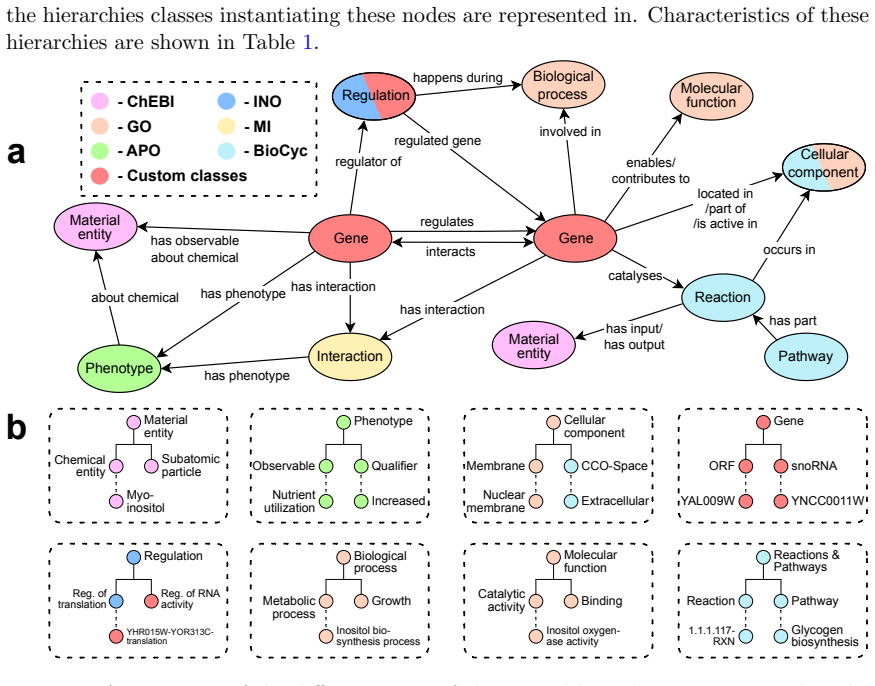
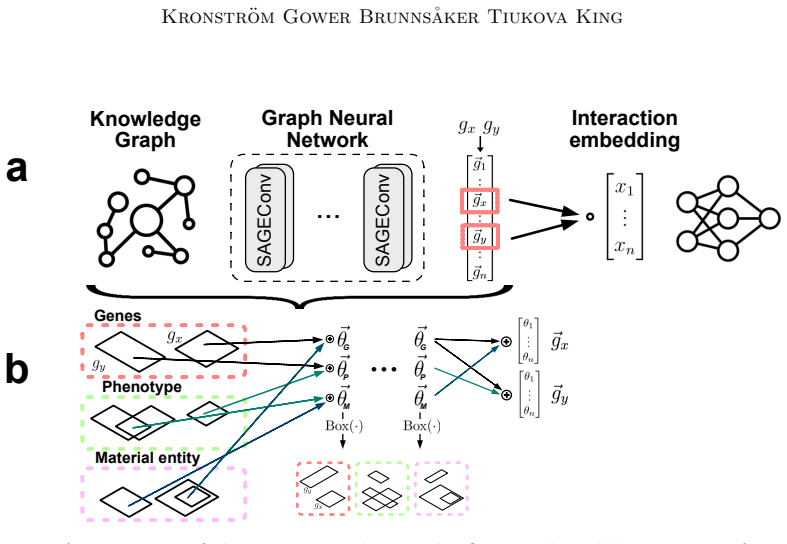
Hierarchy-aware box embeddings learned by graph neural networks augmented with a semantic loss function derived from ontology class hierarchies.
If this is right
- The predictions generalize from double to triple gene knockouts, indicating the model captures broader interaction patterns.
- Analysis of co-occurring relations in the knowledge graph can generate testable hypotheses about biological traits in yeast.
- Box embeddings can be used to evaluate the quality of revisions to the knowledge graph.
- Semantic loss improves alignment with ontology structure, leading to better predictive performance.
Where Pith is reading between the lines
- The method could extend to predicting phenotypes in other organisms if similar knowledge graphs and ontologies are available.
- Incorporating ontology hierarchies this way might improve embedding-based models in other scientific domains with structured knowledge.
- Validated hypotheses from such models could accelerate biological discovery by prioritizing experiments.
- Box embeddings might help detect inconsistencies or gaps in existing knowledge graphs beyond the yeast example.
Load-bearing premise
The yeast knowledge graph built from community databases accurately captures the biologically relevant relationships that determine cell-growth phenotypes under gene deletions.
What would settle it
If the mean R² score on a new set of triple gene knockout experiments or other held-out data falls to the level of baseline models without semantic loss, the claim that the embeddings improve predictions would be falsified.
Figures



read the original abstract
We present a method for finding hierarchy-aware embeddings of knowledge graphs (KGs) using graph neural networks (GNNs) enriched with a semantic loss derived from underlying ontologies. This method yields embeddings that better reflect domain knowledge. To demonstrate their utility, we predict and interpret the effects of gene deletions in the yeast Saccharomyces cerevisiae and learn box embeddings for KGs in the absence of a prediction task. We further show how box embeddings can serve as the basis for evaluating KG revisions. Our yeast KG is constructed from community databases and ontology terms. Low-dimensional box embeddings combined with GNNs are used to predict cell growth for double gene knockouts. Over 10-fold cross validation, these predictions have a mean $R^2$~score~of~0.360, significantly higher than baseline comparisons, demonstrating that high-level qualitative knowledge is informative about experimental outcomes. Incorporating semantic loss terms in the training of the models improves their predictive performance ($R^2$=0.377) by aligning embeddings with ontology structure. This shows that class hierarchies from ontologies can be exploited for quantitative prediction. We also test the trained models on triple gene knockouts, showing they generalise to data beyond those seen in training. Additionally, by identifying co-occurring relations in the yeast KG important for the cell-growth predictions, we construct hypotheses about interacting traits in yeast. A biological experiment validates one such finding, revealing an association between inositol utilisation and osmotic stress resistance, highlighting the model's potential to guide biological discovery.
Editorial analysis
A structured set of objections, weighed in public.
Referee Report
Summary. The manuscript introduces a GNN-based approach to learning hierarchy-aware box embeddings for knowledge graphs by adding a semantic loss term derived from ontology class hierarchies. The method is applied to a yeast KG built from public databases and ontologies to predict cell-growth phenotypes under double gene knockouts, reporting a mean R² of 0.360 over 10-fold cross-validation that rises to 0.377 with the semantic loss; the models are further tested on triple knockouts, used to evaluate KG revisions, and employed to generate hypotheses that receive one biological validation.
Significance. If the reported R² gains are free of transductive leakage, the work provides concrete evidence that ontological hierarchy information can be turned into quantitative predictive gains for experimental phenotypes in a model organism. The biological validation experiment and the generalization test on triple knockouts are positive features that strengthen the utility claim. The semantic-loss construction and box-embedding evaluation of KG revisions may be reusable in other hierarchical domains.
major comments (2)
- [cross-validation procedure and embedding training details] The description of the 10-fold cross-validation for double-knockout phenotype prediction (abstract and experimental results section) does not state whether the GNN parameters and semantic loss are recomputed from scratch on each training fold or learned once on the full yeast KG. If the latter, every gene participates in message passing and ontology alignment even when its knockout pairs are held out, creating a transductive setting in which test-gene representations can encode information from training phenotypes via shared neighbors or ontology paths. This directly affects the central claim that the R² improvement from 0.360 to 0.377 is attributable to hierarchy alignment rather than leakage.
- [baseline construction in experimental evaluation] The baseline comparisons that yield the reported R² of 0.360 are not described in sufficient detail (results section) to allow assessment of whether they use the same KG structure, the same box-embedding parameterization, or the same feature construction; without this, the magnitude of the improvement cannot be interpreted as evidence that the semantic loss adds value beyond standard GNN message passing.
minor comments (2)
- [methods] Notation for the semantic loss term and the box-embedding distance function should be introduced with explicit equations rather than prose descriptions only.
- [data description] The manuscript would benefit from a table listing the exact data sources, number of nodes/edges/relations in the yeast KG, and the phenotype dataset size and split statistics.
Simulated Author's Rebuttal
We thank the referee for their constructive and detailed review. We address each major comment below and will revise the manuscript to improve clarity on the experimental procedures.
read point-by-point responses
-
Referee: The description of the 10-fold cross-validation for double-knockout phenotype prediction (abstract and experimental results section) does not state whether the GNN parameters and semantic loss are recomputed from scratch on each training fold or learned once on the full yeast KG. If the latter, every gene participates in message passing and ontology alignment even when its knockout pairs are held out, creating a transductive setting in which test-gene representations can encode information from training phenotypes via shared neighbors or ontology paths. This directly affects the central claim that the R² improvement from 0.360 to 0.377 is attributable to hierarchy alignment rather than leakage.
Authors: We acknowledge that the manuscript did not explicitly describe the cross-validation procedure in sufficient detail. The GNN parameters and semantic loss are computed once on the full yeast KG (including all genes and ontology paths), after which the 10-fold CV is performed solely on the downstream double-knockout phenotype prediction task. This follows the standard transductive protocol for KG embedding methods, where the complete graph structure is used to learn representations that capture relational and hierarchical information. Both the baseline model (mean R² = 0.360) and the semantic-loss model (mean R² = 0.377) employ identical embedding training on the full KG, so the reported improvement isolates the contribution of the ontology-derived semantic loss. We will revise the experimental results section to state this procedure explicitly, include a discussion of the transductive setting, and clarify that the KG structure itself is label-independent. revision: yes
-
Referee: The baseline comparisons that yield the reported R² of 0.360 are not described in sufficient detail (results section) to allow assessment of whether they use the same KG structure, the same box-embedding parameterization, or the same feature construction; without this, the magnitude of the improvement cannot be interpreted as evidence that the semantic loss adds value beyond standard GNN message passing.
Authors: We agree that the baseline methods require additional implementation details. The baselines are standard GNN models without the semantic loss term; they operate on the identical yeast KG, employ the same box-embedding parameterization, and use the same node feature construction and training protocol as the proposed method. This design isolates the effect of the semantic loss. We will expand the results section in the revised manuscript with a dedicated subsection describing the baseline architectures, hyperparameters, and training procedures to ensure full reproducibility and allow readers to verify the fairness of the comparison. revision: yes
Circularity Check
No circularity: embeddings and semantic loss derive from external KG and ontologies; predictions evaluated on held-out experimental phenotypes
full rationale
The paper builds the yeast KG from community databases and ontology terms separate from the phenotype labels. It trains GNN box embeddings with a semantic loss that aligns to external ontology hierarchies, then measures R² on 10-fold CV held-out double-knockout growth data (and generalizes to triples). No derivation step equates the reported performance gain or hierarchy alignment to a quantity defined solely by the fitted parameters, self-citations, or input data by construction. The improvement is an empirical outcome on independent experimental targets, not a tautology.
Axiom & Free-Parameter Ledger
axioms (1)
- domain assumption The yeast KG built from community databases and ontologies accurately captures relationships relevant to cell growth phenotypes.
Reference graph
Works this paper leans on
-
[2]
An Introduction to Description Logic
Franz Baader, Ian Horrocks, Carsten Lutz, and Uli Sattler. An Introduction to Description Logic. Cambridge University Press. ISBN 978-0-521-87361-1. doi:10.1017/9781139025355
-
[3]
Translating embeddings for modeling multi-relational data
Antoine Bordes, Nicolas Usunier, Alberto Garcia-Durán, Jason Weston, and Oksana Yakhnenko. Translating embeddings for modeling multi-relational data. In Proceedings of the 27th International Conference on Neural Information Processing Systems - Volume 2, volume 2 of NIPS '13 , pages 2787--2795. Curran Associates Inc., 2013
2013
-
[5]
Daniel Brunnsåker, Alexander H. Gower, Prajakta Naval, Erik Y. Bjurström, Filip Kronström, Ievgeniia A. Tiukova, and Ross D. King. Agentic AI integrated with scientific knowledge: Laboratory validation in systems biology, 2025. URL https://www.biorxiv.org/content/10.1101/2025.06.24.661378v3. ISSN : 2692-8205 Pages: 2025.06.24.661378 Section: New Results
-
[6]
Box embeddings: An open-source library for representation learning using geometric structures, 2021
Tejas Chheda, Purujit Goyal, Trang Tran, Dhruvesh Patel, Michael Boratko, Shib Sankar Dasgupta, and Andrew McCallum . Box embeddings: An open-source library for representation learning using geometric structures, 2021. URL http://arxiv.org/abs/2109.04997
-
[7]
Le, and Christopher D
Kevin Clark, Minh-Thang Luong, Quoc V. Le, and Christopher D. Manning. ELECTRA : Pre-training text encoders as discriminators rather than generators. 2019. URL https://openreview.net/forum?id=r1xMH1BtvB
2019
-
[12]
Improving local identifiability in probabilistic box embeddings
Shib Sankar Dasgupta, Michael Boratko, Dongxu Zhang, Luke Vilnis, Xiang Lorraine Li, and Andrew McCallum . Improving local identifiability in probabilistic box embeddings. In Proceedings of the 34th International Conference on Neural Information Processing Systems, NIPS '20, pages 182--192. Curran Associates Inc., 2020. ISBN 978-1-7138-2954-6
2020
-
[15]
Hyperbolic entailment cones for learning hierarchical embeddings
Octavian Ganea, Gary Becigneul, and Thomas Hofmann. Hyperbolic entailment cones for learning hierarchical embeddings. In Proceedings of the 35th International Conference on Machine Learning, pages 1646--1655. PMLR , 2018. ISSN : 2640-3498
2018
-
[17]
Schockaert
Víctor Gutiérrez-Basulto and S. Schockaert. From knowledge graph embedding to ontology embedding? A n analysis of the compatibility between vector space representations and rules. In International Conference on Principles of Knowledge Representation and Reasoning, 2018
2018
-
[18]
Hamilton, Rex Ying, and Jure Leskovec
William L. Hamilton, Rex Ying, and Jure Leskovec. Inductive representation learning on large graphs. In Proceedings of the 31st International Conference on Neural Information Processing Systems, NIPS '17, pages 1025--1035. Curran Associates Inc., 2017. ISBN 978-1-5108-6096-4
2017
-
[21]
Open graph benchmark: datasets for machine learning on graphs
Weihua Hu, Matthias Fey, Marinka Zitnik, Yuxiao Dong, Hongyu Ren, Bowen Liu, Michele Catasta, and Jure Leskovec. Open graph benchmark: datasets for machine learning on graphs. In Proceedings of the 34th International Conference on Neural Information Processing Systems, NIPS '20, pages 22118--22133. Curran Associates Inc., 2020. ISBN 978-1-7138-2954-6
2020
-
[25]
LightGBM : A highly efficient gradient boosting decision tree
Guolin Ke, Qi Meng, Thomas Finley, Taifeng Wang, Wei Chen, Weidong Ma, Qiwei Ye, and Tie-Yan Liu. LightGBM : A highly efficient gradient boosting decision tree. In Advances in Neural Information Processing Systems, volume 30. Curran Associates, Inc., 2017. URL https://papers.nips.cc/paper_files/paper/2017/hash/6449f44a102fde848669bdd9eb6b76fa-Abstract.html
2017
-
[27]
Kipf and Max Welling
Thomas N. Kipf and Max Welling. Semi-supervised classification with graph convolutional networks, 2017
2017
-
[28]
Captum: A unified and generic model interpretability library for pytorch, 2020
Narine Kokhlikyan, Vivek Miglani, Miguel Martin, Edward Wang, Bilal Alsallakh, Jonathan Reynolds, Alexander Melnikov, Natalia Kliushkina, Carlos Araya, Siqi Yan, and Orion Reblitz-Richardson. Captum: A unified and generic model interpretability library for pytorch, 2020
2020
-
[29]
Tiukova, and Ross D
Filip Kronstr \"o m, Daniel Brunns a ker, Ievgeniia A. Tiukova, and Ross D. King. Ontology-based box embeddings and knowledge graphs for predicting phenotypic traits in saccharomyces cerevisiae. In 19th International Conference on Neurosymbolic Learning and Reasoning, 2025
2025
-
[38]
Chris Mungall, David Osumi-Sutherland, James A. Overton, Jim Balhoff, Clare72, pgaudet, Matthew Brush, Nico Matentzoglu, Vasundra Touré, Damion Dooley, Michael Sinclair, Anthony Bretaudeau, Scott Cain, Melissa Haendel, diatomsRcool , Jen Hammock, Marie-Angélique Laporte, Mark Jensen, and Martin Larralde. oborel/obo-relations: 2020-07-21, 2020. URL https:/...
-
[39]
Poincaré embeddings for learning hierarchical representations
Maximilian Nickel and Douwe Kiela. Poincaré embeddings for learning hierarchical representations. In Proceedings of the 31st International Conference on Neural Information Processing Systems, NIPS '17, pages 6341--6350. Curran Associates Inc., 2017. ISBN 978-1-5108-6096-4
2017
-
[40]
A three-way model for collective learning on multi-relational data
Maximilian Nickel, Volker Tresp, and Hans-Peter Kriegel. A three-way model for collective learning on multi-relational data. In Proceedings of the 28th International Conference on International Conference on Machine Learning, ICML '11, pages 809--816. Omnipress, 2011. ISBN 978-1-4503-0619-5
2011
-
[42]
Representing joint hierarchies with box embeddings
Dhruvesh Patel, Shib Sankar Dasgupta, Michael Boratko, Xiang Li, Luke Vilnis, and Andrew McCallum. Representing joint hierarchies with box embeddings. In Automated Knowledge Base Construction ( AKBC ) , 2020. doi:10.24432/C5KS37
-
[43]
Description logic EL ++ embeddings with intersectional closure, 2022
Xi Peng, Zhenwei Tang, Maxat Kulmanov, Kexin Niu, and Robert Hoehndorf. Description logic EL ++ embeddings with intersectional closure, 2022. URL http://arxiv.org/abs/2202.14018
-
[46]
Not just a black box: Learning important features through propagating activation differences, 2017
Avanti Shrikumar, Peyton Greenside, Anna Shcherbina, and Anshul Kundaje. Not just a black box: Learning important features through propagating activation differences, 2017. URL http://arxiv.org/abs/1605.01713
-
[47]
RotatE : Knowledge graph embedding by relational rotation in complex space
Zhiqing Sun, Zhi-Hong Deng, Jian-Yun Nie, and Jian Tang. RotatE : Knowledge graph embedding by relational rotation in complex space. In 7th International Conference on Learning Representations, ICLR 2019, New Orleans, LA , USA , May 6-9, 2019 . OpenReview .net, 2019
2019
-
[48]
Complex embeddings for simple link prediction
Théo Trouillon, Johannes Welbl, Sebastian Riedel, Eric Gaussier, and Guillaume Bouchard. Complex embeddings for simple link prediction. In Proceedings of The 33rd International Conference on Machine Learning, pages 2071--2080. PMLR , 2016. ISSN : 1938-7228
2071
-
[50]
Probabilistic embedding of knowledge graphs with box lattice measures
Luke Vilnis, Xiang Li, Shikhar Murty, and Andrew McCallum . Probabilistic embedding of knowledge graphs with box lattice measures. In Iryna Gurevych and Yusuke Miyao, editors, Proceedings of the 56th Annual Meeting of the Association for Computational Linguistics (Volume 1: Long Papers), pages 263--272. Association for Computational Linguistics, 2018. doi...
-
[55]
A semantic loss function for deep learning with symbolic knowledge
Jingyi Xu, Zilu Zhang, Tal Friedman, Yitao Liang, and Guy Van den Broeck. A semantic loss function for deep learning with symbolic knowledge. In Jennifer Dy and Andreas Krause, editors, Proceedings of the 35th International Conference on Machine Learning, volume 80 of Proceedings of Machine Learning Research, pages 5502--5511. PMLR, 10--15 Jul 2018
2018
-
[56]
Embedding entities and relations for learning and inference in knowledge bases
Bishan Yang, Wen-tau Yih, Xiaodong He, Jianfeng Gao, and Li Deng. Embedding entities and relations for learning and inference in knowledge bases. In Yoshua Bengio and Yann LeCun , editors, 3rd International Conference on Learning Representations, ICLR 2015, San Diego, CA , USA , May 7-9, 2015, Conference Track Proceedings , 2015
2015
-
[60]
and Aleksander, Suzi and Nash, Robert S
Engel, Stacia R. and Aleksander, Suzi and Nash, Robert S. and Wong, Edith D. and Weng, Shuai and Miyasato, Stuart R. and Sherlock, Gavin and Cherry, J. Michael , date =. Saccharomyces Genome Database: Advances in Genome Annotation, Expanded Biochemical Pathways, and Other Key Enhancements , issn =. Genetics , year =. doi:10.1093/genetics/iyae185 , shorttitle =
-
[61]
Ashburner, Michael and Ball, Catherine A. and Blake, Judith A. and Botstein, David and Butler, Heather and Cherry, J. Michael and Davis, Allan P. and Dolinski, Kara and Dwight, Selina S. and Eppig, Janan T. and Harris, Midori A. and Hill, David P. and Issel-Tarver, Laurie and Kasarskis, Andrew and Lewis, Suzanna and Matese, John C. and Richardson, Joel E....
-
[62]
Mungall, Chris and Osumi-Sutherland, David and Overton, James A. and Balhoff, Jim and Clare72 and pgaudet and Brush, Matthew and Matentzoglu, Nico and Touré, Vasundra and Dooley, Damion and Sinclair, Michael and Bretaudeau, Anthony and Cain, Scott and Haendel, Melissa and. oborel/obo-relations: 2020-07-21 , url =. 2020 , doi =
2020
-
[63]
Costanzo, Maria C. and Skrzypek, Marek S. and Nash, Robert and Wong, Edith and Binkley, Gail and Engel, Stacia R. and Hitz, Benjamin and Hong, Eurie L. and Cherry, J. Michael and. New mutant phenotype data curation system in the Saccharomyces Genome Database , volume =. 2009 , journal =. doi:10.1093/database/bap001 , abstract =
-
[64]
Nucleic acids research , shortjournal =
Hastings, Janna and Owen, Gareth and Dekker, Adriano and Ennis, Marcus and Kale, Namrata and Muthukrishnan, Venkatesh and Turner, Steve and Swainston, Neil and Mendes, Pedro and Steinbeck, Christoph , urldate =. Nucleic acids research , shortjournal =. 2016 , pmid =. doi:10.1093/nar/gkv1031 , shorttitle =
-
[65]
Hur, Junguk and Özgür, Arzucan and Xiang, Zuoshuang and He, Yongqun , urldate =. Development and application of an interaction network ontology for literature mining of vaccine-associated gene-gene interactions , volume =. Journal of Biomedical Semantics , shortjournal =. 2015 , keywords =. doi:10.1186/2041-1480-6-2 , abstract =
-
[66]
and Billington, Richard and Caspi, Ron and Fulcher, Carol A
Karp, Peter D. and Billington, Richard and Caspi, Ron and Fulcher, Carol A. and Latendresse, Mario and Kothari, Anamika and Keseler, Ingrid M. and Krummenacker, Markus and Midford, Peter E. and Ong, Quang and Ong, Wai Kit and Paley, Suzanne M. and Subhraveti, Pallavi , date =. The. Briefings in Bioinformatics , shortjournal =. 2019 , pmid =. doi:10.1093/b...
-
[67]
and Rutherford, Kim and Bähler, Jürg and Oliver, Stephen G
Wood, Valerie and Lock, Antonia and Harris, Midori A. and Rutherford, Kim and Bähler, Jürg and Oliver, Stephen G. , urldate =. Hidden in plain sight: what remains to be discovered in the eukaryotic proteome? , volume =. Open Biology , shortjournal =. 2019 , date =. doi:10.1098/rsob.180241 , shorttitle =
-
[68]
Global Genetic Networks and the Genotype-to-Phenotype Relationship , volume =
Costanzo, Michael and Kuzmin, Elena and van Leeuwen, Jolanda and Mair, Barbara and Moffat, Jason and Boone, Charles and Andrews, Brenda , urldate =. Global Genetic Networks and the Genotype-to-Phenotype Relationship , volume =. Cell , year =. doi:10.1016/j.cell.2019.01.033 , abstract =
-
[69]
Saccharomyces cerevisiae and its industrial applications , volume =
Parapouli, Maria and Vasileiadis, Anastasios and Afendra, Amalia-Sofia and Hatziloukas, Efstathios , urldate =. Saccharomyces cerevisiae and its industrial applications , volume =. 2020 , shortjournal =. doi:10.3934/microbiol.2020001 , abstract =
-
[70]
Nucleic Acids Research , shortjournal =
Dubreuil, Benjamin and Sass, Ehud and Nadav, Yotam and Heidenreich, Meta and Georgeson, Joseph M and Weill, Uri and Duan, Yuanqiang and Meurer, Matthias and Schuldiner, Maya and Knop, Michael and Levy, Emmanuel D , urldate =. Nucleic Acids Research , shortjournal =. 2019 , pmid =. doi:10.1093/nar/gky941 , shorttitle =
-
[71]
and Karu, Naama and Djoumbou Feunang, Yannick and Arndt, David and Wishart, David S
Ramirez-Gaona, Miguel and Marcu, Ana and Pon, Allison and Guo, An Chi and Sajed, Tanvir and Wishart, Noah A. and Karu, Naama and Djoumbou Feunang, Yannick and Arndt, David and Wishart, David S. , date =. Nucleic Acids Research , shortjournal =. 2017 , pmid =. doi:10.1093/nar/gkw1058 , shorttitle =
-
[72]
Buzzao, Davide and Persson, Emma and Guala, Dimitri and Sonnhammer, Erik L. L. , date =. Nucleic Acids Research , shortjournal =. 2025 , pmid =. doi:10.1093/nar/gkae1021 , shorttitle =
-
[73]
Hermjakob, Henning and Montecchi-Palazzi, Luisa and Bader, Gary and Wojcik, Jérôme and Salwinski, Lukasz and Ceol, Arnaud and Moore, Susan and Orchard, Sandra and Sarkans, Ugis and von Mering, Christian and Roechert, Bernd and Poux, Sylvain and Jung, Eva and Mersch, Henning and Kersey, Paul and Lappe, Michael and Li, Yixue and Zeng, Rong and Rana, Debashi...
-
[74]
, date =
Arp, Robert and Smith, Barry and Spear, Andrew D. , date =. Building Ontologies with Basic Formal Ontology , isbn =
-
[75]
Walsh, Brian and Mohamed, Sameh K. and Nováček, Vít , urldate =. Proceedings of the 29th. 2020 , file =. doi:10.1145/3340531.3412776 , series =
-
[76]
The scalable precision medicine open knowledge engine (
Morris, John H and Soman, Karthik and Akbas, Rabia E and Zhou, Xiaoyuan and Smith, Brett and Meng, Elaine C and Huang, Conrad C and Cerono, Gabriel and Schenk, Gundolf and Rizk-Jackson, Angela and Harroud, Adil and Sanders, Lauren and Costes, Sylvain V and Bharat, Krish and Chakraborty, Arjun and Pico, Alexander R and Mardirossian, Taline and Keiser, Mich...
-
[77]
Open graph benchmark: datasets for machine learning on graphs , isbn =
Hu, Weihua and Fey, Matthias and Zitnik, Marinka and Dong, Yuxiao and Ren, Hongyu and Liu, Bowen and Catasta, Michele and Leskovec, Jure , urldate =. Open graph benchmark: datasets for machine learning on graphs , isbn =. Proceedings of the 34th International Conference on Neural Information Processing Systems , publisher =. 2020 , file =
2020
-
[78]
Translating embeddings for modeling multi-relational data , volume =
Bordes, Antoine and Usunier, Nicolas and Garcia-Durán, Alberto and Weston, Jason and Yakhnenko, Oksana , urldate =. Translating embeddings for modeling multi-relational data , volume =. Proceedings of the 27th International Conference on Neural Information Processing Systems - Volume 2 , publisher =
-
[79]
Kulmanov, Maxat and Liu-Wei, Wang and Yan, Yuan and Hoehndorf, Robert , urldate =. Proceedings of the Twenty-Eighth International Joint Conference on Artificial Intelligence , publisher =. 2019 , langid =. doi:10.24963/ijcai.2019/845 , shorttitle =
-
[80]
Description logic EL ++ embeddings with intersectional closure, 2022
Peng, Xi and Tang, Zhenwei and Kulmanov, Maxat and Niu, Kexin and Hoehndorf, Robert , urldate =. Description Logic. 2022 , eprinttype =. doi:10.48550/arXiv.2202.14018 , abstract =. 2202.14018 [cs] , keywords =
-
[81]
Improving local identifiability in probabilistic box embeddings , isbn =
Dasgupta, Shib Sankar and Boratko, Michael and Zhang, Dongxu and Vilnis, Luke and Li, Xiang Lorraine and. Improving local identifiability in probabilistic box embeddings , isbn =. Proceedings of the 34th International Conference on Neural Information Processing Systems , publisher =. 2020 , file =
2020
-
[82]
and Ying, Rex and Leskovec, Jure , urldate =
Hamilton, William L. and Ying, Rex and Leskovec, Jure , urldate =. Inductive representation learning on large graphs , isbn =. Proceedings of the 31st International Conference on Neural Information Processing Systems , publisher =. 2017 , file =
2017
-
[83]
Using deep learning to model the hierarchical structure and function of a cell , volume =
Ma, Jianzhu and Yu, Michael Ku and Fong, Samson and Ono, Keiichiro and Sage, Eric and Demchak, Barry and Sharan, Roded and Ideker, Trey , urldate =. Using deep learning to model the hierarchical structure and function of a cell , volume =. Nature Methods , shortjournal =. 2018 , langid =. doi:10.1038/nmeth.4627 , abstract =
-
[84]
Interpreting protein abundance in Saccharomyces cerevisiae through relational learning , volume =
Brunnsåker, Daniel and Kronström, Filip and Tiukova, Ievgeniia A and King, Ross D , urldate =. Interpreting protein abundance in Saccharomyces cerevisiae through relational learning , volume =. Bioinformatics , shortjournal =. 2024 , file =. doi:10.1093/bioinformatics/btae050 , abstract =
-
[85]
Gualdi, Francesco and Oliva, Baldomero and Piñero, Janet , urldate =. Predicting gene disease associations with knowledge graph embeddings for diseases with curtailed information , volume =. 2024 , file =. doi:10.1093/nargab/lqae049 , abstract =
-
[86]
Box embeddings: An open-source library for representation learning using geometric structures, 2021
Chheda, Tejas and Goyal, Purujit and Tran, Trang and Patel, Dhruvesh and Boratko, Michael and Dasgupta, Shib Sankar and. Box Embeddings: An open-source library for representation learning using geometric structures , url =. 2021 , langid =. doi:10.48550/arXiv.2109.04997 , shorttitle =. 2109.04997 [cs] , keywords =
-
[87]
A global genetic interaction network maps a wiring diagram of cellular function , volume =. Science , author =. 2016 , date =. doi:10.1126/science.aaf1420 , abstract =
-
[88]
Systematic analysis of complex genetic interactions , volume =. Science , author =. 2018 , note =. doi:10.1126/science.aao1729 , abstract =
-
[89]
Advances in Neural Information Processing Systems , publisher =
Ke, Guolin and Meng, Qi and Finley, Thomas and Wang, Taifeng and Chen, Wei and Ma, Weidong and Ye, Qiwei and Liu, Tie-Yan , urldate =. Advances in Neural Information Processing Systems , publisher =. 2017 , file =
2017
-
[90]
Not just a black box: Learning important features through propagating activation differences, 2017
Shrikumar, Avanti and Greenside, Peyton and Shcherbina, Anna and Kundaje, Anshul , urldate =. Not Just a Black Box: Learning Important Features Through Propagating Activation Differences , url =. 2017 , langid =. doi:10.48550/arXiv.1605.01713 , shorttitle =. 1605.01713 [cs] , keywords =
-
[91]
Journal of The Royal Society Interface , author =
Testing the reproducibility and robustness of the cancer biology literature by robot , volume =. Journal of The Royal Society Interface , author =. 2022 , note =. doi:10.1098/rsif.2021.0821 , abstract =
-
[92]
Hierarchical deep learning for predicting
Merino, Gabriela A and Saidi, Rabie and Milone, Diego H and Stegmayer, Georgina and Martin, Maria J , urldate =. Hierarchical deep learning for predicting. Bioinformatics , shortjournal =. 2022 , file =. doi:10.1093/bioinformatics/btac536 , abstract =
-
[93]
Functional genomic hypothesis generation and experimentation by a robot scientist , volume =. Nature , author =. 2004 , langid =. doi:10.1038/nature02236 , abstract =
-
[94]
Performance of Regression Models as a Function of Experiment Noise , volume =
Li, Gang and Zrimec, Jan and Ji, Boyang and Geng, Jun and Larsbrink, Johan and Zelezniak, Aleksej and Nielsen, Jens and Engqvist, Martin. Performance of Regression Models as a Function of Experiment Noise , volume =. Bioinformatics and Biology Insights , shortjournal =. 2021 , langid =. doi:10.1177/11779322211020315 , abstract =
-
[95]
Journal of The Royal Society Interface , author =
Cheaper faster drug development validated by the repositioning of drugs against neglected tropical diseases , volume =. Journal of The Royal Society Interface , author =. 2015 , note =. doi:10.1098/rsif.2014.1289 , abstract =
-
[96]
Designing microplate layouts using artificial intelligence , volume =
Francisco Rodríguez, María Andreína and Carreras Puigvert, Jordi and Spjuth, Ola , urldate =. Designing microplate layouts using artificial intelligence , volume =. Artificial Intelligence in the Life Sciences , shortjournal =. 2023 , keywords =. doi:10.1016/j.ailsci.2023.100073 , abstract =
-
[97]
Culbertson, Michael R and Henry, Susan A , urldate =. Genetics , shortjournal =. 1975 , file =. doi:10.1093/genetics/80.1.23 , abstract =
-
[98]
Effect of benzoic acid on metabolic fluxes in yeasts: A continuous-culture study on the regulation of respiration and alcoholic fermentation , volume =. Yeast , author =. 1992 , langid =. doi:10.1002/yea.320080703 , shorttitle =
-
[99]
2020 , eprint=
Captum: A unified and generic model interpretability library for PyTorch , author=. 2020 , eprint=
2020
-
[100]
doi:10.1093/gigascience/giad057 , shorttitle =
Ma, Chunyu and Zhou, Zhihan and Liu, Han and Koslicki, David , urldate =. doi:10.1093/gigascience/giad057 , shorttitle =
-
[101]
Syama, K. and Jothi, J. Angel Arul and Khanna, Namita , urldate =. Automatic disease prediction from human gut metagenomic data using boosting. doi:10.1186/s12859-023-05251-x , abstract =
-
[102]
Medical Entity Disambiguation Using Graph Neural Networks , isbn =
Vretinaris, Alina and Lei, Chuan and Efthymiou, Vasilis and Qin, Xiao and Özcan, Fatma , urldate =. Medical Entity Disambiguation Using Graph Neural Networks , isbn =. Proceedings of the 2021 International Conference on Management of Data , publisher =. doi:10.1145/3448016.3457328 , series =
-
[103]
Dual Box Embeddings for the Description Logic
Jackermeier, Mathias and Chen, Jiaoyan and Horrocks, Ian , urldate =. Dual Box Embeddings for the Description Logic. Proceedings of the. doi:10.1145/3589334.3645648 , series =
-
[104]
International Conference on Principles of Knowledge Representation and Reasoning , author =
From Knowledge Graph Embedding to Ontology Embedding?. International Conference on Principles of Knowledge Representation and Reasoning , author =
-
[105]
Wikidata: a free collaborative knowledgebase
Vrandečić, Denny and Krötzsch, Markus , urldate =. Wikidata: a free collaborative knowledgebase , volume =. Communications of the ACM , abstract =. doi:10.1145/2629489 , shorttitle =
-
[106]
Synergistic Signals: Exploiting Co-Engagement and Semantic Links via Graph Neural Networks , doi =
Huang, Zijie and Li, Baolin and Asgharzadeh, Hafez and Cocos, Anne and Liu, Lingyi and Cox, Evan and Wise, Colby and Lamkhede, Sudarshan , date =. Synergistic Signals: Exploiting Co-Engagement and Semantic Links via Graph Neural Networks , doi =. 2312.04071 [cs] , keywords =
-
[107]
Proceedings of the 35th International Conference on Machine Learning , pages =
A Semantic Loss Function for Deep Learning with Symbolic Knowledge , author =. Proceedings of the 35th International Conference on Machine Learning , pages =. 2018 , editor =
2018
-
[108]
Contrastive Box Embedding for Collaborative Reasoning , isbn =
Liang, Tingting and Zhang, Yuanqing and Di, Qianhui and Xia, Congying and Li, Youhuizi and Yin, Yuyu , urldate =. Contrastive Box Embedding for Collaborative Reasoning , isbn =. Proceedings of the 46th International. doi:10.1145/3539618.3591654 , series =
-
[109]
When Box Meets Graph Neural Network in Tag-aware Recommendation , isbn =
Lin, Fake and Zhao, Ziwei and Zhu, Xi and Zhang, Da and Shen, Shitian and Li, Xueying and Xu, Tong and Zhang, Suojuan and Chen, Enhong , urldate =. When Box Meets Graph Neural Network in Tag-aware Recommendation , isbn =. Proceedings of the 30th. doi:10.1145/3637528.3671973 , series =
-
[110]
Representing Joint Hierarchies with Box Embeddings , doi =
Dhruvesh Patel and Shib Sankar Dasgupta and Michael Boratko and Xiang Li and Luke Vilnis and Andrew McCallum , urldate =. Representing Joint Hierarchies with Box Embeddings , doi =. Automated Knowledge Base Construction (
-
[111]
Probabilistic Embedding of Knowledge Graphs with Box Lattice Measures , doi =
Vilnis, Luke and Li, Xiang and Murty, Shikhar and. Probabilistic Embedding of Knowledge Graphs with Box Lattice Measures , doi =. Proceedings of the 56th Annual Meeting of the Association for Computational Linguistics (Volume 1: Long Papers) , publisher =
-
[112]
and Naval, Prajakta and Bjurström, Erik Y
Brunnsåker, Daniel and Gower, Alexander H. and Naval, Prajakta and Bjurström, Erik Y. and Kronström, Filip and Tiukova, Ievgeniia A. and King, Ross D. , urldate =. Agentic. doi:10.1101/2025.06.24.661378 , shorttitle =
-
[113]
19th International Conference on Neurosymbolic Learning and Reasoning , year=
Ontology-based box embeddings and knowledge graphs for predicting phenotypic traits in Saccharomyces cerevisiae , author=. 19th International Conference on Neurosymbolic Learning and Reasoning , year=
-
[114]
Poincaré embeddings for learning hierarchical representations , isbn =
Nickel, Maximilian and Kiela, Douwe , date =. Poincaré embeddings for learning hierarchical representations , isbn =. 2017 , booktitle =
2017
discussion (0)
Sign in with ORCID, Apple, or X to comment. Anyone can read and Pith papers without signing in.