Recognition: unknown
SAM-NER: Semantic Archetype Mediation for Zero-Shot Named Entity Recognition
Pith reviewed 2026-05-07 16:37 UTC · model grok-4.3
The pith
SAM-NER inserts an intermediate domain-invariant archetype space to reduce semantic drift in zero-shot named entity recognition.
A machine-rendered reading of the paper's core claim, the machinery that carries it, and where it could break.
Core claim
SAM-NER shows that routing entity mentions through an intermediate layer of universal semantic archetypes distilled from ontological abstractions, followed by definition-aligned calibration, produces more reliable zero-shot predictions than direct label mapping, as measured by consistent outperformance over prior baselines on the CrossNER benchmark in cross-domain settings.
What carries the argument
Semantic Archetype Mediation, an intermediate projection into a compact set of universal semantic archetypes that decouples entity discovery from final target-schema assignment.
If this is right
- SAM-NER outperforms prior zero-shot NER baselines on CrossNER under cross-domain conditions.
- The archetype mediation step reduces systematic semantic drift for unseen or overlapping target schemas.
- The full pipeline operates with a frozen LLM and requires no task-specific fine-tuning.
- Consensus-based entity discovery improves span coverage and fidelity before any label assignment occurs.
Where Pith is reading between the lines
- The same archetype-mediation pattern could be tested on zero-shot relation extraction or event extraction where schema drift is also common.
- If the archetypes prove reusable across multiple extraction tasks, they might serve as a lightweight alignment layer for broader LLM-based information extraction pipelines.
- A natural next measurement would be how sensitive final accuracy is to the particular choice or granularity of the ontological abstractions used to define the archetypes.
Load-bearing premise
An intermediate domain-invariant archetype space distilled from high-level ontological abstractions can be projected and calibrated without introducing new semantic misalignment when target schemas are novel or overlapping.
What would settle it
On a held-out cross-domain NER test set with deliberately novel or heavily overlapping label definitions, measure whether SAM-NER's F1 scores fall below those of a strong direct-LLM-prompting baseline.
Figures



read the original abstract
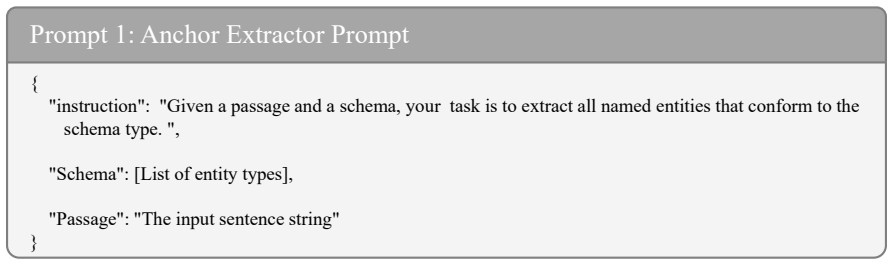
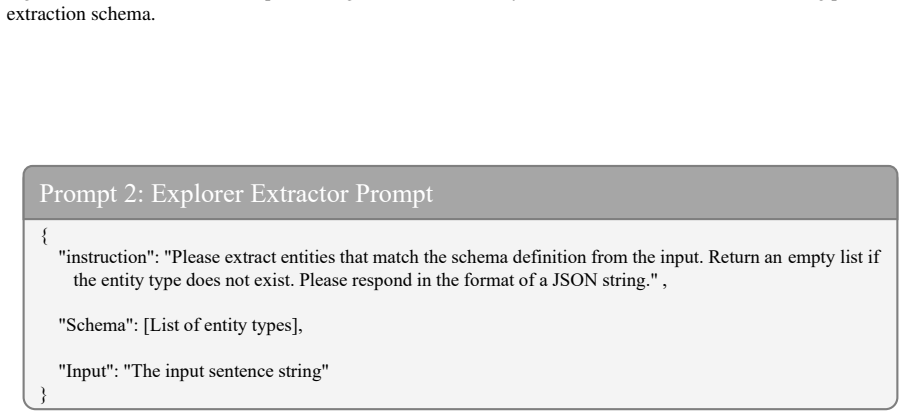
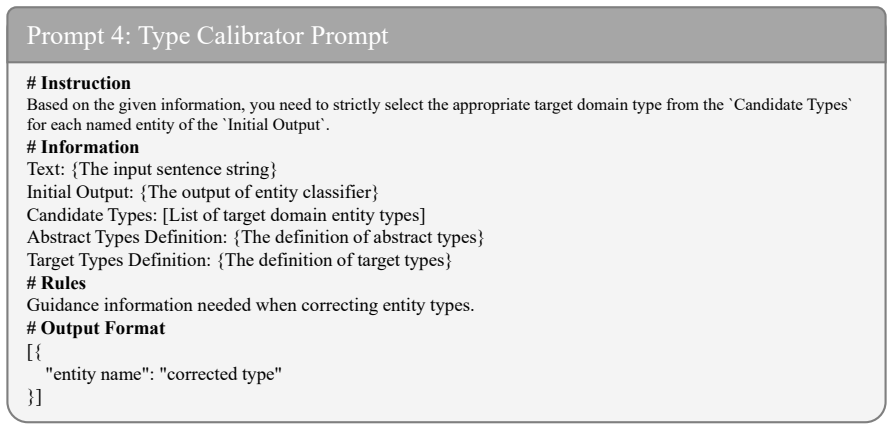
Zero-shot Named Entity Recognition (ZS-NER) remains brittle under domain and schema shifts, where unseen label definitions often misalign with a large language model's (LLM's) intrinsic semantic organization. As a result, directly mapping entity mentions to fine-grained target labels can induce systematic semantic drift, especially when target schemas are novel or semantically overlapping. We propose \textbf{SAM-NER}, a three-stage framework based on \emph{Semantic Archetype Mediation} that stabilizes cross-domain transfer through an intermediate, domain-invariant archetype space. SAM-NER: (i) performs \emph{Entity Discovery} via cooperative extraction and consensus-based denoising to obtain high-coverage, high-fidelity entity spans; (ii) conducts \emph{Abstract Mediation} by projecting entities into a compact set of universal semantic archetypes distilled from high-level ontological abstractions; and (iii) applies \emph{Semantic Calibration} to resolve archetype-level predictions into target-domain types through constrained, definition-aligned inference with a frozen LLM. Experiments on the CrossNER benchmark show that SAM-NER consistently outperforms strong prior ZS-NER baselines in cross-domain settings. Our implementation will be open-sourced at https://github.com/DMIRLAB-Group/SAM-NER.
Editorial analysis
A structured set of objections, weighed in public.
Referee Report
Summary. The manuscript proposes SAM-NER, a three-stage framework for zero-shot named entity recognition (ZS-NER) that stabilizes cross-domain transfer via an intermediate domain-invariant archetype space. The stages are (i) Entity Discovery through cooperative extraction and consensus denoising, (ii) Abstract Mediation by projecting entities into a compact set of universal semantic archetypes distilled from high-level ontological abstractions, and (iii) Semantic Calibration that resolves archetype predictions into target-domain types via constrained LLM inference. The central empirical claim is that SAM-NER consistently outperforms strong prior ZS-NER baselines on the CrossNER benchmark in cross-domain settings.
Significance. If the reported gains hold and can be attributed specifically to the archetype mediation layer rather than LLM priors or the discovery stage, the work would offer a structured approach to mitigating semantic drift under schema shifts by leveraging ontological abstractions as an invariant bridge. This could meaningfully extend existing ZS-NER methods that rely on direct mapping or prompt engineering, particularly for novel or overlapping target schemas.
major comments (3)
- [§3.2] §3.2 (Abstract Mediation): The manuscript asserts that the archetype space is domain-invariant and distilled from high-level ontological abstractions, yet provides no quantitative verification of this invariance, such as archetype assignment entropy, Jaccard overlap of recovered archetypes, or projection fidelity metrics across the different CrossNER domains. Without such checks, it is unclear whether the reported outperformance stems from the claimed mediation or from other pipeline components.
- [Experiments] Experiments section (and abstract): The central claim of consistent outperformance on CrossNER lacks reported details on baseline implementations, exact metrics (e.g., micro/macro F1), statistical significance tests, variance across runs, or ablation studies isolating the contribution of each stage. This makes it impossible to evaluate whether the three-stage pipeline is necessary or whether gains could arise from the Entity Discovery stage alone.
- [§3.3] §3.3 (Semantic Calibration): The calibration step is described as resolving archetype predictions to novel/overlapping target schemas via definition-aligned inference, but the manuscript does not address or measure potential new semantic misalignment introduced during this projection, which is the load-bearing assumption for handling schema shifts.
minor comments (2)
- The abstract states that the implementation will be open-sourced but provides no link or repository details in the main text; this should be added for reproducibility.
- Notation for the archetype set and projection function is introduced without a clear mathematical definition or diagram; a formal notation section or figure would improve clarity.
Simulated Author's Rebuttal
We thank the referee for the constructive and detailed feedback, which highlights important areas for strengthening the validation and presentation of SAM-NER. We address each major comment below and will incorporate revisions to improve the manuscript's rigor and clarity.
read point-by-point responses
-
Referee: [§3.2] §3.2 (Abstract Mediation): The manuscript asserts that the archetype space is domain-invariant and distilled from high-level ontological abstractions, yet provides no quantitative verification of this invariance, such as archetype assignment entropy, Jaccard overlap of recovered archetypes, or projection fidelity metrics across the different CrossNER domains. Without such checks, it is unclear whether the reported outperformance stems from the claimed mediation or from other pipeline components.
Authors: We agree that quantitative verification of domain-invariance would better support the claims in §3.2. The archetype space is constructed from high-level ontological abstractions to serve as a domain-invariant bridge, but the original submission did not report explicit cross-domain metrics. In the revised manuscript, we will add analyses including archetype assignment entropy across CrossNER domains, Jaccard overlap of recovered archetypes, and projection fidelity metrics to demonstrate that the mediation layer contributes to performance beyond the entity discovery stage alone. revision: yes
-
Referee: [Experiments] Experiments section (and abstract): The central claim of consistent outperformance on CrossNER lacks reported details on baseline implementations, exact metrics (e.g., micro/macro F1), statistical significance tests, variance across runs, or ablation studies isolating the contribution of each stage. This makes it impossible to evaluate whether the three-stage pipeline is necessary or whether gains could arise from the Entity Discovery stage alone.
Authors: We acknowledge that greater experimental transparency is required to substantiate the central claims and isolate component contributions. The submitted version reports aggregate outperformance but omits details on baseline re-implementations, the precise metric (micro-F1), statistical tests, variance, and full ablations. We will expand the Experiments section and abstract to specify baseline implementations, confirm micro-F1 as the primary metric (with macro-F1 in the appendix), include statistical significance tests (e.g., paired t-tests), report standard deviations over multiple runs, and provide ablation studies that remove each stage individually to show the necessity of the full pipeline. revision: yes
-
Referee: [§3.3] §3.3 (Semantic Calibration): The calibration step is described as resolving archetype predictions to novel/overlapping target schemas via definition-aligned inference, but the manuscript does not address or measure potential new semantic misalignment introduced during this projection, which is the load-bearing assumption for handling schema shifts.
Authors: We recognize the value of explicitly addressing potential semantic misalignment introduced during calibration. The constrained definition-aligned inference is designed to resolve archetypes to target schemas while limiting drift, yet the original manuscript does not quantify or discuss this risk. In the revision, we will expand §3.3 with a dedicated discussion of the assumption and add empirical measurements, such as pre- and post-calibration embedding similarity or targeted error analysis on misalignment cases, to validate its effectiveness under schema shifts. revision: yes
Circularity Check
No circularity in SAM-NER's empirical framework
full rationale
The paper presents SAM-NER as a three-stage empirical pipeline (Entity Discovery, Abstract Mediation, Semantic Calibration) whose value is asserted through benchmark outperformance on CrossNER. No equations, fitted parameters, self-referential derivations, or load-bearing self-citations appear in the abstract or described method. The archetype space is introduced as an intermediate construct distilled from ontological abstractions, but its stability is not derived from prior results by construction; claims rest on external experimental comparison rather than reducing to inputs.
Axiom & Free-Parameter Ledger
invented entities (1)
-
universal semantic archetypes
no independent evidence
Reference graph
Works this paper leans on
-
[1]
2024 , eprint=
ChatIE: Zero-Shot Information Extraction via Chatting with ChatGPT , author=. 2024 , eprint=
2024
-
[2]
Self-Improving for Zero-Shot Named Entity Recognition with Large Language Models
Xie, Tingyu and Li, Qi and Zhang, Yan and Liu, Zuozhu and Wang, Hongwei. Self-Improving for Zero-Shot Named Entity Recognition with Large Language Models. Proceedings of the 2024 Conference of the North American Chapter of the Association for Computational Linguistics: Human Language Technologies (Volume 2: Short Papers). 2024. doi:10.18653/v1/2024.naacl-short.49
-
[3]
Oscar Sainz and Iker Garc. Go. The Twelfth International Conference on Learning Representations , year=
-
[4]
V erifi NER : Verification-augmented NER via Knowledge-grounded Reasoning with Large Language Models
Kim, Seoyeon and Seo, Kwangwook and Chae, Hyungjoo and Yeo, Jinyoung and Lee, Dongha. V erifi NER : Verification-augmented NER via Knowledge-grounded Reasoning with Large Language Models. Proceedings of the 62nd Annual Meeting of the Association for Computational Linguistics (Volume 1: Long Papers). 2024. doi:10.18653/v1/2024.acl-long.134
-
[5]
arXiv preprint arXiv:2411.00451 , year=
Improving Few-Shot Cross-Domain Named Entity Recognition by Instruction Tuning a Word-Embedding based Retrieval Augmented Large Language Model , author=. arXiv preprint arXiv:2411.00451 , year=
-
[6]
Proceedings of the 31st International Conference on Computational Linguistics , pages=
Ruie: Retrieval-based unified information extraction using large language model , author=. Proceedings of the 31st International Conference on Computational Linguistics , pages=
-
[7]
Electronics , volume=
Enhancing Clinical Named Entity Recognition via Fine-Tuned BERT and Dictionary-Infused Retrieval-Augmented Generation , author=. Electronics , volume=. 2025 , publisher=
2025
-
[8]
Handling Missing Entities in Zero-Shot Named Entity Recognition: Integrated Recall and Retrieval Augmentation , author=. Proceedings of the 2025 Conference of the Nations of the Americas Chapter of the Association for Computational Linguistics: Human Language Technologies (Volume 1: Long Papers) , pages=
2025
-
[9]
Findings of the Association for Computational Linguistics: NAACL 2025 , pages=
OPENBIONER: Lightweight Open-Domain Biomedical Named Entity Recognition Through Entity Type Description , author=. Findings of the Association for Computational Linguistics: NAACL 2025 , pages=
2025
-
[10]
Findings of the Association for Computational Linguistics: ACL 2025 , pages=
ZeroNER: Fueling Zero-Shot Named Entity Recognition via Entity Type Descriptions , author=. Findings of the Association for Computational Linguistics: ACL 2025 , pages=
2025
-
[11]
arXiv preprint arXiv:2407.01272 , year=
Show less, instruct more: Enriching prompts with definitions and guidelines for zero-shot ner , author=. arXiv preprint arXiv:2407.01272 , year=
-
[12]
arXiv preprint arXiv:2304.08085
Instructuie: Multi-task instruction tuning for unified information extraction , author=. arXiv preprint arXiv:2304.08085 , year=
-
[13]
arXiv preprint arXiv:2308.03279 , year=
Universalner: Targeted distillation from large language models for open named entity recognition , author=. arXiv preprint arXiv:2308.03279 , year=
-
[14]
Bioinformatics , volume=
Advancing entity recognition in biomedicine via instruction tuning of large language models , author=. Bioinformatics , volume=. 2024 , publisher=
2024
-
[15]
Findings of the Association for Computational Linguistics: EMNLP 2024 , pages=
Schema-driven information extraction from heterogeneous tables , author=. Findings of the Association for Computational Linguistics: EMNLP 2024 , pages=
2024
-
[16]
CCF International Conference on Natural Language Processing and Chinese Computing , pages=
Retrieval-augmented code generation for universal information extraction , author=. CCF International Conference on Natural Language Processing and Chinese Computing , pages=. 2024 , organization=
2024
-
[17]
Proceedings of the 62nd Annual Meeting of the Association for Computational Linguistics (Volume 1: Long Papers) , pages=
Knowcoder: Coding structured knowledge into llms for universal information extraction , author=. Proceedings of the 62nd Annual Meeting of the Association for Computational Linguistics (Volume 1: Long Papers) , pages=
-
[18]
IEP ile: Unearthing Large Scale Schema-Conditioned Information Extraction Corpus
Gui, Honghao and Yuan, Lin and Ye, Hongbin and Zhang, Ningyu and Sun, Mengshu and Liang, Lei and Chen, Huajun. IEP ile: Unearthing Large Scale Schema-Conditioned Information Extraction Corpus. Proceedings of the 62nd Annual Meeting of the Association for Computational Linguistics (Volume 2: Short Papers). 2024. doi:10.18653/v1/2024.acl-short.13
-
[19]
Proceedings of the 31st International Conference on Computational Linguistics , pages=
Beyond boundaries: Learning a universal entity taxonomy across datasets and languages for open named entity recognition , author=. Proceedings of the 31st International Conference on Computational Linguistics , pages=
-
[20]
Proceedings of the AAAI conference on artificial intelligence , volume=
Crossner: Evaluating cross-domain named entity recognition , author=. Proceedings of the AAAI conference on artificial intelligence , volume=
-
[21]
GUIDEX : Guided Synthetic Data Generation for Zero-Shot Information Extraction
Fuente, Neil De La and Sainz, Oscar and Garc \'i a-Ferrero, Iker and Agirre, Eneko. GUIDEX : Guided Synthetic Data Generation for Zero-Shot Information Extraction. Findings of the Association for Computational Linguistics: ACL 2025. 2025. doi:10.18653/v1/2025.findings-acl.1245
-
[22]
, author=
Lora: Low-rank adaptation of large language models. , author=. ICLR , volume=
-
[23]
LlamaFactory: Unified Efficient Fine-Tuning of 100+ Language Models
Llamafactory: Unified efficient fine-tuning of 100+ language models , author=. arXiv preprint arXiv:2403.13372 , year=
work page internal anchor Pith review arXiv
-
[24]
Zaratiana, Urchade and Tomeh, Nadi and Holat, Pierre and Charnois, Thierry. GL i NER : Generalist Model for Named Entity Recognition using Bidirectional Transformer. Proceedings of the 2024 Conference of the North American Chapter of the Association for Computational Linguistics: Human Language Technologies (Volume 1: Long Papers). 2024. doi:10.18653/v1/2...
-
[25]
Proceedings of the ACM on Web Conference 2025 , pages =
Wang, Zihan and Zhao, Ziqi and Lyu, Yougang and Chen, Zhumin and de Rijke, Maarten and Ren, Zhaochun , title =. Proceedings of the ACM on Web Conference 2025 , pages =. 2025 , isbn =. doi:10.1145/3696410.3714923 , abstract =
-
[26]
Proceedings of the AAAI Conference on Artificial Intelligence , volume=
A Multi-Agent LLM Framework for Multi-Domain Low-Resource In-Context NER via Knowledge Retrieval, Disambiguation and Reflective Analysis , author=. Proceedings of the AAAI Conference on Artificial Intelligence , volume=
-
[27]
arXiv preprint arXiv:2511.15211 , year=
OEMA: Ontology-Enhanced Multi-Agent Collaboration Framework for Zero-Shot Clinical Named Entity Recognition , author=. arXiv preprint arXiv:2511.15211 , year=
discussion (0)
Sign in with ORCID, Apple, or X to comment. Anyone can read and Pith papers without signing in.