Recognition: unknown
Generalized Virtual-Wave Theory for Photothermal Coherence Tomography under Arbitrary Excitation Toward Non-Contact Industrial Inspection of Composite Materials
Pith reviewed 2026-05-08 02:22 UTC · model grok-4.3
The pith
A Fredholm integral maps arbitrary thermal excitation responses to virtual wave fields obeying a wave equation.
A machine-rendered reading of the paper's core claim, the machinery that carries it, and where it could break.
Core claim
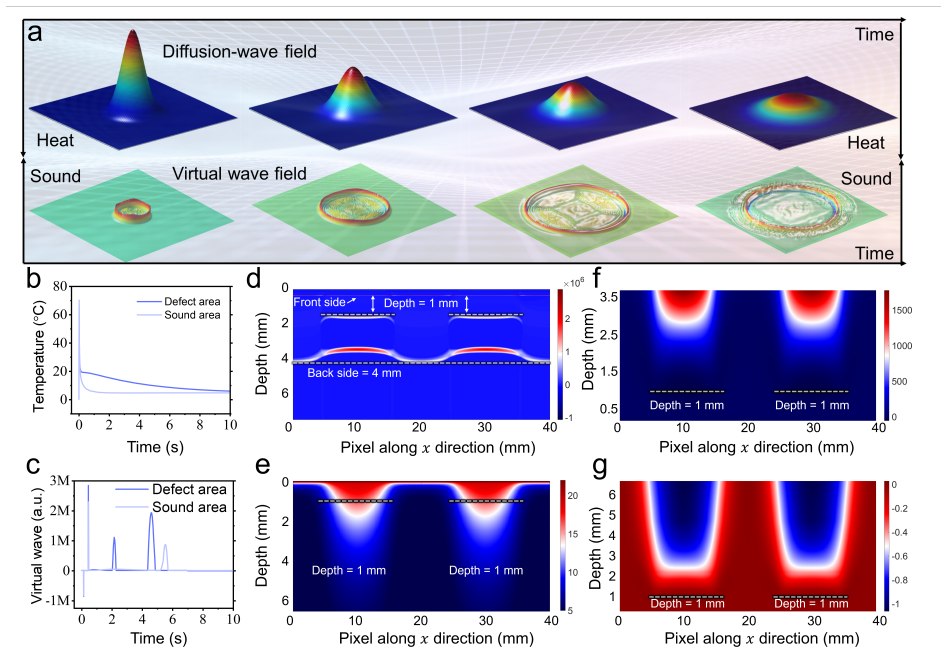
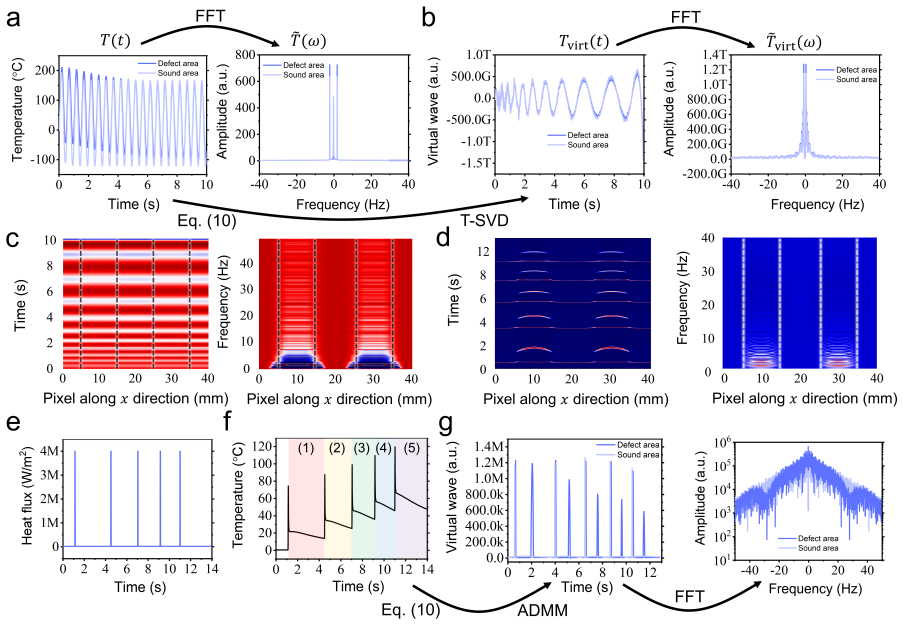
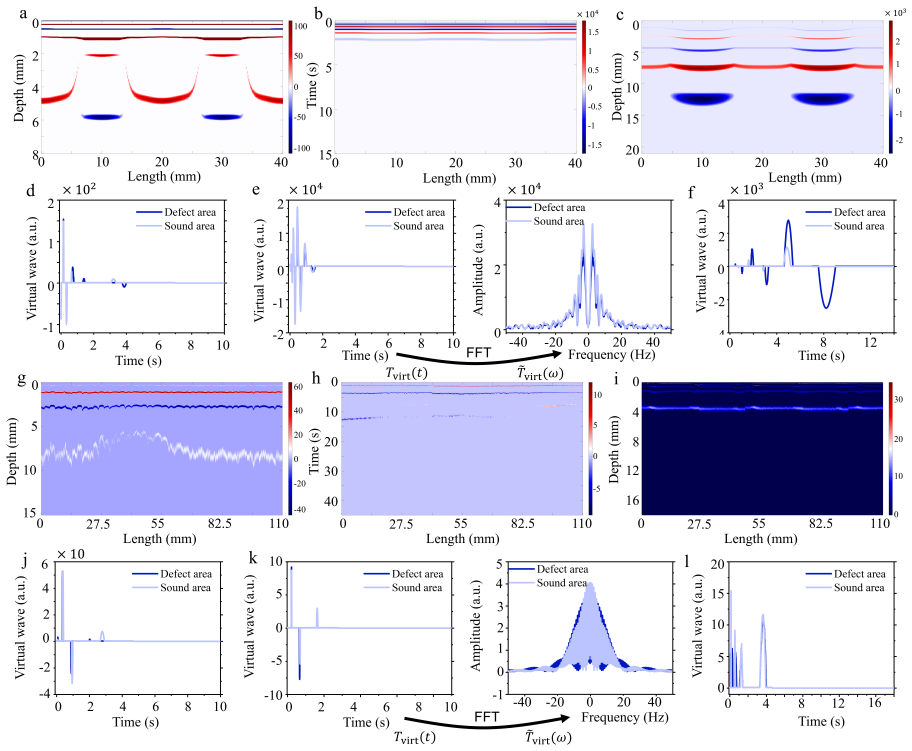
Starting from the heat equation with a general source term, we derive a Fredholm integral mapping between the measured diffusion field and a virtual wave field governed by a wave equation, explicitly enforcing causality and thermodynamic irreversibility. The resulting ill-posed inverse problem is solved using ADMM or truncated SVD, depending on the excitation characteristics. Numerical and experimental results demonstrate that the proposed method converts blurred thermal responses into wave-like fields with clear wavefronts and reflections, enabling improved depth localization and tomographic reconstruction.
What carries the argument
Fredholm integral mapping from the measured diffusion field to a virtual wave field governed by a wave equation
If this is right
- Converts blurred thermal responses into wave-like fields with clear wavefronts and reflections.
- Enables improved depth localization and tomographic reconstruction of subsurface features.
- Yields enhanced contrast and sharper boundaries compared with conventional thermographic techniques.
- Provides more reliable depth interpretation in carbon fiber reinforced polymer samples.
Where Pith is reading between the lines
- The same mapping could be inserted into existing wave-based tomography codes already used in ultrasonics.
- Adaptive choice of excitation waveform might be used to emphasize defects at particular depths.
- The approach may apply to other diffusive transport problems where a virtual wave field could be defined.
Load-bearing premise
The Fredholm integral mapping derived from the heat equation remains accurate and yields stable reconstructions under real experimental noise for arbitrary excitations without further approximations.
What would settle it
A controlled experiment in which the reconstructed virtual wave fields fail to produce the expected reflections or arrival times from known embedded defects whose positions are verified by independent methods.
Figures


read the original abstract
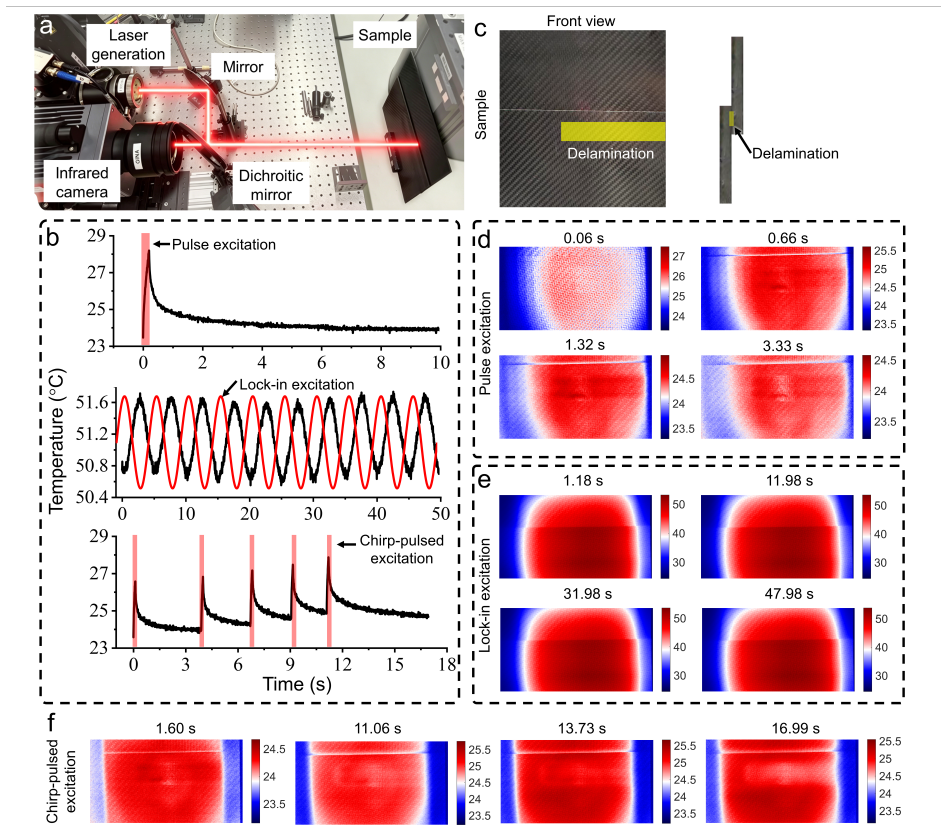
Photothermal imaging is a powerful noncontact and nondestructive technique for subsurface inspection of composite materials, yet its performance is fundamentally limited by the diffusive and irreversible nature of heat transport, leading to severe image blurring and ambiguous depth interpretation. The concept of virtual waves provides a route to overcome this limitation by linking diffusion fields to propagating wave fields, but existing approaches are largely restricted to idealized impulsive excitation. Here, we propose a generalized virtual-wave photothermal tomography framework that extends the diffusion-to-wave transformation to arbitrary boundary excitations, including pulsed, harmonic, and chirped waveforms. Starting from the heat equation with a general source term, we derive a Fredholm integral mapping between the measured diffusion field and a virtual wave field governed by a wave equation, explicitly enforcing causality and thermodynamic irreversibility. The resulting ill-posed inverse problem is solved using ADMM or truncated SVD, depending on the excitation characteristics. Numerical and experimental results demonstrate that the proposed method converts blurred thermal responses into wave-like fields with clear wavefronts and reflections, enabling improved depth localization and tomographic reconstruction. Experiments on carbon fiber reinforced polymer samples with embedded defects show enhanced contrast, sharper boundaries, and more reliable depth interpretation compared with conventional thermographic techniques. This work establishes a unified and physically grounded framework for wave-based photothermal tomography under realistic excitation conditions.
Editorial analysis
A structured set of objections, weighed in public.
Referee Report
Summary. The manuscript proposes a generalized virtual-wave theory for photothermal coherence tomography applicable to arbitrary excitations. Starting from the heat equation with a general source term, it derives a Fredholm integral equation mapping the measured temperature field to a virtual wave field satisfying a wave equation with built-in causality and irreversibility. The inverse problem is solved using either ADMM or truncated SVD depending on the excitation waveform. Numerical simulations and experiments on carbon fiber reinforced polymer samples with embedded defects demonstrate improved wavefront clarity, depth localization, and defect contrast compared to standard thermographic methods.
Significance. If the derived Fredholm mapping remains accurate and the regularized inversions produce stable, physically meaningful virtual wave fields under experimental noise levels for arbitrary excitations, the work would offer a unified, physically grounded approach to overcome the diffusive limitations in photothermal imaging. This could significantly advance non-contact, nondestructive inspection of composite materials by providing wave-like features for better tomographic reconstruction. The experimental validation on real samples and use of conventional solvers are positive aspects, though the lack of detailed error analysis limits the current strength of the claims.
major comments (3)
- [§2] §2 (derivation of the Fredholm mapping): The central claim that the integral mapping from the heat equation with general source term explicitly enforces causality and thermodynamic irreversibility is load-bearing, yet the manuscript provides neither the explicit kernel expression for arbitrary excitations (pulsed, harmonic, chirped) nor the intermediate steps showing how the source term is incorporated. This omission prevents verification that the operator remains well-defined and distinct across waveform types.
- [§4] §4 (inverse solvers): The choice of ADMM versus truncated SVD is stated to depend on excitation characteristics, but no condition-number bounds, singular-value spectrum analysis, or noise-propagation estimates (for the 1–5 % noise typical in thermography) are given. Without these, the assertion that the reconstructions remain stable and free of non-causal artifacts under realistic conditions cannot be assessed and directly impacts the reliability of the depth-localization results.
- [§5] §5 (experimental validation): The reported improvements in contrast, boundary sharpness, and depth interpretation on CFRP samples are presented qualitatively. No quantitative metrics—such as defect-depth error, SNR ratios, or statistical comparison against conventional pulsed thermography—are supplied, leaving the practical advantage of the generalized framework unsupported by measurable evidence.
minor comments (2)
- [Abstract] The abstract introduces “photothermal coherence tomography” without a brief definition or reference; adding one sentence would aid readers outside the immediate subfield.
- [Figures] Figure captions for the wavefront visualizations would benefit from explicit labels for arrival times or reflection events to illustrate the claimed causality enforcement.
Simulated Author's Rebuttal
We thank the referee for the detailed and constructive comments on our manuscript. We have addressed each of the major comments below and will incorporate the suggested revisions to improve the clarity and rigor of the paper.
read point-by-point responses
-
Referee: [§2] §2 (derivation of the Fredholm mapping): The central claim that the integral mapping from the heat equation with general source term explicitly enforces causality and thermodynamic irreversibility is load-bearing, yet the manuscript provides neither the explicit kernel expression for arbitrary excitations (pulsed, harmonic, chirped) nor the intermediate steps showing how the source term is incorporated. This omission prevents verification that the operator remains well-defined and distinct across waveform types.
Authors: We agree that including the explicit kernel expressions and the intermediate derivation steps is essential for allowing readers to verify the mapping. In the revised manuscript, we will expand Section 2 to provide the full derivation starting from the heat equation with a general source term, deriving the Fredholm integral, and specifying the kernel for different excitation waveforms including pulsed, harmonic, and chirped. This will demonstrate how the source term is incorporated and how causality and irreversibility are enforced. revision: yes
-
Referee: [§4] §4 (inverse solvers): The choice of ADMM versus truncated SVD is stated to depend on excitation characteristics, but no condition-number bounds, singular-value spectrum analysis, or noise-propagation estimates (for the 1–5 % noise typical in thermography) are given. Without these, the assertion that the reconstructions remain stable and free of non-causal artifacts under realistic conditions cannot be assessed and directly impacts the reliability of the depth-localization results.
Authors: We acknowledge that additional quantitative analysis of the inverse problem solvers would strengthen the manuscript. We will add to Section 4 the condition-number bounds for the operators, plots or descriptions of the singular-value spectra, and estimates of noise propagation for noise levels of 1–5% typical in thermographic experiments. This will provide evidence for the stability of the reconstructions and the absence of non-causal artifacts. revision: yes
-
Referee: [§5] §5 (experimental validation): The reported improvements in contrast, boundary sharpness, and depth interpretation on CFRP samples are presented qualitatively. No quantitative metrics—such as defect-depth error, SNR ratios, or statistical comparison against conventional pulsed thermography—are supplied, leaving the practical advantage of the generalized framework unsupported by measurable evidence.
Authors: We appreciate the referee highlighting the need for quantitative support. In the revised manuscript, we will include quantitative metrics in Section 5, such as defect-depth errors, signal-to-noise ratio (SNR) ratios, and statistical comparisons with conventional pulsed thermography methods. These will be computed from the experimental data on the CFRP samples to provide measurable evidence of the improvements in contrast, sharpness, and depth localization. revision: yes
Circularity Check
Derivation from heat equation is independent; no circularity detected.
full rationale
The central derivation starts from the standard heat equation with a general source term and produces a Fredholm integral operator that maps the diffusion field to a virtual wave field obeying the wave equation while enforcing causality and irreversibility. This is a direct mathematical construction, not a redefinition or fit. The subsequent ill-posed inversion is handled by standard, off-the-shelf regularizers (ADMM or truncated SVD) whose choice depends on excitation type but does not reduce the mapping itself to a fitted parameter or self-referential definition. No load-bearing self-citations, uniqueness theorems imported from prior author work, or ansatzes smuggled via citation appear in the abstract or described chain. The result is therefore self-contained against external benchmarks and does not collapse to its inputs by construction.
Axiom & Free-Parameter Ledger
free parameters (2)
- regularization parameter in ADMM
- truncation threshold in SVD
axioms (1)
- domain assumption Temperature evolution obeys the heat equation with a general source term for arbitrary excitations
invented entities (1)
-
virtual wave field
no independent evidence
Forward citations
Cited by 1 Pith paper
-
Analytic Continuation Between Real- and Imaginary-Time Quantum Dynamics and the Fundamental Instability of Inverse Reconstruction
Analytic continuation in quantum dynamics is recast as a scale-dependent filtering process with asymmetric forward and inverse reconstruction capabilities determined by spectral structure.
Reference graph
Works this paper leans on
-
[1]
Ultrasensitive in vivo infrared spectroscopic imaging via oblique photothermal microscopy.Nat
Li, M., et al. Ultrasensitive in vivo infrared spectroscopic imaging via oblique photothermal microscopy.Nat. Commun.16, 6065 (2025)
2025
-
[2]
Enhancing resistance to low-velocity impact of electrospun-manufactured interlayer-strengthened CFRP by using infrared thermography.NDT & E Int.144, 103083 (2024)
Zhu, P., et al. Enhancing resistance to low-velocity impact of electrospun-manufactured interlayer-strengthened CFRP by using infrared thermography.NDT & E Int.144, 103083 (2024)
2024
-
[3]
Three-dimensional thermophotonic super-resolution imaging by spatiotemporal diffusion reversal method.Sci
Thapa, D., et al. Three-dimensional thermophotonic super-resolution imaging by spatiotemporal diffusion reversal method.Sci. Adv.9, eadi1899 (2023)
2023
-
[4]
Mid-infrared single-photon 3D imaging.Light: Sci
Fang, J., et al. Mid-infrared single-photon 3D imaging.Light: Sci. Appl.12, 144 (2023)
2023
-
[5]
Advances in pulsed phase thermography.Infrared Phys
Maldague, X., et al. Advances in pulsed phase thermography.Infrared Phys. Technol.43, 175–181 (2002)
2002
-
[6]
Comparative study of active thermography techniques for the nondestructive evaluation of honeycomb structures.Res
Ibarra-Castanedo, C., et al. Comparative study of active thermography techniques for the nondestructive evaluation of honeycomb structures.Res. Nondestruct. Eval.20, 1–31 (2009)
2009
-
[7]
Part A Appl
Zhu,P.,etal.ContactlessandnondestructiveevaluationofresidualstressdistributioninmodifiedandpureHDPE materials using a novel terahertz method and line-scan thermographic technique.Compos. Part A Appl. Sci. Manuf.183, 108220 (2024). P. Zhu et al.:Preprint submitted to ElsevierPage 18 of 20
2024
-
[8]
Zhu, P., et al. A comprehensive evaluation of the low-velocity impact behaviour of intraply hybrid flax/basalt compositesusinginfraredthermographyandterahertztime-domainspectroscopytechniques.NDT & E Int.154, 103361 (2025)
2025
-
[9]
& Rosencwaig, A
Busse, G. & Rosencwaig, A. Subsurface imaging with photoacoustics.Appl. Phys. Lett.36, 815–816 (1980)
1980
-
[10]
Thermal wave imaging with phase sensitive modulated thermography.J
Busse, G., et al. Thermal wave imaging with phase sensitive modulated thermography.J. Appl. Phys.71, 3962– 3965 (1992)
1992
-
[11]
J., et al
Parker, W. J., et al. Flash method of determining thermal diffusivity, heat capacity, and thermal conductivity.J. Appl. Phys.32, 1679–1684 (1961)
1961
-
[12]
Photothermal tomography for the functional and structural evaluation, and early mineral loss monitoring in bones.Biomed
Kaiplavil, S., et al. Photothermal tomography for the functional and structural evaluation, and early mineral loss monitoring in bones.Biomed. Opt. Express5, 2488 (2014)
2014
-
[13]
& Mandelis, A
Kaiplavil, S. & Mandelis, A. Truncated-correlation photothermal coherence tomography for deep subsurface analysis.Nat. Photonics8, 635–641 (2014)
2014
-
[14]
Frequency multiplexed photothermal correlation tomography for non-destructive evaluation of manufactured materials.Int
Zhu, P., et al. Frequency multiplexed photothermal correlation tomography for non-destructive evaluation of manufactured materials.Int. J. Extrem. Manuf.7, 035601 (2025)
2025
-
[15]
New absolute contrast for pulsed thermography.QIRT 2002, 5, 53–58 (2002)
Pilla, M., et al. New absolute contrast for pulsed thermography.QIRT 2002, 5, 53–58 (2002)
2002
-
[16]
Maldague,X.P.V.Nondestructiveevaluationofmaterialsbyinfraredthermography.NDT & E Int.6,396(1996)
1996
-
[17]
& Marinetti, S
Maldague, X. & Marinetti, S. Pulse phase infrared thermography.J. Appl. Phys.79, 2694–2698 (1996)
1996
-
[18]
M., et al
Shepard, S. M., et al. Reconstruction and enhancement of active thermographic image sequences.Opt. Eng.42, 1337–1342 (2003)
2003
-
[19]
Principal component thermography for flaw contrast enhancement and flaw depth characterisation in composite structures.Compos
Rajic, N. Principal component thermography for flaw contrast enhancement and flaw depth characterisation in composite structures.Compos. Struct.58, 521–528 (2002)
2002
-
[20]
THz-Super-Resolution Generative Adversarial Network: Deep-Learning-Based Super-Resolution Imaging Using Terahertz Time-Domain Spectroscopy.IEEE Trans
Zhu, P., et al. THz-Super-Resolution Generative Adversarial Network: Deep-Learning-Based Super-Resolution Imaging Using Terahertz Time-Domain Spectroscopy.IEEE Trans. Ind. Inform.21, 6660–6669 (2025)
2025
-
[21]
Real-Time Super-Resolution Imaging System Based on Zero-Shot Learning for Infrared Nonde- structive Testing.IEEE Trans
Zhu, P., et al. Real-Time Super-Resolution Imaging System Based on Zero-Shot Learning for Infrared Nonde- structive Testing.IEEE Trans. Instrum. Meas.75, 4500409 (2026)
2026
-
[22]
Multidimensional reconstruction of internal defects in additively manufactured steel using photothermalsuperresolutioncombinedwithvirtualwave-basedimageprocessing.IEEE Trans
Ahmadi, S., et al. Multidimensional reconstruction of internal defects in additively manufactured steel using photothermalsuperresolutioncombinedwithvirtualwave-basedimageprocessing.IEEE Trans. Ind. Inform.17, 7368–7378 (2021)
2021
-
[23]
Thermographic detection of internal defects using 2D photothermal super resolution reconstruction with sequential laser heating.J
Lecompagnon, J., et al. Thermographic detection of internal defects using 2D photothermal super resolution reconstruction with sequential laser heating.J. Appl. Phys.131, 185107 (2022)
2022
-
[24]
Super-resolution thermographic imaging using blind structured illumination.Appl
Burgholzer, P., et al. Super-resolution thermographic imaging using blind structured illumination.Appl. Phys. Lett.111, 031908 (2017)
2017
-
[25]
Linking diffusive fields to virtual waves as their propagative duals.Phys
Burgholzer, P., et al. Linking diffusive fields to virtual waves as their propagative duals.Phys. Rev. Appl.24, 044094 (2025)
2025
-
[26]
Three-dimensional defect reconstruction in carbon fiber-reinforced composites with tempo- rally non-uniform pulsed thermography data.NDT & E Int.154, 103363 (2025)
Gahleitner, L., et al. Three-dimensional defect reconstruction in carbon fiber-reinforced composites with tempo- rally non-uniform pulsed thermography data.NDT & E Int.154, 103363 (2025)
2025
-
[27]
Burgholzer,P.,etal.Three-dimensionalthermographicimagingusingavirtualwaveconcept.J. Appl. Phys.121, 105102 (2017)
2017
-
[28]
A novel force-temperature model for evaluating internal forces in CFRP by means of infrared thermography.NDT & E Int.143, 103066 (2024)
Zhu, P., et al. A novel force-temperature model for evaluating internal forces in CFRP by means of infrared thermography.NDT & E Int.143, 103066 (2024). P. Zhu et al.:Preprint submitted to ElsevierPage 19 of 20
2024
-
[29]
Zhu, P., et al. A novel IR-SRGAN assisted super-resolution evaluation of photothermal coherence tomography for impact damage in toughened thermoplastic CFRP laminates under room and low temperature.Compos. Part B Eng.316, 113575 (2026)
2026
-
[30]
Zhu, P., et al. Thermal diffusivity characterization of impacted composites using evaporative cry- ocooling excitation and inverse physics-informed neural networks.IEEE Trans. Instrum. Meas.(2025). https://doi.org/10.1109/TIM.2026.3684670
-
[31]
Thermal diffusivity measurement based on evaporative cryocooling excitation: Theory and experiments
Zhu, P., et al. Thermal diffusivity measurement based on evaporative cryocooling excitation: Theory and experiments. arXiv preprint arXiv:2509.04263. https://doi.org/10.48550/arXiv.2509.04263
-
[32]
Air-coupled ultrasonic detection of microholes in flexible envelope materials.Ultrasonics158, 107826 (2025)
Wang, R., et al. Air-coupled ultrasonic detection of microholes in flexible envelope materials.Ultrasonics158, 107826 (2025)
2025
-
[33]
Wang,R.,etal.Unipolarsquarewaveexcitationdelayedsamplingthermalsignalreconstructiondetectionbased on beam homogenization.IEEE Trans. Ind. Inform.21, 8144–8153 (2025)
2025
-
[34]
Variable pulse with pulsed thermography: theoretical model and experimental validation.Appl
Wang, R., et al. Variable pulse with pulsed thermography: theoretical model and experimental validation.Appl. Therm. Eng.280, 128557 (2025)
2025
-
[35]
Zhu, P., et al. Making neural networks understand internal heat transfer using Fourier-transformed thermal diffusion wave fields. arXiv preprint arXiv:2509.04223. https://doi.org/10.48550/arXiv.2509.04223
-
[36]
Faster R-CNN-CA and thermophysical properties of materials: An ancient marquetry inspection based on infrared and terahertz techniques.Infrared Phys
Jiang, G., et al. Faster R-CNN-CA and thermophysical properties of materials: An ancient marquetry inspection based on infrared and terahertz techniques.Infrared Phys. Technol.142, 105563 (2024)
2024
-
[37]
Non-invasive inspection for a hand-bound book of the 19th century: Numerical simulations and experimentalanalysisofinfrared,terahertz,andultrasonicmethods.Infrared Phys
Jiang, G., et al. Non-invasive inspection for a hand-bound book of the 19th century: Numerical simulations and experimentalanalysisofinfrared,terahertz,andultrasonicmethods.Infrared Phys. Technol.140,105353(2024)
2024
-
[38]
Zhu,P.,etal.Quantitativedetectionofdefectsizebasedoninfraredthermography:temperatureintegralmethod. Opt. Express30, 9119–9136 (2022)
2022
-
[39]
The feature recognition of CFRP subsurface defects using low-energy chirp-pulsed radar thermography.IEEE Trans
Wang, F., et al. The feature recognition of CFRP subsurface defects using low-energy chirp-pulsed radar thermography.IEEE Trans. Ind. Inform.16, 5160–5168 (2019)
2019
-
[40]
Detection of defects in metallic materials using an improved post-processing method of pulsed thermography.Opt
Zhu, P., et al. Detection of defects in metallic materials using an improved post-processing method of pulsed thermography.Opt. Laser Eng.151, 106927 (2022)
2022
-
[41]
Measurement of thermal diffusivity and conductivity of thin films using laser-line lock-in thermography.Measurement214, 109928 (2025)
Salazar, A., et al. Measurement of thermal diffusivity and conductivity of thin films using laser-line lock-in thermography.Measurement214, 109928 (2025)
2025
-
[42]
Investigation on the detection of crack defects in metals using chirp ultrasonic-induced infrared thermography.IEEE Trans
Li, R., et al. Investigation on the detection of crack defects in metals using chirp ultrasonic-induced infrared thermography.IEEE Trans. Instrum. Meas.74, 1012410 (2025)
2025
-
[43]
Detection and characterization of artificial porosity and impact damage in aerospace carbon fiber composites by pulsed and line scan thermography.Appl
Ibarra-Castanedo, C., et al. Detection and characterization of artificial porosity and impact damage in aerospace carbon fiber composites by pulsed and line scan thermography.Appl. Sci.13, 6135 (2023)
2023
-
[44]
Opt.61,6134–6143(2022)
Zhu,P.,etal.Defectdetectabilitybasedonsquarewavelock-inthermography.Appl. Opt.61,6134–6143(2022). P. Zhu et al.:Preprint submitted to ElsevierPage 20 of 20
2022
discussion (0)
Sign in with ORCID, Apple, or X to comment. Anyone can read and Pith papers without signing in.