Recognition: 2 theorem links
· Lean TheoremAnalytic Continuation Between Real- and Imaginary-Time Quantum Dynamics and the Fundamental Instability of Inverse Reconstruction
Pith reviewed 2026-05-12 03:26 UTC · model grok-4.3
The pith
Analytic continuation recasts imaginary-time quantum evolution as a fractional low-pass filter with strict limits on stable inverse reconstruction of real-time dynamics.
A machine-rendered reading of the paper's core claim, the machinery that carries it, and where it could break.
Core claim
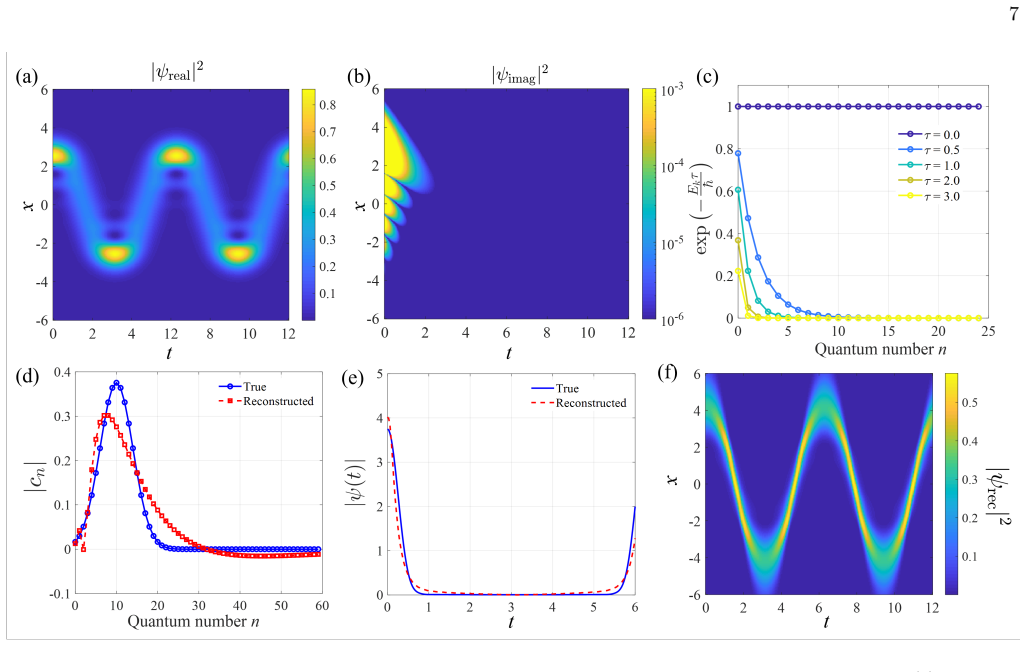
Evolution is expressed as an exponential reweighting of spectral components generated by a single operator G, placing unitary and dissipative dynamics on equal footing. The mapping induces a nonlocal fractional operator in time that yields a contractive semigroup governed by square-root spectral deformation, identifying imaginary-time evolution as an effective fractional low-pass filter. The inverse transformation remains systematically controllable within a well-defined spectral window, yielding stable reconstruction of low-energy and coarse-grained dynamical features and a quantitative bandwidth-resolved asymmetry between forward propagation and inverse recovery. Spectral structure governs
What carries the argument
The single operator G that generates exponential reweighting of spectral components, unifying real- and imaginary-time dynamics and inducing the fractional time operator whose square-root deformation produces the contractive low-pass filter.
If this is right
- Stable reconstruction of low-energy and coarse-grained features is achievable within a defined spectral window.
- Irreversibility in non-Hermitian and open systems emerges as a geometry- and scale-dependent property of the spectrum.
- Reconstruction fidelity is controlled uniformly by spectral structure across continuous, discrete, and few-level systems.
- The asymmetry between forward propagation and inverse recovery is quantifiable by bandwidth.
Where Pith is reading between the lines
- Simulations that use imaginary-time data could be designed to stay inside the recoverable bandwidth so that low-energy dynamics are extracted with controlled error.
- The filtering picture may apply to other analytic-continuation problems where one direction damps information and the reverse direction must be limited by spectral scale.
Load-bearing premise
A well-defined spectral window exists in which the inverse transformation from imaginary-time data remains stable and controllable for low-energy features without extra assumptions on the spectrum or eigenstate non-orthogonality.
What would settle it
A direct numerical test in which reconstruction error for low-frequency modes grows without bound once the imaginary-time window is extended beyond the predicted scale, or an explicit calculation showing that the inverse map fails to recover a known low-energy oscillation even when the spectrum is fully continuous and noise-free.
Figures



read the original abstract
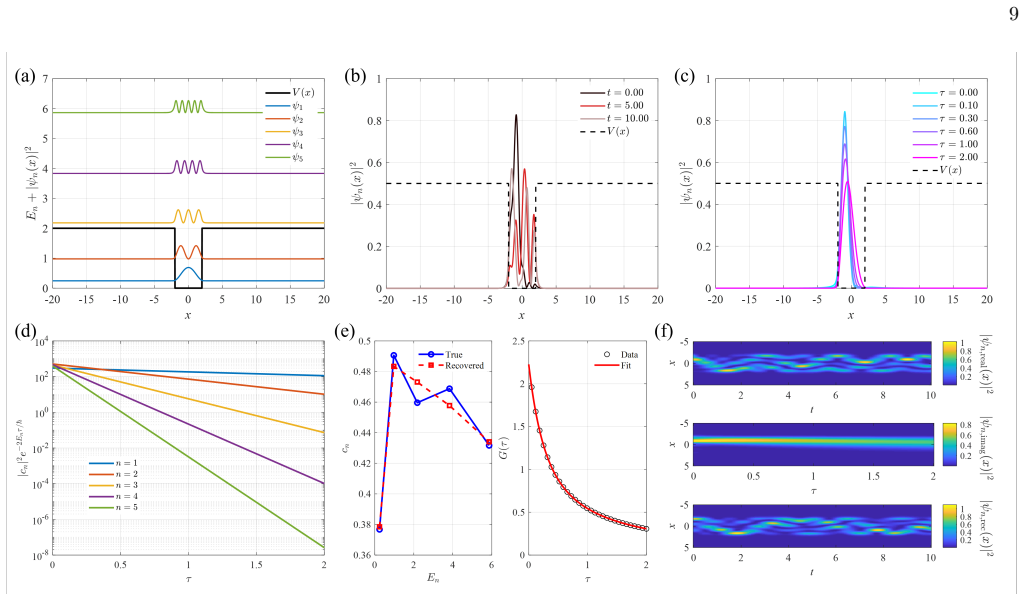
We develop a unified spectral-semigroup framework that connects real-time and imaginary-time quantum dynamics through analytic continuation. Within this formulation, evolution is expressed as an exponential reweighting of spectral components generated by a single operator $\mathcal{G}$, placing unitary and dissipative dynamics on equal footing within a common spectral structure. The mapping naturally induces a nonlocal fractional operator in time, giving rise to a contractive semigroup governed by a square-root spectral deformation and identifying imaginary-time evolution as an effective fractional low-pass filter. While exponential attenuation suppresses high-frequency components, the inverse transformation remains systematically controllable within a well-defined spectral window. In this regime, stable reconstruction of low-energy and coarse-grained dynamical features is achieved, establishing a predictive relation between imaginary-time evolution and recoverable information. This leads to a quantitative description of a bandwidth-resolved asymmetry between forward propagation and inverse recovery. Across systems with continuous and discrete spectra, few-level coherence, and non-Hermitian generators, we demonstrate that spectral structure governs reconstruction fidelity in a unified manner. In particular, non-Hermitian and open-system settings reveal that irreversibility emerges as a geometry- and scale-dependent feature of the spectrum, tied to both damping and eigenstate non-orthogonality. These results recast analytic continuation as a structured, scale-dependent filtering process with quantifiable and systematically accessible reconstruction limits, providing a unified perspective on the interplay between dynamics, spectral geometry, and information recovery.
Editorial analysis
A structured set of objections, weighed in public.
Referee Report
Summary. The paper develops a unified spectral-semigroup framework connecting real-time and imaginary-time quantum dynamics via analytic continuation. Evolution is modeled as exponential reweighting of spectral components by a single operator G, inducing a nonlocal fractional time operator and a contractive semigroup via square-root spectral deformation. Imaginary-time evolution is interpreted as a fractional low-pass filter, with the inverse map claimed to remain stable and controllable for low-energy features within a well-defined spectral window. The work asserts this holds uniformly for continuous/discrete spectra, few-level coherence, and non-Hermitian generators, with irreversibility as a geometry- and scale-dependent feature tied to damping and eigenstate non-orthogonality. The central result is a quantitative, bandwidth-resolved asymmetry between forward propagation and inverse recovery.
Significance. If the derivations and stability conditions are rigorously established, the work offers a unified perspective on analytic continuation as a scale-dependent filtering process with quantifiable reconstruction limits. This could aid understanding of information recovery in quantum dynamics and open systems. The parameter-free character of the spectral approach and the uniform treatment of Hermitian and non-Hermitian cases are potential strengths.
major comments (2)
- [Abstract and main framework section] Abstract and main framework section: The load-bearing claim that the inverse transformation 'remains systematically controllable within a well-defined spectral window' for low-energy features across continuous spectra and non-Hermitian generators lacks explicit bounds on the numerical range of G, resolvent growth, or eigenbasis condition number. Without these, the contractive semigroup property and low-pass filtering picture may not hold uniformly, as high-frequency components can re-enter the recoverable band for non-normal operators.
- [Demonstration sections (e.g., few-level and non-Hermitian cases)] Demonstration sections (e.g., few-level and non-Hermitian cases): The assertions of unified reconstruction fidelity are presented conceptually but without concrete error bounds, numerical examples, or comparisons to existing methods, making it difficult to verify that spectral structure alone governs the asymmetry without additional assumptions on orthogonality or decay.
minor comments (2)
- The notation for the nonlocal fractional operator and square-root deformation would benefit from an explicit spectral decomposition formula to improve clarity.
- A summary table comparing reconstruction limits across the discussed spectral cases (continuous, discrete, non-Hermitian) would aid readability.
Simulated Author's Rebuttal
We thank the referee for the careful and constructive review of our manuscript. The comments highlight important aspects of rigor and verifiability that we address point by point below. Where appropriate, we indicate revisions that will be incorporated to strengthen the presentation while preserving the core spectral-semigroup framework.
read point-by-point responses
-
Referee: [Abstract and main framework section] Abstract and main framework section: The load-bearing claim that the inverse transformation 'remains systematically controllable within a well-defined spectral window' for low-energy features across continuous spectra and non-Hermitian generators lacks explicit bounds on the numerical range of G, resolvent growth, or eigenbasis condition number. Without these, the contractive semigroup property and low-pass filtering picture may not hold uniformly, as high-frequency components can re-enter the recoverable band for non-normal operators.
Authors: We appreciate the referee pointing out the need for more explicit quantitative controls. The framework establishes controllability via the spectral decomposition of G and the contractive property induced by square-root deformation, which suppresses high-frequency modes while preserving low-energy features within the defined window. For non-Hermitian generators, the analysis incorporates the numerical range and eigenstate non-orthogonality to quantify the asymmetry. To address the concern directly, the revised manuscript will add explicit bounds: the resolvent growth will be controlled by the spectral gap and the condition number of the (possibly non-orthogonal) eigenbasis, ensuring that high-frequency re-entry is precluded within the low-energy window. This will be presented as a new proposition in the main framework section, confirming uniform validity for both continuous and discrete spectra. revision: yes
-
Referee: [Demonstration sections (e.g., few-level and non-Hermitian cases)] Demonstration sections (e.g., few-level and non-Hermitian cases): The assertions of unified reconstruction fidelity are presented conceptually but without concrete error bounds, numerical examples, or comparisons to existing methods, making it difficult to verify that spectral structure alone governs the asymmetry without additional assumptions on orthogonality or decay.
Authors: The demonstration sections derive the reconstruction fidelity analytically from the spectral structure for few-level systems and non-Hermitian generators, showing that the forward-inverse asymmetry is determined by damping, bandwidth, and eigenstate geometry without invoking external assumptions beyond the spectrum itself. While these derivations are supported by explicit calculations, we agree that concrete illustrations would improve verifiability. The revised version will include numerical examples for representative Hermitian and non-Hermitian cases, together with derived error bounds expressed in terms of the spectral window parameters. We will also add comparisons to standard analytic continuation techniques (e.g., maximum-entropy and Padé methods) to demonstrate that the observed fidelity limits arise from spectral properties alone. revision: yes
Circularity Check
No significant circularity detected
full rationale
The derivation is presented as following from standard spectral theory and analytic continuation applied to a single operator G, with imaginary-time evolution identified as a fractional low-pass filter via square-root deformation. No equations, fitted parameters, or self-citations are visible in the abstract or description that reduce any prediction or central claim to its own inputs by construction. The framework treats continuous/discrete spectra and non-Hermitian cases uniformly under general semigroup properties without self-definitional loops or renamed empirical patterns. The reconstruction limits are asserted as consequences of the contractive semigroup, not presupposed in the inputs.
Axiom & Free-Parameter Ledger
axioms (2)
- standard math Analytic continuation of the time-evolution operator into the complex plane is valid for the systems considered
- domain assumption A single operator G generates the spectral components for both unitary and dissipative evolution
invented entities (2)
-
Nonlocal fractional operator in time
no independent evidence
-
Square-root spectral deformation
no independent evidence
Lean theorems connected to this paper
-
IndisputableMonolith/Cost/FunctionalEquation.leanwashburn_uniqueness_aczel unclear?
unclearRelation between the paper passage and the cited Recognition theorem.
square-root spectral deformation... exp(−τ√ω)... subordination formula... fractional low-pass filter
-
IndisputableMonolith/Foundation/AbsoluteFloorClosure.leanabsolute_floor_iff_bare_distinguishability unclear?
unclearRelation between the paper passage and the cited Recognition theorem.
recoverability bound Ec(τ,ε)∼(1/τ)log(1/ε)... scale-dependent spectral threshold
What do these tags mean?
- matches
- The paper's claim is directly supported by a theorem in the formal canon.
- supports
- The theorem supports part of the paper's argument, but the paper may add assumptions or extra steps.
- extends
- The paper goes beyond the formal theorem; the theorem is a base layer rather than the whole result.
- uses
- The paper appears to rely on the theorem as machinery.
- contradicts
- The paper's claim conflicts with a theorem or certificate in the canon.
- unclear
- Pith found a possible connection, but the passage is too broad, indirect, or ambiguous to say the theorem truly supports the claim.
Reference graph
Works this paper leans on
-
[1]
E. C. G. Sudarshan and Charles B. Chiu,Analytic contin- uation of quantum systems and their temporal evolution, Phys. Rev. D, 47, 0602 (1993)
work page 1993
-
[2]
Sarah Day, Jean-Philippe Lessard, and Konstantin Mis- chaikow,Validated Continuation for Equilibria of PDEs, SIAM J. Numer. Anal., 45, 1398-1424 (2007)
work page 2007
- [3]
- [4]
-
[5]
P. Zhu, R. Wang, K. Sivagurunathan, S. Sfarra, F. 17 Sarasini, C. Ibarra-Castanedo, X. Maldague, H. Zhang, and A. Mandelis,Frequency multiplexed photothermal correlation tomography for non-destructive evaluation of manufactured materials, Int. J. Extrem. Manuf., 7, 035601 (2025)
work page 2025
-
[6]
P. Zhu, X. Maldague,THz-PINNs: Time-Domain For- ward Modeling of Terahertz Spectroscopy With Physics- Informed Neural Networks, IEEE Trans. Terahertz Sci. Technol., 2026. DOI: 10.1109/TTHZ.2026.3674212
- [7]
-
[8]
M. Fleischhauer, A. Imamoglu, and J. P. Marangos,Elec- tromagnetically induced transparency: Optics in coherent media, Rev. Mod. Phys., 77, 633 (2005)
work page 2005
-
[9]
F. D’Andrea, M. A. Kurkov, and F. Lizzi,Wick rota- tion and fermion doubling in noncommutative geometry, Phys. Rev. D, 94, 025030 (2016)
work page 2016
-
[10]
Kuipers,Analytic continuation of stochastic mechan- ics, J
F. Kuipers,Analytic continuation of stochastic mechan- ics, J. Math. Phys., 63, 042301 (2022)
work page 2022
-
[11]
P. Zhu, J. Lecompagnon, P. D. Hirsch, M. Ziegler, Generalized Virtual-Wave Theory for Photother- mal Coherence Tomography under Arbitrary Exci- tation Toward Non-Contact Industrial Inspection of Composite Materials, arXiv:2605.03747, 2026. https://doi.org/10.48550/arXiv.2605.03747
work page internal anchor Pith review Pith/arXiv arXiv doi:10.48550/arxiv.2605.03747 2026
-
[12]
P. Zhu, J. Lecompagnon, M. Ziegler, C. Ibarra- Castanedo, X. Maldague,Generalized virtual wave re- construction for vibrothermography: Overcoming the wavefront-free behavior and quantification challenges in the diffusion-wave field, arXiv:2603.23765, 2026. https://doi.org/10.48550/arXiv.2603.23765
-
[13]
M. G. Cowling,Harmonic Analysis on Semigroups, Ann. Math., 117, 267-283 (1983)
work page 1983
-
[14]
High Energy Phys., 2023, 82 (2023)
Barak Gabai and Xi Yin,Exact quantization and analytic continuation, J. High Energy Phys., 2023, 82 (2023)
work page 2023
-
[15]
A. W. Sandvik,Stochastic method for analytic continu- ation of quantum Monte Carlo data, Phys. Rev. B, 57, 10287 (1998)
work page 1998
- [16]
-
[17]
V. V. Kryzhniy,Numerical inversion of the Laplace transform: analysis via regularized analytic continuation, Inverse Probl., 22, 579 (2006)
work page 2006
-
[18]
J. V. Herod and R. W. McKelvey,A Hille-Yosida theory for evolutions, Isr. J. Math., 36, 13-40 (1980)
work page 1980
-
[19]
Symanzik,Euclidean Quantum Field Theory
K. Symanzik,Euclidean Quantum Field Theory. I. Equa- tions for a Scalar Model, J. Math. Phys., 7, 510-525 (1966)
work page 1966
-
[20]
T. Lang, K. Liegener, and T. Thiemann,Hamiltonian renormalisation I: derivation from Osterwalder–Schrader reconstruction, Class. Quantum Grav., 35, 245011 (2018)
work page 2018
-
[21]
Dungey,Subordinated discrete semigroups of opera- tors, Trans
N. Dungey,Subordinated discrete semigroups of opera- tors, Trans. Amer. Math. Soc., 363, 2011 (2011)
work page 2011
-
[22]
E. J. Hurtado,Non-local Diffusion Equations Involving the Fractional p(.)-Laplacian, J. Dyn. Differ. Equ., 32, 557-587 (2020)
work page 2020
-
[23]
R. R. Coifman and G. Weiss,Extensions of Hardy spaces and their use in analysis, Bull. Amer. Math. Soc., 83, 569-645 (1977)
work page 1977
-
[24]
A. Dienstfrey and L. Greengard,Analytic continuation, singular-value expansions, and Kramers-Kronig analysis, Inverse Probl., 17, 1307 (2001)
work page 2001
discussion (0)
Sign in with ORCID, Apple, or X to comment. Anyone can read and Pith papers without signing in.