Recognition: unknown
Multimodal Learning on Low-Quality Data with Conformal Predictive Self-Calibration
Pith reviewed 2026-05-07 17:49 UTC · model grok-4.3
The pith
A conformal prediction loop lets multimodal models self-calibrate features and gradients on low-quality data.
A machine-rendered reading of the paper's core claim, the machinery that carries it, and where it could break.
Core claim
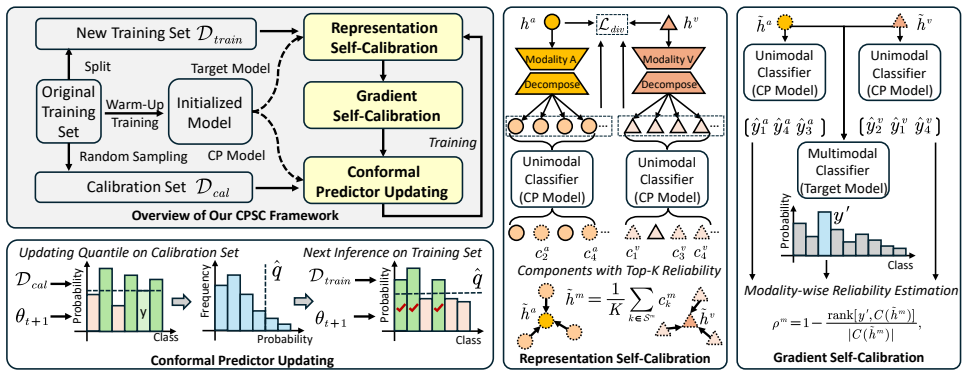
Conformal Predictive Self-Calibration equips a multimodal model with an on-the-fly self-calibrating loop: a conformal predictor decomposes each unimodal feature into components and selects the robust subset for fusion (Representation Self-Calibration), while also computing instance-wise reliability scores that reweight gradients during back-propagation (Gradient Self-Calibration); the predictor is itself updated from the model’s evolving predictions so that calibration and learning co-evolve without external clean data.
What carries the argument
The self-calibrating training loop that interleaves a conformal predictor’s robustness scoring with feature decomposition and gradient reweighting.
If this is right
- The same loop can be applied to any multimodal architecture without changing the backbone or loss.
- Separate techniques for imbalance correction and noise robustness can be replaced by one mechanism.
- Training no longer requires a held-out clean validation set to estimate modality or instance reliability.
- The framework produces per-instance reliability scores that can be inspected or used for downstream filtering.
- Performance remains stable when the degree of imbalance or noise changes during training.
Where Pith is reading between the lines
- The approach may generalize to other uncertainty sources such as missing modalities or domain shift if the conformal scoring is kept unchanged.
- Because the calibration runs continuously, the method could be extended to online or lifelong multimodal settings where data quality drifts over time.
- If the conformal predictor’s coverage guarantees hold under distribution shift, the reliability scores could serve as uncertainty estimates for active learning or human-in-the-loop correction.
Load-bearing premise
A conformal predictor can reliably identify robust feature components and instance-wise reliability scores from the model’s own evolving predictions without introducing bias or requiring separate clean validation data.
What would settle it
Ablation experiments in which the conformal predictor is replaced by a fixed threshold or random selection show no performance gain over standard multimodal training on the same imbalanced-plus-noisy datasets.
Figures



read the original abstract
Multimodal learning often grapples with the challenge of low-quality data, which predominantly manifests as two facets: modality imbalance and noisy corruption. While these issues are often studied in isolation, we argue that they share a common root in the predictive uncertainty towards the reliability of individual modalities and instances during learning. In this paper, we propose a unified framework, termed Conformal Predictive Self-Calibration (CPSC), which leverages conformal prediction to equip the model with the ability to perform self-guided calibration on-the-fly. The core of our proposed CPSC lies in a novel self-calibrating training loop that seamlessly integrates two key modules: (1) Representation Self-Calibration, which decomposes unimodal features into components, and selectively fuses the most robust ones identified by a conformal predictor to enhance feature resilience. (2) Gradient Self-Calibration, which recalibrates the gradient flow during backpropagation based on instance-wise reliability scores, steering the optimization towards more trustworthy directions. Furthermore, we also devise a self-update strategy for the conformal predictor to ensure the entire system co-evolves consistently throughout the training process. Extensive experiments on six benchmark datasets under both imbalanced and noisy settings demonstrate that our CPSC framework consistently outperforms existing state-of-the-art methods. Our code is available at https://github.com/XunCHN/CPSC.
Editorial analysis
A structured set of objections, weighed in public.
Referee Report
Summary. The manuscript proposes Conformal Predictive Self-Calibration (CPSC), a unified framework for multimodal learning on low-quality data characterized by modality imbalance and label noise. It introduces a self-calibrating training loop that integrates Representation Self-Calibration (decomposing unimodal features and selectively fusing robust components via a conformal predictor) and Gradient Self-Calibration (recalibrating gradients using instance-wise reliability scores), together with a self-update strategy for the conformal predictor to enable co-evolution during training. The central claim is that this approach consistently outperforms existing state-of-the-art methods across six benchmark datasets under both imbalanced and noisy settings.
Significance. If the self-calibration loop can be rigorously shown to improve rather than degrade performance without bias amplification, the work would offer a principled, on-the-fly mechanism for robustness in multimodal models that avoids reliance on separate clean validation data. The public release of code at the provided GitHub link is a clear strength supporting reproducibility.
major comments (2)
- [Abstract and Method] Abstract and Method section: The self-update strategy for the conformal predictor is described as relying on the model's own evolving predictions to identify robust feature components and instance-wise reliability scores. This setup risks circular dependency, since standard conformal prediction requires exchangeable calibration data independent of the model being calibrated; the manuscript provides no theoretical analysis or early-training ablation demonstrating that initial unreliable predictions (dominated by stronger modalities or noise) do not systematically bias the calibration and amplify errors rather than mitigate them.
- [Experiments] Experiments section: The claim of consistent outperformance on six benchmarks under imbalanced and noisy settings lacks reported details on statistical significance testing, ablation studies isolating the conformal predictor's contribution, or sensitivity analysis to noise/imbalance levels. Without these, it is impossible to confirm that gains are attributable to the proposed self-calibration rather than other factors.
minor comments (2)
- [Abstract] Abstract: Implementation specifics for the conformal predictor (e.g., nonconformity score definition, how the self-update is performed without external data) are absent, hindering immediate assessment of novelty and reproducibility.
- [Overall] Overall: Notation for reliability scores and feature decomposition components could be clarified with explicit equations or pseudocode to improve readability.
Simulated Author's Rebuttal
We thank the referee for the thoughtful and constructive comments. We address each major point below and describe the revisions planned for the next version of the manuscript.
read point-by-point responses
-
Referee: [Abstract and Method] Abstract and Method section: The self-update strategy for the conformal predictor is described as relying on the model's own evolving predictions to identify robust feature components and instance-wise reliability scores. This setup risks circular dependency, since standard conformal prediction requires exchangeable calibration data independent of the model being calibrated; the manuscript provides no theoretical analysis or early-training ablation demonstrating that initial unreliable predictions (dominated by stronger modalities or noise) do not systematically bias the calibration and amplify errors rather than mitigate them.
Authors: We acknowledge the referee's concern about potential circular dependency. The self-update strategy is intended to allow the conformal predictor to co-evolve with the model by progressively incorporating more reliable samples as training proceeds, rather than relying on a fixed independent calibration set. While the manuscript does not contain a formal theoretical proof of non-amplification, the empirical results across multiple noisy and imbalanced settings indicate that performance improves rather than degrades. To address the comment directly, we will add an early-training ablation study that tracks calibration quality, prediction set sizes, and downstream accuracy from epoch 1 onward, together with a short discussion of the conservative sample-selection heuristic used to initialize the predictor. revision: yes
-
Referee: [Experiments] Experiments section: The claim of consistent outperformance on six benchmarks under imbalanced and noisy settings lacks reported details on statistical significance testing, ablation studies isolating the conformal predictor's contribution, or sensitivity analysis to noise/imbalance levels. Without these, it is impossible to confirm that gains are attributable to the proposed self-calibration rather than other factors.
Authors: We agree that these elements would strengthen the experimental claims. In the revised manuscript we will (i) report statistical significance (paired t-tests or Wilcoxon signed-rank tests over five random seeds) for all main-table comparisons, (ii) expand the ablation section with variants that disable the conformal predictor while keeping other components fixed, and (iii) add sensitivity plots that vary the degree of modality imbalance and label-noise ratio on at least two representative datasets. These additions will make the attribution of gains to the self-calibration components explicit. revision: yes
Circularity Check
No significant circularity in the CPSC self-calibration framework
full rationale
The paper describes an iterative self-calibrating training loop that integrates conformal prediction for representation and gradient recalibration, along with a self-update strategy for the predictor to allow co-evolution. No equations or definitions are provided in the available text that reduce the reliability scores, robust feature components, or final predictions to the inputs by construction (e.g., no self-definitional mapping where the conformal output is fitted directly from the target quantity it is claimed to predict). The framework is presented as a procedural training mechanism evaluated on external benchmark datasets under imbalanced and noisy conditions, rendering the central claims self-contained rather than tautological. No load-bearing self-citation chains or ansatz smuggling are exhibited.
Axiom & Free-Parameter Ledger
axioms (1)
- domain assumption Conformal prediction yields valid uncertainty estimates that can be used to select robust features and reweight gradients during training
Reference graph
Works this paper leans on
-
[1]
Indoor segmentation and support inference from rgbd images
Nathan Silberman, Derek Hoiem, Pushmeet Kohli, and Rob Fergus. Indoor segmentation and support inference from rgbd images. InECCV, pages 746–760. Springer, 2012. 1, 5
2012
-
[2]
Crema-d: Crowd-sourced emotional multimodal actors dataset.IEEE TAFFC, 5(4):377–390, 2014
Houwei Cao, David G Cooper, Michael K Keutmann, Ruben C Gur, Ani Nenkova, and Ragini Verma. Crema-d: Crowd-sourced emotional multimodal actors dataset.IEEE TAFFC, 5(4):377–390, 2014. 1, 5
2014
-
[3]
Empowering visible- infrared person re-identification with large foundation mod- els.NeurIPS, 37:117363–117387, 2024
Zhangyi Hu, Bin Yang, and Mang Ye. Empowering visible- infrared person re-identification with large foundation mod- els.NeurIPS, 37:117363–117387, 2024. 1, 5, 6, 8
2024
-
[4]
A survey of mul- timodal learning: Methods, applications, and future.ACM Comput
Yuan Yuan, Zhaojian Li, and Bin Zhao. A survey of mul- timodal learning: Methods, applications, and future.ACM Comput. Surv., 57(7):1–34, 2025. 1
2025
-
[5]
Foundations & trends in multimodal machine learning: Prin- ciples, challenges, and open questions.ACM Comput
Paul Pu Liang, Amir Zadeh, and Louis-Philippe Morency. Foundations & trends in multimodal machine learning: Prin- ciples, challenges, and open questions.ACM Comput. Surv., 56(10):1–42, 2024
2024
-
[6]
Joint objective and subjective fuzziness denoising for multimodal sentiment analysis.IEEE TFS, 33(1):15–27, 2024
Xun Jiang, Xing Xu, Huimin Lu, Lianghua He, and Heng Tao Shen. Joint objective and subjective fuzziness denoising for multimodal sentiment analysis.IEEE TFS, 33(1):15–27, 2024. 1, 2
2024
-
[7]
Multimodal fusion on low-quality data: A comprehensive survey.arXiv preprint arXiv:2404.18947, 2024
Qingyang Zhang, Yake Wei, Zongbo Han, Huazhu Fu, Xi Peng, Cheng Deng, Qinghua Hu, Cai Xu, Jie Wen, Di Hu, et al. Multimodal fusion on low-quality data: A comprehen- sive survey.arXiv preprint arXiv:2404.18947, 2024. 1
-
[8]
Embracing unimodal aleatoric uncertainty for robust multimodal fusion
Zixian Gao, Xun Jiang, Xing Xu, Fumin Shen, Yujie Li, and Heng Tao Shen. Embracing unimodal aleatoric uncertainty for robust multimodal fusion. InCVPR, pages 26876–26885,
-
[9]
Balanced multimodal learning via on-the-fly gradient modulation
Xiaokang Peng, Yake Wei, Andong Deng, Dong Wang, and Di Hu. Balanced multimodal learning via on-the-fly gradient modulation. InCVPR, pages 8238–8247, 2022. 1, 2
2022
-
[10]
Mmpareto: Boosting multimodal learning with innocent unimodal assistance.ICML, 2024
Yake Wei and Di Hu. Mmpareto: Boosting multimodal learning with innocent unimodal assistance.ICML, 2024. 1
2024
-
[11]
Provable dynamic fusion for low-quality multimodal data
Qingyang Zhang, Haitao Wu, Changqing Zhang, Qinghua Hu, Huazhu Fu, Joey Tianyi Zhou, and Xi Peng. Provable dynamic fusion for low-quality multimodal data. InICML, pages 41753–41769, 2023. 1, 2, 5
2023
-
[12]
Intra-and inter-modal curriculum for multi- modal learning
Yuwei Zhou, Xin Wang, Hong Chen, Xuguang Duan, and Wenwu Zhu. Intra-and inter-modal curriculum for multi- modal learning. InACM MM, pages 3724–3735, 2023. 1
2023
-
[13]
Geometric gradient di- vergence modulation for imbalanced multimodal learning
Disen Hu, Xun Jiang, Zhe Sun, Hao Yang, Chong Peng, Peng Yan, Heng Tao Shen, and Xing Xu. Geometric gradient di- vergence modulation for imbalanced multimodal learning. In ACM MM, pages 1337–1345, 2025. 1, 2
2025
-
[14]
Towards balanced active learning for multimodal classification
Meng Shen, Yizheng Huang, Jianxiong Yin, Heqing Zou, Deepu Rajan, and Simon See. Towards balanced active learning for multimodal classification. InACM MM, pages 3434–3445, 2023. 1
2023
-
[15]
Improving mul- timodal learning balance and sufficiency through data remix- ing.ICML, 2025
Xiaoyu Ma, Hao Chen, and Yongjian Deng. Improving mul- timodal learning balance and sufficiency through data remix- ing.ICML, 2025. 1
2025
-
[16]
Ro- bust multimodal learning via representation decoupling
Shicai Wei, Yang Luo, Yuji Wang, and Chunbo Luo. Ro- bust multimodal learning via representation decoupling. In ECCV, pages 38–54. Springer, 2024. 2
2024
-
[17]
A tutorial on conformal prediction.JMLR, 9(3), 2008
Glenn Shafer and Vladimir V ovk. A tutorial on conformal prediction.JMLR, 9(3), 2008. 2, 3
2008
-
[18]
A simple baseline for bayesian uncertainty in deep learning.NeurIPS, 32, 2019
Wesley J Maddox, Pavel Izmailov, Timur Garipov, Dmitry P Vetrov, and Andrew Gordon Wilson. A simple baseline for bayesian uncertainty in deep learning.NeurIPS, 32, 2019. 2
2019
-
[19]
A dynamic bayesian network based framework for multimodal context- aware interactions
Violet Yinuo Han, Tianyi Wang, Hyunsung Cho, Kashyap Todi, Ajoy Savio Fernandes, Andre Levi, Zheng Zhang, Tovi Grossman, Alexandra Ion, and Tanya R Jonker. A dynamic bayesian network based framework for multimodal context- aware interactions. InIUI, pages 54–69, 2025. 2
2025
-
[20]
Zero-shot video moment retrieval with angular reconstructive text embeddings.IEEE TMM, 26:9657–9670, 2024
Xun Jiang, Xing Xu, Zailei Zhou, Yang Yang, Fumin Shen, and Heng Tao Shen. Zero-shot video moment retrieval with angular reconstructive text embeddings.IEEE TMM, 26:9657–9670, 2024. 2
2024
-
[21]
Evidence-based multi- feature fusion for adversarial robustness.IEEE TPAMI, 2025
Zheng Wang, Xing Xu, Lei Zhu, Yi Bin, Guoqing Wang, Yang Yang, and Heng Tao Shen. Evidence-based multi- feature fusion for adversarial robustness.IEEE TPAMI, 2025
2025
-
[22]
Generalizable egocentric task ver- ification via cross-modal hybrid hypergraph matching.IEEE TPAMI, 2026
Xun Jiang, Xing Xu, Zheng Wang, Jingkuan Song, Fumin Shen, and Heng Tao Shen. Generalizable egocentric task ver- ification via cross-modal hybrid hypergraph matching.IEEE TPAMI, 2026. 2
2026
-
[23]
Multi- set feature learning for highly imbalanced data classification
Xiao-Yuan Jing, Xinyu Zhang, Xiaoke Zhu, Fei Wu, Xinge You, Yang Gao, Shiguang Shan, and Jing-Yu Yang. Multi- set feature learning for highly imbalanced data classification. IEEE TPAMI, 43(1):139–156, 2019. 2
2019
-
[24]
Learning with privileged multi- modal knowledge for unimodal segmentation.IEEE TMI, 41(3):621–632, 2021
Cheng Chen, Qi Dou, Yueming Jin, Quande Liu, and Pheng Ann Heng. Learning with privileged multi- modal knowledge for unimodal segmentation.IEEE TMI, 41(3):621–632, 2021. 2
2021
-
[25]
Adaptive unimodal regulation for balanced multimodal in- formation acquisition
Chengxiang Huang, Yake Wei, Zequn Yang, and Di Hu. Adaptive unimodal regulation for balanced multimodal in- formation acquisition. InCVPR, pages 25854–25863, 2025. 2, 6
2025
-
[26]
Mmpareto: Boosting multimodal learning with innocent unimodal assistance.ICML, 2024
Yake Wei and Di Hu. Mmpareto: Boosting multimodal learning with innocent unimodal assistance.ICML, 2024. 2, 5, 6
2024
-
[27]
Trusted multi-view classification with dynamic evi- dential fusion.IEEE TPAMI, 45(2):2551–2566, 2022
Zongbo Han, Changqing Zhang, Huazhu Fu, and Joey Tianyi Zhou. Trusted multi-view classification with dynamic evi- dential fusion.IEEE TPAMI, 45(2):2551–2566, 2022. 2
2022
-
[28]
Dynamic evidence decoupling for trusted multi-view learning
Ying Liu, Lihong Liu, Cai Xu, Xiangyu Song, Ziyu Guan, and Wei Zhao. Dynamic evidence decoupling for trusted multi-view learning. InACM MM, pages 7269–7277, 2024. 2
2024
-
[29]
Resisting noise in pseudo la- bels: Audible video event parsing with evidential learning
Xun Jiang, Xing Xu, Liqing Zhu, Zhe Sun, Andrzej Ci- chocki, and Heng Tao Shen. Resisting noise in pseudo la- bels: Audible video event parsing with evidential learning. IEEE TNNLS, 36(6):10874–10888, 2024. 2
2024
-
[30]
Cross-modal uncertainty modeling with diffusion-based refinement for text-based person retrieval
Shenshen Li, Xing Xu, Chen He, Fumin Shen, Yang Yang, and Heng Tao Shen. Cross-modal uncertainty modeling with diffusion-based refinement for text-based person retrieval. IEEE TCSVT, 35(3):2881–2893, 2024. 2
2024
-
[31]
Adaptive uncertainty-based learning for text-based person retrieval
Shenshen Li, Chen He, Xing Xu, Fumin Shen, Yang Yang, and Heng Tao Shen. Adaptive uncertainty-based learning for text-based person retrieval. InAAAI, volume 38, pages 3172–3180, 2024. 2
2024
-
[32]
Ensemble quantile networks: Uncertainty-aware reinforcement learn- ing with applications in autonomous driving.IEEE TITS, 24(6):6030–6041, 2023
Carl-Johan Hoel, Krister Wolff, and Leo Laine. Ensemble quantile networks: Uncertainty-aware reinforcement learn- ing with applications in autonomous driving.IEEE TITS, 24(6):6030–6041, 2023. 2
2023
-
[33]
Uncertainty quantifi- cation of collaborative detection for self-driving
Sanbao Su, Yiming Li, Sihong He, Songyang Han, Chen Feng, Caiwen Ding, and Fei Miao. Uncertainty quantifi- cation of collaborative detection for self-driving. InICRA, 2023
2023
-
[34]
Hyperdi- mensional uncertainty quantification for multimodal uncer- tainty fusion in autonomous vehicles perception
Luke Chen, Junyao Wang, Trier Mortlock, Pramod Khar- gonekar, and Mohammad Abdullah Al Faruque. Hyperdi- mensional uncertainty quantification for multimodal uncer- tainty fusion in autonomous vehicles perception. InCVPR, pages 22306–22316, 2025. 2
2025
-
[35]
Hyper-opinion vague- ness quantification for robust multimodal learning
Disen Hu, Xun Jiang, Xiaofeng Cao, Zheng Wang, Jingkuan Song, Heng Tao Shen, and Xing Xu. Hyper-opinion vague- ness quantification for robust multimodal learning. InAAAI, volume 40, pages 21831–21839, 2026
2026
-
[36]
Uncertainty-debiased multimodal fusion: Learning deterministic joint representation for multimodal sentiment analysis
Zixian Gao, Xun Jiang, Hua Chen, Yujie Li, Yang Yang, and Xing Xu. Uncertainty-debiased multimodal fusion: Learning deterministic joint representation for multimodal sentiment analysis. InICME, pages 1–6, 2024. 2
2024
-
[37]
Aligning model properties via conformal risk control
William Overman, Jacqueline Vallon, and Mohsen Bay- ati. Aligning model properties via conformal risk control. NeurIPS, 37:110702–110722, 2024. 2
2024
-
[38]
Uncertainty- aware real-time visual anomaly detection with conformal prediction in dynamic indoor environments.IEEE RAL,
Arya Saboury and Mustafa Kemal Uyguroglu. Uncertainty- aware real-time visual anomaly detection with conformal prediction in dynamic indoor environments.IEEE RAL,
-
[39]
Confor- mal graph-level out-of-distribution detection with adaptive data augmentation
Xixun Lin, Yanan Cao, Nan Sun, Lixin Zou, Chuan Zhou, Peng Zhang, Shuai Zhang, Ge Zhang, and Jia Wu. Confor- mal graph-level out-of-distribution detection with adaptive data augmentation. InWWW, pages 4755–4765, 2025. 2
2025
-
[40]
Analyzing uncertainty of llm-as-a-judge: Interval evaluations with conformal prediction.EMNLP, 2025
Huanxin Sheng, Xinyi Liu, Hangfeng He, Jieyu Zhao, and Jian Kang. Analyzing uncertainty of llm-as-a-judge: Interval evaluations with conformal prediction.EMNLP, 2025. 2
2025
-
[41]
Conformal alignment: Knowing when to trust foundation models with guarantees
Yu Gui, Ying Jin, and Zhimei Ren. Conformal alignment: Knowing when to trust foundation models with guarantees. NeurIPS, 37:73884–73919, 2024. 2
2024
-
[42]
Con- formal prediction with learned features
Shayan Kiyani, George J Pappas, and Hamed Hassani. Con- formal prediction with learned features. InICML, pages 24749–24769, 2024. 3
2024
-
[43]
Po-han Li, Yunhao Yang, Mohammad Omama, Sandeep Chinchali, and Ufuk Topcu. Any2any: Incomplete multi- modal retrieval with conformal prediction.arXiv preprint arXiv:2411.10513, 2024
-
[44]
Confor- mal prediction for multimodal regression.arXiv preprint arXiv:2410.19653, 2024
Alexis Bose, Jonathan Ethier, and Paul Guinand. Confor- mal prediction for multimodal regression.arXiv preprint arXiv:2410.19653, 2024. 3
work page internal anchor Pith review arXiv 2024
-
[45]
Mutual information- calibrated conformal feature fusion for uncertainty-aware multimodal 3d object detection at the edge
Alex C Stutts, Danilo Erricolo, Sathya Ravi, Theja Tula- bandhula, and Amit Ranjan Trivedi. Mutual information- calibrated conformal feature fusion for uncertainty-aware multimodal 3d object detection at the edge. InICRA, pages 2029–2035, 2024. 3
2029
-
[46]
Conformal- ized multimodal uncertainty regression and reasoning
Domenico Parente, Nastaran Darabi, Alex C Stutts, Theja Tulabandhula, and Amit Ranjan Trivedi. Conformal- ized multimodal uncertainty regression and reasoning. In ICASSP, pages 6985–6989, 2024
2024
-
[47]
Multi-model on- line conformal prediction with graph-structured feedback
Erfan Hajihashemi and Yanning Shen. Multi-model on- line conformal prediction with graph-structured feedback. TMLR. 3
-
[48]
Reconboost: Boosting can achieve modal- ity reconcilement.ICML, 2024
Cong Hua, Qianqian Xu, Shilong Bao, Zhiyong Yang, and Qingming Huang. Reconboost: Boosting can achieve modal- ity reconcilement.ICML, 2024. 6
2024
-
[49]
Towards equi- librium: An instantaneous probe-and-rebalance multimodal learning approach
Yang Yang, Xixian Wu, and Qing-Yuan Jiang. Towards equi- librium: An instantaneous probe-and-rebalance multimodal learning approach. InIJCAI, pages 3552–3560, 2025. 6
2025
-
[50]
Improving mul- timodal learning via imbalanced learning
Shicai Wei, Chunbo Luo, and Yang Luo. Improving mul- timodal learning via imbalanced learning. InICCV, pages 2250–2259, 2025. 6
2025
-
[51]
Boosting multi- modal learning via disentangled gradient learning
Shicai Wei, Chunbo Luo, and Yang Luo. Boosting multi- modal learning via disentangled gradient learning. InICCV, pages 22879–22888, 2025. 6
2025
-
[52]
Audio-visual event localization in unconstrained videos
Yapeng Tian, Jing Shi, Bochen Li, Zhiyao Duan, and Chen- liang Xu. Audio-visual event localization in unconstrained videos. InECCV, pages 247–263, 2018. 5
2018
-
[53]
The Kinetics Human Action Video Dataset
Will Kay, Joao Carreira, Karen Simonyan, Brian Zhang, Chloe Hillier, Sudheendra Vijayanarasimhan, Fabio Viola, Tim Green, Trevor Back, Paul Natsev, et al. The kinetics hu- man action video dataset.arXiv preprint arXiv:1705.06950,
work page internal anchor Pith review arXiv
-
[54]
Sun rgb-d: A rgb-d scene understanding benchmark suite
Shuran Song, Samuel P Lichtenberg, and Jianxiong Xiao. Sun rgb-d: A rgb-d scene understanding benchmark suite. In CVPR, pages 567–576, 2015. 5
2015
-
[55]
Sentiment analysis on multi-view social data
Teng Niu, Shiai Zhu, Lei Pang, and Abdulmotaleb El Sad- dik. Sentiment analysis on multi-view social data. InMMM, pages 15–27. Springer, 2016. 5
2016
-
[56]
Reliable conflictive multi-view learning
Cai Xu, Jiajun Si, Ziyu Guan, Wei Zhao, Yue Wu, and Xiyue Gao. Reliable conflictive multi-view learning. InAAAI, vol- ume 38, pages 16129–16137, 2024. 6
2024
-
[57]
Noisy label calibra- tion for multi-view classification
Shilin Xu, Yuan Sun, Xingfeng Li, Siyuan Duan, Zhenwen Ren, Zheng Liu, and Dezhong Peng. Noisy label calibra- tion for multi-view classification. InAAAI, volume 39, pages 21797–21805, 2025. 6
2025
-
[58]
Stochastic gradient descent tricks
L ´eon Bottou. Stochastic gradient descent tricks. InNeural networks: tricks of the trade: second edition, pages 421–436
-
[59]
A method for stochastic opti- mization.ICLR, 1412(6), 2014
Kingma DP Ba J Adam et al. A method for stochastic opti- mization.ICLR, 1412(6), 2014. 7
2014
-
[60]
Adaptive sub- gradient methods for online learning and stochastic opti- mization.JMLR, 12(7), 2011
John Duchi, Elad Hazan, and Yoram Singer. Adaptive sub- gradient methods for online learning and stochastic opti- mization.JMLR, 12(7), 2011. 7
2011
discussion (0)
Sign in with ORCID, Apple, or X to comment. Anyone can read and Pith papers without signing in.