Recognition: unknown
Plasmons in Holographic Ersatz Fermi Liquids
Pith reviewed 2026-05-07 13:37 UTC · model grok-4.3
The pith
Holographic non-Fermi liquid model produces a damped plasmon whose frequency scales as Luttinger's theorem requires.
A machine-rendered reading of the paper's core claim, the machinery that carries it, and where it could break.
Core claim
In this infrared effective holographic model of a non-Fermi liquid at finite temperature that satisfies Luttinger's theorem and incorporates long-range Coulomb interactions, an appropriate choice of boundary conditions on the Maxwell-Chern-Simons theory coupled to an LU(1) gauge field produces a damped collective plasmon mode whose plasma frequency scales as predicted by Luttinger's theorem. The density-density correlator in the absence of long-range Coulomb interactions contains a contribution consistent with a Lindhard-like continuum.
What carries the argument
Maxwell-Chern-Simons theory on a static anti-de Sitter-Schwarzschild background coupled to an LU(1) gauge field, with boundary conditions chosen to realize a Luttinger-compliant plasmon pole.
If this is right
- The model yields a damped collective plasmon whose real frequency follows the Luttinger scaling with charge density.
- The plasmon remains damped at finite temperature.
- Without Coulomb interactions the density-density response contains a Lindhard-like particle-hole continuum.
- The construction provides a holographic dual that simultaneously respects Luttinger's theorem and long-range Coulomb physics.
Where Pith is reading between the lines
- The same boundary-condition choice might be portable to other holographic models that currently violate Luttinger counting.
- Temperature dependence of the plasmon damping could be extracted by allowing the background to become dynamical.
- The Lindhard-like continuum suggests the model reproduces conventional Fermi-liquid response in the charge channel despite being a non-Fermi liquid overall.
Load-bearing premise
The chosen boundary conditions on the Maxwell-Chern-Simons theory with the LU(1) gauge field are physically motivated and produce a consistent dual description without artifacts.
What would settle it
Extracting the quasinormal-mode frequency of the density-density correlator and finding that its real part does not scale linearly with the charge density in the manner required by Luttinger's theorem.
Figures



read the original abstract
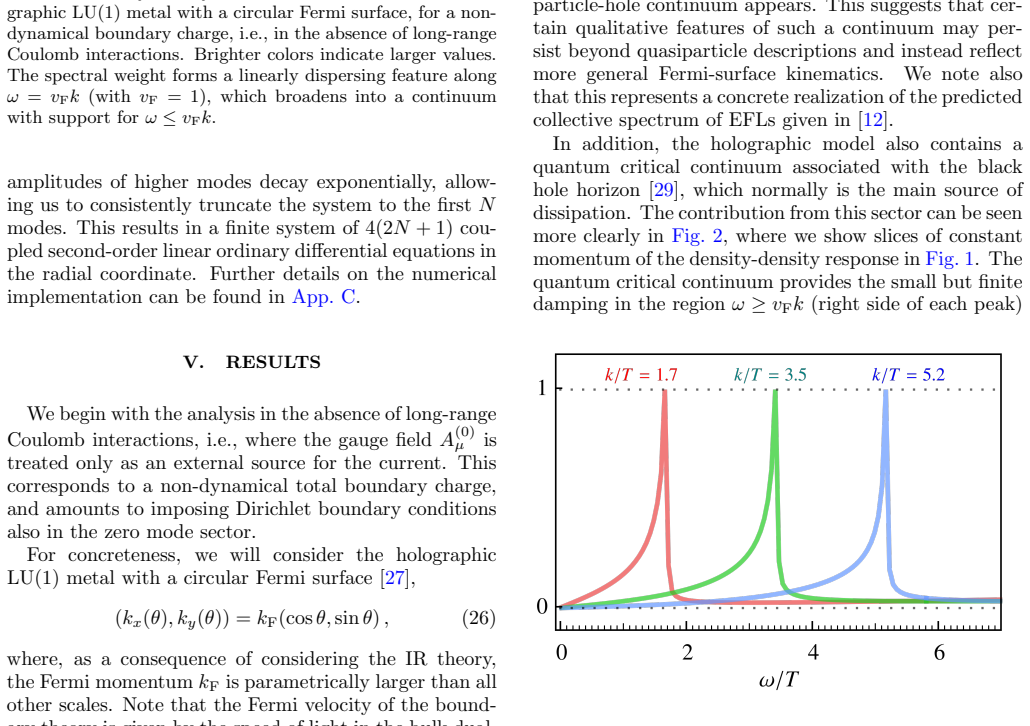
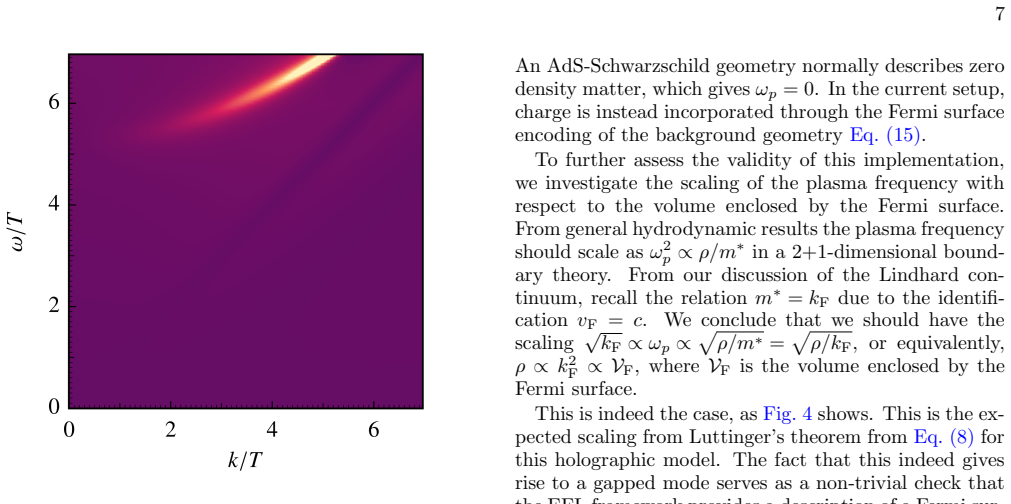
We solve an infrared effective holographic model of a non-Fermi liquid at finite temperature that satisfies Luttinger's theorem and incorporates long-range Coulomb interactions. Motivated by the absence of a Luttinger-counting Fermi surface in standard Reissner-Nordstrom holographic metals, we consider a Maxwell-Chern-Simons theory in a static anti-de Sitter-Schwarzschild background, coupled to an LU(1) gauge field rather than a conventional U(1) gauge field. By an appropriate choice of boundary conditions, we obtain a damped collective plasmon mode whose plasma frequency scales as predicted by Luttinger's theorem. We further analyze the density-density correlator in the absence of long-range Coulomb interactions and identify a contribution consistent with a Lindhard-like continuum.
Editorial analysis
A structured set of objections, weighed in public.
Referee Report
Summary. The manuscript constructs an infrared effective holographic model of a non-Fermi liquid using a Maxwell-Chern-Simons theory coupled to an LU(1) gauge field in a static AdS-Schwarzschild background. Motivated by the absence of Luttinger-counting Fermi surfaces in standard Reissner-Nordström holography, the authors select boundary conditions that yield a damped collective plasmon mode whose plasma frequency satisfies the Luttinger scaling ω_p² ∝ n. They additionally compute the density-density correlator in the absence of long-range Coulomb interactions and identify a contribution consistent with a Lindhard-like continuum.
Significance. If the boundary conditions can be shown to be uniquely fixed by consistency requirements rather than tuned to the desired scaling, and if the dual description remains free of spurious poles or violations of analyticity, the result would provide a concrete holographic realization of plasmons in ersatz Fermi liquids. This would strengthen the connection between holographic methods and condensed-matter phenomenology for collective modes, particularly by incorporating long-range Coulomb interactions while preserving Luttinger’s theorem.
major comments (2)
- [Model setup and boundary conditions] The central claim rests on an 'appropriate choice of boundary conditions' for the LU(1) Maxwell-Chern-Simons theory (stated in the abstract and model section). No derivation is supplied showing why these conditions are the unique or physically preferred quantization (standard vs. alternate) that preserves the Luttinger count without extra counterterms or artifacts in the density-density correlator. The choice appears selected to reproduce ω_p² ∝ n, which must be demonstrated to follow from the IR effective description rather than imposed by hand.
- [Density-density correlator analysis] The analysis of the density-density correlator (without Coulomb interactions) identifies a 'Lindhard-like continuum,' but the manuscript does not provide explicit checks on the analytic properties (e.g., location of poles, branch cuts, or satisfaction of sum rules) that would confirm the absence of dual artifacts introduced by the LU(1) structure or Chern-Simons term.
minor comments (2)
- [Introduction] The abstract and introduction should clarify the precise definition of the LU(1) gauge field and its relation to standard U(1) holography, including any additional degrees of freedom or constraints.
- [Results figures] Figure captions and axis labels for the plasmon dispersion and correlator plots should explicitly state the units, temperature scaling, and parameter values used (e.g., Chern-Simons coupling).
Simulated Author's Rebuttal
We thank the referee for their careful reading and constructive feedback. We address the two major comments point by point below. Where the manuscript requires clarification or additional analysis, we have revised accordingly.
read point-by-point responses
-
Referee: The central claim rests on an 'appropriate choice of boundary conditions' for the LU(1) Maxwell-Chern-Simons theory (stated in the abstract and model section). No derivation is supplied showing why these conditions are the unique or physically preferred quantization (standard vs. alternate) that preserves the Luttinger count without extra counterterms or artifacts in the density-density correlator. The choice appears selected to reproduce ω_p² ∝ n, which must be demonstrated to follow from the IR effective description rather than imposed by hand.
Authors: The boundary conditions are selected to realize the infrared effective description of an ersatz Fermi liquid in which the LU(1) structure and Chern-Simons term encode the absence of a conventional Fermi surface while preserving Luttinger counting for the charge density. In the revised manuscript we expand the model section with an explicit discussion of the physical motivation for these conditions, including why they are preferred over standard quantizations for consistency with the dual charge density and why no additional counterterms are required. We do not claim a derivation of uniqueness from a microscopic UV completion, as the construction is an IR effective model; the Luttinger scaling emerges directly from the conserved charge in the chosen quantization. revision: partial
-
Referee: The analysis of the density-density correlator (without Coulomb interactions) identifies a 'Lindhard-like continuum,' but the manuscript does not provide explicit checks on the analytic properties (e.g., location of poles, branch cuts, or satisfaction of sum rules) that would confirm the absence of dual artifacts introduced by the LU(1) structure or Chern-Simons term.
Authors: We agree that explicit verification of analytic properties strengthens the interpretation. In the revised manuscript we add a dedicated subsection (with supporting calculations in an appendix) that examines the locations of poles and branch cuts in the density-density correlator and verifies that the relevant sum rules are satisfied. These checks confirm that the Lindhard-like continuum is free of spurious artifacts from the LU(1) gauge field or Chern-Simons term. revision: yes
Circularity Check
Boundary conditions selected to enforce Luttinger scaling for plasmon frequency
specific steps
-
fitted input called prediction
[Abstract]
"By an appropriate choice of boundary conditions, we obtain a damped collective plasmon mode whose plasma frequency scales as predicted by Luttinger's theorem."
The boundary conditions are chosen specifically ('appropriate choice') so that the resulting plasmon mode reproduces the Luttinger-predicted scaling ω_p² ∝ n. This makes the scaling an enforced feature of the selected quantization rather than a derived prediction from the dynamics independent of that choice.
full rationale
The paper constructs an IR holographic model using Maxwell-Chern-Simons with LU(1) to address the lack of Luttinger-counting FS in standard RN-AdS. The central result for the damped plasmon is obtained only after an 'appropriate choice' of boundary conditions that directly yields the ω_p scaling predicted by Luttinger's theorem. This choice is not derived from the bulk equations or uniqueness but is imposed to produce the desired match, making the scaling a consequence of the input BC rather than an independent output. Luttinger's theorem itself is external, but the model's output is aligned to it by construction. No other circular steps (self-citations, ansatze, or renamings) are evident from the provided text.
Axiom & Free-Parameter Ledger
free parameters (1)
- Chern-Simons coupling
axioms (2)
- domain assumption The AdS/CFT correspondence applies to this strongly coupled non-Fermi liquid
- domain assumption The static anti-de Sitter-Schwarzschild background correctly captures finite-temperature physics
invented entities (1)
-
LU(1) gauge field
no independent evidence
Reference graph
Works this paper leans on
-
[1]
introduced a different perspective on metallic phases through the framework ofersatz Fermi liquids(EFLs) [11–16], which incorporates both Fermi liquids and non- Fermi liquids. In this framework, metallic phases are ∗ ismailov@chalmers.se † ulf.gran@chalmers.se ‡ nieric@chalmers.se characterized by emergent infinite-dimensional symme- try groups with speci...
work page internal anchor Pith review Pith/arXiv arXiv 2026
-
[2]
the emergent symmetryG IR,
-
[3]
the homomorphismφ:R d ×U(1)→G IR that specifies how microscopic translations and charge symmetry are realized in the IR,
-
[4]
the ’t Hooft anomaly of the IR theory, the microscopic charge densityρis fixed, independent of the interaction strength. For the present case of a two-dimensional LU(1) metal, Luttinger’s theorem reads ρ= mVF (2π)2 ,(8) whereV F is the volume enclosed by the Fermi surface. The anomaly coefficient,m∈Z, corresponding to the Chern-Simons level of Eq. (6), ca...
-
[5]
In the coordinates Eq
Horizon boundary conditions At finite temperature the bulk geometry contains a black hole horizon that, without loss of generality, we have chosen to be located atz= 1. In the coordinates Eq. (15), the linearized equations of motion have a reg- ular singular point at the horizon due to the vanishing of the emblackening factorf(z). Consequently, generic so...
-
[6]
Zaanen, Y
J. Zaanen, Y. Liu, Y.-W. Sun, and K. Schalm,Holo- graphic Duality in Condensed Matter Physics(Cam- bridge University Press, Cambridge, 2015)
2015
-
[7]
S. A. Hartnoll, A. Lucas, and S. Sachdev,Holographic Quantum Matter(The MIT Press, Cambridge, 2018)
2018
-
[8]
F. Balm, N. Chagnet, S. Arend, J. Aretz, K. Grosvenor, M. Janse, O. Moors, J. Post, V. Ohanesjan, D. Rodriguez-Fernandez, K. Schalm, and J. Zaanen, Physical Review B108, 125145 (2023)
2023
-
[9]
S. Smit, E. Mauri, L. Bawden, F. Heringa, F. Gerritsen, E. Van Heumen, Y. K. Huang, T. Kondo, T. Takeuchi, N. E. Hussey, M. Allan, T. K. Kim, C. Cacho, A. Krikun, K. Schalm, H. Stoof, and M. S. Golden, Nature Commu- nications15, 4581 (2024)
2024
-
[10]
Iqbal and H
N. Iqbal and H. Liu, Classical and Quantum Gravity29, 194004 (2012)
2012
-
[11]
J. M. Luttinger, Physical Review119, 1153 (1960)
1960
-
[12]
There are holographic electron star models where the charge density is sourced explicitly by bulk fermions, c.f. Refs. 39-41. However, these models tend to have a large number of smeared Fermi surfaces, making them less relevant for typical condensed matter scenarios
-
[13]
Polchinski and E
J. Polchinski and E. Silverstein, Classical and Quantum Gravity29, 194008 (2012)
2012
-
[14]
Faulkner and N
T. Faulkner and N. Iqbal, Journal of High Energy Physics 2013, 60 (2013)
2013
-
[15]
D. V. Else, R. Thorngren, and T. Senthil, Physical Re- view X11, 021005 (2021)
2021
-
[16]
D. V. Else and T. Senthil, Physical Review Letters127, 086601 (2021)
2021
- [17]
-
[18]
D. V. Else and T. Senthil, Physical Review B104, 205132 (2021)
2021
- [19]
-
[20]
D.-C. Lu, J. Wang, and Y.-Z. You, Physical Review B 109, 045123 (2024)
2024
-
[21]
Huang, A
X. Huang, A. Lucas, U. Mehta, and M. Qi, Physical Re- view B110, 035102 (2024)
2024
-
[22]
D. V. Else, Physical Review B109, 035163 (2024)
2024
-
[23]
We restrict to the most parsimonious case ofF=S 1
Any one-dimensional closed manifold is homeomorphic to a disjoint union of circles. We restrict to the most parsimonious case ofF=S 1
-
[24]
Shankar, Reviews of Modern Physics66, 129 (1994)
R. Shankar, Reviews of Modern Physics66, 129 (1994)
1994
-
[25]
Polchinski, Effective Field Theory and the Fermi Sur- face (1999), arXiv:hep-th/9210046
J. Polchinski, Effective Field Theory and the Fermi Sur- face (1999), arXiv:hep-th/9210046
-
[26]
AdS is a maximally symmetric solution to Einstein’s equations with a negative cosmological constant
-
[27]
W. A. Bardeen and B. Zumino, Nuclear Physics B244, 421 (1984)
1984
-
[28]
Gynther, K
A. Gynther, K. Landsteiner, F. Pena-Benitez, and A. Rebhan, Journal of High Energy Physics2011, 110 (2011)
2011
-
[29]
Jimenez-Alba and L
A. Jimenez-Alba and L. Melgar, Journal of High Energy Physics2014, 120 (2014)
2014
-
[30]
Landsteiner and L
K. Landsteiner and L. Melgar, Journal of High Energy Physics2012, 131 (2012)
2012
-
[31]
U. Gran, M. Torns¨ o, and T. Zingg, Journal of High En- ergy Physics2018, 176 (2018)
2018
-
[32]
Here we consider the simplest case of a circular Fermi surface, thereby speeding up the numerics
Our machinery allows us to consider a Fermi surface of any (closed) shape parameterized byθ. Here we consider the simplest case of a circular Fermi surface, thereby speeding up the numerics
-
[33]
G. F. Giuliani and G. Vignale,Quantum Theory of the Electron Liquid(Cambridge University Press, New York, 2005)
2005
-
[34]
Romero-Berm´ udez, A
A. Romero-Berm´ udez, A. Krikun, K. Schalm, and J. Za- anen, Physical Review B99, 235149 (2019)
2019
-
[35]
Mauri and H
E. Mauri and H. Stoof, Journal of High Energy Physics 2019, 35 (2019)
2019
-
[36]
Mitrano, A
M. Mitrano, A. A. Husain, S. Vig, A. Kogar, M. S. Rak, S. I. Rubeck, J. Schmalian, B. Uchoa, J. Schneeloch, R. Zhong, G. D. Gu, and P. Abbamonte, Proceedings of the National Academy of Sciences115, 5392 (2018)
2018
-
[38]
J. Chen, X. Guo, C. Boyd, S. Bettler, C. Kengle, D. Chaudhuri, F. Hoveyda, A. Husain, J. Schneeloch, G. Gu, P. Phillips, B. Uchoa, T.-C. Chiang, and P. Ab- bamonte, Physical Review B109, 045108 (2024)
2024
-
[39]
N. de Vries, E. Hoglund, D. Chaudhuri, S. hyun Bae, J. Chen, X. Guo, D. Balut, G. Gu, P. Huang, J. Hachtel, and P. Abbamonte, Reexamining the strange metal charge response with transmission inelastic electron scat- tering (2026), arXiv:2602.02348
-
[40]
Janssen, Loop groups (2016), lecture notes from a minicourse at the Summer School on Geometry, Utrecht
B. Janssen, Loop groups (2016), lecture notes from a minicourse at the Summer School on Geometry, Utrecht
2016
-
[41]
Pressley, G
A. Pressley, G. Segal, A. Pressley, and G. Segal,Loop Groups, Oxford Mathematical Monographs (Oxford Uni- versity Press, Oxford, New York, 1988)
1988
-
[42]
J. P. Boyd,Chebyshev and Fourier Spectral Methods (Courier Corporation, 2001)
2001
-
[43]
Ismailov,Fermi Surfaces of Holographic Metals, Mas- ter’s thesis, Chalmers University of Technology (2024)
E. Ismailov,Fermi Surfaces of Holographic Metals, Mas- ter’s thesis, Chalmers University of Technology (2024)
2024
-
[44]
U. Gran, M. Torns¨ o, and T. Zingg, Journal of High En- ergy Physics2019, 19 (2019)
2019
-
[45]
S. A. Hartnoll and A. Tavanfar, Phys. Rev. D83, 046003 (2011)
2011
-
[46]
S. A. Hartnoll, D. M. Hofman, and A. Tavanfar, Euro- physics Letters95, 31002 (2011)
2011
discussion (0)
Sign in with ORCID, Apple, or X to comment. Anyone can read and Pith papers without signing in.