Recognition: unknown
Two Regularized Determinants of Laplacian through Resurgence theory
Pith reviewed 2026-05-07 12:45 UTC · model grok-4.3
The pith
Resurgence theory yields closed formulas for two regularized determinants of the Laplacian.
A machine-rendered reading of the paper's core claim, the machinery that carries it, and where it could break.
Core claim
Under appropriate conditions, the closed formulas for both regularized determinants are established through Borel-Laplace resummation which takes into account the contribution of the singularities along the analytic continuation of Theta series hat Theta_{D_X}. The series resembles the trace of the heat kernel, but is defined via the spectrum of the square-root of the Laplacian.
What carries the argument
Borel-Laplace resummation of the theta series hat Theta_{D_X} that incorporates contributions from singularities in its analytic continuation.
Load-bearing premise
The manifold and spectrum must satisfy conditions that make the singularities of the analytically continued theta series of the precise type needed for the resummation to converge to the regularized determinant.
What would settle it
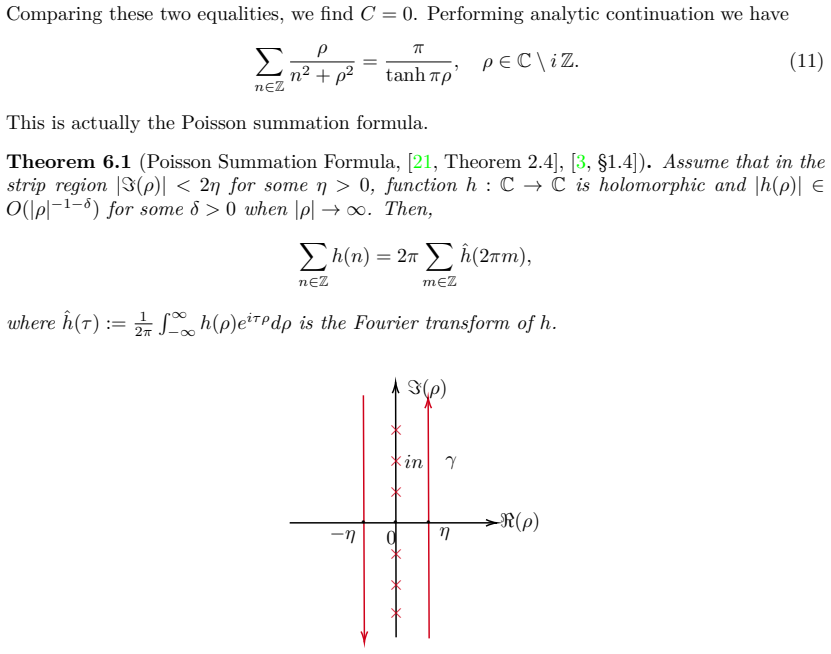
For the Laplacian on the circle S^1, evaluate the resummed expression and compare it directly with the explicit value given by the Poisson summation formula.
Figures




read the original abstract
We study two types of regularizations of the determinant of Laplacian on Riemann manifold from the viewpoint of resurgence theory. One is the formal logarithmic derivative of the determinant, and the other is its exponential deformation. Under appropriate conditions, the close formulas for both regularized determinant are established through Borel-Laplace resummation which takes into account the contribution of the singularities along the analytic continuation of Theta series $\hat{\Theta}_{D_X}$. The series resembles the trace of the heat kernel, but is defined via the spectrum of the square-root of the Laplacian. As applications, we revisit the well known formal logarithmic derivative of determinant on $S^1$ and compact Riemann surface with higher genus ($\geq2$) corresponding to the Poisson summation formula and Selberg trace formula respectively. Furthermore, the 1-Gevrey asymptotic behavior of the exponential deformation regularization at infinity is considered whose coefficients are determined by the trace of the heat kernel. In the end, we establish the relationship between the two regularized determinants. In fact, they have the same derivatives when the deformation parameter tends to $0$ in exponentially deformed regularization.
Editorial analysis
A structured set of objections, weighed in public.
Referee Report
Summary. The manuscript develops a resurgence-theoretic approach to two regularized determinants of the Laplacian on Riemann manifolds. It defines a theta series from the spectrum of the square root of the Laplacian and uses Borel-Laplace resummation of its analytic continuation to derive closed formulas for the formal logarithmic derivative of the determinant and an exponentially deformed version, under appropriate conditions. Applications to the circle S^1 and compact Riemann surfaces of genus at least 2 recover the Poisson summation and Selberg trace formulas, respectively. The paper also examines the 1-Gevrey asymptotics of the deformed regularization and establishes that the two regularizations have the same derivatives as the deformation parameter tends to zero.
Significance. If the resummation procedure rigorously recovers the regularized determinants under the stated conditions, the work would provide a valuable bridge between resurgence theory and spectral geometry. It offers a method to obtain closed expressions for determinants via Stokes data from the theta series, with the recovery of classical trace formulas serving as important consistency checks. The analysis of Gevrey asymptotics and the relationship between the two regularizations adds further insight into the analytic properties of these objects.
major comments (2)
- [Abstract] Abstract: The central claim that closed formulas for both regularized determinants are established through Borel-Laplace resummation of the analytic continuation of hat Theta_{D_X} rests on unspecified 'appropriate conditions' on the Riemann manifold, the spectrum, and the analytic properties of the theta series (e.g., growth bounds, singularity locations, or Gevrey order). These conditions are not listed or verified for the applications to S^1 and genus >=2 surfaces, yet the entire derivation depends on the singularities permitting the required resummation to equal the regularized determinant.
- [Applications] Applications to S^1 and genus >=2 surfaces: The recovery of the Poisson summation formula and Selberg trace formula provides consistency checks but does not include independent verification, error estimates, or direct comparison showing that the resummed series equals the regularized determinant. Since the central claim is that the resummation yields the closed formulas, the absence of such checks leaves the equality unconfirmed beyond known results.
minor comments (2)
- In the abstract, 'close formulas' is a typographical error and should be 'closed formulas'.
- The 1-Gevrey asymptotic behavior is mentioned but the precise definition of the exponential deformation and its relation to the heat kernel trace should be clarified for readability.
Simulated Author's Rebuttal
We thank the referee for the careful reading and constructive comments on our manuscript. We agree that the appropriate conditions require explicit statement and will revise accordingly. We also address the verification in the applications by clarifying the role of the recovered formulas.
read point-by-point responses
-
Referee: [Abstract] Abstract: The central claim that closed formulas for both regularized determinants are established through Borel-Laplace resummation of the analytic continuation of hat Theta_{D_X} rests on unspecified 'appropriate conditions' on the Riemann manifold, the spectrum, and the analytic properties of the theta series (e.g., growth bounds, singularity locations, or Gevrey order). These conditions are not listed or verified for the applications to S^1 and genus >=2 surfaces, yet the entire derivation depends on the singularities permitting the required resummation to equal the regularized determinant.
Authors: We agree that the 'appropriate conditions' must be stated explicitly. In the revised manuscript we will add a new paragraph in the introduction (and update the abstract) that lists the required assumptions: the manifold is compact without boundary, the spectrum of the square-root Laplacian consists of discrete positive eigenvalues with Weyl-type growth, the theta series admits an analytic continuation to a sector with controlled growth at infinity, and the singularities are of exponential type permitting Borel-Laplace resummation to recover the regularized determinant. For the applications to S^1 and genus >=2 surfaces we will explicitly verify that these spectral and analytic properties hold, using the known eigenvalue asymptotics and the resulting trace formulas. revision: yes
-
Referee: [Applications] Applications to S^1 and genus >=2 surfaces: The recovery of the Poisson summation formula and Selberg trace formula provides consistency checks but does not include independent verification, error estimates, or direct comparison showing that the resummed series equals the regularized determinant. Since the central claim is that the resummation yields the closed formulas, the absence of such checks leaves the equality unconfirmed beyond known results.
Authors: The recovery of the Poisson summation and Selberg trace formulas is not merely a consistency check; it constitutes the verification that the resummation procedure produces the exact closed-form expressions for the regularized determinants. Because these formulas are independently established in the literature, exact matching demonstrates that the Borel-Laplace sum, incorporating the Stokes data from the theta series, equals the known regularized determinant. In the revision we will add a short explanatory paragraph after each application, recalling how the singularity contributions in the resummation directly reproduce the classical formulas. We maintain that further numerical error estimates or independent comparisons are not required for this theoretical derivation, as the equality is exact once the stated conditions are satisfied. revision: partial
Circularity Check
No circularity: resurgence resummation connects theta series to determinants without reducing to input by construction
full rationale
The derivation begins with the spectral definition of the theta series hat Theta_{D_X} (resembling a heat-kernel trace but using sqrt(Laplacian) eigenvalues) and applies Borel-Laplace resummation along its analytic continuation to obtain closed formulas for the logarithmic derivative and exponentially deformed regularized determinants. This step relies on the contribution of singularities under explicitly invoked 'appropriate conditions' rather than defining the output in terms of the input. Applications recover the Poisson summation and Selberg trace formulas as consistency checks on known cases (S^1 and genus >=2 surfaces), without the final expressions being tautological rewrites of the starting spectral data. No self-citation chains, fitted parameters renamed as predictions, ansatz smuggling, or uniqueness theorems imported from the authors' prior work appear as load-bearing steps. The relationship between the two regularizations (same derivatives as deformation parameter ->0) follows directly from the shared resummation construction without circular reduction.
Axiom & Free-Parameter Ledger
axioms (2)
- standard math Borel-Laplace resummation recovers the regularized determinant when singularities of the theta series are properly accounted for
- domain assumption The theta series hat Theta_{D_X} admits an analytic continuation with singularities whose contributions can be isolated
Reference graph
Works this paper leans on
-
[1]
Geometry and spectra of compact Riemann surfaces
Peter Buser. Geometry and spectra of compact Riemann surfaces . Springer Science & Business Media, 2010
2010
-
[2]
On equivalent methods for functional determinants
Matthias Carosi. On equivalent methods for functional determinants. arXiv: 2601.08686 , 2026
-
[3]
Une nouvelle interprétation de la formule des traces de Selberg
Pierre Cartier and André Voros. Une nouvelle interprétation de la formule des traces de Selberg. In The Grothendieck Festschrift: A Collection of Articles Written in Honor of the 60th Birthday of Alexander Grothendieck , pages 1–67. Springer, 2007
2007
-
[4]
Resurgent methods in semi-classical asymptotics
Eric Delabaere and Frédéric Pham. Resurgent methods in semi-classical asymptotics. Annales de l’IHP Physique théorique , 71(1):1–94, 1999
1999
-
[5]
Duistermaat and Victor W
Johannes J. Duistermaat and Victor W. Guillemin. The spectrum of positive elliptic operators and periodic bicharacteristics. Inventiones Mathematicae , 29(1):39–79, 1975
1975
-
[6]
Les fonctions résurgentes, Vol
Jean Ecalle. Les fonctions résurgentes, Vol. 1: Algèbres de fonctions résurgentes , vol- ume 05. Publ. Math. d’Orsay, 1981
1981
-
[7]
Les fonctions résurgentes, Vol
Jean Ecalle. Les fonctions résurgentes, Vol. 2: Les fonctions résurgentes appliquées à l’itération, volume 06. Publ. Math. Orsay, 1981
1981
-
[8]
Les fonctions résurgentes, Vol
Jean Ecalle. Les fonctions résurgentes, Vol. 3: L’équation du pont et la classification analytique des objets locaux , volume 05. Publ. Math. Orsay, 1985
1985
-
[9]
Gutzwiller
Martin C. Gutzwiller. Periodic orbits and classical quantization conditions. Journal of Mathematical Physics , 12(3):343–358, 1971. 36
1971
-
[10]
Gutzwiller
Martin C. Gutzwiller. Chaos in Classical and Quantum Mechanics , volume 1. Springer Science & Business Media, 1991
1991
-
[11]
Resurgence and partial theta series
Li Han, Yong Li, David Sauzin, and Shanzhong Sun. Resurgence and partial theta series. Functional Analysis and Its Applications , 57(3):248–265, 2023
2023
-
[12]
Fast way to compute functional determinants of radially sym- metric partial differential operators in general dimensions
Jin Hur and Hyunsoo Min. Fast way to compute functional determinants of radially sym- metric partial differential operators in general dimensions. Physical Review D—Particles, Fields, Gravitation, and Cosmology , 77(12):125033, 2008
2008
-
[13]
Regularized products and determinants
Georg Illies. Regularized products and determinants. Communications in Mathematical Physics, 220(1):69–94, 2001
2001
-
[14]
Klaus Kirsten and Alan J. McKane. Functional determinants by contour integration methods. Annals of Physics , 308(2):502–527, 2003
2003
-
[15]
Resurgence in the universal structures in B-model topological string theory
Yong Li, David Sauzin, and Shanzhong Sun. Resurgence in the universal structures in B-model topological string theory. arXiv:2503.12815, 2025
-
[16]
Some properties of the eigenfunctions of the Laplace-Operator on Riemannian manifolds
Subbaramiah Minakshisundaram and Åke Pleijel. Some properties of the eigenfunctions of the Laplace-Operator on Riemannian manifolds. Canadian Journal of Mathematics , 1(3):242–256, 1949
1949
-
[17]
Divergent series, summability and resurgence
Claude Mitschi and David Sauzin. Divergent series, summability and resurgence. , volume 2153 of Lecture Notes in Mathematics . Springer, 2016
2016
-
[18]
Unified treatment of explicit and trace formulas via Poisson-Newton formula
Vicente Muñoz and Ricardo Pérez Marco. Unified treatment of explicit and trace formulas via Poisson-Newton formula. Communications in Mathematical Physics, 336(3):1201–1230, 2015
2015
-
[19]
Introduction à la résurgence quantique
Frédéric Pham. Introduction à la résurgence quantique. Séminaire Bourbaki, 28:103–110, 1987
1987
-
[20]
Resurgent functions and splitting problems
David Sauzin. Resurgent functions and splitting problems. In New Trends and Applicati ons of Complex Asymptotic Analysis : around dynamical systems, summability, continued fractions. RIMS Kokyuroku, 1493 , pages 48–117. RIMS, Kyoto, 2006
2006
-
[21]
Stein and Rami Shakarchi
Elias M. Stein and Rami Shakarchi. Complex analysis . Princeton University Press, 2003
2003
-
[22]
Gutzwiller’s semiclassical trace formula and Maslov-type index theory for symplectic paths
Shanzhong Sun. Gutzwiller’s semiclassical trace formula and Maslov-type index theory for symplectic paths. Journal of Fixed Point Theory and Applications , 19(1):299–343, 2017
2017
-
[23]
On a new method of analysis and its appli- cations
Paul Turán, Gábor Halász, and János Pintz. On a new method of analysis and its appli- cations. Wiley-Interscience, 1984
1984
-
[24]
Spectral functions, special functions and the Selberg zeta function
André Voros. Spectral functions, special functions and the Selberg zeta function. Com- munications in Mathematical Physics , 110(3):439–465, 1987
1987
-
[25]
Spectral zeta functions
André Voros. Spectral zeta functions. In Zeta functions in geometry , volume 21, pages 327–359. Mathematical Society of Japan, 1992
1992
-
[26]
Résurgence quantique
André Voros. Résurgence quantique. Annales de L’Institut Fourier, 43(5):1509–1534, 1993. 37
1993
discussion (0)
Sign in with ORCID, Apple, or X to comment. Anyone can read and Pith papers without signing in.