Recognition: unknown
Quantum Metric Localization and Quantum Metric Protection
Pith reviewed 2026-05-07 14:19 UTC · model grok-4.3
The pith
Isolated bands with quantum metric pin localization length at twice the quantum metric length under strong disorder.
A machine-rendered reading of the paper's core claim, the machinery that carries it, and where it could break.
Core claim
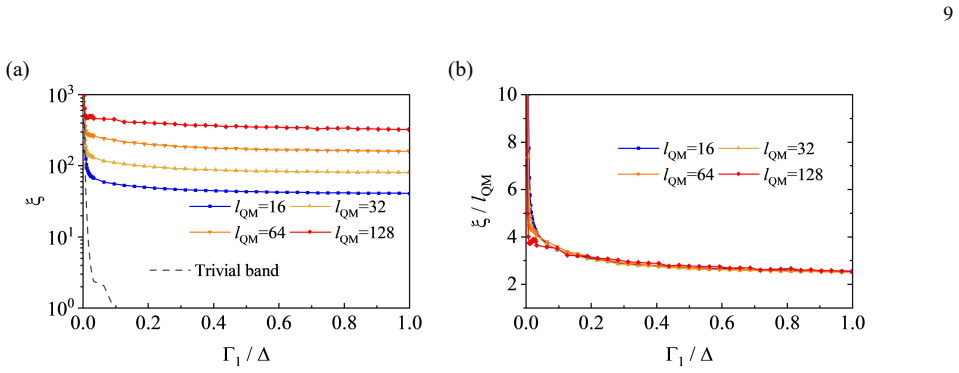
For an isolated band with a finite bandwidth separated from other bands by a band gap Δ, weak disorder results in conventional Anderson localization behavior. However, as the disorder increases, the localization length ceases to decrease and becomes pinned at a value approximately twice the quantum metric length, forming a localization length plateau. The regime within this plateau is termed the quantum metric localization regime. The localization length does not deviate from the plateau until the disorder strength far exceeds Δ. This strong protection against disorder, characterized by the quantum metric length, is called quantum metric protection.
What carries the argument
The quantum metric length, a length scale extracted from the band's quantum metric tensor, which sets the pinned value of the localization length once the Anderson regime ends.
If this is right
- The same plateau and protection should appear in any disordered electronic, photonic or acoustic system whose bands remain isolated and carry nonzero quantum metric.
- The supersymmetric field theory accounts for both the crossover out of Anderson localization and the factor-of-two relation between localization length and quantum metric length.
- Wannier-function overlap supplies a real-space picture for why the plateau forms and why it is stable up to disorder strengths comparable to the gap.
Where Pith is reading between the lines
- The protection may survive in higher-dimensional lattices or in bands that are topologically nontrivial, provided the gap and isolation conditions hold.
- Synthetic lattices or photonic crystals could be used to tune disorder while tracking localization length directly against the computed quantum metric length.
- Device design could exploit the plateau to maintain finite localization even under strong disorder by engineering bands with large quantum metric.
Load-bearing premise
The band stays isolated with a finite bandwidth and a well-defined gap even as disorder strength increases.
What would settle it
Measuring a monotonic decrease in localization length with no plateau when disorder is ramped up in an isolated band whose quantum metric length can be independently computed would falsify the pinning claim.
Figures


read the original abstract
The study of disorder effects in electronic systems is one of the central themes in physics. It is well established that in the Anderson localization regime, the localization length of electrons decreases monotonically as the disorder strength increases. Here, we demonstrate that the conventional Anderson localization paradigm fails completely in describing an isolated band with quantum metric, where the quantum metric of the band defines a length scale called the quantum metric length. For an isolated band with a finite bandwidth separated from other bands by a band gap $\Delta$, weak disorder results in conventional Anderson localization behavior. However, as the disorder increases, the localization length ceases to decrease and becomes pinned at a value approximately twice the quantum metric length, forming a localization length plateau. We term the regime within this localization length plateau as the quantum metric localization regime. Remarkably, the localization length does not deviate from the plateau until the disorder strength far exceeds $\Delta$. We refer to this strong protection against disorder, characterized by the quantum metric length, as quantum metric protection. In this work, we first numerically demonstrate quantum metric localization using a 1D Lieb lattice. We then provide a simple physical picture based on the properties of Wannier functions to explain the origin of the localization length plateau. A supersymmetric field theory approach explains why the localization length is approximately twice the quantum metric length and captures the crossover from Anderson localization to quantum metric localization. Our conclusions are broadly applicable to disordered electronic, photonic, and acoustic systems.
Editorial analysis
A structured set of objections, weighed in public.
Referee Report
Summary. The manuscript claims that conventional Anderson localization fails for isolated bands possessing a quantum metric: weak disorder produces the usual monotonic decrease in localization length, but beyond a crossover the length plateaus at a value approximately twice the quantum metric length (termed the quantum metric localization regime) and remains pinned until disorder strength W greatly exceeds the band gap Δ. The plateau is demonstrated numerically on a 1D Lieb lattice; a Wannier-function picture supplies an intuitive origin, while a supersymmetric field theory accounts for the factor-of-two relation and the crossover.
Significance. If the central claim is quantitatively supported, the work identifies a previously unrecognized protection mechanism rooted in quantum geometry that overrides conventional disorder scaling over a wide range of W/Δ. The combination of concrete lattice numerics and an analytic field-theoretic derivation is a clear strength; the result would be broadly relevant to disordered electronic, photonic, and acoustic systems.
major comments (2)
- [Numerical demonstration (1D Lieb lattice)] Numerical demonstration section (1D Lieb lattice): the claim that the localization-length plateau survives until W ≫ Δ requires explicit verification that the original band remains isolated. The manuscript should report the disorder-dependent single-particle gap (or at least the band-projected participation ratio) across the full range of W shown in the figures; without this, interband mixing could invalidate the effective single-band quantum-metric description and cause the plateau to terminate earlier than asserted.
- [Supersymmetric field theory] Supersymmetric field-theory section: the derivation of the factor-of-two relation between localization length and quantum metric length is presented as explaining the numerical plateau. The manuscript should state the precise assumptions under which the supersymmetric mapping remains valid (in particular, the neglect of interband scattering) and whether the factor is exact or only asymptotic; if the mapping assumes an isolated band by construction, the protection claim for W ≫ Δ rests on an unverified extrapolation.
minor comments (2)
- [Abstract and figures] The abstract and introduction use “approximately twice” without a quantitative error bar; the numerical figures should include a direct comparison (e.g., ratio of plateau value to quantum metric length) with uncertainty.
- [Introduction] Notation for the quantum metric length should be defined once in the main text (including its relation to the quantum metric tensor) rather than only in the abstract.
Simulated Author's Rebuttal
We thank the referee for the careful reading and constructive comments on our manuscript. We address each major comment below and will incorporate the suggested clarifications and additional data in the revised version.
read point-by-point responses
-
Referee: Numerical demonstration section (1D Lieb lattice): the claim that the localization-length plateau survives until W ≫ Δ requires explicit verification that the original band remains isolated. The manuscript should report the disorder-dependent single-particle gap (or at least the band-projected participation ratio) across the full range of W shown in the figures; without this, interband mixing could invalidate the effective single-band quantum-metric description and cause the plateau to terminate earlier than asserted.
Authors: We agree that explicit verification of band isolation is essential to support the claimed regime. In the revised manuscript we will add a supplementary figure (or extended panel in the main text) displaying the disorder-dependent single-particle gap and the band-projected participation ratio over the entire range of W values used in the localization-length plots. These data will confirm that interband mixing remains negligible until W significantly exceeds Δ, thereby validating the single-band quantum-metric description throughout the plateau. revision: yes
-
Referee: Supersymmetric field-theory section: the derivation of the factor-of-two relation between localization length and quantum metric length is presented as explaining the numerical plateau. The manuscript should state the precise assumptions under which the supersymmetric mapping remains valid (in particular, the neglect of interband scattering) and whether the factor is exact or only asymptotic; if the mapping assumes an isolated band by construction, the protection claim for W ≫ Δ rests on an unverified extrapolation.
Authors: The supersymmetric mapping is derived under the explicit assumption of an isolated band with interband scattering neglected; the factor-of-two relation is obtained asymptotically in the quantum-metric-localization regime and is therefore approximate rather than exact. We will revise the relevant section to state these assumptions clearly and to emphasize that the field theory accounts for the plateau value and the Anderson-to-quantum-metric crossover, while the persistence of the plateau up to W ≫ Δ is established by the numerical data (where the band remains isolated). We will avoid any implication that the field theory alone extrapolates the protection beyond the isolated-band regime. revision: yes
Circularity Check
No significant circularity; derivation supported by independent numerics and field theory
full rationale
The paper supports its central claims through direct numerical simulation on the 1D Lieb lattice, a physical picture derived from Wannier-function properties of the isolated band, and a separate supersymmetric field theory that derives the approximate factor-of-two relation between localization length and quantum metric length. None of these steps reduce by construction to the input definitions or to self-citations; the quantum metric length is computed from the clean-band geometry while the disordered localization behavior is obtained independently. The isolation assumption (finite bandwidth and gap Δ) is stated explicitly as a precondition rather than smuggled in via definition or prior self-work. This is the typical non-circular case of a paper whose results remain falsifiable against external benchmarks.
Axiom & Free-Parameter Ledger
axioms (1)
- domain assumption The band is isolated with finite bandwidth and separated from other bands by a gap Δ.
Reference graph
Works this paper leans on
-
[1]
Department of Physics, Hong Kong University of Science and Technology, Clear Water Bay, Hong Kong, China and
-
[2]
Quantum Metric Localization and Quantum Metric Protection
Max Planck Institute for the Physics of Complex Systems, N ¨othnitzer Straße 38, Dresden 01187, Germany The study of disorder effects in electronic systems is one of the central themes in physics. It is well estab- lished that in the Anderson localization regime, the localization length of electrons decreases monotonically as the disorder strength increas...
work page internal anchor Pith review Pith/arXiv arXiv 2026
-
[3]
Provost and G
J. Provost and G. Vallee, Communications in Mathematical Physics76, 289 (1980)
1980
-
[4]
Haldane, Physical review letters93, 206602 (2004)
F. Haldane, Physical review letters93, 206602 (2004)
2004
-
[5]
Nagaosa, J
N. Nagaosa, J. Sinova, S. Onoda, A. H. MacDonald, and N. P. Ong, Reviews of modern physics82, 1539 (2010)
2010
-
[6]
Xiao, M.-C
D. Xiao, M.-C. Chang, and Q. Niu, Rev. Mod. Phys.82, 1959 (2010), URLhttps://link.aps.org/doi/10.1103/ RevModPhys.82.1959
1959
-
[7]
Sodemann and L
I. Sodemann and L. Fu, Physical review letters115, 216806 (2015)
2015
-
[8]
Resta, Reviews of modern physics66, 899 (1994)
R. Resta, Reviews of modern physics66, 899 (1994)
1994
-
[9]
Thonhauser, D
T. Thonhauser, D. Ceresoli, D. Vanderbilt, and R. Resta, Physi- cal review letters95, 137205 (2005)
2005
-
[10]
A. M. Essin, J. E. Moore, and D. Vanderbilt, Physical review letters102, 146805 (2009)
2009
-
[11]
X.-L. Qi, T. L. Hughes, and S.-C. Zhang, Physical Review B 78, 195424 (2008)
2008
-
[12]
Vanderbilt, Berry Phases in Electronic Structure Theory (Cambridge University Press, 2018)
D. Vanderbilt, Berry Phases in Electronic Structure Theory (Cambridge University Press, 2018)
2018
-
[13]
D. J. Thouless, M. Kohmoto, M. P. Nightingale, and M. den Nijs, Physical review letters49, 405 (1982)
1982
-
[14]
C.-Z. Chang, J. Zhang, X. Feng, J. Shen, and Z. Zhang, Science340, 167 (2013), URLhttps://www.science. org/doi/10.1126/science.1234414
-
[15]
<i>Colloquium</i> : Quantum anomalous Hall effect
C.-Z. Chang, C.-X. Liu, and A. H. MacDonald, Rev. Mod. Phys.95, 011002 (2023), URLhttps://link.aps.org/ doi/10.1103/RevModPhys.95.011002
-
[16]
Marzari and D
N. Marzari and D. Vanderbilt, Physical review B56, 12847 (1997)
1997
-
[17]
Marzari, A
N. Marzari, A. A. Mostofi, J. R. Yates, I. Souza, and D. Vander- bilt, Reviews of Modern Physics84, 1419 (2012)
2012
-
[18]
Verma, P
N. Verma, P. J. Moll, T. Holder, and R. Queiroz, Nature Reviews Physics pp. 1–14 (2026)
2026
-
[19]
Anandan and Y
J. Anandan and Y . Aharonov, Physical review letters65, 1697 (1990)
1990
-
[20]
Liu, X.-B
T. Liu, X.-B. Qiang, H.-Z. Lu, and X. Xie, National Science Review12, nwae334 (2025)
2025
-
[21]
Rossi, Current Opinion in Solid State and Materials Science 25, 100952 (2021)
E. Rossi, Current Opinion in Solid State and Materials Science 25, 100952 (2021)
2021
-
[22]
J. Yu, B. A. Bernevig, R. Queiroz, E. Rossi, P. T¨orm¨a, and B.-J. Yang, npj Quantum Materials10, 101 (2025)
2025
-
[23]
Y . Gao, S. A. Yang, and Q. Niu, Physical review letters112, 166601 (2014)
2014
-
[24]
N. Wang, D. Kaplan, Z. Zhang, T. Holder, N. Cao, A. Wang, X. Zhou, F. Zhou, Z. Jiang, C. Zhang, et al., Nature621, 487 (2023)
2023
-
[25]
Gao, Y .-F
A. Gao, Y .-F. Liu, J.-X. Qiu, B. Ghosh, T. V . Trevisan, Y . On- ishi, C. Hu, T. Qian, H.-J. Tien, S.-W. Chen, et al., Science381, 181 (2023)
2023
-
[26]
Raoux, F
A. Raoux, F. Pi ´echon, J.-N. Fuchs, and G. Montambaux, Phys- ical Review B91, 085120 (2015)
2015
-
[27]
Y . Gao, S. A. Yang, and Q. Niu, Physical Review B91, 214405 (2015)
2015
-
[28]
Ahn, G.-Y
J. Ahn, G.-Y . Guo, N. Nagaosa, and A. Vishwanath, Nature Physics18, 290 (2022)
2022
-
[29]
M. Kang, S. Kim, Y . Qian, P. M. Neves, L. Ye, J. Jung, D. Pun- tel, F. Mazzola, S. Fang, C. Jozwiak, et al., Nature Physics21, 110 (2025)
2025
-
[30]
G. E. Topp, C. J. Eckhardt, D. M. Kennes, M. A. Sentef, and P. T¨orm¨a, Physical Review B104, 064306 (2021)
2021
-
[31]
Roy, Physical Review B90, 165139 (2014)
R. Roy, Physical Review B90, 165139 (2014)
2014
-
[32]
Antebi, J
O. Antebi, J. Mitscherling, and T. Holder, Physical Review B 110, L241111 (2024)
2024
-
[33]
Mitscherling and T
J. Mitscherling and T. Holder, Physical Review B105, 085154 (2022)
2022
-
[34]
Bouzerar, Physical Review B106, 125125 (2022)
G. Bouzerar, Physical Review B106, 125125 (2022)
2022
-
[35]
Kruchkov, Physical Review B107, L241102 (2023)
A. Kruchkov, Physical Review B107, L241102 (2023)
2023
-
[36]
Peotta and P
S. Peotta and P. T¨orm¨a, Nature communications6, 8944 (2015)
2015
-
[37]
T ¨orm¨a, S
P. T ¨orm¨a, S. Peotta, and B. A. Bernevig, Nature Reviews Physics4, 528 (2022)
2022
-
[38]
S. A. Chen and K. Law, Physical Review Letters132, 026002 (2024)
2024
-
[39]
J.-X. Hu, S. A. Chen, and K. T. Law, Communications Physics 8, 20 (2025)
2025
-
[40]
Z. C. Li, Y . Deng, S. A. Chen, D. K. Efetov, and K. Law, Phys- ical Review Research7, 023273 (2025)
2025
-
[41]
X. Guo, X. Ma, X. Ying, and K. Law, Physical Review Letters 135, 076601 (2025)
2025
-
[42]
P. W. Anderson et al., Physical review109, 1492 (1958)
1958
-
[43]
D. J. Thouless, Physics Reports13, 93 (1974)
1974
-
[44]
D. J. Thouless, Phys. Rev. Lett.39, 1167 (1977), URLhttps://link.aps.org/doi/10.1103/ PhysRevLett.39.1167
1977
-
[45]
Abrahams, P
E. Abrahams, P. W. Anderson, D. C. Licciardello, and T. V . Ramakrishnan, Physical Review Letters42, 673 (1979)
1979
-
[46]
P. A. Lee and T. V . Ramakrishnan, Rev. Mod. Phys.57, 287 (1985), URLhttps://link.aps.org/doi/10.1103/ RevModPhys.57.287
1985
-
[47]
C. W. J. Beenakker, Rev. Mod. Phys.69, 731 (1997), URLhttps://link.aps.org/doi/10.1103/ RevModPhys.69.731
1997
-
[48]
Nishino, H
S. Nishino, H. Matsuda, and M. Goda, Journal of the Physical Society of Japan76, 024709 (2007)
2007
-
[49]
Leykam, S
D. Leykam, S. Flach, O. Bahat-Treidel, and A. S. Desyatnikov, Physical Review B88, 224203 (2013)
2013
-
[50]
Leykam, J
D. Leykam, J. D. Bodyfelt, A. S. Desyatnikov, and S. Flach, The European Physical Journal B90, 1 (2017)
2017
-
[51]
J. Mitscherling, Phys. Rev. B102, 165151 (2020), URL https://link.aps.org/doi/10.1103/PhysRevB. 102.165151
-
[52]
Bouzerar and D
G. Bouzerar and D. Mayou, Phys. Rev. Res.2, 033063 (2020), URLhttps://link.aps.org/doi/10.1103/ PhysRevResearch.2.033063
2020
-
[53]
Bouzerar and D
G. Bouzerar and D. Mayou, Phys. Rev. B103, 075415 (2021), URLhttps://link.aps.org/doi/10.1103/ PhysRevB.103.075415
2021
-
[54]
ˇCadeˇz, Y
T. ˇCadeˇz, Y . Kim, A. Andreanov, and S. Flach, Physical Review B104, L180201 (2021). 8
2021
-
[55]
Mitscherling and T
J. Mitscherling and T. Holder, Phys. Rev. B105, 085154 (2022), URLhttps://link.aps.org/doi/10.1103/ PhysRevB.105.085154
2022
-
[56]
Mera and J
B. Mera and J. Mitscherling, Phys. Rev. B106, 165133 (2022), URLhttps://link.aps.org/doi/10.1103/ PhysRevB.106.165133
2022
-
[57]
Onishi and L
Y . Onishi and L. Fu, Phys. Rev. Res.7, 023158 (2025), URLhttps://link.aps.org/doi/10.1103/ PhysRevResearch.7.023158
2025
-
[58]
I. T. Rosen, S. Muschinske, C. N. Barrett, D. A. Rower, R. Das, D. K. Kim, B. M. Niedzielski, M. Schuldt, K. Ser- niak, M. E. Schwartz, et al., Phys. Rev. X15, 021091 (2025), URLhttps://link.aps.org/doi/10.1103/ PhysRevX.15.021091
2025
- [59]
-
[60]
Z. Hou, H. Li, Q. Yan, Y .-H. Li, and H. Jiang, Phys. Rev. B113, 155421 (2026), URLhttps://link.aps.org/ doi/10.1103/9lc1-9m8t
-
[61]
A. A. Burkov, Phys. Rev. B113, 155145 (2026), URLhttps: //link.aps.org/doi/10.1103/8lkl-x1nq
-
[62]
B. Yin, Z. Wang, and Q. Wu, arXiv:2604.17438 (2026)
work page internal anchor Pith review Pith/arXiv arXiv 2026
-
[63]
Schwartz, G
T. Schwartz, G. Bartal, S. Fishman, and M. Segev, Nature446, 52 (2007)
2007
-
[64]
Y . Lahini, A. Avidan, F. Pozzi, M. Sorel, R. Morandotti, D. N. Christodoulides, and Y . Silberberg, Phys. Rev. Lett. 100, 013906 (2008), URLhttps://link.aps.org/ doi/10.1103/PhysRevLett.100.013906
-
[65]
H. Xue, Y . Yang, F. Gao, Y . Chong, and B. Zhang, Nature Materials18, 108 (2019), ISSN 1476-4660, URLhttps: //doi.org/10.1038/s41563-018-0251-x
-
[66]
MacKinnon and B
A. MacKinnon and B. Kramer, Physical Review Letters47, 1546 (1981)
1981
-
[67]
MacKinnon and B
A. MacKinnon and B. Kramer, Zeitschrift f ¨ur Physik B Con- densed Matter53, 1 (1983)
1983
-
[68]
Kramer and A
B. Kramer and A. MacKinnon, Reports on Progress in Physics 56, 1469 (1993)
1993
-
[69]
Slevin and T
K. Slevin and T. Ohtsuki, New Journal of Physics16, 015012 (2014)
2014
-
[70]
Efetov, Supersymmetry in disorder and chaos (Cambridge university press, 1999)
K. Efetov, Supersymmetry in disorder and chaos (Cambridge university press, 1999)
1999
-
[71]
A. D. Mirlin, Physics Reports326, 259 (2000)
2000
-
[72]
Efetov and A
K. Efetov and A. Larkin, Sov. Phys. JETP58, 444 (1983). Appendix A. Spinful Lieb lattice with magnetic Disorder To demonstrate that quantum metric localization extends beyond the single-band setting considered in the main text, we generalize the model to a spinful multiband system with spin-orbit coupling and spin-dependent disorder. The Hamil- tonian is ...
1983
discussion (0)
Sign in with ORCID, Apple, or X to comment. Anyone can read and Pith papers without signing in.