Recognition: 3 theorem links
· Lean TheoremTOI-159 b: an eccentric hot-Jupiter planet around a young, pulsating γ Doradus star
Pith reviewed 2026-05-08 18:39 UTC · model grok-4.3
The pith
TOI-159 b is confirmed as the hottest hot Jupiter with significant eccentricity, orbiting a young pulsating gamma Doradus star.
A machine-rendered reading of the paper's core claim, the machinery that carries it, and where it could break.
Core claim
TOI-159 b is the hottest hot Jupiter yet found with a significant eccentricity (e = 0.24 plus or minus 0.04). Its Keplerian radial-velocity signal is detected at 13-sigma significance after the stellar rotational modulation and gamma-Doradus pulsation periods are disentangled from the data. The planet has an orbital period of about 3.7 days, a radius of 1.6 Jupiter radii, a mass of 3.5 Jupiter masses, and an equilibrium temperature of roughly 1900 K; it resides in an S-type configuration within a close binary system.
What carries the argument
Joint modeling of HARPS and CORALIE radial velocities, TESS transits, and IMACS spectro-photometry that separates the planetary Keplerian orbit from stellar activity signals.
If this is right
- The measured eccentricity implies ongoing dynamical excitation, possibly from the binary companion, that has not yet been damped by tides.
- The high equilibrium temperature supplies an extreme test case for atmospheric escape and chemistry models in the hottest regime.
- The youth of the host star offers a direct window into the early structural and orbital evolution of a massive planet.
- The ability to extract a transmission spectrum despite strong stellar variability demonstrates a pathway for atmosphere studies around other pulsating stars.
Where Pith is reading between the lines
- Similar multi-instrument campaigns could be applied to other young, variable stars that have so far been avoided in exoplanet surveys.
- If the binary companion is dynamically active, future monitoring could reveal whether the planet's eccentricity is still changing.
- The current low-resolution spectrum leaves open whether any detected modulation arises from the planet or residual starlight; resolved spectroscopy at higher resolution is the direct next step.
Load-bearing premise
The observed periodic signals in velocity and light can be cleanly assigned to a planet once the star's rotation, pulsations, and the light from the close binary companion are removed.
What would settle it
A higher-resolution transmission spectrum that either shows or fails to show the same absorption features reported in the low-resolution data would confirm or refute a planetary atmosphere versus stellar contamination.
Figures




read the original abstract
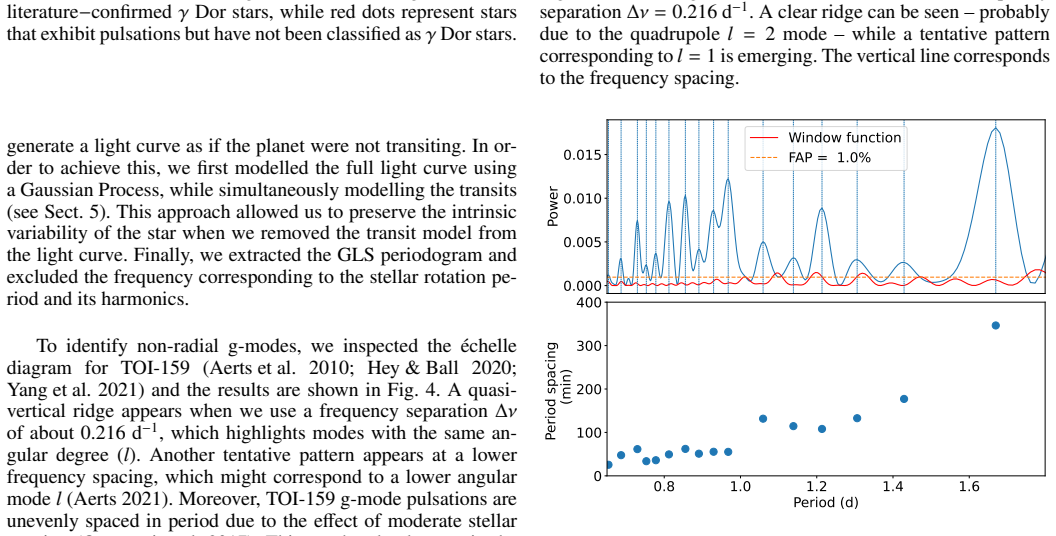
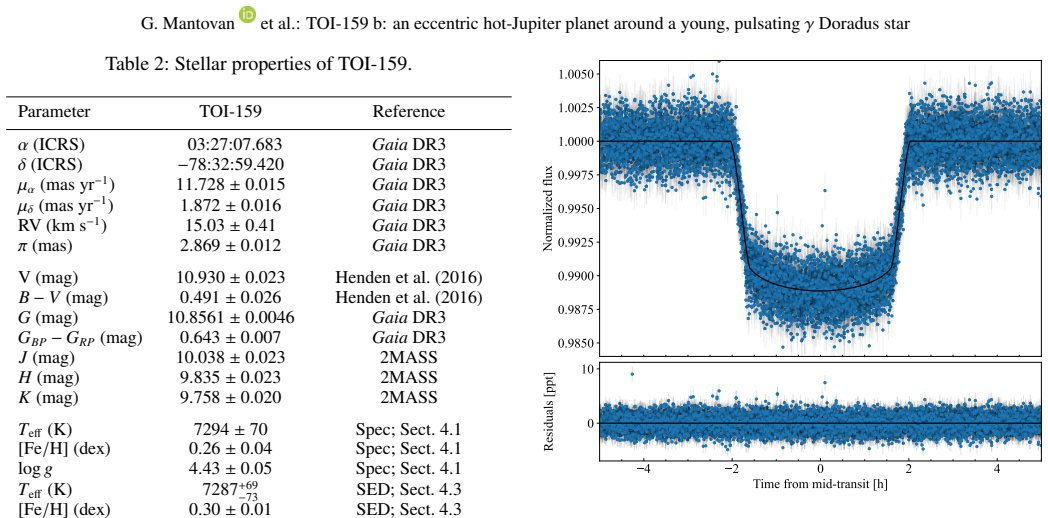
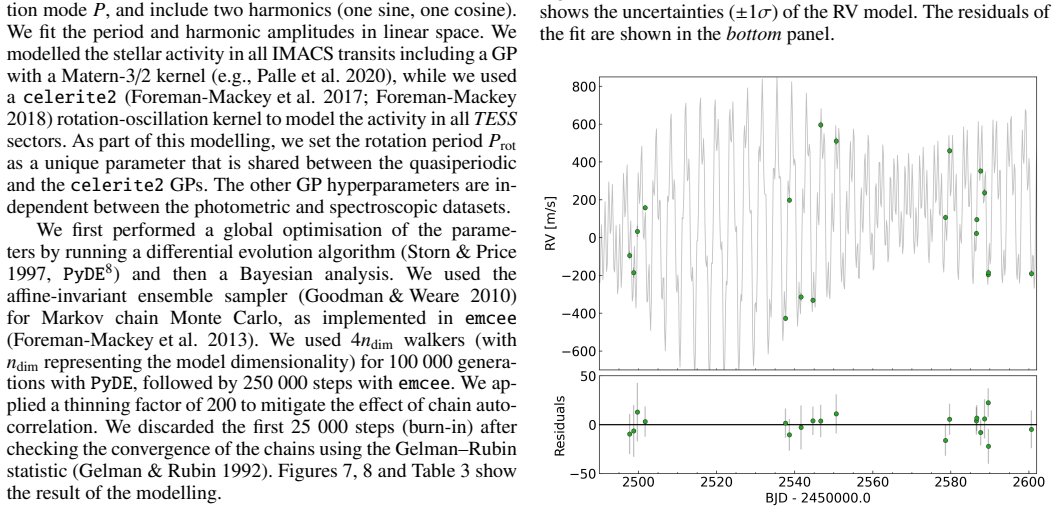
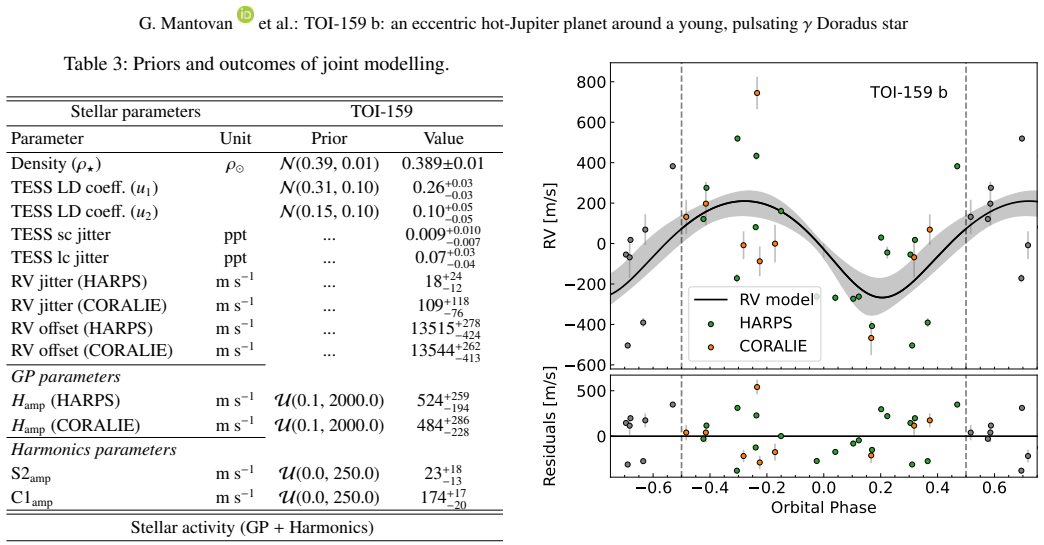
Fast-rotating hot stars are challenging targets for exoplanet searches due to rotational broadening and stellar variability. Moreover, hot stars often exhibit pulsations, an additional source of scatter in both photometric and spectroscopic series. Because of these challenges, such stars remain a relatively unexplored environment for planetary architecture and evolution studies. In this study, we present the confirmation and preliminary atmospheric characterisation of a giant planet orbiting a young ($\approx$ 150 Myr), pulsating $\gamma$ Doradus star. TOI-159 b ($P_{\rm orb} \simeq 3.7$ d, $R_{\rm p} \simeq 1.6~R_{\rm J}$, $M_{\rm p} \simeq 3.5 M_{\rm J}$) is an S-type planet in a close binary system and is the hottest ($T_{\rm eq} \simeq 1900$ K) hot Jupiter with a significant eccentricity ($e = 0.24 \pm 0.04$) ever detected. Our joint modelling of radial velocities (HARPS and CORALIE), transits (\textit{TESS}), and spectro-photometry (IMACS) allows us to detect its Keplerian signal at high significance ($13 \sigma$), place strong constraints on its eccentricity ($6 \sigma$), disentangle the stellar rotational modulation and pulsation periods, and generate a low-resolution transmission spectrum, on which we conduct an exploratory analysis to constrain the presence of a planetary atmosphere using combined star-planet retrievals. Whilst our spectrum appears to display some modulation, the data is too coarse to allow for any conclusive detections at this stage. Higher-resolution observations are needed to confirm or refute these features and, if genuine, determine whether they originate from contamination from the star or a planetary atmosphere.
Editorial analysis
A structured set of objections, weighed in public.
Referee Report
Summary. The manuscript presents the confirmation and preliminary characterization of TOI-159 b, an eccentric hot Jupiter (P_orb ≈ 3.7 d, R_p ≈ 1.6 R_J, M_p ≈ 3.5 M_J, e = 0.24 ± 0.04, T_eq ≈ 1900 K) orbiting a young (~150 Myr) pulsating γ Doradus star in a close binary system. The central results are a 13σ Keplerian detection and 6σ eccentricity constraint from joint modeling of HARPS/CORALIE radial velocities, TESS transits, and IMACS spectro-photometry, with explicit separation of stellar rotational modulation and pulsation signals, plus an exploratory low-resolution transmission spectrum that is inconclusive.
Significance. If the joint modeling robustly isolates the planetary signal, the result is significant for exoplanet demographics around hot, variable stars: it identifies the hottest known eccentric hot Jupiter and demonstrates viable detection methods in the presence of γ Dor pulsations. The high statistical significance, joint multi-dataset fit, and appropriate caveating of the atmospheric analysis are clear strengths.
minor comments (3)
- Abstract: the statement that the planet is an 'S-type planet in a close binary system' would benefit from a brief clause noting whether a binary orbital term was included in the RV model, to allow immediate assessment of potential contamination risks.
- The transmission spectrum section: while correctly labeled exploratory, the text could add a short quantitative note on the spectral resolution and wavelength coverage to better justify why no atmospheric features can be claimed.
- Figure captions for the RV and transit fits: ensure all panels explicitly label the stellar activity components (rotation, pulsations) versus the Keplerian model to improve readability for readers focused on signal separation.
Simulated Author's Rebuttal
We thank the referee for their positive assessment of our manuscript on TOI-159 b and for recommending minor revision. The report correctly identifies the key strengths of our work, including the high-significance Keplerian detection and the demonstration of viable methods for planets around pulsating stars.
Circularity Check
No circularity in orbital parameter derivation
full rationale
The paper derives all reported quantities (mass, radius, eccentricity, 13σ detection, 6σ eccentricity constraint) as direct outputs of standard joint Keplerian orbit fitting applied to independent datasets: HARPS/CORALIE radial velocities, TESS transits, and IMACS spectro-photometry. The modeling explicitly includes terms to disentangle stellar rotational modulation and γ Dor pulsations, but this is a conventional multi-component fit rather than any self-definitional loop, fitted input renamed as prediction, or load-bearing self-citation. No equation reduces the claimed results to the inputs by construction, and the provided text contains no self-citation chains or ansatz smuggling that would force the central claims.
Axiom & Free-Parameter Ledger
free parameters (3)
- orbital eccentricity =
0.24
- planet mass =
3.5 M_J
- planet radius =
1.6 R_J
axioms (2)
- domain assumption The observed periodic signals in photometry and radial velocities originate from a planetary companion after subtraction of stellar pulsation and rotation signals.
- domain assumption Standard stellar isochrone models correctly assign an age of approximately 150 Myr to the gamma Doradus host.
Reference graph
Works this paper leans on
-
[1]
Validation of TESS exoplanet candidates orbiting solar analogues in the all-sky PLATO input catalogue. , keywords =. doi:10.1093/mnras/stac2451 , archivePrefix =. 2208.12276 , primaryClass =
-
[2]
, year = 1995, month = nov, volume =
A Jupiter-mass companion to a solar-type star. , year = 1995, month = nov, volume =. doi:10.1038/378355a0 , adsurl =
-
[3]
Transiting Exoplanet Survey Satellite (TESS). Journal of Astronomical Telescopes, Instruments, and Systems , year = 2015, month = jan, volume =. doi:10.1117/1.JATIS.1.1.014003 , adsurl =
-
[4]
M., et al., 2016, in Chiozzi G., Guzman J
The TESS science processing operations center. Software and Cyberinfrastructure for Astronomy IV , year = 2016, editor =. doi:10.1117/12.2233418 , adsurl =
-
[5]
The TESS Objects of Interest Catalog from the TESS Prime Mission. , keywords =. doi:10.3847/1538-4365/abefe1 , archivePrefix =. 2103.12538 , primaryClass =
-
[6]
X., Vanderburg, A., P´ al, A., et al
Photometry of 10 Million Stars from the First Two Years of TESS Full Frame Images: Part I. , keywords =. doi:10.3847/2515-5172/abca2e , archivePrefix =. 2011.06459 , primaryClass =
-
[7]
Journal of Geophysical Research (Planets) , keywords =
Hot Jupiters: Origins, Structure, Atmospheres. Journal of Geophysical Research (Planets) , keywords =. doi:10.1029/2020JE006629 , archivePrefix =. 2102.05064 , primaryClass =
-
[8]
Giant Planets at Small Orbital Distances. , keywords =. doi:10.1086/309935 , archivePrefix =. astro-ph/9511109 , primaryClass =
-
[9]
Bayesian Analysis of Hot-Jupiter Radius Anomalies: Evidence for Ohmic Dissipation?. , keywords =. doi:10.3847/1538-3881/aaba13 , archivePrefix =. 1709.04539 , primaryClass =
-
[10]
The Mass-Metallicity Relation for Giant Planets. , keywords =. doi:10.3847/0004-637X/831/1/64 , archivePrefix =. 1511.07854 , primaryClass =
-
[11]
Planetary Radii across Five Orders of Magnitude in Mass and Stellar Insolation: Application to Transits. , keywords =. doi:10.1086/512120 , archivePrefix =. astro-ph/0612671 , primaryClass =
-
[12]
Grain opacity and the bulk composition of extrasolar planets. I. Results from scaling the ISM opacity. , keywords =. doi:10.1051/0004-6361/201321479 , archivePrefix =. 1403.5272 , primaryClass =
-
[13]
Frontiers in Astronomy and Space Sciences , keywords =
Warm giant exoplanet characterisation: current state, challenges and outlook. Frontiers in Astronomy and Space Sciences , keywords =. doi:10.3389/fspas.2023.1179000 , archivePrefix =. 2304.12782 , primaryClass =
-
[14]
Analysis of the planetary mass uncertainties on the accuracy of atmospherical retrieval. , keywords =. doi:10.1051/0004-6361/202244881 , archivePrefix =. 2211.02897 , primaryClass =
-
[15]
2021, Research Notes of the American Astronomical Society, 5, 234, doi: 10.3847/2515-5172/ac2ef0
Quick-look Pipeline Lightcurves for 9.1 Million Stars Observed over the First Year of the TESS Extended Mission. , keywords =. doi:10.3847/2515-5172/ac2ef0 , archivePrefix =. 2110.05542 , primaryClass =
-
[16]
Research Notes of the American Astronomical Society , keywords =
TESS Science Processing Operations Center FFI Target List Products. , keywords =. doi:10.3847/2515-5172/abc9b3 , archivePrefix =. 2011.05495 , primaryClass =
-
[17]
Kepler Presearch Data Conditioning II - A Bayesian Approach to Systematic Error Correction. , keywords =. doi:10.1086/667697 , archivePrefix =. 1203.1383 , primaryClass =
-
[18]
Kepler Presearch Data Conditioning I Architecture and Algorithms for Error Correction in Kepler Light Curves. , keywords =. doi:10.1086/667698 , archivePrefix =. 1203.1382 , primaryClass =
-
[19]
, year = 2014, month = jan, volume = 126, pages =
Multiscale Systematic Error Correction via Wavelet-Based Bandsplitting in Kepler Data. , year = 2014, month = jan, volume =. doi:10.1086/674989 , adsurl =
-
[20]
, archivePrefix = "arXiv", eprint =
Kepler Data Validation I Architecture, Diagnostic Tests, and Data Products for Vetting Transiting Planet Candidates. , keywords =. doi:10.1088/1538-3873/aab694 , archivePrefix =. 1803.04526 , primaryClass =
-
[21]
American Astronomical Society Meeting Abstracts \#233 , year = 2019, series =
TESS Follow-up Observing Program Working Group (TFOP WG) Sub Group 1 (SG1): Ground-based Time-series Photometry. American Astronomical Society Meeting Abstracts \#233 , year = 2019, series =
2019
-
[22]
Tapir: A web interface for transit/eclipse observability
-
[23]
Summary of the content and survey properties
Gaia Data Release 3. Summary of the content and survey properties. , keywords =. doi:10.1051/0004-6361/202243940 , archivePrefix =. 2208.00211 , primaryClass =
-
[24]
Las Cumbres Observatory Global Telescope Network. , keywords =. doi:10.1086/673168 , archivePrefix =. 1305.2437 , primaryClass =
-
[26]
European Physical Journal Web of Conferences , year = 2011, series =
TRAPPIST: a robotic telescope dedicated to the study of planetary systems. European Physical Journal Web of Conferences , year = 2011, series =. doi:10.1051/epjconf/20101106002 , archivePrefix =. 1101.5807 , primaryClass =
-
[27]
The Messenger , year = 2011, month = sep, volume =
TRAPPIST: TRAnsiting Planets and PlanetesImals Small Telescope. The Messenger , year = 2011, month = sep, volume =
2011
-
[28]
Revista Mexicana de Astronomia y Astrofisica Conference Series , year = 2021, series =
Observatorio El Sauce: Hosting Robotic Science in Chile. Revista Mexicana de Astronomia y Astrofisica Conference Series , year = 2021, series =. doi:10.22201/ia.14052059p.2021.53.12 , adsurl =
-
[29]
The Messenger , year = 2003, month = dec, volume =
Setting New Standards with HARPS. The Messenger , year = 2003, month = dec, volume =
2003
-
[30]
Chasing exoplanets with the La Silla 3.6-m telescope
HARPS: ESO's coming planet searcher. Chasing exoplanets with the La Silla 3.6-m telescope. The Messenger , keywords =
-
[31]
Journal of Open Source Software3(31), 667 (2018) https: //doi.org/10.21105/joss.00667
ACTIN: A tool to calculate stellar activity indices. The Journal of Open Source Software , keywords =. doi:10.21105/joss.00667 , archivePrefix =. 1811.11172 , primaryClass =
-
[32]
Stellar chromospheric activity of 1674 FGK stars from the AMBRE-HARPS sample. I. A catalogue of homogeneous chromospheric activity. , keywords =. doi:10.1051/0004-6361/202039765 , archivePrefix =. 2012.10199 , primaryClass =
-
[33]
Three years of Sun-as-a-star radial-velocity observations on the approach to solar minimum. , keywords =. doi:10.1093/mnras/stz1215 , archivePrefix =. 1904.12186 , primaryClass =
-
[34]
Intrinsic Colors, Temperatures, and Bolometric Corrections of Pre-main-sequence Stars. , keywords =. doi:10.1088/0067-0049/208/1/9 , archivePrefix =. 1307.2657 , primaryClass =
-
[35]
On the Occurrence Rate of Hot Jupiters in Different Stellar Environments. , keywords =. doi:10.1088/0004-637X/799/2/229 , archivePrefix =. 1412.1731 , primaryClass =
-
[36]
A Framework for Prioritizing the TESS Planetary Candidates Most Amenable to Atmospheric Characterization. , keywords =. doi:10.1088/1538-3873/aadf6f , archivePrefix =. 1805.03671 , primaryClass =
-
[37]
An Efficient Automated Validation Procedure for Exoplanet Transit Candidates. , keywords =. doi:10.1088/0004-637X/761/1/6 , archivePrefix =. 1206.1568 , primaryClass =
-
[38]
A search for transiting planets around FGKM dwarfs and subgiants in the TESS full frame images of the Southern ecliptic hemisphere. , keywords =. doi:10.1093/mnras/staa2438 , archivePrefix =. 2008.09832 , primaryClass =
-
[39]
2020, MNRAS, 495, 4924, doi: 10.1093/mnras/staa1465
A PSF-based Approach to TESS High quality data Of Stellar clusters (PATHOS) - II. Search for exoplanets in open clusters of the Southern ecliptic hemisphere and their frequency. , keywords =. doi:10.1093/mnras/staa1465 , archivePrefix =. 2005.12281 , primaryClass =
-
[40]
The GAPS Programme at TNG. XXXV. Fundamental properties of transiting exoplanet host stars. , keywords =. doi:10.1051/0004-6361/202243467 , archivePrefix =. 2205.15796 , primaryClass =
-
[41]
The GAPS programme with HARPS-N at TNG. X. Differential abundances in the XO-2 planet-hosting binary. , keywords =. doi:10.1051/0004-6361/201526375 , archivePrefix =. 1506.01614 , primaryClass =
-
[42]
The nitrogen abundance of the very metal-poor star HD 122563. , year = 1973, month = sep, volume =. doi:10.1086/152374 , adsurl =
-
[43]
New Grids of ATLAS9 Model Atmospheres
New Grids of ATLAS9 Model Atmospheres. Modelling of Stellar Atmospheres , year = 2003, editor =. doi:10.48550/arXiv.astro-ph/0405087 , archivePrefix =. astro-ph/0405087 , primaryClass =
work page internal anchor Pith review doi:10.48550/arxiv.astro-ph/0405087 2003
-
[44]
The GAPS Programme at TNG. XXV. Stellar atmospheric parameters and chemical composition through GIARPS optical and near-infrared spectra. , keywords =. doi:10.1051/0004-6361/202038511 , archivePrefix =. 2007.00475 , primaryClass =
-
[45]
Departures from LTE for neutral Li in late-type stars. , keywords =. doi:10.1051/0004-6361/200912221 , archivePrefix =. 0906.0899 , primaryClass =
-
[46]
, keywords =
The Tycho-2 catalogue of the 2.5 million brightest stars. , keywords =
-
[47]
The GAPS programme with HARPS-N at TNG. XI. Pr 0211 in M 44: the first multi-planet system in an open cluster. , keywords =. doi:10.1051/0004-6361/201527933 , archivePrefix =. 1602.00009 , primaryClass =
-
[48]
An Ultra-short Period Rocky Super-Earth with a Secondary Eclipse and a Neptune-like Companion around K2-141. , keywords =. doi:10.3847/1538-3881/aaa5b5 , archivePrefix =. 1801.03502 , primaryClass =
-
[49]
2015, Publications of the Astronomical Society of the Pacific, 127, 1161, doi: 10.1086/683602
batman: BAsic Transit Model cAlculatioN in Python. , keywords =. doi:10.1086/683602 , archivePrefix =. 1507.08285 , primaryClass =
-
[50]
Efficient, uninformative sampling of limb darkening coefficients for two-parameter laws. , keywords =. doi:10.1093/mnras/stt1435 , archivePrefix =. 1308.0009 , primaryClass =
-
[51]
EXOFAST: A Fast Exoplanetary Fitting Suite in IDL. , keywords =. doi:10.1086/669497 , archivePrefix =. 1206.5798 , primaryClass =
-
[52]
2013, A&A, 553, A6, doi: 10.1051/0004-6361/201219058
A new extensive library of PHOENIX stellar atmospheres and synthetic spectra. , keywords =. doi:10.1051/0004-6361/201219058 , archivePrefix =. 1303.5632 , primaryClass =
-
[53]
2015, MNRAS, 453, 3821, doi: 10.1093/mnras/stv1857 19
LDTK: Limb Darkening Toolkit. , keywords =. doi:10.1093/mnras/stv1857 , archivePrefix =. 1508.02634 , primaryClass =
-
[54]
Differential Evolution - A Simple and Efficient Heuristic for global Optimization over Continuous Spaces. Journal of Global Optimization , keywords =. doi:10.1023/A:1008202821328 , adsurl =
-
[55]
2010, CAMCS, 5, 65, doi: 10.2140/camcos.2010.5.65
Ensemble samplers with affine invariance. Communications in Applied Mathematics and Computational Science , keywords =. doi:10.2140/camcos.2010.5.65 , adsurl =
-
[56]
emcee: The MCMC Hammer. , keywords =. doi:10.1086/670067 , archivePrefix =. 1202.3665 , primaryClass =
-
[57]
Inference from Iterative Simulation Using Multiple Sequences. Statistical Science , year = 1992, month = jan, volume =. doi:10.1214/ss/1177011136 , adsurl =
-
[58]
On detecting terrestrial planets with timing of giant planet transits. , keywords =. doi:10.1111/j.1365-2966.2005.08922.x , adsurl =
-
[59]
The Use of Transit Timing to Detect Terrestrial-Mass Extrasolar Planets. Science , keywords =. doi:10.1126/science.1107822 , archivePrefix =. astro-ph/0412028 , primaryClass =
-
[60]
doi:10.1051/0004-6361/201424080
TRADES: A new software to derive orbital parameters from observed transit times and radial velocities. Revisiting Kepler-11 and Kepler-9. , keywords =. doi:10.1051/0004-6361/201424080 , archivePrefix =. 1408.2844 , primaryClass =
-
[61]
HARPS-N radial velocities confirm the low densities of the Kepler-9 planets. , keywords =. doi:10.1093/mnras/stz181 , archivePrefix =. 1901.05471 , primaryClass =
-
[62]
Exploiting timing capabilities of the CHEOPS mission with warm-Jupiter planets. , keywords =. doi:10.1093/mnras/stab1782 , archivePrefix =. 2106.11331 , primaryClass =
-
[63]
A Recommendation to Retire VESPA for Exoplanet Validation. , keywords =. doi:10.3847/2515-5172/acd9a6 , adsurl =
-
[64]
M., et al.\ 2011, , 727, 1, 24
Modeling Kepler Transit Light Curves as False Positives: Rejection of Blend Scenarios for Kepler-9, and Validation of Kepler-9 d, A Super-earth-size Planet in a Multiple System. , keywords =. doi:10.1088/0004-637X/727/1/24 , archivePrefix =. 1008.4393 , primaryClass =
-
[65]
General framework, models, and performance
PASTIS: Bayesian extrasolar planet validation - I. General framework, models, and performance. , keywords =. doi:10.1093/mnras/stu601 , archivePrefix =. 1403.6725 , primaryClass =
-
[66]
The generalised Lomb-Scargle periodogram. A new formalism for the floating-mean and Keplerian periodograms. , keywords =. doi:10.1051/0004-6361:200811296 , archivePrefix =. 0901.2573 , primaryClass =
-
[67]
Annals of Statistics , year = 1978, month = jul, volume =
Estimating the Dimension of a Model. Annals of Statistics , year = 1978, month = jul, volume =
1978
-
[68]
Kass and Adrian E
Robert E. Kass and Adrian E. Raftery , title =. Journal of the American Statistical Association , volume =. 1995 , publisher =
1995
-
[69]
, year = 2008, month = feb, volume =
First Speckle Interferometry at SOAR Telescope with Electron-Multiplication CCD. , year = 2008, month = feb, volume =. doi:10.1086/528809 , adsurl =
-
[70]
Ten Years of Speckle Interferometry at SOAR. , keywords =. doi:10.1088/1538-3873/aaa7d9 , archivePrefix =. 1801.04772 , primaryClass =
-
[71]
SOAR TESS Survey. I. Sculpting of TESS Planetary Systems by Stellar Companions. , keywords =. doi:10.3847/1538-3881/ab55e9 , archivePrefix =. 1908.10871 , primaryClass =
-
[72]
SOAR TESS Survey. II. The Impact of Stellar Companions on Planetary Populations. , keywords =. doi:10.3847/1538-3881/ac17f6 , archivePrefix =. 2103.12076 , primaryClass =
-
[73]
Exoplanet Atmosphere Measurements from Transmission Spectroscopy and Other Planet Star Combined Light Observations. Handbook of Exoplanets , year = 2018, editor =. doi:10.1007/978-3-319-55333-7_100 , adsurl =
-
[74]
Simulated JWST/NIRISS Transit Spectroscopy of Anticipated Tess Planets Compared to Select Discoveries from Space-based and Ground-based Surveys. , keywords =. doi:10.1088/1538-3873/aaa87b , archivePrefix =. 1711.02098 , primaryClass =
-
[75]
Synthetic evolution tracks of giant planets. , keywords =. doi:10.1093/mnras/stab2250 , archivePrefix =. 2108.00949 , primaryClass =
-
[76]
The Hot Jupiter Radius Anomaly and Stellar Connections. arXiv e-prints , keywords =. doi:10.48550/arXiv.2405.05307 , archivePrefix =. 2405.05307 , primaryClass =
-
[77]
The Heavy-element Masses of Extrasolar Giant Planets, Revealed. , keywords =. doi:10.1088/2041-8205/736/2/L29 , archivePrefix =. 1105.0024 , primaryClass =
-
[78]
Extrasolar planet population synthesis . IV. Correlations with disk metallicity, mass, and lifetime. , keywords =. doi:10.1051/0004-6361/201117350 , archivePrefix =. 1201.1036 , primaryClass =
-
[79]
Exoplanets , year = 2010, editor =
Exoplanet Transits and Occultations. Exoplanets , year = 2010, editor =. doi:10.48550/arXiv.1001.2010 , adsurl =
-
[80]
SOLES. VII. The Spin-Orbit Alignment of WASP-106 b, a Warm Jupiter along the Kraft Break. , keywords =. doi:10.3847/1538-3881/ad0131 , archivePrefix =. 2308.07532 , primaryClass =
-
[81]
Orbital obliquity of the young planet TOI-5398 b and the evolutionary history of the system. , keywords =. doi:10.1051/0004-6361/202449769 , archivePrefix =. 2404.02969 , primaryClass =
discussion (0)
Sign in with ORCID, Apple, or X to comment. Anyone can read and Pith papers without signing in.