Recognition: 3 theorem links
· Lean TheoremTesting Dark Energy with Black Hole Ringdown
Pith reviewed 2026-05-15 00:26 UTC · model grok-4.3
The pith
Dynamical dark energy imprints order-one shifts on black hole ringdown quasi-normal modes.
A machine-rendered reading of the paper's core claim, the machinery that carries it, and where it could break.
Core claim
Dynamical dark energy theories imprint O(1) modifications on the quasi-normal mode spectrum that characterises black hole ringdown. Taking the cubic Galileon as the only known stable solution of this kind, the cosmological and black-hole regimes are parametrically connected, the induced QNM shifts are derived, and the resulting dark energy constraints are forecast at the level of 10^{-2} for LVK and 10^{-4} for LISA.
What carries the argument
Cosmological hair from the time-dependent dark energy scalar field in the cubic Galileon, which modifies the effective potential for metric perturbations and thereby shifts the quasi-normal mode spectrum.
If this is right
- The quasi-normal mode spectrum becomes a direct observational probe of the time evolution of dark energy.
- LVK detections can constrain the dark energy field profile to roughly one-percent accuracy.
- LISA observations can tighten the same constraint by two orders of magnitude.
- Black-hole ringdowns supply an independent test of scalar-tensor gravity that complements cosmological surveys.
Where Pith is reading between the lines
- Similar ringdown shifts are likely to appear in other scalar-tensor models that give dark energy a time-dependent vacuum expectation value.
- Absence of the predicted shifts in future high-precision data would disfavour the entire class of Galileon-like theories with stable cosmological hair.
- Combining ringdown constraints with late-time cosmological observables could break degeneracies between the dark energy profile and modified gravity parameters.
- The method may eventually yield an independent measurement of the present-day Hubble rate from individual merger events.
Load-bearing premise
The cubic Galileon supplies the only stable solution that can be connected parametrically from cosmology to the black-hole regime without extra assumptions that would invalidate the quasi-normal mode calculation.
What would settle it
A high-signal-to-noise ringdown measurement from a binary black hole merger whose fundamental quasi-normal mode frequency and decay time agree with general-relativity predictions to better than the forecasted precision, even though the universe contains dynamical dark energy.
Figures


read the original abstract
We show that dynamical dark energy theories can imprint $O(1)$ modifications on the quasi-normal mode (QNM) spectrum characterising black hole ringdown. The time dependence of dynamical dark energy naturally gives rise to cosmological 'hair' around a black hole. Taking the cubic Galileon as a concrete example, which admits the only known stable solution of this kind, we parametrically connect the cosmological and black hole regimes, derive the induced QNM shifts and forecast the resulting dark energy constraints. We find that the dark energy field profile can be constrained with an accuracy of up to $10^{-2}$ for LVK and $10^{-4}$ for LISA.
Editorial analysis
A structured set of objections, weighed in public.
Referee Report
Summary. The paper claims that dynamical dark energy theories imprint O(1) modifications on black hole quasi-normal mode (QNM) spectra via cosmological hair. Using the cubic Galileon as the sole known stable example, the authors parametrically connect the cosmological solution to a black-hole background, derive the induced QNM shifts from the Galileon action, and forecast constraints on the dark energy field profile at the level of 10^{-2} (LVK) and 10^{-4} (LISA).
Significance. If the central derivation holds, the result would establish a new, falsifiable link between time-dependent dark energy and strong-field gravitational-wave observables. It supplies concrete, detector-specific forecasts that could be tested with existing LVK data and upcoming LISA observations, thereby extending dark-energy tests into the ringdown regime.
major comments (2)
- [Section describing the parametric connection and the linearised wave equation] The parametric connection between the cosmological Galileon solution and the black-hole background (the step that fixes the scalar hair profile entering the QNM calculation) is load-bearing for the O(1) shift claim. The manuscript must show explicitly that time-dependent corrections and near-horizon adjustments remain sub-dominant at the order needed to produce the reported shifts; otherwise the forecasted 10^{-2} and 10^{-4} constraints do not follow.
- [Introduction and the Galileon solution subsection] The assertion that the cubic Galileon is the only known stable solution of this kind requires a concise but explicit justification (including the stability criterion used) so that readers can assess whether the QNM derivation is tied to a unique or representative case.
minor comments (2)
- [Forecasting section] Clarify the precise definition of the 'field profile' parameter that is being constrained (e.g., its relation to the Galileon coupling coefficients) in the forecasting section.
- [QNM derivation subsection] Add a brief statement on the range of validity of the linearised perturbation analysis around the matched background.
Simulated Author's Rebuttal
We thank the referee for their careful reading of our manuscript and for the constructive comments. We address each major point below and have revised the manuscript to incorporate the requested clarifications and explicit derivations.
read point-by-point responses
-
Referee: The parametric connection between the cosmological Galileon solution and the black-hole background (the step that fixes the scalar hair profile entering the QNM calculation) is load-bearing for the O(1) shift claim. The manuscript must show explicitly that time-dependent corrections and near-horizon adjustments remain sub-dominant at the order needed to produce the reported shifts; otherwise the forecasted 10^{-2} and 10^{-4} constraints do not follow.
Authors: We agree that an explicit demonstration of the sub-dominance is necessary to support the O(1) shifts. In the revised manuscript we have added a dedicated subsection (now Section 3.2) that linearizes the wave equation around the matched background and shows that time-dependent corrections enter suppressed by the dark-energy slow-roll parameter (of order 10^{-2} or smaller), while near-horizon adjustments contribute only at O(ε) where ε parametrizes deviations from the cosmological solution. These terms do not alter the leading-order QNM shifts at the precision required for the LVK and LISA forecasts, which therefore remain valid. revision: yes
-
Referee: The assertion that the cubic Galileon is the only known stable solution of this kind requires a concise but explicit justification (including the stability criterion used) so that readers can assess whether the QNM derivation is tied to a unique or representative case.
Authors: We accept the need for an explicit justification. The revised introduction and Galileon subsection now include a short paragraph stating the stability criterion: the background must be free of ghost and gradient instabilities, verified by requiring positive kinetic terms and sound speed squared in the quadratic action for scalar perturbations. We note that the cubic Galileon is the only known example satisfying this criterion without additional fine-tuning or higher-order operators, making it a representative case for the class of theories that can support stable cosmological hair around black holes. revision: yes
Circularity Check
No circularity in derivation of QNM shifts from Galileon action
full rationale
The paper presents the QNM modifications as derived from the cubic Galileon action via parametric connection of cosmological and black-hole regimes, followed by direct computation of shifts and subsequent forecasting of observational constraints. No step reduces a claimed prediction to a fitted input by construction, nor does any load-bearing premise collapse to a self-citation whose content is unverified within the paper. The statement identifying the Galileon as the only known stable solution is descriptive background rather than a uniqueness theorem imported to force the result. The forecasting step uses the independently derived shifts to project sensitivities and does not retroactively define those shifts. The derivation chain therefore remains self-contained against external benchmarks.
Axiom & Free-Parameter Ledger
free parameters (1)
- Galileon coupling coefficients
axioms (2)
- domain assumption Cubic Galileon admits a unique stable black-hole solution with cosmological hair
- ad hoc to paper Parametric connection between cosmological and black-hole regimes preserves the leading QNM shifts
invented entities (1)
-
cosmological hair
no independent evidence
Lean theorems connected to this paper
-
IndisputableMonolith/Cost/FunctionalEquation.leanwashburn_uniqueness_aczel unclear?
unclearRelation between the paper passage and the cited Recognition theorem.
Taking the cubic Galileon as a concrete example... parametrically connect the cosmological and black hole regimes, derive the induced QNM shifts
-
IndisputableMonolith/Foundation/AlexanderDuality.leanalexander_duality_circle_linking unclear?
unclearRelation between the paper passage and the cited Recognition theorem.
stable black hole solutions with cosmological hair... only known stable solution
What do these tags mean?
- matches
- The paper's claim is directly supported by a theorem in the formal canon.
- supports
- The theorem supports part of the paper's argument, but the paper may add assumptions or extra steps.
- extends
- The paper goes beyond the formal theorem; the theorem is a base layer rather than the whole result.
- uses
- The paper appears to rely on the theorem as machinery.
- contradicts
- The paper's claim conflicts with a theorem or certificate in the canon.
- unclear
- Pith found a possible connection, but the passage is too broad, indirect, or ambiguous to say the theorem truly supports the claim.
Forward citations
Cited by 3 Pith papers
-
A Master Equation for Screening in Luminal Horndeski Gravity
A master screening equation is derived for luminal Horndeski gravity that recovers Vainshtein and Chameleon mechanisms and introduces Phaedrus screening with screening radius scaling linearly with source mass.
-
Stable black hole solutions with cosmological hair
Stable black hole solutions with cosmological scalar hair are explicitly derived in the cubic Galileon theory, recovering cosmological behavior at large distances and regular short-range dynamics.
-
A cosmology-to-ringdown EFT consistency map for scalar-tensor gravity
An EFT consistency map transports cosmology-conditioned posteriors from scalar-tensor FLRW backgrounds to black-hole quasinormal-mode kernels, showing tensor-speed effects fall below ringdown detectability while other...
Reference graph
Works this paper leans on
-
[1]
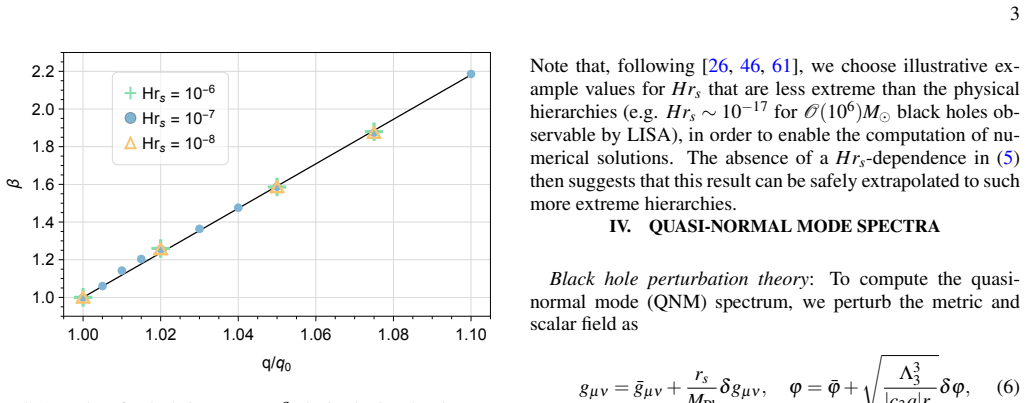
a screening mechanism on smaller scales [27, 55, 56], 3) their shift symmetry resulting in analytically tractable cos- mological attractor solutions [54]. The action for the cubic Galileon, the simplest such example, is given by S= Z d4x√−g M2 Pl 2 R+ 1 2 (∂ ϕ)2 − c3 Λ3 3 □ϕ(∂ ϕ)2 ,(1) where in addition to the scalarϕ, we have included the standard kineti...
work page internal anchor Pith review Pith/arXiv arXiv 2026
-
[2]
Note that, when computing inspiral/merger constraints for the solutions considered here, we (optimistically) assume that mass uncertainties will eventually be obtainable with similar precision as the GR values quoted here. It is worth highlight- ing, that dark-energy motivated models with an interaction scaleΛ 3 3 =M PlH2 0 (as discussed here) have a naiv...
-
[3]
The precision of Mc andηmeasurements depends on survey characteristics, as discussed in detail below
the measurement precision forM c andη, and 2) the ac- curacy with whichf NR can be computed. The precision of Mc andηmeasurements depends on survey characteristics, as discussed in detail below. Thef NR mapping, on the other hand, can e.g. be obtained from theSURFINBH/NRSURfam- ily of surrogate remnant models [112–116] resulting in an es- timate ofM(for a...
-
[4]
Note that reaching both accuracies with a single event can be challenging (and would require e.g
(CE) – ‘golden events’ can reach a ringdown SNR of ρ∼O(10 2), while the measurement precision forM c and ηcan reach levels ofO(10 −5)– see [87]. Note that reaching both accuracies with a single event can be challenging (and would require e.g. a golden GW250114-like observation with ET/CE), since events that are optimal in terms of constraints onM c andηar...
-
[5]
Event horizons in static vacuum space-times,
W. Israel, “Event horizons in static vacuum space-times,” Phys. Rev.164(1967) 1776–1779
work page 1967
-
[6]
Axisymmetric Black Hole Has Only Two Degrees of Freedom,
B. Carter, “Axisymmetric Black Hole Has Only Two Degrees of Freedom,”Phys. Rev. Lett.26(1971) 331–333
work page 1971
-
[7]
Nonexistence of baryon number for static black holes,
J. D. Bekenstein, “Nonexistence of baryon number for static black holes,”Phys. Rev. D5(1972) 1239–1246
work page 1972
-
[8]
R. Ruffini and J. A. Wheeler, “Introducing the black hole,” Phys. Today24(1971) no. 1, 30
work page 1971
-
[9]
Nonexistence of baryon number for black holes. ii,
J. D. Bekenstein, “Nonexistence of baryon number for black holes. ii,”Phys. Rev. D5(1972) 2403–2412
work page 1972
-
[10]
DESI 2024 VI: Cosmological Constraints from the Measurements of Baryon Acoustic Oscillations
D. C. Robinson, “Uniqueness of the Kerr black hole,”Phys. Rev. Lett.34(1975) 905–906. [7]DESICollaboration, A. G. Adameet al., “DESI 2024 VI: cosmological constraints from the measurements of baryon acoustic oscillations,”JCAP02(2025) 021, arXiv:2404.03002 [astro-ph.CO]. [8]DESCollaboration, B. Popovicet al., “The Dark Energy Survey Supernova Program: A R...
work page internal anchor Pith review Pith/arXiv arXiv 1975
-
[11]
E. J. Copeland, M. Sami, and S. Tsujikawa, “Dynamics of dark energy,”Int. J. Mod. Phys. D15(2006) 1753–1936, arXiv:hep-th/0603057
work page internal anchor Pith review Pith/arXiv arXiv 2006
-
[12]
Modified Gravity and Cosmology
T. Clifton, P. G. Ferreira, A. Padilla, and C. Skordis, “Modified Gravity and Cosmology,”Phys. Rept.513(2012) 1–189,arXiv:1106.2476 [astro-ph.CO]
work page internal anchor Pith review Pith/arXiv arXiv 2012
-
[13]
Black holes in the presence of dark energy
E. O. Babichev, V . I. Dokuchaev, and Y . N. Eroshenko, “Black holes in the presence of dark energy,”Phys. Usp.56 (2013) 1155–1175,arXiv:1406.0841 [gr-qc]
work page internal anchor Pith review Pith/arXiv arXiv 2013
-
[14]
Beyond the Cosmological Standard Model
A. Joyce, B. Jain, J. Khoury, and M. Trodden, “Beyond the Cosmological Standard Model,”Phys. Rept.568(2015) 1–98, arXiv:1407.0059 [astro-ph.CO]
work page internal anchor Pith review Pith/arXiv arXiv 2015
-
[15]
Cosmological Tests of Modified Gravity
K. Koyama, “Cosmological Tests of Modified Gravity,”Rept. Prog. Phys.79(2016) no. 4, 046902,arXiv:1504.04623 [astro-ph.CO]
work page internal anchor Pith review Pith/arXiv arXiv 2016
-
[16]
Horndeski theory and beyond: a review
T. Kobayashi, “Horndeski theory and beyond: a review,” Rept. Prog. Phys.82(2019) no. 8, 086901, arXiv:1901.07183 [gr-qc]
work page internal anchor Pith review Pith/arXiv arXiv 2019
-
[17]
Primordial black hole evolution in tensor-scalar cosmology
T. Jacobson, “Primordial black hole evolution in tensor scalar 14 Note that for SMBHB both the inspiral and ringdown phases can simulta- neously reach 103 SNRs in the LISA band [89]. cosmology,”Phys. Rev. Lett.83(1999) 2699–2702, arXiv:astro-ph/9905303
work page internal anchor Pith review Pith/arXiv arXiv 1999
-
[18]
Dressing a black hole with a time-dependent Galileon
E. Babichev and C. Charmousis, “Dressing a black hole with a time-dependent Galileon,”JHEP08(2014) 106, arXiv:1312.3204 [gr-qc]
work page internal anchor Pith review Pith/arXiv arXiv 2014
-
[19]
Exact black hole solutions in shift symmetric scalar-tensor theories
T. Kobayashi and N. Tanahashi, “Exact black hole solutions in shift symmetric scalar–tensor theories,”PTEP2014(2014) 073E02,arXiv:1403.4364 [gr-qc]
work page internal anchor Pith review Pith/arXiv arXiv 2014
-
[20]
Cosmological self-tuning and local solutions in generalized Horndeski theories
E. Babichev and G. Esposito-Farese, “Cosmological self-tuning and local solutions in generalized Horndeski theories,”Phys. Rev. D95(2017) no. 2, 024020, arXiv:1609.09798 [gr-qc]
work page internal anchor Pith review Pith/arXiv arXiv 2017
-
[21]
Hairy Schwarzschild-(A)dS black hole solutions in DHOST theories beyond shift symmetry
J. Ben Achour and H. Liu, “Hairy Schwarzschild-(A)dS black hole solutions in degenerate higher order scalar-tensor theories beyond shift symmetry,”Phys. Rev. D99(2019) no. 6, 064042,arXiv:1811.05369 [gr-qc]
work page internal anchor Pith review Pith/arXiv arXiv 2019
-
[22]
H. Motohashi and M. Minamitsuji, “Exact black hole solutions in shift-symmetric quadratic degenerate higher-order scalar-tensor theories,”Phys. Rev. D99(2019) no. 6, 064040,arXiv:1901.04658 [gr-qc]
work page internal anchor Pith review Pith/arXiv arXiv 2019
-
[23]
Rotating Black Holes in Higher Order Gravity,
C. Charmousis, M. Crisostomi, R. Gregory, and N. Stergioulas, “Rotating Black Holes in Higher Order Gravity,”Phys. Rev. D100(2019) no. 8, 084020, arXiv:1903.05519 [hep-th]
-
[24]
Perturbations of stealth black holes in degenerate higher-order scalar-tensor theories,
C. de Rham and J. Zhang, “Perturbations of stealth black holes in degenerate higher-order scalar-tensor theories,”Phys. Rev. D100(2019) no. 12, 124023,arXiv:1907.00699 [hep-th]
-
[25]
K. Takahashi and H. Motohashi, “General Relativity solutions with stealth scalar hair in quadratic higher-order scalar-tensor theories,”JCAP06(2020) 034, arXiv:2004.03883 [gr-qc]
-
[26]
Existence and instability of hairy black holes in shift-symmetric Horndeski theories,
J. Khoury, M. Trodden, and S. S. C. Wong, “Existence and instability of hairy black holes in shift-symmetric Horndeski theories,”JCAP11(2020) 044,arXiv:2007.01320 [astro-ph.CO]
-
[27]
K. Takahashi and H. Motohashi, “Black hole perturbations in DHOST theories: master variables, gradient instability, and strong coupling,”JCAP08(2021) 013, arXiv:2106.07128 [gr-qc]
-
[28]
Stable black hole solutions with cosmological hair
L. Smulders and J. Noller, “Stable black hole solutions with cosmological hair,”arXiv:2603.22398 [gr-qc]
work page internal anchor Pith review Pith/arXiv arXiv
-
[29]
The galileon as a local modification of gravity
A. Nicolis, R. Rattazzi, and E. Trincherini, “The Galileon as a local modification of gravity,”Phys. Rev.D79(2009) 064036, arXiv:0811.2197 [hep-th]. 11
work page internal anchor Pith review Pith/arXiv arXiv 2009
-
[30]
A. De Felice, S. Mukohyama, and K. Takahashi, “Avoidance of Strong Coupling in General Relativity Solutions with a Timelike Scalar Profile in a Class of Ghost-Free Scalar-Tensor Theories,”Phys. Rev. Lett.129(2022) no. 3, 031103,arXiv:2204.02032 [gr-qc]
-
[31]
Weakly-coupled stealth solution in scordatura degenerate theory,
H. Motohashi and S. Mukohyama, “Weakly-coupled stealth solution in scordatura degenerate theory,”JCAP01(2020) 030,arXiv:1912.00378 [gr-qc]
-
[32]
Approximately stealth black hole in higher-order scalar-tensor theories,
A. De Felice, S. Mukohyama, and K. Takahashi, “Approximately stealth black hole in higher-order scalar-tensor theories,”JCAP03(2023) 050, arXiv:2212.13031 [gr-qc]
-
[33]
Effective Field Theory of Black Hole Quasinormal Modes in Scalar-Tensor Theories
G. Franciolini, L. Hui, R. Penco, L. Santoni, and E. Trincherini, “Effective Field Theory of Black Hole Quasinormal Modes in Scalar-Tensor Theories,”JHEP02 (2019) 127,arXiv:1810.07706 [hep-th]
work page internal anchor Pith review Pith/arXiv arXiv 2019
-
[34]
Black Hole Ringdown as a Probe for Dark Energy,
J. Noller, L. Santoni, E. Trincherini, and L. G. Trombetta, “Black Hole Ringdown as a Probe for Dark Energy,”Phys. Rev. D101(2020) 084049,arXiv:1911.11671 [gr-qc]
-
[35]
Effective Field Theory for the perturbations of a slowly rotating black hole,
L. Hui, A. Podo, L. Santoni, and E. Trincherini, “Effective Field Theory for the perturbations of a slowly rotating black hole,”JHEP12(2021) 183,arXiv:2111.02072 [hep-th]
-
[36]
Effective field theory of black hole perturbations with timelike scalar profile: formulation,
S. Mukohyama and V . Yingcharoenrat, “Effective field theory of black hole perturbations with timelike scalar profile: formulation,”JCAP09(2022) 010,arXiv:2204.00228 [hep-th]
-
[37]
J. Khoury, T. Noumi, M. Trodden, and S. S. C. Wong, “Stability of hairy black holes in shift-symmetric scalar-tensor theories via the effective field theory approach,” JCAP04(2023) 035,arXiv:2208.02823 [hep-th]
-
[38]
S. Mukohyama, K. Takahashi, and V . Yingcharoenrat, “Generalized Regge-Wheeler equation from Effective Field Theory of black hole perturbations with a timelike scalar profile,”JCAP10(2022) 050,arXiv:2208.02943 [gr-qc]
-
[39]
Quasinormal modes from EFT of black hole perturbations with timelike scalar profile,
S. Mukohyama, K. Takahashi, K. Tomikawa, and V . Yingcharoenrat, “Quasinormal modes from EFT of black hole perturbations with timelike scalar profile,”JCAP07 (2023) 050,arXiv:2304.14304 [gr-qc]
-
[40]
Bridging dark energy and black holes with EFT: frame transformation and gravitational wave speed,
S. Mukohyama, E. Seraille, K. Takahashi, and V . Yingcharoenrat, “Bridging dark energy and black holes with EFT: frame transformation and gravitational wave speed,”JCAP01(2025) 085,arXiv:2407.15123 [gr-qc]
-
[41]
Tidal Love Numbers from EFT of Black Hole Perturbations with Timelike Scalar Profile,
C. G. A. Barura, H. Kobayashi, S. Mukohyama, N. Oshita, K. Takahashi, and V . Yingcharoenrat, “Tidal Love Numbers from EFT of Black Hole Perturbations with Timelike Scalar Profile,”arXiv:2405.10813 [gr-qc]
-
[42]
S. Mukohyama, E. Seraille, K. Takahashi, and V . Yingcharoenrat, “Effective field theory of perturbations on arbitrary black hole backgrounds with spacelike scalar profile,”JHEP10(2025) 128,arXiv:2507.02066 [gr-qc]
-
[43]
Spherical black hole perturbations in EFT of scalar-tensor gravity with timelike scalar profile,
S. Mukohyama, K. Takahashi, K. Tomikawa, and V . Yingcharoenrat, “Spherical black hole perturbations in EFT of scalar-tensor gravity with timelike scalar profile,” JCAP05(2025) 084,arXiv:2503.00520 [gr-qc]
-
[44]
Black Holes in the Ghost Condensate
S. Mukohyama, “Black holes in the ghost condensate,”Phys. Rev. D71(2005) 104019,arXiv:hep-th/0502189
work page internal anchor Pith review Pith/arXiv arXiv 2005
-
[45]
K. Takahashi and T. Suyama, “Linear perturbation analysis of hairy black holes in shift-symmetric Horndeski theories: Odd-parity perturbations,”Phys. Rev. D95(2017) no. 2, 024034,arXiv:1610.00432 [gr-qc]
work page internal anchor Pith review Pith/arXiv arXiv 2017
-
[46]
K. Takahashi, H. Motohashi, and M. Minamitsuji, “Linear stability analysis of hairy black holes in quadratic degenerate higher-order scalar-tensor theories: Odd-parity perturbations,”Phys. Rev. D100(2019) no. 2, 024041, arXiv:1904.03554 [gr-qc]
work page internal anchor Pith review Pith/arXiv arXiv 2019
-
[47]
Time-dependent spherically symmetric covariant Galileons
E. Babichev and G. Esposito-Farèse, “Time-Dependent Spherically Symmetric Covariant Galileons,”Phys. Rev. D87 (2013) 044032,arXiv:1212.1394 [gr-qc]
work page internal anchor Pith review Pith/arXiv arXiv 2013
-
[48]
Black holes in a cubic Galileon universe
E. Babichev, C. Charmousis, A. Lehébel, and T. Moskalets, “Black holes in a cubic Galileon universe,”JCAP09(2016) 011,arXiv:1605.07438 [gr-qc]
work page internal anchor Pith review Pith/arXiv arXiv 2016
-
[49]
Large black-hole scalar charges in- duced by cosmology in Horndeski theories,
E. Babichev, G. Esposito-Farèse, I. Sawicki, and L. G. Trombetta, “Large black-hole scalar charges induced by cosmology in Horndeski theories,”Phys. Rev. D112(2025) no. 2, 024043,arXiv:2504.07882 [gr-qc]
-
[50]
Black holes with primary scalar hair,
A. Bakopoulos, C. Charmousis, P. Kanti, N. Lecoeur, and T. Nakas, “Black holes with primary scalar hair,” arXiv:2310.11919 [gr-qc]
-
[51]
Stability and quasinormal modes for black holes with time-dependent scalar hair,
S. Sirera and J. Noller, “Stability and quasinormal modes for black holes with time-dependent scalar hair,”Phys. Rev. D 111(2025) no. 4, 044067,arXiv:2408.01720 [gr-qc]
-
[52]
H. Kobayashi, S. Mukohyama, J. Noller, S. Sirera, K. Takahashi, and V . Yingcharoenrat, “Inverting no-hair theorems: How requiring general relativity solutions restricts scalar-tensor theories,”Phys. Rev. D111(2025) no. 12, 124022,arXiv:2503.05651 [gr-qc]
work page internal anchor Pith review Pith/arXiv arXiv 2025
-
[53]
Axial perturbations of black holes with primary scalar hair,
C. Charmousis, S. Iteanu, D. Langlois, and K. Noui, “Axial perturbations of black holes with primary scalar hair,”JCAP 05(2025) 102,arXiv:2503.22348 [gr-qc]
-
[54]
Primary black-hole scalar charges and kinetic screening in K-essence-Gauss-Bonnet gravity,
G. Lara, G. Trenkler, and L. G. Trombetta, “Primary black-hole scalar charges and kinetic screening in K-essence-Gauss-Bonnet gravity,”arXiv:2512.23683 [gr-qc]
-
[55]
Self-Accelerating Universe in Galileon Cosmology
F. P. Silva and K. Koyama, “Self-Accelerating Universe in Galileon Cosmology,”Phys. Rev. D80(2009) 121301, arXiv:0909.4538 [astro-ph.CO]
work page internal anchor Pith review Pith/arXiv arXiv 2009
-
[56]
Cosmology of a covariant Galileon field
A. De Felice and S. Tsujikawa, “Cosmology of a covariant Galileon field,”Phys. Rev. Lett.105(2010) 111301, arXiv:1007.2700 [astro-ph.CO]
work page internal anchor Pith review Pith/arXiv arXiv 2010
-
[57]
Revisiting fifth forces in the Galileon model
C. Burrage and D. Seery, “Revisiting fifth forces in the Galileon model,”JCAP08(2010) 011, arXiv:1005.1927 [astro-ph.CO]
work page internal anchor Pith review Pith/arXiv arXiv 2010
-
[58]
An introduction to the Vainshtein mechanism
E. Babichev and C. Deffayet, “An introduction to the Vainshtein mechanism,”Class. Quant. Grav.30(2013) 184001,arXiv:1304.7240 [gr-qc]
work page internal anchor Pith review Pith/arXiv arXiv 2013
-
[59]
A. De Felice and S. Tsujikawa, “Conditions for the cosmological viability of the most general scalar-tensor theories and their applications to extended Galileon dark energy models,”JCAP1202(2012) 007, arXiv:1110.3878 [gr-qc]
work page internal anchor Pith review Pith/arXiv arXiv 2012
-
[60]
The parameter space in Galileon gravity models
A. Barreira, B. Li, A. Sanchez, C. M. Baugh, and S. Pascoli, “Parameter space in Galileon gravity models,”Phys. Rev. D 87(2013) 103511,arXiv:1302.6241 [astro-ph.CO]
work page internal anchor Pith review Pith/arXiv arXiv 2013
-
[61]
Positivity bounds from multiple vacua and their cosmological consequences,
S. Melville and J. Noller, “Positivity bounds from multiple vacua and their cosmological consequences,”JCAP06(2022) no. 06, 031,arXiv:2202.01222 [hep-th]
-
[62]
T. Kobayashi, H. Tashiro, and D. Suzuki, “Evolution of linear cosmological perturbations and its observational implications in Galileon-type modified gravity,”Phys. Rev. D81(2010) 063513,arXiv:0912.4641 [astro-ph.CO]
work page internal anchor Pith review Pith/arXiv arXiv 2010
-
[63]
Black holes in self-tuning cubic Horndeski cosmology,
W. T. Emond, A. Lehébel, and P. M. Saffin, “Black holes in 12 self-tuning cubic Horndeski cosmology,”Phys. Rev. D101 (2020) no. 8, 084008,arXiv:1912.09199 [gr-qc]
-
[64]
Stability of a Schwarzschild singularity,
T. Regge and J. A. Wheeler, “Stability of a Schwarzschild singularity,”Phys. Rev.108(1957) 1063–1069
work page 1957
-
[65]
M. Maggiore,Gravitational Waves. Vol. 2: Astrophysics and Cosmology. Oxford University Press, 3, 2018
work page 2018
-
[66]
BLACK HOLE NORMAL MODES: A SEMIANALYTIC APPROACH,
B. F. Schutz and C. M. Will, “BLACK HOLE NORMAL MODES: A SEMIANALYTIC APPROACH,”Astrophys. J. Lett.291(1985) L33–L36
work page 1985
-
[67]
R. A. Konoplya, A. Zhidenko, and A. F. Zinhailo, “Higher order WKB formula for quasinormal modes and grey-body factors: recipes for quick and accurate calculations,”Class. Quant. Grav.36(2019) 155002,arXiv:1904.10333 [gr-qc]
work page internal anchor Pith review Pith/arXiv arXiv 2019
-
[68]
General theories of linear gravitational perturbations to a Schwarzschild Black Hole
O. J. Tattersall, P. G. Ferreira, and M. Lagos, “General theories of linear gravitational perturbations to a Schwarzschild Black Hole,”Phys. Rev. D97(2018) no. 4, 044021,arXiv:1711.01992 [gr-qc]
work page internal anchor Pith review Pith/arXiv arXiv 2018
-
[69]
The quasi-normal modes of the Schwarzschild black hole,
S. Chandrasekhar and S. L. Detweiler, “The quasi-normal modes of the Schwarzschild black hole,”Proc. Roy. Soc. Lond. A344(1975) 441–452
work page 1975
-
[70]
Vainshtein Mechanism in Binary Pulsars
C. de Rham, A. J. Tolley, and D. H. Wesley, “Vainshtein Mechanism in Binary Pulsars,”Phys. Rev. D87(2013) no. 4, 044025,arXiv:1208.0580 [gr-qc]
work page internal anchor Pith review Pith/arXiv arXiv 2013
-
[71]
Scalar Gravitational Radiation from Binaries: Vainshtein Mechanism in Time-dependent Systems
F. Dar, C. De Rham, J. T. Deskins, J. T. Giblin, and A. J. Tolley, “Scalar Gravitational Radiation from Binaries: Vainshtein Mechanism in Time-dependent Systems,”Class. Quant. Grav.36(2019) no. 2, 025008, arXiv:1808.02165 [hep-th]
work page internal anchor Pith review Pith/arXiv arXiv 2019
-
[72]
Unveiling the Galileon in a three-body system : scalar and gravitational wave production,
P. Brax, L. Heisenberg, and A. Kuntz, “Unveiling the Galileon in a three-body system : scalar and gravitational wave production,”JCAP05(2020) 012, arXiv:2002.12590 [gr-qc]
-
[73]
Black hole binaries in cubic Horndeski theories,
P. Figueras and T. França, “Black hole binaries in cubic Horndeski theories,”Phys. Rev. D105(2022) no. 12, 124004, arXiv:2112.15529 [gr-qc]
-
[74]
On gravitational-wave spectroscopy of massive black holes with the space interferometer LISA
E. Berti, V . Cardoso, and C. M. Will, “On gravitational-wave spectroscopy of massive black holes with the space interferometer LISA,”Phys. Rev. D73(2006) 064030, arXiv:gr-qc/0512160
work page internal anchor Pith review Pith/arXiv arXiv 2006
-
[75]
Quasi-Normal Modes of Hairy Scalar Tensor Black Holes: Odd Parity,
O. J. Tattersall, “Quasi-Normal Modes of Hairy Scalar Tensor Black Holes: Odd Parity,”Class. Quant. Grav.37(2020) no. 11, 115007,arXiv:1911.07593 [gr-qc]
-
[77]
Testing the speed of gravity with black hole ringdowns,
S. Sirera and J. Noller, “Testing the speed of gravity with black hole ringdowns,”Phys. Rev. D107(2023) no. 12, 124054,arXiv:2301.10272 [gr-qc]
-
[78]
Modeling Ringdown: Beyond the Fundamental Quasi-Normal Modes
L. London, D. Shoemaker, and J. Healy, “Modeling ringdown: Beyond the fundamental quasinormal modes,” Phys. Rev. D90(2014) no. 12, 124032, arXiv:1404.3197 [gr-qc]. [Erratum: Phys.Rev.D 94, 069902 (2016)]
work page internal anchor Pith review Pith/arXiv arXiv 2014
-
[79]
Inspiral, merger and ringdown of unequal mass black hole binaries: a multipolar analysis
E. Berti, V . Cardoso, J. A. Gonzalez, U. Sperhake, M. Hannam, S. Husa, and B. Bruegmann, “Inspiral, merger and ringdown of unequal mass black hole binaries: A Multipolar analysis,”Phys. Rev. D76(2007) 064034, arXiv:gr-qc/0703053
work page internal anchor Pith review Pith/arXiv arXiv 2007
-
[80]
Matched-filtering and parameter estimation of ringdown waveforms
E. Berti, J. Cardoso, V . Cardoso, and M. Cavaglia, “Matched-filtering and parameter estimation of ringdown waveforms,”Phys. Rev. D76(2007) 104044, arXiv:0707.1202 [gr-qc]
work page internal anchor Pith review Pith/arXiv arXiv 2007
-
[81]
S. Bhagwat, M. Cabero, C. D. Capano, B. Krishnan, and D. A. Brown, “Detectability of the subdominant mode in a binary black hole ringdown,”Phys. Rev. D102(2020) no. 2, 024023,arXiv:1910.13203 [gr-qc]
discussion (0)
Sign in with ORCID, Apple, or X to comment. Anyone can read and Pith papers without signing in.