Recognition: 2 theorem links
· Lean TheoremError analysis for learning fractional stochastic differential equations with applications in neural approximations
Pith reviewed 2026-05-08 18:07 UTC · model grok-4.3
The pith
Error analysis unifies discretization, approximation, and fitting errors for fractional SDEs using Sobolev norms that reflect trajectory regularity.
A machine-rendered reading of the paper's core claim, the machinery that carries it, and where it could break.
Core claim
The central claim is that the three primary error sources in discrete-observation nonparametric fitting of fractional SDEs can be controlled together through Sobolev-type norms, producing convergence rates that explicitly include the regularity of the solution paths and capture how the errors interact with each other.
What carries the argument
A unified error decomposition quantified via Sobolev-type norms that incorporates trajectory regularity to bound the sum of discretization, approximation, and fitting errors.
Load-bearing premise
The trajectories possess enough regularity for Sobolev norms to make sense and for the three error sources to be bounded with controlled interactions.
What would settle it
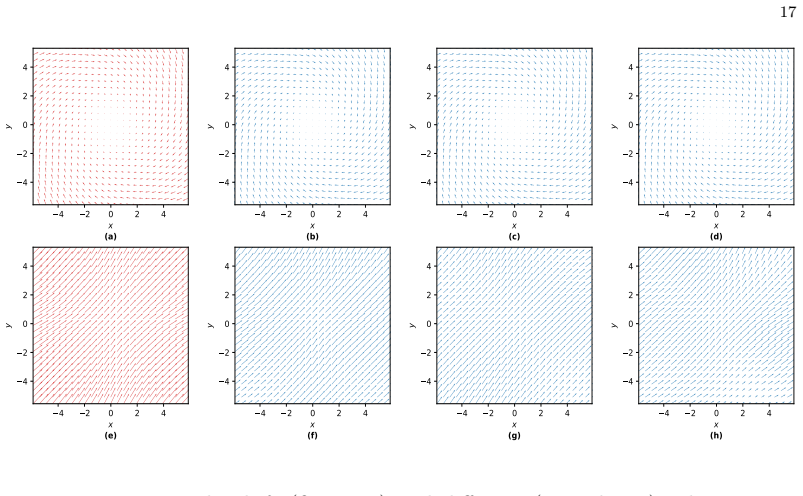
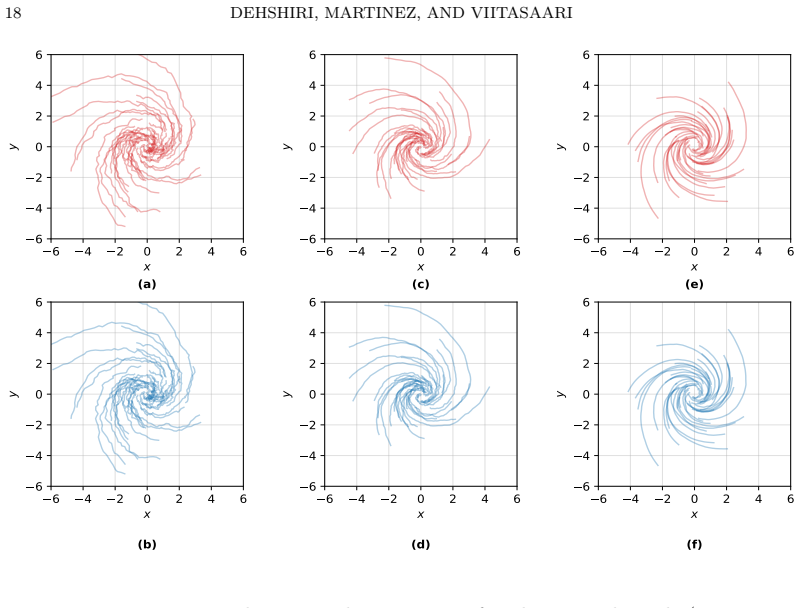
Run numerical experiments with known fractional SDEs of varying regularity, refine the discretization step and training data size, and check if the measured total error decreases at the exact rates predicted by the Sobolev norm analysis; failure to match would falsify the interaction control.
Figures



read the original abstract
This paper develops a framework for the error analysis in nonparametric model fitting of fractional stochastic differential equations based on discrete observations. We identify and quantify the main error sources -- time discretization, coefficient approximation, and model fitting error -- within a unified framework. Through Sobolev-type norms, we derive convergence rates that incorporate the regularity of trajectories, thereby capturing the interaction of these error components. To demonstrate the applicability of the theory, we introduce a training scheme for coefficient function estimation based on shallow neural networks and a recurrent architecture. Numerical experiments validate the theoretical findings and illustrate the effectiveness of the approach.
Editorial analysis
A structured set of objections, weighed in public.
Referee Report
Summary. The manuscript develops a framework for error analysis of nonparametric fitting for fractional SDEs observed at discrete times. It decomposes the total error into time-discretization, coefficient-approximation, and model-fitting components, then employs Sobolev-type norms to obtain convergence rates that incorporate trajectory regularity and control the interactions among the three sources. The theory is specialized to coefficient estimation via shallow neural networks and recurrent architectures, with numerical experiments offered as validation.
Significance. A rigorously justified unified rate that accounts for the interplay of discretization, approximation, and statistical errors would be a useful contribution to the analysis of learning problems for processes with memory, especially if the rates remain explicit in the Hurst parameter and mesh size. The neural-network application illustrates one concrete use case.
major comments (2)
- [§3 (Error Analysis) and Assumption 2.1] The central convergence statement (presumably Theorem 3.1 or the main result in §3) invokes Sobolev norms of order s > 1/2 + d/2 to bound cross terms between discretization and approximation errors. For fractional Brownian motion with Hurst index H < 1/2 the driving noise yields paths that are only Hölder-α with α < H; the paper does not derive the necessary restriction on H (or the compensating logarithmic factor) that would make the chosen s admissible under the discrete-observation scheme.
- [§3.2 and the statement of the main rate] The claim that the three error sources interact in a controlled way inside the Sobolev norm (Abstract and §3.2) rests on interpolation inequalities whose constants depend on the fractional order α and the mesh size. No explicit dependence of the final rate on α is displayed, nor is it shown that the bound remains valid when α is chosen independently of H.
minor comments (2)
- [§2.1] The notation for the Sobolev norm (Eq. (2.3)) should explicitly record the underlying domain and the precise definition of the fractional derivative used.
- [§5] Numerical figures would benefit from reporting the number of independent runs and standard deviations to allow assessment of variability in the neural-network training.
Simulated Author's Rebuttal
We thank the referee for the careful reading and valuable comments on our manuscript. We address each major comment point by point below, indicating where revisions will be made to strengthen the presentation and clarify the assumptions.
read point-by-point responses
-
Referee: [§3 (Error Analysis) and Assumption 2.1] The central convergence statement (presumably Theorem 3.1 or the main result in §3) invokes Sobolev norms of order s > 1/2 + d/2 to bound cross terms between discretization and approximation errors. For fractional Brownian motion with Hurst index H < 1/2 the driving noise yields paths that are only Hölder-α with α < H; the paper does not derive the necessary restriction on H (or the compensating logarithmic factor) that would make the chosen s admissible under the discrete-observation scheme.
Authors: We appreciate the referee's observation on the compatibility between the Sobolev order s and the path regularity induced by fractional Brownian motion. In the error analysis of §3, the condition s > 1/2 + d/2 is imposed to invoke Sobolev embeddings that control the cross terms arising from the decomposition into discretization, approximation, and fitting errors. Assumption 2.1 encodes the regularity of the coefficients and the driving noise, but does not yet explicitly link this to the admissible range of H. We will revise the statement of the main result (Theorem 3.1) by adding a remark that explicitly requires H > 1/2 + d/2 (ensuring the Hölder exponent α exceeds s) for the stated rate to hold without logarithmic corrections. When H is smaller, we will note that a mild logarithmic factor in the mesh size can be absorbed into the bound, consistent with standard Hölder regularity results for fBM. This revision will also confirm compatibility with the discrete-observation scheme. revision: yes
-
Referee: [§3.2 and the statement of the main rate] The claim that the three error sources interact in a controlled way inside the Sobolev norm (Abstract and §3.2) rests on interpolation inequalities whose constants depend on the fractional order α and the mesh size. No explicit dependence of the final rate on α is displayed, nor is it shown that the bound remains valid when α is chosen independently of H.
Authors: We agree that the interpolation inequalities employed in §3.2 to bound the interactions among the three error sources have constants that depend on the fractional order α and the mesh size. In the current version these dependencies are absorbed into generic constants appearing in the convergence rate. We will revise the main rate statement to display the explicit dependence on α. We will also add a clarifying paragraph in §3.2 explaining that α is determined by the Hurst parameter H via the Hölder regularity of the driving noise, yet the underlying interpolation bounds remain valid for any fixed α satisfying the necessary inequalities (with s chosen relative to α), even when α is selected independently of the specific value of H. This will make the generality of the framework transparent. revision: yes
Circularity Check
No significant circularity; derivation self-contained from regularity assumptions
full rationale
The paper presents a theoretical framework deriving convergence rates for error components in fractional SDE model fitting via Sobolev-type norms applied to trajectory regularity. No steps reduce by construction to fitted parameters, self-citations, or renamed inputs; the bounds follow from standard embedding and interpolation inequalities under stated regularity. The analysis identifies three error sources and controls their interactions directly from the assumed Sobolev index without redefining quantities in terms of the target rates. External benchmarks (numerical validation) are separate from the derivation chain. This is the expected non-finding for a pure error-analysis paper.
Axiom & Free-Parameter Ledger
Reference graph
Works this paper leans on
-
[1]
Avelin B., Kuusi T., Nummi P., Saksman E., Tölle J. M. & Viitasaari L. (2025).Renormalized stochastic pressure equation with log-correlated Gaussian coefficients.Journal of Differential Equations 439, 113416. 20 DEHSHIRI, MARTINEZ, AND VIITASAARI
2025
-
[2]
& Gatheral J
Bayer C., Friz P. & Gatheral J. (2016).Pricing under rough volatility.Quantitative Finance 16(6), 887–904
2016
-
[3]
& Scholes M
Black F. & Scholes M. (1973).The pricing of options and corporate liabilities.Journal of political economy 81(3), 637–654
1973
-
[4]
Bossy M., Martinez K. & Maurer P. (2025).Weak rough kernel comparison via PPDEs for integrated Volterra processes.arXiv preprint arXiv:2501.07509
-
[5]
& Scotti S
Bondi A., Pulido S. & Scotti S. (2024).The rough Hawkes Heston stochastic volatility model. Mathematical Finance 34(4), 1197–1241
2024
-
[6]
Chen R. T. Q., Rubanova Y., Bettencourt J. & Duvenaud D. K. (2018).Neural ordinary differential equations.Advances in Neural Information Processing Systems 31
2018
-
[7]
(2001).Estimating the parameters of a fractional Brownian motion by discrete variations of its sample paths.Statistical Inference for Stochastic Processes 4(2), 199–227
Coeurjolly J.-F. (2001).Estimating the parameters of a fractional Brownian motion by discrete variations of its sample paths.Statistical Inference for Stochastic Processes 4(2), 199–227
2001
-
[8]
The Journal of Computational Finance 7, 1–49
ContR.&TankovP.(2004).Nonparametric calibration of jump-diffusion option pricing models. The Journal of Computational Finance 7, 1–49
2004
-
[9]
(2012).A Milstein-type scheme without Lévy area terms for SDEs driven by fractional Brownian motion
Deya A., Neuenkirch A., & Tindel S. (2012).A Milstein-type scheme without Lévy area terms for SDEs driven by fractional Brownian motion. Annales de l’IHP Probabilités et statistiques, 48(2), 518–550
2012
-
[10]
& Nakagawa K
Hayashi K. & Nakagawa K. (2022).Fractional SDE-Net: Generation of time series data with long-term memory.IEEE 9th International Conference on Data Science and Advanced Ana- lytics (DSAA), 1–10
2022
-
[11]
(2023).Variability of paths and differential equations with BV-coefficients
Hinz M., Tölle J., & Viitasaari L. (2023).Variability of paths and differential equations with BV-coefficients. Annales de l’Institut Henri Poincare (B) Probabilites et statistiques, 59(4), 2036–2082
2023
-
[12]
& Auer P
Hornik K., Stinchcombe M., White H. & Auer P. (1994).Degree of approximation results for feedforward networks approximating unknown mappings and their derivatives.Neural compu- tation, 6(6), 1262-1275
1994
-
[13]
& Nualart D
Hu Y., Liu Y. & Nualart D. (2016).Rate of convergence and asymptotic error distribution of Euler approximation schemes for fractional diffusions. The Annals of Applied Probability, 26(2), 1147–1207
2016
-
[14]
& Nualart D
Hu Y. & Nualart D. (2010).Parameter estimation for fractional Ornstein–Uhlenbeck processes. Statistics & Probability Letters 80(11-12), 1030–1038
2010
-
[15]
& Nualart D
Hu Y. & Nualart D. (2010).Differential equations driven by Hölder continuous functions of order greater than 1/2.Stochastic Analysis and Applications: The Abel Symposium 2005. Springer Berlin Heidelberg, 2007
2010
-
[16]
& Lyons T
Kidger P., Foster J., Li X. & Lyons T. J. (2021).Neural SDEs as infinite-dimensional GANs. In: International Conference on Machine Learning, 5453–5463
2021
-
[17]
& Ralchenko K
Kubilius K., Mishura Y. & Ralchenko K. (2017).Parameter Estimation in Fractional Diffusion Models.Bocconi & Springer Series, 8: Mathematics, Statistics, Finance and Economics
2017
-
[18]
Kutz J. N. (2017).Deep learning in fluid dynamics.Journal of Fluid Mechanics 814, 1–4
2017
-
[19]
Mandelbrot B. B. & Van Ness J. W. (1968).Fractional Brownian motions, fractional noises and applications.SIAM Review 10(4), 422–437
1968
-
[20]
& Shevchenko G
Mishura Y. & Shevchenko G. (2008).The rate of convergence for Euler approximations of solutions of stochastic differential equations driven by fractional Brownian motion.Stochastics An International Journal of Probability and Stochastic Processes, 80(5), 489–511
2008
-
[21]
& Răşcanu A.(2002).Differential equations driven by fractional Brownian motion
Nualart D. & Răşcanu A.(2002).Differential equations driven by fractional Brownian motion. Collectanea Mathematica, 53(1), 55–81
2002
-
[22]
& Viitasaari L
Nummi P. & Viitasaari L. (2024).Necessary and sufficient conditions for continuity of hyper- contractive processes and fields.Statistics & Probability Letters, 208, 110049
2024
-
[23]
Pope S. B. (1994).On the relationship between stochastic Lagrangian models of turbulence and second-moment closures.Physics of Fluids 6(2), 973–985. 21
1994
-
[24]
& Viitasaari L
Shevchenko G. & Viitasaari L. (2015).Adapted integral representations of random variables. Int. J. Mod. Phys. Conf. Ser. 36
2015
-
[25]
Foundations of Computational Mathematics, 24(2), 481-537
SiegelJ.&XuJ.(2024).Sharp bounds on the approximation rates, metric entropy, andn-widths of shallow neural networks. Foundations of Computational Mathematics, 24(2), 481-537
2024
-
[26]
& Zeng C
Viitasaari L. & Zeng C. (2022).Stationary Wong–Zakai Approximation of Fractional Brownian Motion and Stochastic Differential Equations with Noise Perturbations. Fractal and Fractional, 6(6), 303
2022
-
[27]
& Hlubinka D
Štěpán J. & Hlubinka D. (2007).Kermack-McKendrick epidemic model revisited.Kybernetika 43(4), 395–414
2007
-
[28]
YangL., GaoT., LuY., DuanJ.&LiuT.(2023).Neural network stochastic differential equation models with applications to financial data forecasting.Applied Mathematical Modelling 115, 279–299
2023
-
[29]
ˆ t´s ´8 ! pt´s´rq H1´1{2 ´ p´rqH1´1{2 ` ) ! pt´s´rq H2´1{2 ´ p´rqH2´1{2 ` ) dr “ pt´sq H1`H2 ˆ 8 ´1 ! p1`uq H1´1{2 ´u H1´1{2 ` ) ! p1`uq H2´1{2 ´u H2´1{2 ` ) du “ |t´s| H1`H2
Yarotsky D. (2017).Error bounds for approximations with deep ReLU networks. Neural net- works, 94, 103-114. Appendix A. Proof of Theorem 2.2 We split the proof into a series of lemmas and three propositions dealing with different sources of error. We begin with the time-discretisation error that follows directly from the existing results presented in the ...
2017
discussion (0)
Sign in with ORCID, Apple, or X to comment. Anyone can read and Pith papers without signing in.